Urban Socio-Semantic Segmentation
Script
If you look at a satellite photo, you can easily spot a building's roof or a paved road, but can you tell if that complex is a school or a commercial district just by the concrete? The researchers behind this paper tackle that exact challenge, bridging the gap between seeing physical shapes and understanding social functions.
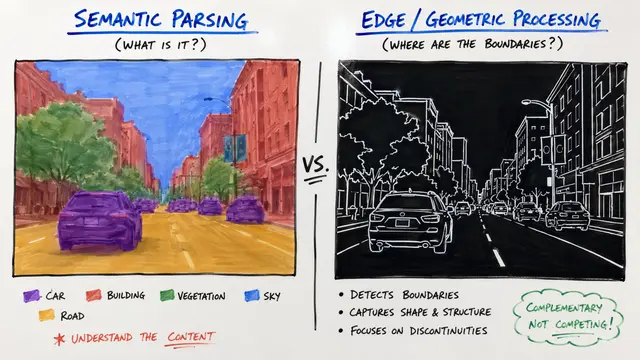
To understand the gravity of the problem, we need to distinguish between physical and social entities. While current AI is excellent at finding physical edges like roads or rooftops, it struggles with 'social semantics'—understanding that a specific cluster of buildings actually functions as a university or a hospital, especially when these places look vastly different across cities like Nairobi and Tokyo.
The authors propose a solution called SocioReasoner, which mimics how a human annotator works. Instead of guessing a segmentation mask in one shot, the system utilizes a 'Render-and-Refine' strategy, where a Vision-Language Model collaborates with the Segment Anything Model. Critically, it treats standard map screenshots as visual inputs, bypassing the need for proprietary, hard-to-parse geospatial data files.
Here acts the core mechanism of the framework. In standard approaches, a model might just output a mask blindly, but SocioReasoner first generates a coarse bounding box based on the satellite image and map screenshot. It then 'draws' this draft onto the image and feeds it back into the system to visually reflect on the error, allowing it to issue refined corrective points that sharpen the final boundary.
Because the interaction between the language model and the segmentation tool is discrete, you can't use standard backpropagation training. The researchers successfully applied Reinforcement Learning with a specific algorithm called GRPO to optimize the system. This approach yielded impressive results, outperforming standard baselines like UNet and demonstrating the ability to generalize across totally different map styles and cities not seen during training.
By treating complex urban data as a visual reasoning task rather than a pure pattern-matching problem, this work opens new doors for automated urban planning and environmental monitoring. For more insights on AI research, visit EmergentMind.com.