Transformers Learn Transfer Operators In-Context
This presentation explores how small transformer models trained on univariate time series from dynamical systems develop remarkable out-of-distribution forecasting abilities. The work reveals that transformers don't merely memorize sequences—they adaptively reconstruct latent state-space structure and implicitly learn transfer operators, performing time-delay embedding consistent with Takens' theorem. Through mechanistic analysis of attention patterns, eigenfunction recovery, and manifold dimension estimation, the research demonstrates that transformers emerge as in-context learners of operator-theoretic dynamics, explaining their surprising ability to generalize to completely unseen dynamical systems.Script
A tiny two-layer transformer trained on just one dynamical system can forecast trajectories from completely different systems it has never seen. This isn't memorization—the model is doing something far more sophisticated, reconstructing the mathematical operators that govern invisible state spaces.
The researchers trained a small GPT-style transformer on quantized univariate observations from one dynamical system, then tested it on 100 randomly selected systems from an ODE database. The model didn't just fail gracefully—it actually predicted these alien systems with surprising accuracy.
The training dynamics reveal something unexpected: a double descent phenomenon where out-of-distribution performance peaks early, well before the model fully memorizes the training data. This secondary descent in the OOD loss curve suggests the transformer extracts system-independent structure during learning, a capability that classical supervised learning theory doesn't predict.
What is this system-independent structure the model discovers?
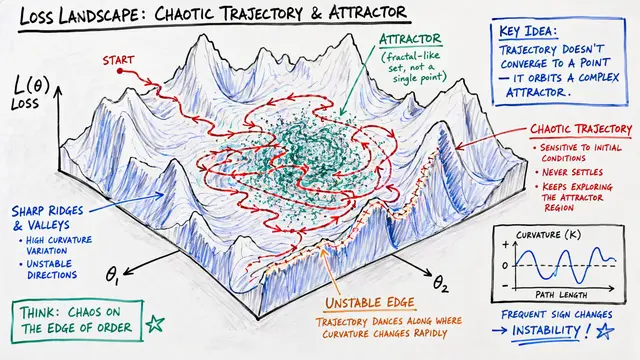
By analyzing the conditional distributions across different input lags, the authors discovered the transformer is performing time-delay embedding consistent with Takens' theorem. From a single observed variable, it reconstructs the full attractor geometry of systems it has never encountered, inferring the correct dimensionality of the hidden state space.
The mechanism goes deeper. The model constructs approximations of Perron-Frobenius transfer operators—the mathematical objects that propagate probability distributions forward in time. Its eigenfunction spectrum closely matches the true operator, meaning it's not copying sequences but actually learning how probability mass flows through reconstructed state space.
Experiments with Lorenz-96 systems of varying dimensionality reveal the transformer adaptively adjusts its internal representations. The stable rank of attention rollout matrices—a proxy for effective latent dimension—increases precisely when the underlying attractor becomes more complex, even though the model only observes a single univariate signal.
These findings clarify why large foundation models for scientific computing achieve surprising cross-system generalization. They're not just pattern matching—they're performing automated state reconstruction and operator inference. This positions attention mechanisms as uniquely suited for physical domains characterized by partial observability, and suggests that scaling context length will be central to future advances.
The work focuses on carefully controlled settings with small transformers and clean synthetic data. Whether these mechanisms scale to multivariate observations, noisy experimental measurements, or high-dimensional partial differential equations is still an open question—but the mechanistic foundation is now established.
Transformers trained on time series aren't just predicting the next token—they're reconstructing invisible state spaces and the operators that govern them, achieving generalization through mathematical structure the models were never explicitly taught. Visit EmergentMind.com to explore this work and discover how foundation models are becoming operator-theoretic reasoners.