Reconstructing Hidden Worlds from Data
This presentation explores Takens Embedding Theorem, a foundational result that reveals how complete dynamical systems can be reconstructed from simple time series observations. We'll examine the mathematical foundations, practical applications in machine learning and forecasting, and the profound implications for understanding complex systems from partial data.Script
Imagine you're watching shadows on a cave wall, but from those shadows alone, you could reconstruct the entire three-dimensional world casting them. This is the profound promise of Takens Embedding Theorem, which shows us how to recover complete dynamical systems from simple time series observations.
Let's start by understanding the core problem this theorem solves.
Building on this challenge, we typically observe only a single measurement from systems whose true dynamics unfold in spaces we cannot directly access. Traditional linear methods break down completely when dealing with chaotic or nonlinear behavior.
Takens discovered that by creating coordinates from time delays of a single observation, we can generically reconstruct the entire state space. The key insight is that temporal structure contains geometric information about the underlying manifold.
Now let's examine the precise mathematical statement that makes this reconstruction possible.
The classical theorem establishes precise conditions under which delay coordinate maps become embeddings. For a q-dimensional manifold, we need 2q plus 1 delay coordinates to guarantee a faithful reconstruction that preserves all topological properties.
The delay coordinate map takes each state and creates a vector using the observation function applied at successive time steps. This seemingly simple construction creates a faithful embedding where dynamics in the original space correspond exactly to dynamics in the reconstruction.
Recent advances distinguish between topological and geometric preservation. While classical results guarantee faithful dynamics, stable embedding extensions ensure that distances and geometric relationships are approximately preserved, enabling quantitative analysis.
The theorem's impact has expanded far beyond its original formulation through powerful generalizations.
Modern extensions dramatically broaden the theorem's scope beyond smooth manifolds. These generalizations handle strange attractors, noisy systems, and probabilistic settings where embedding is guaranteed almost everywhere rather than everywhere.
These probabilistic versions are particularly powerful for real applications. They show that embedding dimension can often be reduced to the attractor dimension itself, rather than twice that dimension, when we accept measure-theoretic rather than pointwise guarantees.
One of the most surprising modern developments connects Takens embedding to machine learning architectures.
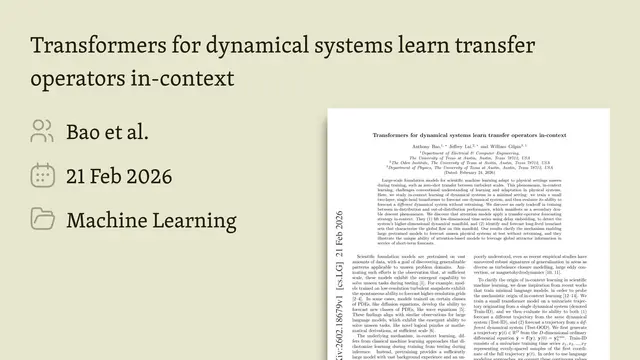
Perhaps most remarkably, Takens embedding theory provides the mathematical foundation for reservoir computing. Echo state networks and similar architectures work precisely because they implement generalized delay coordinate embeddings through their random recurrent connections.
This connection reveals that classical delay coordinate embedding is actually a special case of reservoir computing. Random reservoirs provide a much richer class of embeddings than fixed delay coordinates, explaining their superior performance in practice.
Let's turn to the crucial practical aspects of applying these theoretical insights.
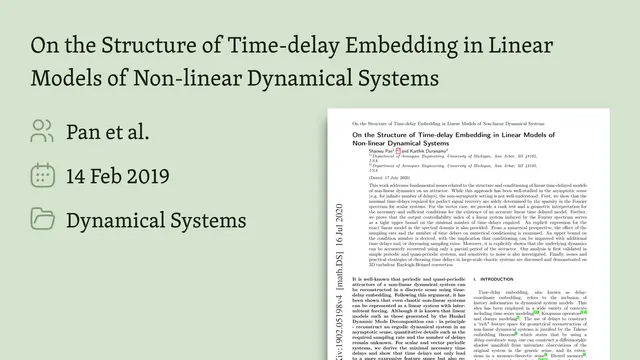
Practical implementation requires careful parameter selection. The embedding dimension must exceed twice the attractor dimension, while the time delay should be chosen to maximize information content without introducing irrelevant correlations.
The choice of time delay involves a fundamental trade-off. Too small delays create redundant coordinates, while too large delays lose the temporal correlations essential for reconstruction, highlighting the need for principled selection methods.
These theoretical foundations enable powerful applications across multiple domains.
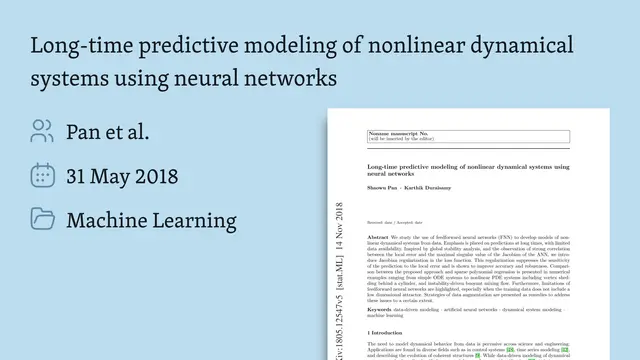
In forecasting applications, embedding methods enable prediction without explicit model assumptions. The reconstructed state space provides the Markovian representation needed for machine learning approaches to capture complex nonlinear dynamics.
Modern machine learning architectures leverage embedding theory by training on reconstructed state spaces. This provides access to topological invariants, Lyapunov exponents, and other dynamical properties that would be invisible from the original time series alone.
Despite its power, the theory faces important limitations that drive ongoing research.
Key limitations include the non-constructive nature of genericity assumptions and sensitivity to real-world complications like noise and nonstationarity. These challenges motivate robust extensions and practical observable selection methods.
Active research focuses on making the theory more practical and robust. This includes developing explicit bounds for finite data regimes, constructive methods for observable selection, and extensions to multiscale and high-dimensional settings.
Takens Embedding Theorem bridges the gap between abstract dynamical systems theory and practical data science, showing us that hidden worlds can indeed be reconstructed from their shadows. To explore more cutting-edge research in dynamical systems and machine learning, visit EmergentMind.com for the latest developments in this rapidly evolving field.