PathWise: Planning Heuristic Evolution
This lightning talk presents PathWise, a novel approach to automated heuristic design that treats the discovery process as sequential decision-making over a structured memory of heuristic derivations. Instead of relying on fixed evolutionary rules, PathWise uses multi-agent planning with entailment graphs to achieve faster convergence and better heuristics across multiple combinatorial optimization problems.Script
When language models try to discover better optimization algorithms, they often get stuck repeating the same mistakes over and over. This fascinating problem reveals a deeper challenge: how can AI systems learn from their derivation history to plan smarter evolutionary strategies?
Let's start by understanding what makes automated heuristic design so challenging.
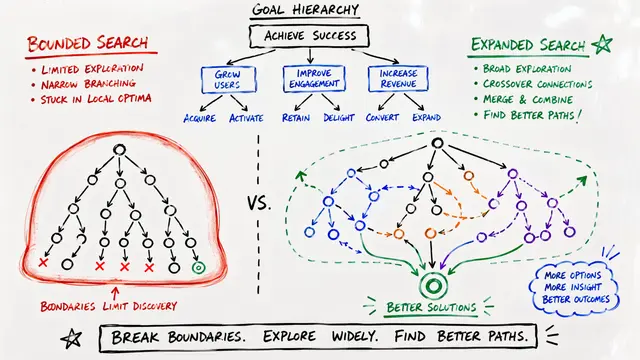
Building on this challenge, existing language model approaches to automated heuristic design suffer from several critical limitations. They use static prompts that create myopic search patterns and fail to learn from their own discovery process.
This problem becomes even more pressing when we consider that combinatorial optimization underpins countless real-world applications. The authors recognize that better automated design could transform how we approach these fundamental challenges.
PathWise introduces a fundamentally different way of thinking about this problem.
Instead of random evolutionary mutations, the authors reframe heuristic discovery as a Markov decision process. This creates a principled foundation for learning from derivation history and planning better search strategies.
The entailment graph serves as the system's memory, capturing not just what heuristics work, but how they were derived. Each node becomes a rich representation that includes both code and the reasoning behind its creation.
This comparison highlights the fundamental shift PathWise introduces. Rather than relying on fixed evolutionary patterns, the system learns to plan its search strategy based on accumulated derivation experience.
Let's dive into the technical mechanics that make this approach work.
The system orchestrates four specialized agents that work together in a continuous learning loop. Each agent has a distinct role in planning, executing, and reflecting on the heuristic discovery process.
By casting heuristic discovery as a Markov decision process, the authors create a mathematical foundation for principled search. The state representation captures both current possibilities and historical derivation patterns.
Several clever engineering choices make the system practical and robust. These design decisions address common pitfalls in language model-based search while maintaining computational efficiency.
Now let's examine how well this approach performs in practice.
The authors conducted an impressively thorough evaluation across diverse optimization domains and algorithmic frameworks. This breadth demonstrates the generality of their approach beyond any single problem type.
The results consistently show that structured planning outperforms traditional evolutionary approaches. What's particularly encouraging is how the advantages grow stronger on larger, more challenging problem instances.
The ablation studies reveal which components drive the performance gains. Interestingly, the system's richer context doesn't significantly increase overall computational costs compared to simpler baselines.
Like any research contribution, PathWise has important limitations to consider.
The authors honestly acknowledge that their approach inherits some instability from the underlying language models. The system's effectiveness remains tied to the capabilities and quirks of its Large Language Model backbone.
Let's step back and consider the broader implications of this work.
PathWise demonstrates a fundamental shift from random exploration to principled planning in automated algorithm design. This structured approach to learning from derivation history could transform how we think about AI-assisted discovery.
The entailment graph framework opens exciting possibilities for transferring learned search strategies across different optimization domains. Future work could explore how these derivation patterns generalize beyond individual problems.
PathWise shows us that the future of automated algorithm design lies not in smarter mutations, but in learning to plan from structured memories of discovery. Visit EmergentMind.com to explore more cutting-edge research at the intersection of AI and optimization.