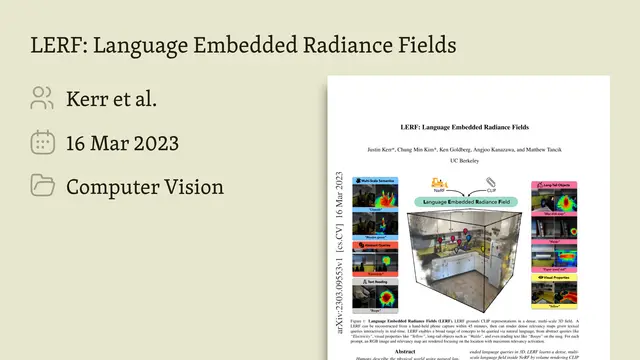
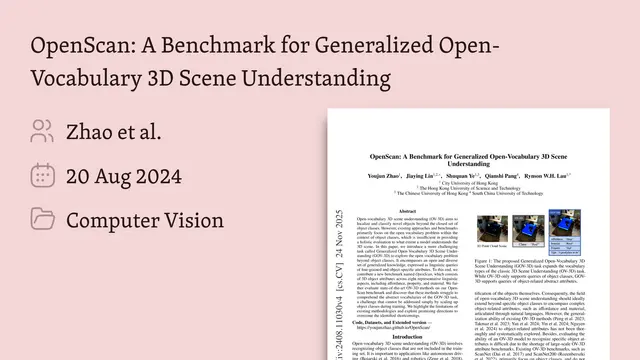
Learning Objects From Scenes Naturally
This presentation explores object-centric learning, a revolutionary paradigm that teaches machines to understand scenes by discovering individual objects without supervision. We'll journey through how neural networks can learn to decompose complex visual environments into meaningful components, enabling systematic generalization and compositional reasoning across diverse applications from video understanding to robotics.Script
What if machines could learn to see the world the way we do, naturally breaking down complex scenes into individual objects without anyone teaching them what objects are? This fundamental challenge sits at the heart of object-centric learning, a paradigm that's transforming how AI systems understand and reason about visual environments.
Let's start by understanding what makes this problem so compelling.
Building on this insight, object-centric learning recognizes that conventional distributed scene embeddings fundamentally miss the compositional nature of visual environments. The goal is to discover discrete, entity-like components that each capture a single object's properties.
This contrast reveals why object-centric representations are so powerful. Each slot binds to a single entity, enabling consistent generalization across novel arrangements and object counts that would challenge traditional approaches.
Now let's examine how this actually works in practice.
The elegance of Slot Attention lies in its simplicity. Starting with K learnable slots, the mechanism iteratively refines each slot through competitive attention, where slots essentially compete to explain different parts of the input scene.
What's remarkable is that object-centricity emerges without explicit supervision. Training the system simply to reconstruct scenes leads each slot to naturally specialize to different objects, and the approach can even generalize to images with more objects than seen during training.
However, basic reconstruction alone has limitations that recent advances have addressed.
These innovations address a key insight: pure reconstruction can allow slots to focus on spatial regions rather than true objects. Explicit compositional objectives and feature-based approaches align representations more closely with genuine object identities.
Moving beyond synthetic datasets, these methodological innovations enable object-centric learning on complex, real-world collections like COCO and VOC. The key breakthrough is replacing pixel reconstruction with similarity to frozen foundation model features.
Let's examine how well these approaches actually work in practice.
These numbers tell a compelling story. The performance scales from near-perfect segmentation on synthetic data to meaningful object discovery on real-world images, all while maintaining significant efficiency advantages over alternative methods.
Beyond raw performance, object-centric models demonstrate encouraging robustness properties. The slot-based architecture naturally isolates perturbations, though global scene transformations still present challenges for current approaches.
The real excitement comes from how broadly this paradigm applies.
Extending to video reveals another dimension of object-centric learning's power. Temporal consistency naturally emerges as slots learn to track coherent entities across frames, achieving impressive segmentation results on both synthetic and real video datasets.
In reinforcement learning, object-centric representations unlock remarkable sample efficiency and transfer capabilities. Agents can learn skills more rapidly and generalize to new environments by reasoning about individual objects rather than holistic scene representations.
The paradigm extends beautifully to multimodal settings and 3D understanding. Object slots serve as natural anchors for language grounding, while 3D extensions enable robust scene understanding for robotics applications.
As the field matures, several exciting challenges and opportunities are emerging.
These challenges reflect the field's evolution from proof-of-concept to practical deployment. Dynamic slot allocation and better alignment with downstream goals represent particularly active areas of current research.
Perhaps most exciting is the convergence with foundation models. Recent work shows that combining object-centric learning with models like Segment Anything can achieve impressive results without traditional training, pointing toward more scalable approaches.
The broader implications extend far beyond computer vision. Object-centric learning provides a pathway toward more interpretable, composable, and robust AI systems that can reason about the world in structured, meaningful ways.
Object-centric learning represents a fundamental shift toward AI systems that understand the world through the lens of discrete, composable entities. This paradigm doesn't just improve performance, it offers a more natural and interpretable foundation for machine intelligence that aligns with how we naturally perceive and reason about our environment. To dive deeper into these concepts and explore the latest research, visit EmergentMind.com for comprehensive coverage of cutting-edge AI developments.