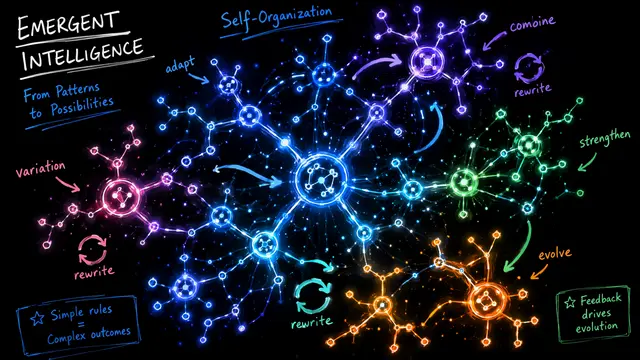
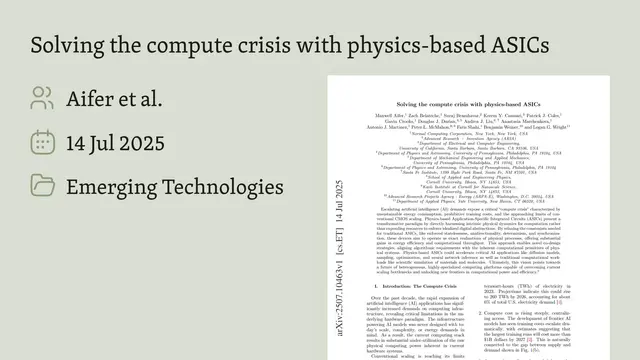
A New Paradigm for Computational Chemistry
This presentation explores how foundation machine learning interatomic potentials are revolutionizing computational chemistry. By achieving quantum-level accuracy at speeds orders of magnitude faster than density functional theory, these data-driven models promise to transform how we simulate molecules and materials. We examine their architecture, capabilities, and the remaining challenges in physical fidelity and transferability.Script
For decades, computational chemists have relied on density functional theory to map molecular energy landscapes. But DFT's accuracy comes at a brutal computational cost, consuming massive supercomputing resources while offering no systematic path to improvement. A new class of models is now challenging this paradigm entirely.
Foundation machine learning interatomic potentials represent a fundamental shift in how we model chemistry. Trained on enormous datasets spanning molecules and materials, models like UMA can predict energies and forces with quantum accuracy while running at near-classical-force-field speeds. They require no system-specific tuning, working immediately on new problems.
How do these models achieve both accuracy and symmetry?
The architecture treats molecules as graphs where atoms are nodes and bonds define neighborhoods. Each atom maintains a feature vector that gets updated by gathering information from nearby atoms through message passing. This scheme automatically respects the fundamental symmetries chemistry demands: translation, rotation, and permutation invariance. Equivariant architectures go further, encoding directional information to capture orientation-dependent properties with improved data efficiency.
Practitioners face a strategic choice. Static foundation models offer plug-and-play convenience for many applications. When accuracy falls short—say, for diatomic molecules far from equilibrium or precise surface energies—fine-tuning becomes necessary. But this introduces continual learning challenges, particularly catastrophic forgetting where the model loses its general capabilities. Solutions include parameter freezing, low-rank adaptations, and replay mechanisms borrowed from broader machine learning.
Despite their power, foundation models face fundamental limitations. Local interaction cutoffs fail to capture the long-range electrostatics governing large biomolecules and interfaces. Magnetic degrees of freedom—essential for transition metals and open-shell systems—remain an open problem. And as training datasets scale to billions of structures, ensuring data quality becomes critical, since a single flawed calculation can propagate errors throughout the learned representation.
Foundation machine learning potentials are inverting the computational chemistry workflow, transforming expensive quantum calculations into dataset generation for transferable models. This is not just faster simulation—it is a reconceptualization of how we encode and predict molecular behavior. Visit EmergentMind.com to explore more cutting-edge research and create your own videos.