Next Embedding Prediction Makes World Models Stronger
This presentation examines NE-Dreamer, a decoder-free world model that replaces pixel reconstruction with next-embedding prediction using causal temporal transformers. We explore how this temporal predictive alignment mechanism achieves state-of-the-art performance in memory-intensive navigation tasks while maintaining efficiency in standard control benchmarks, demonstrating that predictive sequence modeling in embedding space can surpass traditional reconstruction objectives for model-based reinforcement learning.Script
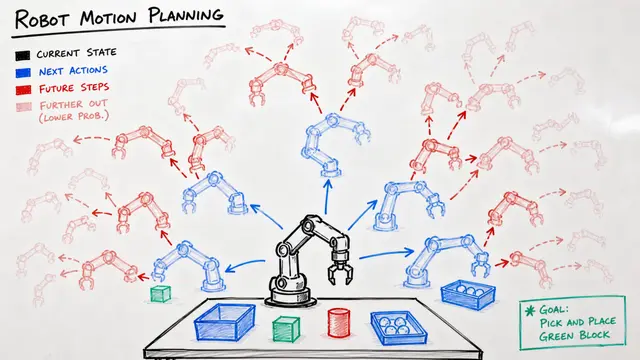
Model-based reinforcement learning has a problem: world models learn by reconstructing pixels, which forces them to model every visual detail whether it matters for decision-making or not. What if instead of recreating what you see, you predicted what matters next?
Traditional world models like Dreamer reconstruct observations pixel by pixel. This approach captures visual fidelity but comes at a cost: the model wastes capacity on transient details that don't influence long-horizon decisions. Even decoder-free alternatives that skip reconstruction typically align representations only at individual timesteps, which fails when success requires integrating information across extended sequences.
NE-Dreamer reframes the entire objective around temporal prediction.
The architecture retains the recurrent state-space backbone but adds a causal temporal transformer that predicts the next encoder embedding from historical context. Instead of reconstructing pixels, the model aligns this prediction to a target embedding using Barlow Twins loss, which enforces high correlation on meaningful features while suppressing redundancy. This next-embedding prediction objective establishes causality across time and prevents the representational collapse that plagues many self-supervised predictive frameworks.
The empirical results reveal where temporal predictive alignment delivers its advantage. On DMLab navigation tasks that demand retaining spatial information across dozens of timesteps, NE-Dreamer substantially outperforms both reconstruction-based and decoder-free baselines under matched compute budgets. Critically, post-hoc decoder reconstructions from frozen latents show that NE-Dreamer preserves task-relevant features consistently, while alternatives lose spatial coherence. On standard continuous control benchmarks, NE-Dreamer maintains parity or slight gains, proving that removing reconstruction doesn't sacrifice performance when temporal dependencies are less pronounced.
Ablations confirm that the gains stem specifically from predictive sequence modeling. Removing the causal temporal transformer or eliminating the next-step target shift sharply degrades performance, especially on memory-intensive tasks. Meanwhile, removing the lightweight projection head affects only optimization dynamics, not final returns. This isolates the temporal transformer and next-embedding objective as the essential ingredients, not auxiliary architectural details.
NE-Dreamer demonstrates that predicting what matters next, rather than reconstructing what you see, can produce world models that are both more efficient and more capable in environments where time is the puzzle. Visit EmergentMind.com to explore this paper further and create your own research video.