Multi-Dimensional Event Data in Graph Databases
This presentation explores how graph databases revolutionize the representation and querying of complex, multi-dimensional event data for process mining. The authors introduce a labeled property graph model that captures temporal relationships and entity interactions across multiple dimensions, enabling sophisticated queries that traditional relational databases cannot efficiently handle. We'll examine the core approach, implementation details, and implications for discovering synchronous and asynchronous process behaviors in real-world business systems.Script
When a customer applies for a loan, dozens of events fire across multiple systems: applications, offers, credit checks, approvals. Traditional event logs flatten this into simple sequences, but the real story lives in how these entities interact across time and dimensions. That's the puzzle this paper tackles.
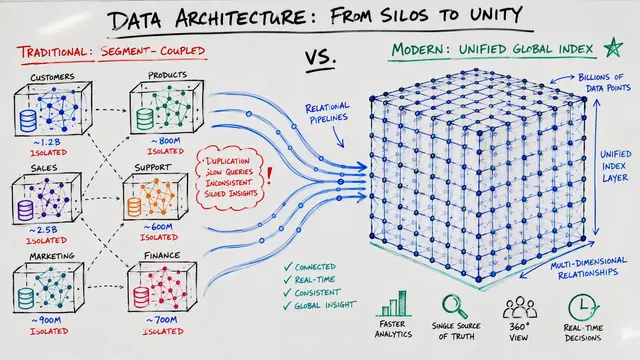
Existing approaches hit a wall. Event logs reduce complex business processes to linear traces, erasing the interplay between applications, offers, and resources. Relational databases can store the connections, but asking temporal questions like "which offers directly followed which applications" becomes computationally expensive and conceptually awkward.
The authors propose a fundamentally different representation.
The model uses labeled property graphs where events become nodes connected by two relationship types. Correlation relationships link events to their entities—applications, offers, resources. Temporal relationships capture the directly-follows sequences within each entity type. This structure lets you query across dimensions naturally, asking questions like "show me all offers that followed application events within the same case."
Here's what this looks like in practice. Each event node carries its timestamp and attributes. The correlation edges connect events to their parent entities—one application, one offer, one resource. The directly-follows edges create temporal chains within each entity type. Notice how this preserves both the sequential flow within each dimension and the cross-cutting relationships between them. You can traverse from an application event to its related offer event while maintaining temporal context in both dimensions.
The approach unlocks new capabilities in process mining. For the first time, analysts can systematically discover how multiple entities synchronize and interact over time, revealing patterns invisible in traditional single-entity process models. The authors validated this on real business process datasets, demonstrating both expressive power and practical performance. The main limitation is that entity relationships must currently be identified manually—automating this extraction is the next frontier.
Graph databases don't just store event data differently—they let us ask different questions entirely, questions about how complex systems actually coordinate across dimensions. Visit EmergentMind.com to explore more cutting-edge research and create your own videos.