Git-Context-Controller: Version-Controlled Agent Memory
Git-Context-Controller (GCC) reimagines how AI agents manage memory by applying version control principles to context. This presentation explores how GCC's structured, persistent memory architecture—using operations like COMMIT, BRANCH, and MERGE—enables agents to tackle complex, long-horizon tasks with unprecedented coherence. We examine the framework's design, its dramatic performance gains on software engineering benchmarks, and its implications for autonomous, collaborative AI systems.Script
AI agents lose their way in long tasks because their memory has no structure. Git-Context-Controller solves this by giving agents version-controlled memory, just like software engineers version their code.
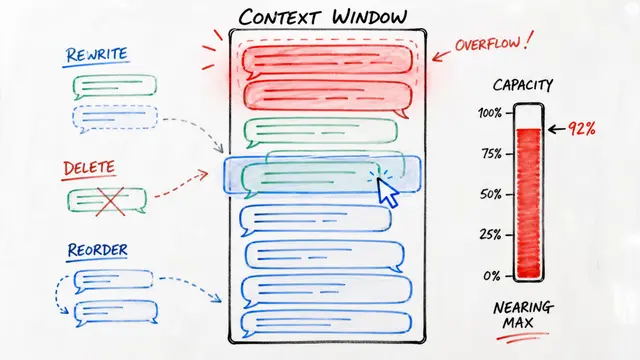
Current Large Language Model agents hit a hard limit: their context windows fill up and overflow during extended work. When agents truncate or compress their history, they lose the precise details needed for sophisticated reasoning. The result is fragmented memory that cannot support persistent, long-term goals.
GCC treats context as a first-class, versioned entity, borrowing directly from software engineering.
GCC organizes agent memory as a navigable file system. Every milestone, decision, and action gets written to structured files. Main dot m d holds the big picture, commits capture progress checkpoints, and logs preserve every observation and thought. Branches let agents explore alternatives without contaminating the main path.
GCC gives agents four Git-inspired commands. Commit saves progress at key moments. Branch spins off isolated experiments. Merge brings successful branches back together. Context retrieves any past memory, enabling reflection across arbitrary time scales.
The architecture delivers measurable, dramatic gains on real-world benchmarks.
On SWE-Bench-Lite, a notoriously difficult software engineering benchmark, GCC-equipped agents resolve 48% of bugs, beating every other system tested. Localization accuracy reaches nearly 79% at the file level. In a striking self-replication test, an agent using GCC rebuilt itself from scratch with a 40.7% success rate, more than tripling the baseline.
Traditional agents compress their past into summaries, losing the details that matter. GCC preserves a full, structured history. Where conventional systems follow a single linear path, GCC supports branching and merging. And because GCC memory is explicit and persistent, agents can hand off work to each other or resume seamlessly across sessions.
GCC enables workflows that were previously out of reach. Agents can now manage complex, long-running goals by decomposing them into milestones and tracking progress over weeks. Branching lets them experiment safely, trying risky approaches in isolation before committing. And because the system is recursive, agents can spawn sub-agents to tackle modules, then merge the results back into a coherent whole.
Version control transformed software engineering by making every change visible, reversible, and shareable. GCC brings the same discipline to agent memory. The result is transparency—you can audit every step an agent took. Collaboration—agents can work together like developers on a shared codebase. And true autonomy—agents with structured, persistent memory can operate independently over the long term, in environments too complex for brittle, short-horizon systems.
GCC proves that agents with structured memory can achieve what seemed impossible: coherent, long-term reasoning in the real world. To explore this framework further and create your own agent-powered videos, visit EmergentMind dot com.