Frequency-Dependent Surface Tension
This presentation explores how surface tension at liquid interfaces becomes a dynamic, frequency-dependent property when subjected to rapid external excitation. We examine the physical mechanisms—molecular relaxation, capillary wave radiation pressure, and dynamical freezing—that cause effective surface tension to deviate from equilibrium values. Through atomistic simulations of molten metals, microfluidic experiments with surfactant-laden droplets, and chaotic capillary wave systems, we reveal quantitative shifts in surface tension ranging from 5% increases at gigahertz frequencies to 20% decreases in wave-driven systems, opening new pathways for ultrafast capillary control and dynamic interfacial manipulation.Script
Imagine an interface between liquid and vapor, not as a static boundary with fixed tension, but as a dynamic membrane that responds to every vibration and strain imposed upon it. When we drive these interfaces at different frequencies, their effective surface tension can shift dramatically, sometimes increasing by 40 percent, other times dropping by 20 percent, revealing a hidden world of interfacial dynamics.
Let's begin by understanding what causes this remarkable frequency dependence.
Building on that foundation, three core mechanisms drive frequency dependence. First, molecular rearrangement at interfaces takes finite time, creating response lags. Second, in wave-driven systems, fluctuation-induced radiation pressure acts like an extra surface force. Third, when excitation frequencies exceed relaxation rates, interfacial structures become frozen in non-equilibrium configurations, often elevating effective tension.
Now we turn to how researchers model and quantify these dynamic responses.
Researchers employ two complementary frameworks to describe these effects. The oscillator analogy treats the interface as a resonant mechanical system, revealing natural frequencies tied to molecular timescales. Meanwhile, complex surface tension formalism separates elastic and dissipative components, particularly powerful for surfactant-laden interfaces where adsorption kinetics dominate the response.
Let's examine the striking experimental and computational results that validate these theories.
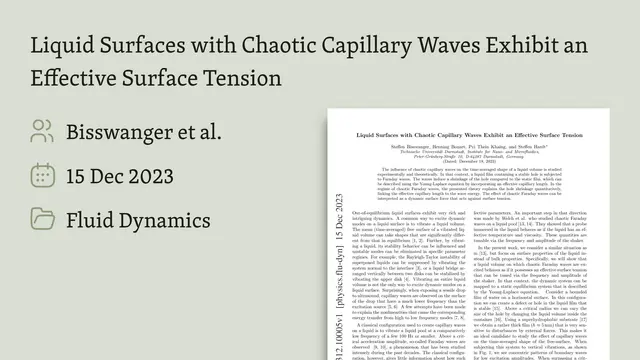
Turning to quantitative evidence, molecular dynamics of molten lead reveals dramatic cycle-to-cycle swings and sustained mean shifts at gigahertz frequencies. Microfluidic experiments with Tween 80 surfactant show a 50 percent tension increase as frequency climbs, while fast-equilibrating SDS exhibits almost no change. In vibrated capillary films, chaotic wave energy reduces effective tension by a fifth, demonstrating that frequency dependence can shift tension in either direction depending on the dominant physical mechanism.
Diving deeper into microscopic origins, we find that in pure liquids, oscillatory tension response periods align beautifully with near-surface density relaxation times measured independently. For surfactants, the key timescale is adsorption-desorption kinetics: large, slowly diffusing molecules produce pronounced viscoelastic effects, while small, mobile ones maintain near-equilibrium behavior even at high frequencies. In chaotic wave fields, the wave energy itself generates momentum flux analogous to radiation pressure in optics.
These fundamental insights open exciting technological opportunities.
These discoveries enable practical control strategies previously unimaginable. By tuning excitation to interfacial resonances, we can transiently boost surface tension by 40 percent on ultrafast timescales, opening routes to precision droplet manipulation and next-generation additive manufacturing. In microfluidics, understanding how surfactants behave under rapid oscillatory flows guides formulation for stable, high-throughput emulsions. Even chaotic vibration becomes a tuning knob for capillary phenomena in soft materials.
Frequency-dependent surface tension reveals that interfaces are not passive boundaries but active, tunable elements responsive to the rhythm of external forces. To explore the full depth of this dynamic interfacial physics and its emerging applications, visit EmergentMind.com.