Fourier Neural Operator for Parametric Partial Differential Equations
This presentation explores a breakthrough neural network architecture that solves parametric partial differential equations with unprecedented speed and accuracy. The Fourier Neural Operator leverages the Fast Fourier Transform to learn mappings between function spaces, achieving discretization-invariant predictions that generalize across resolutions. We examine how this method outperforms traditional PDE solvers by orders of magnitude in speed while delivering significantly lower error rates, and explore its remarkable zero-shot super-resolution capabilities that enable high-resolution predictions from low-resolution training data.Script
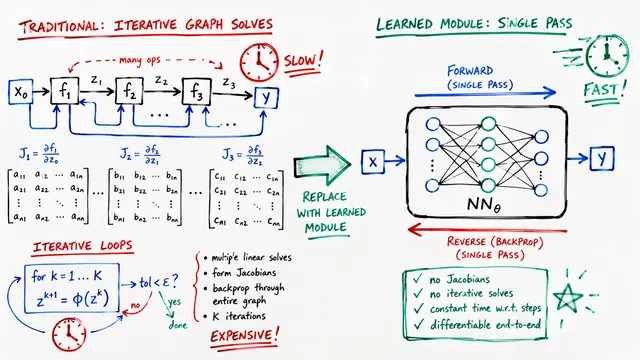
Traditional PDE solvers force an impossible choice: high resolution with crushing computational cost, or speed with sacrificed accuracy. A 256 by 256 grid simulation takes over 2 seconds per evaluation, making design optimization and real-time applications virtually impossible.
The Fourier Neural Operator attacks this problem by moving the entire computation into Fourier space. Instead of learning point-wise operations on grids, it learns to map between entire function spaces, making its predictions independent of the resolution at which you trained it.
The performance gains are not incremental.
On Burgers' Equation, the FNO achieves 30% lower error than previous neural methods. For Darcy Flow, that gap widens to 60%. Even on the notoriously difficult turbulent Navier-Stokes equations, FNO delivers 30% better accuracy.
But accuracy is only half the story. On a 256 by 256 grid, traditional pseudo-spectral methods require 2.2 seconds per evaluation. The FNO completes the same task in 0.005 seconds. That is 440 times faster, transforming computational design from an overnight batch process into an interactive experience.
Perhaps most remarkable is what happens when you ask the FNO to predict at resolutions it has never seen. Train it on coarse grids, then query it at high resolution. It works. The Fourier representation inherently captures scale-independent structure, enabling zero-shot super-resolution without any additional training.
These benchmark results span three canonical PDEs, each with distinct physical behavior. Burgers' equation tests shock formation, Darcy Flow evaluates permeability fields in porous media, and Navier-Stokes captures turbulent fluid dynamics. Across all three, the FNO consistently outperforms both traditional convolutional networks and prior operator learning methods, with error reductions that compound when you need repeated evaluations in optimization or control tasks.
The fundamental difference is where computation happens. Convolutional networks process spatial grids directly, locking them to specific resolutions. The Fourier Neural Operator transforms into frequency space, processes global relationships through efficient FFT-based convolutions, then transforms back. This detour through Fourier space is what grants resolution independence and massive speed gains.
The implications extend far beyond benchmark improvements. Airfoil design, previously requiring days of iterative simulation, becomes interactive. Climate models gain the ability to run ensemble predictions at scales previously impossible. And hybrid methods that combine the FNO's speed with traditional solvers' guarantees open entirely new algorithmic possibilities.
When solving PDEs no longer demands choosing between speed and accuracy, the bottleneck shifts from computation to imagination. Visit EmergentMind.com to learn more and create your own research videos.