Liquid Surfaces with Chaotic Capillary Waves Exhibit an Effective Surface Tension
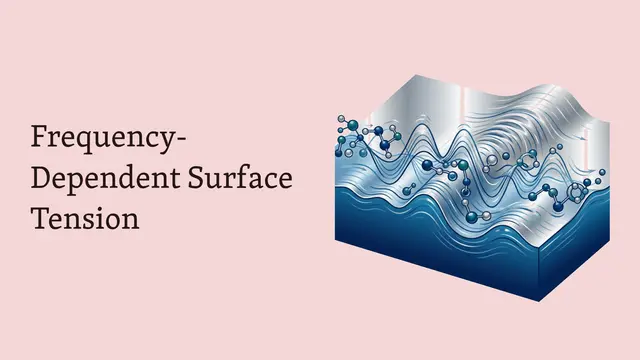
This presentation explores a fascinating discovery about how chaotic capillary waves reshape liquid surfaces. When liquid films are subjected to Faraday waves, stable holes in the film shrink in a predictable way that can be described by introducing an effective surface tension into the Young-Laplace equation. Through careful experiments and theoretical analysis, the researchers demonstrate how wave energy fundamentally alters the time-averaged behavior of liquid interfaces, offering new insights into fluid dynamics under vibratory conditions and potential applications in materials science.Script
Imagine a pool of liquid dancing to an invisible rhythm, its surface alive with chaotic waves that somehow shrink the holes within it. This paper reveals how those turbulent capillary waves create an effective surface tension, fundamentally changing how we understand vibrated liquid interfaces.
Let's start by understanding the puzzle the researchers set out to solve.
Building on this puzzle, the researchers asked how chaotic capillary waves actually reshape a liquid's surface over time. When they subjected liquid films containing stable holes to Faraday waves, those holes began shrinking in ways that existing models couldn't fully explain.
So what insight unlocks this mysterious behavior?
The key breakthrough was recognizing that chaotic waves effectively change the surface tension itself. By adjusting the classic Young-Laplace equation with this effective surface tension parameter, the researchers could map the complex dynamic behavior onto a simpler static model.
To test this theory, they used laser triangulation to measure wave patterns with precision, while tracking how hole diameters evolved under different vibratory amplitudes. Careful experimental controls ensured they captured the pure effect of chaotic capillary waves.
Connecting these observations, the researchers derived an effective capillary length that directly relates wave energy to changes in the liquid surface. This parameter emerges from momentum flux calculations and aligns beautifully with capillary turbulence theory predictions.
Now let's examine what the experiments actually revealed.
The experiments confirmed the theory remarkably well. As vibratory amplitude increased, holes shrank consistently in the manner predicted by the effective surface tension model, providing quantitative validation across multiple experimental conditions.
This work provides a powerful framework for understanding and predicting how liquids behave under vibration, with potential applications in material design and engineering. While the static model has boundaries, it opens doors to exploring effective surface tension concepts across fluid dynamics more broadly.
Chaotic waves, it turns out, don't just disturb liquid surfaces, they fundamentally redefine them through effective surface tension. To dive deeper into this elegant fusion of chaos and equilibrium, visit EmergentMind.com to learn more.