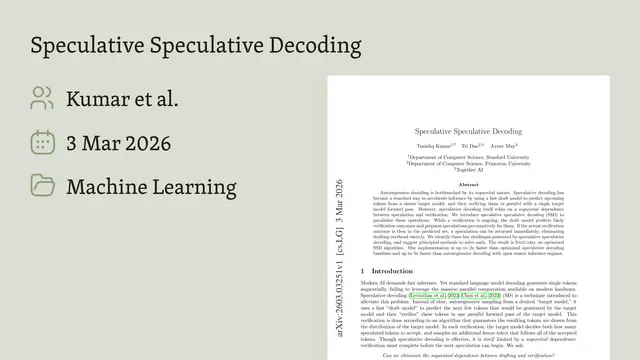
FlashMap: Flow Map Speculative Decoding
FlashMap accelerates large language model inference by replacing factorized block-diffusion proposals with a continuous flow map over one-hot token embeddings. Using a shared noise sample to model dependencies among positions, it generates entire token blocks in one or two network evaluations while conditioning on the target model's hidden states. On Qwen3-8B across nine benchmarks, one-step FlashMap achieves up to 6.14× speedup with 7.4% average improvement over matched baselines, while two-step FlashMap provides the strongest acceptance among parallel drafters by recovering joint block-level structure that prevents the rapid suffix-decay typical of independent per-position prediction.Script
Autoregressive decoding forces large language models to generate one token at a time, but speculative decoding can break that bottleneck by delegating proposal generation to a lightweight drafter and verifying an entire block in parallel. FlashMap introduces a continuous flow map that drafts 16 tokens in one network evaluation while preserving dependencies across positions, achieving up to 6.14 times faster inference on Qwen3-8B.
Factorized drafters treat each token position independently, so individually plausible predictions can form jointly inconsistent sequences. When the target continuation is either new york or san diego, independent per-slot prediction can produce new diego or san york. FlashMap uses a shared noise sample to model the dependency between positions, selecting a coherent block-level mode instead.
The drafter interpolates between Gaussian noise and the one-hot encoding of the target block, predicting the clean representation through a continuous flow. Training emphasizes early positions with exponentially decaying loss weights, because a rejection near the beginning invalidates the remainder of the proposed block. A direct numerical integration would require roughly 100 network evaluations, so FlashMap distills the flow into a two-time map that approximates the solution operator in one or two jumps.
One-step FlashMap achieves the highest end-to-end speedup on all nine benchmarks, reaching 6.14 times on GSM8K and averaging 7.4 percent faster than the matched DFlash baseline. Two-step FlashMap provides the strongest acceptance among parallel drafters, improving accepted length over DFlash by approximately 10 percent on average while remaining faster in 13 of 18 temperature and benchmark configurations.
The shuffle test isolates the contribution of joint structure by comparing drafts generated with shared noise versus independent noise per slot. Two-step FlashMap recovers most of the dependence signal present in the 16-step teacher, with gains of 0.78 on mathematics, 0.47 on code, and 0.25 on chat. One-step FlashMap captures only partial inter-token dependencies, explaining its stronger early predictions but weaker suffix behavior compared to its two-step variant.
FlashMap demonstrates that parallel drafting can improve not only through cheaper computation, but also through a more appropriate joint generative structure that prevents the rapid suffix decay of factorized proposals. The results establish flow-map drafting as a practical path to faster language model inference, with the principal unresolved challenge being direct one-step distillation that fully captures block-level dependencies. Visit EmergentMind.com to explore this paper in depth and create your own video summaries of the latest research.