FlashMap: Flow Map Speculative Decoding
Abstract: Speculative decoding accelerates LLM inference by using a lightweight drafter to propose a block of tokens that the target model verifies in one parallel pass. Autoregressive drafters generate this block one token at a time, whereas block diffusion drafters such as DFlash generate it in one pass, making drafting faster. However, these diffusion drafters predict each token independently, ignoring dependencies between tokens in the block. We introduce FlashMap, a continuous flow drafter that conditions a flow map LLM on the target model's hidden states and generates the whole block in one forward pass while capturing inter-token dependencies. On Qwen3-8B, FlashMap is faster than a matched DFlash baseline on every benchmark, with 7% higher average speedup and up to 6.1x lossless acceleration.
Paper Prompts
Sign up for free to create and run prompts on this paper.
Top Community Prompts
Explain it Like I'm 14
1. What is this paper about?
This paper introduces FlashMap, a new way to make LLMs produce text faster.
LLMs usually write one token at a time. A token might be a whole word, part of a word, or punctuation. Writing one token after another can be slow, especially for large models.
FlashMap uses a technique called speculative decoding. The basic idea is:
- A small, fast model guesses several upcoming tokens.
- The large, accurate model checks all those guesses at once.
- The correct guesses are kept, while incorrect ones are replaced.
FlashMap is designed to make these guesses both fast and consistent with one another.
2. What questions does the research ask?
The researchers wanted to find out:
- Can a lightweight model guess a whole group of future tokens in one step?
- Can it make guesses that fit together naturally?
- Is FlashMap faster and more accurate than earlier methods, especially DFlash?
- Does FlashMap work well for mathematics, programming, and conversation?
- How much does it help to understand the relationships between nearby tokens?
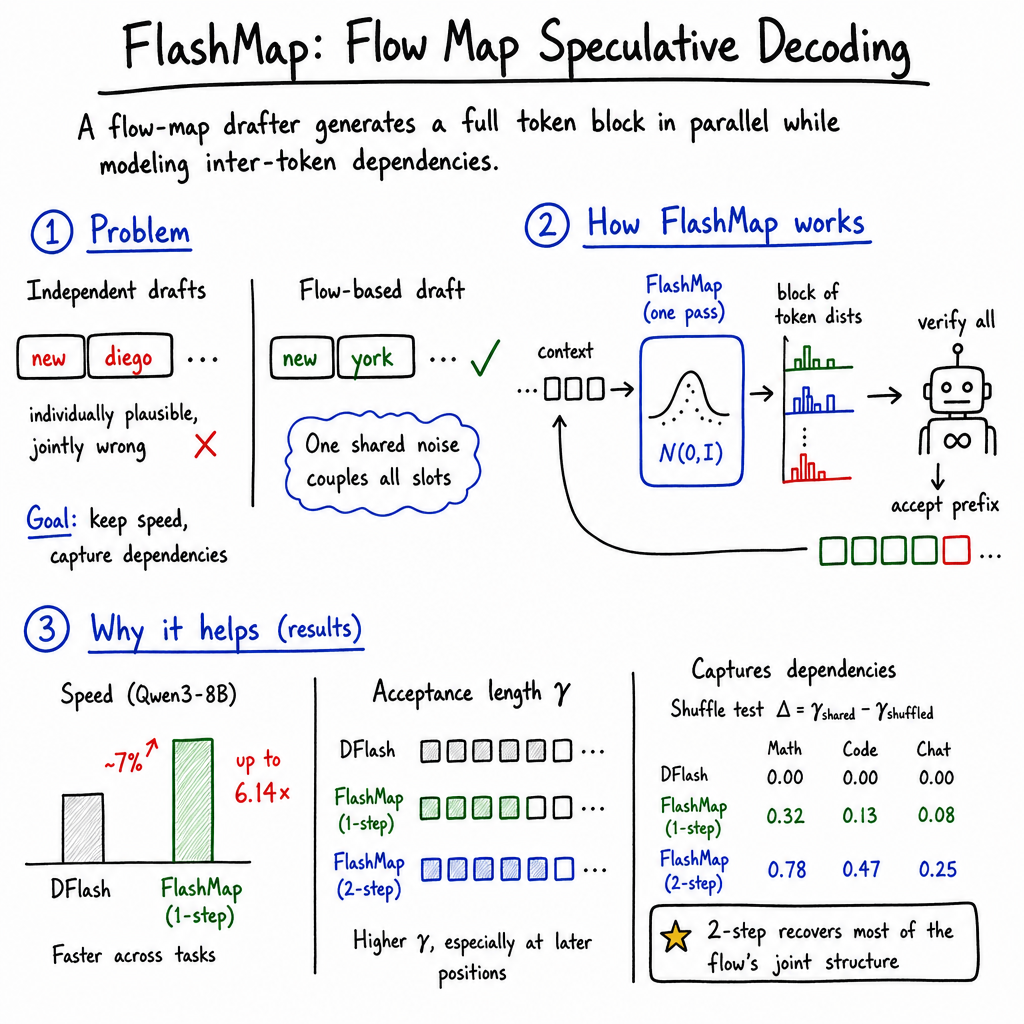
A key problem is that some fast drafting systems guess each token separately. This can create strange combinations.
For example, suppose the correct sentence is either:
- “new york”
- “san diego”
A system that guesses each word independently might accidentally produce:
- “new diego”
- “san york”
Each word looks reasonable by itself, but the pair does not make sense together. FlashMap tries to avoid this problem.
3. How did the researchers approach the problem?
Speculative decoding
The large model is called the target model. It is accurate but slow.
A smaller model, called the drafter, makes a block of guesses. For example, it might guess the next 16 tokens. The target model then checks the entire block in one pass.
This is similar to a student quickly proposing several answers and a teacher checking them all together. If most answers are correct, the process is faster than solving every question separately.
The method is called lossless when the final text still follows the target model’s original probability rules. In other words, the speed improves without intentionally changing what the target model would produce.
The problem with earlier parallel drafters
DFlash is an earlier system that predicts many tokens at the same time. This makes drafting fast, but it treats the token positions mostly independently.
FlashMap instead uses a continuous flow. This begins with random numbers, called noise, and gradually transforms them into a complete group of tokens. The important point is that the whole group is created together.
An everyday analogy is the difference between:
- Choosing each word of a sentence separately from separate boxes, and
- Shaping the entire sentence from one connected plan.
The second approach is more likely to produce words that belong together.
Flow maps
Normally, turning noise into a sequence of tokens can require many small steps. That would be too slow.
FlashMap uses a flow map, which tries to learn how to make a large transformation in only one or two steps. This is like learning to take a shortcut instead of walking along every small part of a long path.
The drafter also uses hidden information from the target model. These hidden states are internal signals that summarize what the target model understands about the text so far.
Training and testing
The researchers:
- Built FlashMap for the Qwen3-4B and Qwen3-8B LLMs.
- Trained it using about 500,000 examples.
- Used blocks of 16 predicted tokens.
- Compared it with DFlash and EAGLE-3.
- Tested it on nine benchmarks covering:
- Mathematics
- Computer programming
- Chat and general conversation
- Measured:
- Acceptance length: how many guessed tokens the target accepts
- Speedup: how much faster the system is than ordinary token-by-token generation
They tested both greedy generation, where the model usually picks the most likely token, and more random generation.
4. What did the researchers find?
FlashMap was faster than the comparison systems
On the Qwen3-8B model, FlashMap was faster than the matched DFlash system on every benchmark.
With one flow-map step, FlashMap was about 7% faster on average than DFlash. Its best result was a 6.14-times speedup on a mathematics benchmark.
This means a task that might normally take six units of time could take about one unit with the accelerated system, although the exact result depends on the task and hardware.
FlashMap usually made better guesses
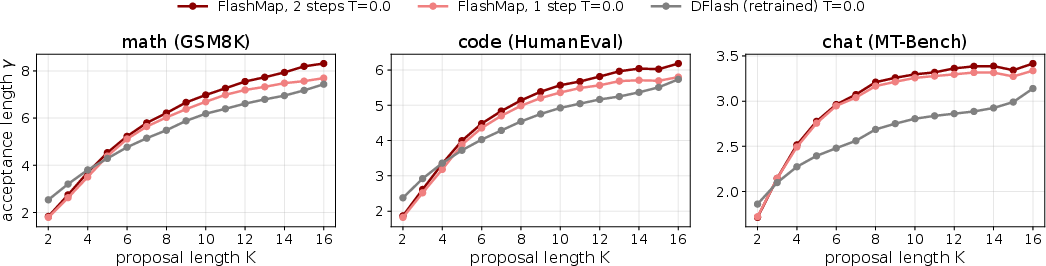
With one step, FlashMap had a higher acceptance length than DFlash in 15 out of 18 settings.
With two steps, FlashMap had the best acceptance length among the parallel methods in all 18 tested settings. On average, it accepted about 10% more tokens than DFlash.
The system performed especially well on:
- Mathematics
- Programming
- Structured text
It was harder to speed up chat tasks because conversations can have many reasonable next sentences.
More steps improved consistency
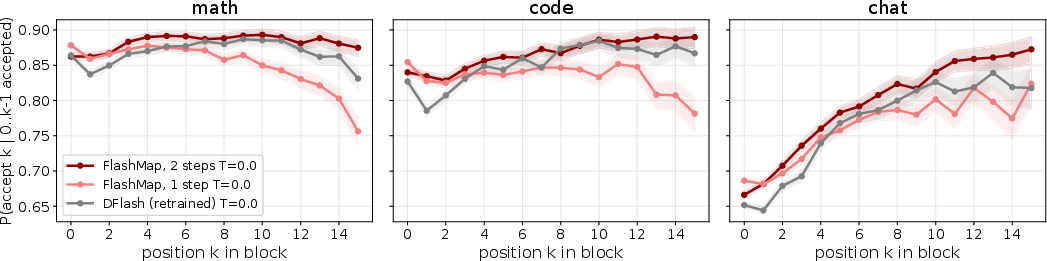
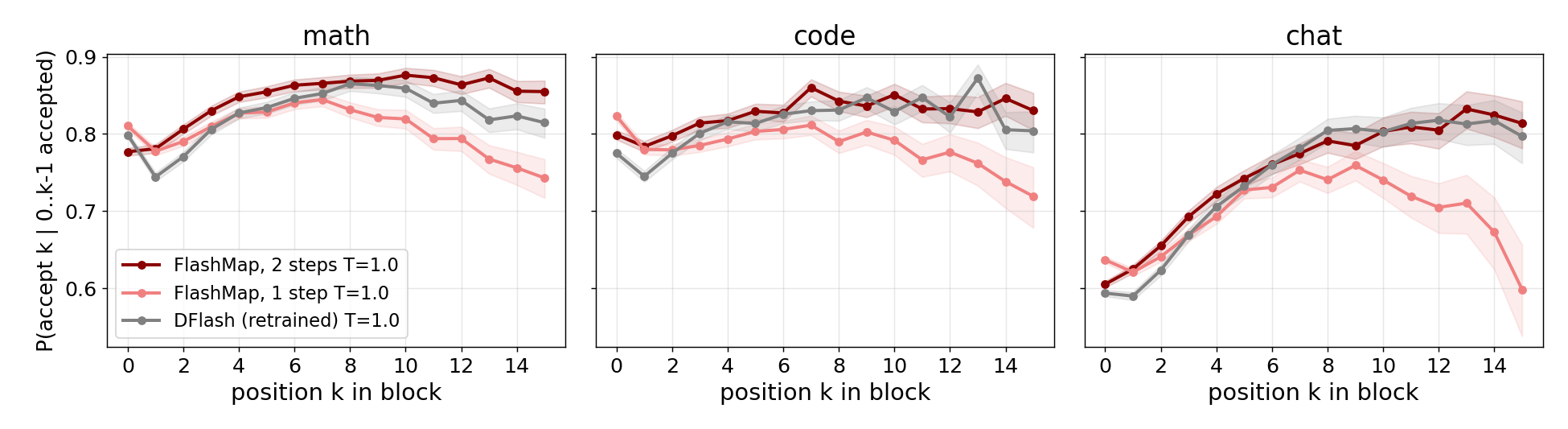
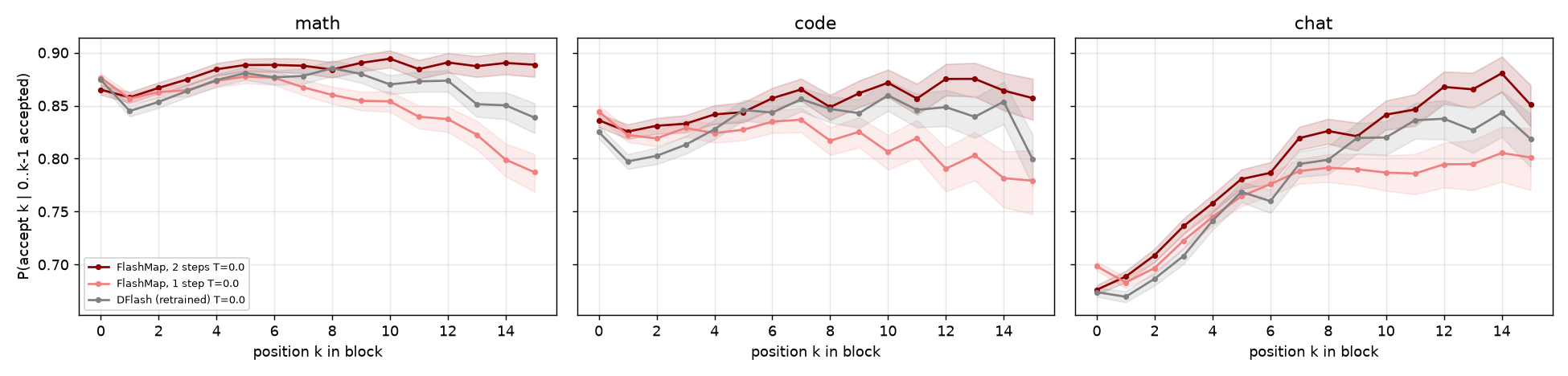
One-step FlashMap was the fastest, but two-step FlashMap usually made more reliable groups of tokens.
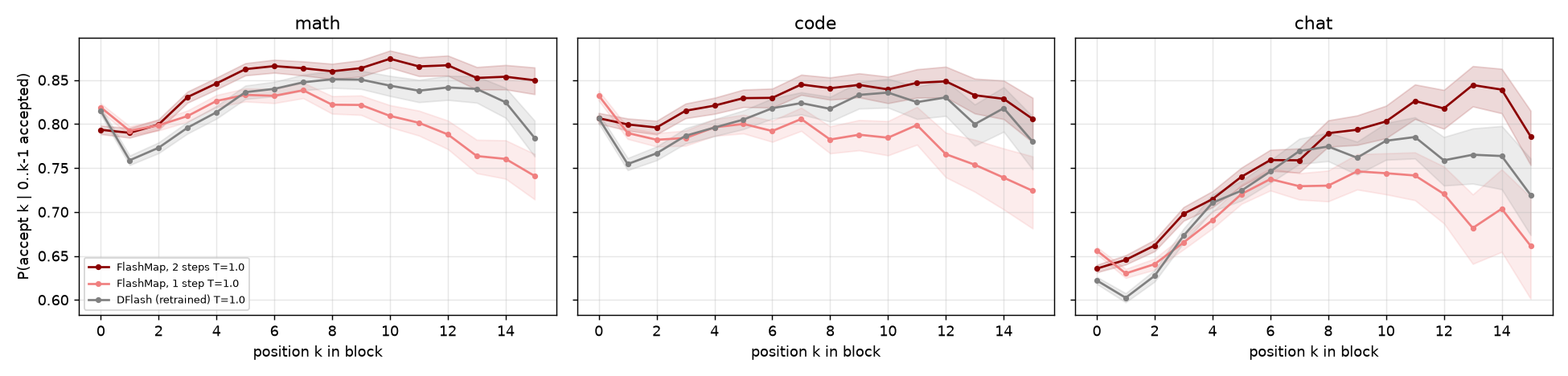
The researchers found that two-step FlashMap was better at keeping tokens connected. Its later guesses did not become much worse than its earlier guesses.
This matters because speculative decoding stops at the first incorrect token. If a later token does not fit with the earlier ones, the system may have to throw away the rest of the guesses.
FlashMap really did use relationships between tokens
The researchers performed a test called a shuffle test.
They compared:
- A block created using one shared random input
- A block where every token used separate random input
If the tokens were truly connected, using one shared input should produce better results.
The test showed:
- DFlash gained nothing from shared randomness because it predicts tokens independently.
- One-step FlashMap showed a small amount of token-to-token coordination.
- Two-step FlashMap captured much more of this coordination.
- A slower 16-step flow model captured the most.
This suggests that FlashMap’s main advantage is not only that it predicts each position well. It also helps the predicted tokens agree with one another.
5. Why are these results important?
The paper shows that a LLM drafter does not have to choose between being:
- Fast but inconsistent, or
- Accurate but slow
FlashMap offers a useful middle ground. It can produce a whole block of possible tokens at once while preserving some of the relationships between those tokens.
The strongest practical result is that one-step FlashMap gives the best overall speed, while two-step FlashMap gives better-quality drafts with only a small extra cost.
However, the researchers also found limitations:
- One-step FlashMap does not capture all possible relationships between tokens.
- Two steps work better, but still do not match a much slower 16-step system.
- The experiments focused mainly on Qwen3 models, English tasks, and one GPU setup.
- The models were trained on a limited amount of data because of computing limits.
Conclusion
FlashMap is a faster way for LLMs to generate text. It uses a small model to guess several tokens at once, then lets the large model check those guesses.
Its special feature is that it creates the guesses as a connected group rather than predicting every token independently. This reduces awkward combinations such as “new diego” and “san york.”
The research suggests that FlashMap could make chatbots, programming assistants, and mathematical reasoning systems respond more quickly while keeping the target model’s output behavior. In the future, better training and improved flow-map methods could make the system even more accurate, especially when drafting in only one step.
Knowledge Gaps
Knowledge gaps, limitations, and open questions
The paper leaves the following issues unresolved:
- Generalization beyond Qwen3: FlashMap is evaluated only on Qwen3-4B and Qwen3-8B, so its effectiveness on other model families, architectures, vocabularies, context lengths, and substantially larger target models remains unknown.
- Scaling behavior: The paper does not establish how drafting latency, parameter count, acceptance length, and end-to-end speedup scale as the target model or FlashMap drafter becomes larger.
- Deployment under realistic batching: Experiments use concurrency 1 on a single NVIDIA H200 NVL GPU. Performance under batched serving, high concurrency, varying batch sizes, and multi-user workloads is not measured.
- Hardware and systems portability: It is unclear whether the reported speedups persist on other GPUs, TPUs, consumer hardware, or distributed inference systems, particularly because FlashMap and DFlash have different parameter sizes and memory-access patterns.
- Effect of training-data scale and composition: All drafters are trained on only 500K samples from Open-PerfectBlend. The impact of using the full dataset, more diverse corpora, domain-specific data, multilingual data, or data aligned with the target model’s pretraining distribution is not studied.
- Undertraining effects: The authors note that FlashMap is trained for substantially fewer steps than prior flow-map work, but do not quantify how additional teacher or student training changes acceptance, speedup, entropy collapse, or joint-structure recovery.
- Sensitivity to block length: Models are trained with and evaluated mostly at that length. The maximum effective block size, performance when trained directly at larger , and the trade-off between verification cost and acceptance for different block lengths remain unresolved.
- Training–inference mismatch: The paper evaluates smaller proposal lengths without retraining and cites prior work for the resulting penalty, but does not systematically compare models trained and evaluated at matched values of .
- Optimal slot-loss weighting: The choice is not extensively ablated. It remains unclear whether different decay schedules, position-dependent objectives, or objectives directly optimized for expected accepted tokens would improve later-slot acceptance.
- Distillation objective limitations: Semigroup self-distillation uses student-generated targets for long jumps, which may propagate errors. The paper does not compare this approach with teacher-generated flow-map targets, consistency losses, adversarial or likelihood-based objectives, or distillation methods specifically optimized for one-step inference.
- One-step flow-map quality: One-step FlashMap captures only a small fraction of the teacher’s joint-structure benefit, but the paper does not identify whether the main cause is insufficient model capacity, optimization failure, poor conditioning, long-jump approximation error, or the choice of Gaussian-to-one-hot interpolation.
- Theoretical characterization of one-step dependence: The paper demonstrates dependence empirically through the shuffle test, but does not provide a formal characterization of when a one-step flow map can represent the target block distribution or how much dependence it can preserve under finite capacity.
- Validity of the shuffle test: The shuffle test is treated as isolating inter-token dependence, but the paper does not analyze possible confounds such as changes in marginal calibration, noise-dependent token confidence, target-conditioned correlations, or the effects of argmax decoding.
- Alternative flow parameterizations: Only the described rectified-flow interpolation and two-time denoiser parameterization are evaluated. Other probability paths, categorical-flow constructions, transport couplings, noise distributions, or simplex-aware parameterizations may yield better one-step drafts but are not compared.
- Noise-distribution and sampling sensitivity: The effects of changing the initial Gaussian distribution, using common versus structured noise, varying random seeds, temperature-dependent noise calibration, or applying multiple noise samples are not systematically investigated.
- Temperature coverage: Evaluation is limited to and . Behavior at intermediate and higher sampling temperatures, nucleus or top- sampling, repetition penalties, and other decoding settings remains unknown.
- Target–drafter distribution mismatch: The experiments do not quantify how FlashMap behaves when the target uses sampling policies different from those used during drafter training, or when the drafter is trained on outputs from a different target checkpoint.
- Evaluation of exactness under all decoding settings: Speculative decoding is theoretically lossless when the verification rule is applied correctly, but the paper does not empirically verify distributional equivalence or quantify implementation-induced deviations across temperatures and sampling policies.
- Comparison with stronger contemporary baselines: The evaluation excludes DFlash extensions such as draft trees, autoregressive postprocessing, and low-rank latent mixtures. Consequently, it is unresolved whether FlashMap outperforms the strongest available parallel-drafting systems rather than only the base DFlash model.
- Fairness of baseline matching: Although baselines are retrained under shared settings, the paper does not provide a complete compute, memory, parameter-count, training-FLOP, or wall-clock comparison, making it difficult to determine the contribution of architecture versus training budget.
- End-to-end memory costs: The paper reports speedup but does not fully analyze peak memory, KV-cache usage, activation memory, compilation overhead, or memory bandwidth, all of which may affect practical deployment.
- Prompt-length and context-length effects: The influence of input length, proximity to the target model’s maximum context window, and the number of target hidden states supplied to FlashMap is not evaluated.
- Hidden-state selection: The method uses target layers 1, 9, 17, 25, and 33, but the paper does not ablate layer selection, feature dimensionality, context truncation, or alternative target representations.
- Robustness across domains and languages: The benchmarks are primarily English and cover math, code, and chat. Performance on multilingual generation, factual knowledge, tool use, long-form writing, reasoning with rapidly changing modes, and safety-sensitive prompts is untested.
- Quality beyond acceptance length: Acceptance length and speedup are the primary metrics. The paper does not evaluate downstream task accuracy, code execution success, mathematical answer correctness, response quality, calibration, repetition, or toxicity before and after speculative decoding.
- Rare-token and long-tail behavior: The effect of the very large Qwen3 vocabulary and rare or unseen token combinations on flow-map training, entropy collapse, marginal accuracy, and joint consistency is not analyzed.
- Failure modes of later slots: The paper observes faster conditional-acceptance decay for one-step FlashMap but does not identify which linguistic or structural patterns cause late-slot failures or whether targeted training can correct them.
- Optimal allocation between flow steps and verification budget: The study compares one and two flow-map steps with a fixed verification setup, but does not optimize jointly over the number of flow steps, proposal length, tree width, and verification strategy.
- Multi-sample and tree-decoding trade-offs: Independent noise samples and tree verification yield approximately 11% improvement in one experiment, but the search-space, memory, latency, and acceptance trade-offs are not systematically explored.
- Training-cost amortization: The paper focuses on inference speedup but does not report the training cost, energy use, or break-even number of generated tokens required for FlashMap to offset its additional training and deployment complexity.
- Reproducibility and statistical uncertainty: Several results are based on small prompt sets or single runs, and uncertainty is not reported consistently. More repetitions, confidence intervals for speedups, and significance tests are needed to establish the reliability of the reported improvements.
- Incomplete treatment of implementation details: The supplied paper text does not include the referenced appendices and appears to end mid-reference, leaving details about implementation, multi-sample decoding, Qwen3-4B results, fast multi-step inference, and reproducibility insufficiently documented.
Practical Applications
Immediate Applications
- Faster production serving of Qwen-family LLMs — software and cloud AI.
FlashMap can be integrated into speculative-decoding runtimes such as
SGLangor DeepSpec-compatible serving stacks. A lightweight flow-map drafter proposes up to 16 tokens in one or two passes, while the target model verifies them in parallel. The paper reports up to lossless acceleration on Qwen3-8B and an average 7.4% speed improvement over DFlash for one-step drafting. Dependencies: The target model must expose hidden states at the layers expected by the drafter, and the runtime must support target verification and rejection sampling. The reported gains were measured at concurrency 1 on an NVIDIA H200; throughput gains under batching or on other hardware require validation. - Lower-latency interactive chat assistants — consumer software and enterprise support. FlashMap can reduce response latency in chatbots, coding assistants, search assistants, and customer-service agents. This is particularly relevant to chat workloads, where one-step FlashMap showed larger relative improvements over DFlash than on math tasks. Dependencies: Open-ended dialogue has lower token acceptance than structured text, so benefits depend on prompt distribution, decoding temperature, and target/drafter compatibility. FlashMap does not improve factuality, safety, or reasoning quality; it preserves the target model’s output distribution through verification.
- Accelerated code-generation workflows — software engineering and developer tools. Code completion, repository-level assistance, test generation, and interactive debugging can use FlashMap to propose blocks of syntactically and semantically correlated tokens. The paper evaluates MBPP, HumanEval, and LiveCodeBench and finds substantial speedups for code, where continuations are more structured and therefore easier to accept. Dependencies: Production systems should verify that exact target-model behavior is preserved, especially when using temperature-based sampling. Tool calls, constrained decoding, grammar masks, and long-context repository prompts may require additional engineering.
- Faster mathematical and technical reasoning interfaces — education and research software. FlashMap can be deployed in tutoring systems, symbolic problem-solving assistants, technical question-answering tools, and batch generation of mathematical solutions. Structured mathematical text produced higher speedups than open-ended chat in the reported experiments. Dependencies: Faster generation does not guarantee correct reasoning. Applications should retain existing answer verification, calculator, symbolic algebra, or human-review stages.
- Reduced inference cost and energy per generated token — cloud infrastructure and data centers. By increasing the number of target tokens committed per verification pass, FlashMap can reduce target-model forward passes, GPU time, and potentially energy consumption. This is useful for API providers and organizations operating large-scale generation workloads. Dependencies: Net savings depend on drafter overhead, GPU memory utilization, verification efficiency, and workload concurrency. The paper does not measure energy directly, so carbon or power reductions must be established with deployment-specific profiling.
- A practical alternative to autoregressive draft models — LLM systems engineering. Teams currently using EAGLE-style autoregressive drafters can evaluate FlashMap when draft latency is the main bottleneck. The paper reports that EAGLE-3 may have higher acceptance in some settings but is substantially slower because it generates draft tokens sequentially. Dependencies: Migration requires retraining or obtaining a drafter matched to the exact target model, tokenizer, hidden-state layout, and target vocabulary. The released implementation and code can lower prototyping cost, but production compatibility is not established for arbitrary model families.
- Adaptive latency-quality serving policies — cloud platforms. A serving system can select among one-step FlashMap, two-step FlashMap, ordinary decoding, or another drafter according to workload needs. One-step drafting minimizes drafter cost, while two-step drafting provides higher acceptance and stronger recovery of inter-token dependencies. Dependencies: The policy must be calibrated using real latency, queueing, and batch-size measurements. The paper’s results suggest a speed/acceptance trade-off but do not provide a universal optimal switching rule.
- Research and teaching tools for non-autoregressive generation — academia. Researchers can use FlashMap as an experimental baseline for studying joint sequence generation, flow-map distillation, speculative decoding, and factorization error. Its shuffle-test methodology is also directly useful for separating improvements in per-position accuracy from improvements in inter-token dependency modeling. Dependencies: Reproducibility is affected by the limited 500K-example training set, short training schedule, Qwen-only evaluation, and hardware-specific measurements. Independent replication across model families and larger datasets is needed.
Long-Term Applications
- High-throughput LLM APIs and large-scale enterprise automation — cloud AI. A mature FlashMap implementation could support lower-cost document processing, summarization, translation, report generation, code production, and agentic workflows at scale. Two-step flow maps may be especially useful where longer accepted blocks offset their extra drafter evaluation. Dependencies: The current evidence is limited to Qwen3-4B/8B, English math/code/chat benchmarks, and low-concurrency evaluation. Large-scale deployment requires testing batching, multi-tenant serving, long contexts, memory pressure, heterogeneous accelerators, and larger target models.
- Jointly consistent planning and tool-use drafts — AI agents and robotics. Because FlashMap models a block jointly rather than independently, future versions could draft coherent sequences of tool calls, structured actions, or intermediate planning steps for agents and robots, with the target policy or planner acting as verifier. Dependencies: This requires extending the method beyond ordinary text tokens to structured action spaces, tool schemas, state-dependent constraints, and safety-critical verification. Token-level acceptance may not adequately guarantee that an entire external action sequence is safe or executable.
- Multilingual translation and generation — language technology. Flow-map drafters could accelerate translation, captioning, multilingual summarization, and speech-to-text postprocessing while preserving the target model’s verified distribution. Modeling dependencies jointly may be valuable for phrases whose tokens must be selected together. Dependencies: The paper trains and evaluates primarily on English data. Different scripts, tokenization schemes, vocabulary sizes, morphology, and language-specific continuation structures require new training and evaluation.
- Longer-block speculative decoding — advanced LLM inference. The nearly flat conditional acceptance curve observed for two-step FlashMap suggests that models trained for larger blocks could exploit more than the 16-token window used in the paper. This could reduce verification frequency further and improve throughput for structured generation. Dependencies: Longer blocks may increase training difficulty, memory use, and exposure to late-position errors. The paper explicitly notes that larger values require dedicated training and were not validated.
- Tree-based and multi-sample speculative decoding — search and sampling systems. FlashMap can be combined with independent noise samples, draft trees, or joint verification to explore several coherent continuations. The paper reports approximately 11% improvement from multi-sampling in one explored configuration, suggesting a path toward faster sampling at temperature . Dependencies: Tree verification increases memory and implementation complexity. Benefits depend on the diversity of samples, target-model parallelism, and whether the workload values stochastic exploration rather than greedy decoding.
- Flow-map acceleration for other categorical generative models — generative modeling research. The core approach could transfer to masked LLMs, discrete sequence generators, structured prediction systems, or categorical diffusion models. The central innovation is to replace factorized one-pass prediction with a learned map from noise to a jointly structured block. Dependencies: Applying the method to non-text data requires suitable categorical representations, target hidden-state interfaces, verification rules, and distillation objectives. One-step maps currently retain only part of the teacher’s joint structure, so improved distillation is needed.
- Better one-step and few-step flow-map distillation — foundational ML research. Future work could produce more accurate one-step drafters by improving semigroup training, full-jump supervision, loss weighting, or noise-to-sequence transport. Closing the gap with the 16-step teacher would make the method more attractive for latency-sensitive systems. Dependencies: The paper identifies residual loss in both marginal prediction and inter-token dependence, along with possible entropy collapse in one-step models. Improvements must be demonstrated without increasing drafter cost enough to eliminate the speed advantage.
- Hardware-aware inference products — accelerator and systems design. Specialized kernels or serving hardware could fuse target hidden-state extraction, flow-map drafting, verification, and token acceptance. Such co-design may make FlashMap useful in edge devices, private enterprise servers, or energy-constrained deployments. Dependencies: The reported results rely on NVIDIA H200 measurements and a specific software stack. Realizing hardware benefits requires profiling memory bandwidth, kernel-launch overhead, cache reuse, quantization effects, and support for target-drafter parallelism.
- Policy and public-sector language services — government and regulated environments. If validated for approved models, FlashMap could lower the cost and latency of public-service chatbots, legal-document triage, multilingual information portals, and internal government assistants. Exact verification is useful where organizations need the accelerated system to retain the target model’s intended sampling behavior. Dependencies: Deployment still inherits the target model’s bias, hallucination, privacy, and misuse risks. Regulated applications require auditability, data governance, safety evaluation, secure model hosting, and evidence that acceleration does not interfere with compliance controls.
- Everyday-device assistants — mobile, embedded, and personal computing. Lower target-model compute requirements could support faster on-device summarization, email drafting, accessibility tools, personal scheduling, and offline coding or writing assistance. Dependencies: The paper does not evaluate quantized models, mobile NPUs, memory-limited devices, or battery consumption. A smaller drafter may still be expensive relative to edge hardware, and target-model verification must fit within device memory and thermal limits.
Glossary
- Acceptance length: Expected number of tokens committed in one speculative-decoding round, including the token contributed by the target model. “The acceptance length is the expected number of tokens committed per round, including the one contributed by the target.”
- AdaLN-Zero: A zero-initialized adaptive layer-normalization mechanism that modulates neural-network blocks using conditioning information. “Each block applies self-attention among the slots, cross-attention to context features from the target, and an MLP, each modulated by adaLN-Zero on the time .”
- Autoregressive: Generating a sequence one token at a time, conditioning each token on previously generated tokens. “Most drafters are autoregressive.”
- Beam/tree verification: Verification of multiple candidate sequences arranged as a branching draft structure. “As an alternative to more function evaluations, another way to spend more drafting compute is to draft several blocks from independent noise draws and verify them together as a tree.”
- Block diffusion model: A diffusion model that generates or denoises an entire token block in parallel. “DFlash instead drafts an entire block in one forward pass using a lightweight block diffusion model.”
- Conditional acceptance rate: The probability that a token is accepted given that all preceding tokens were accepted. “the probability that the draft token at position of a block is accepted given that all earlier tokens in the block were accepted”
- Continuous flow: A continuous-time dynamical process that transports an initial random distribution into a data distribution. “We introduce FlashMap, a continuous flow drafter that conditions a flow map LLM on the target model's hidden states”
- Cross-attention: An attention mechanism in which one sequence attends to representations from another sequence. “Each block applies self-attention among the slots, cross-attention to context features from the target, and an MLP”
- Denoiser: A model that estimates clean data from a noisy or partially corrupted representation. “A denoiser outputs the clean-data prediction”
- Distillation: Training a student model to reproduce the behavior of a larger or more computationally expensive teacher model. “we distill the trained flow (the teacher) into a flow map (the student)”
- Euler steps: Numerical integration steps using Euler’s method to approximate the solution of an ordinary differential equation. “Drafting directly from the flow takes Euler steps on this grid”
- Factorized approximation: An approximation that represents a joint distribution as a product of independent per-position distributions. “few-step inference with discrete diffusion typically relies on the factorized approximation”
- Flow map: An operator that maps a dynamical system’s state at one time directly to its state at another time. “The flow map sends the ODE's state at time to its state at time ”
- Flow Map LLMs (FMLM): LLMs that use continuous flows to transform noise into sequences represented by token embeddings. “Flow Map LLMs (FMLM;~\citealp{lee_flow_2026}) instead model language with a continuous flow.”
- Flow-map distillation: The process of learning a direct flow-map operator from a pretrained continuous flow. “Following the flow map distillation framework of \citet{boffi2025flowmap}, we distill the trained flow”
- Gaussian noise: Random values sampled from a normal distribution, used here as the initial state of the flow. “the point on the flow's trajectory between Gaussian noise () and the one-hot encoding of the draft tokens ().”
- Hidden states: Internal vector representations produced by a neural network’s layers. “We extract the target model's hidden states at layers 1, 9, 17, 25, and 33”
- Interpolant: A parameterized intermediate representation connecting an initial noisy state to a target data state. “During training the state is the interpolant ”
- Joint distribution: A probability distribution describing multiple variables simultaneously, including their dependencies. “Sampling several tokens in one step would require their joint distribution over ”
- Joint structure: Dependencies and consistency among multiple token positions in a generated block. “This indicates that it is integration of the flow that resolves each noise draw into one consistent block.”
- Language-model head: The output projection that converts hidden representations into token scores or probabilities. “Both vocabulary projections are copied from the target and kept frozen”
- Logits: Unnormalized scores assigned by a neural network to possible output tokens. “\node[font=\scriptsize, below=1pt] at (0.6, 0) {logits};”
- Marginal distribution: The probability distribution of one variable obtained from a joint distribution by ignoring the other variables. “Per-slot cross-entropy is minimized by the target's marginals .”
- Memory-bound: Limited primarily by memory access or data movement rather than arithmetic computation. “where $T_{\text{verify}$ is roughly constant because decoding is memory-bound”
- Non-autoregressive: Generating multiple or all sequence elements without sequential dependence on previously generated elements. “This is a problem that plagues many non-autoregressive methods”
- One-hot encoding: A vector representation in which exactly one component is active to identify a categorical item. “A sequence is represented by its one-hot encoding”
- Ordinary differential equation (ODE): An equation relating a function to its derivatives with respect to one or more continuous variables. “Sampling integrates the flow with a numerical ODE solver”
- Per-slot cross-entropy: Cross-entropy loss computed separately for each token position in a generated block. “Training samples random anchor positions in target-generated responses and weights the per-slot cross-entropy by exponentially decaying weights over block positions.”
- Rectified flow: A flow-matching method that connects noise and data through a linear interpolation and learns the corresponding transport velocity. “Following rectified flow \citep{lipman_flow_2023,liu2022rf,albergo_stochastic_2025}, noise and data are connected by”
- Residual distribution: The probability distribution used to resample a rejected token so that speculative decoding preserves the target distribution. “At the first rejection, the target resamples that token from the residual distribution”
- Semigroup property: The composition rule stating that a transition from one time to another can be decomposed through an intermediate time. “It satisfies and the semigroup property .”
- Self-attention: An attention mechanism in which elements of a sequence attend to other elements within the same sequence. “Each block applies self-attention among the slots”
- Semigroup distillation: Training a flow-map model to satisfy the semigroup composition rule across multiple time intervals. “We train the student on the semigroup property of flow maps”
- Simplex: A geometric space representing probability vectors whose components are nonnegative and sum to one. “Because one-hot vectors are the vertices of the simplex”
- Speculative decoding: An inference method in which a smaller model proposes tokens that a larger model verifies in parallel. “Speculative decoding accelerates LLM inference by using a lightweight drafter to propose a block of tokens that the target model verifies in one parallel pass.”
- Stop-gradient: An operation that prevents gradients from propagating through a tensor during training. “$\sg$ denotes the stop-gradient, since the target is computed from the student itself.”
- Target model: The larger LLM whose distribution is preserved and whose predictions verify draft tokens. “Speculative decoding drafts a block of future tokens with a lightweight model and verifies it in one parallel pass of the larger target LLM.”
- Total correlation: A multivariate generalization of mutual information measuring dependence among several variables. “The remaining gap is the total correlation ”
- Velocity field: A function specifying the direction and speed at which states move through a continuous flow. “the velocity transports at to data at .”
- Vocabulary projection: A learned linear transformation between hidden representations and vocabulary-sized token representations. “Both vocabulary projections are copied from the target and kept frozen”
- Wilson interval: A statistical confidence interval for a binomial proportion, often more reliable than a simple normal approximation. “shaded bands are 95\% Wilson intervals.”