Next-Concept Modeling: Fast, Parallel Coarse-to-Fine Text Generation
This presentation introduces Next-Concept Modeling (NCM), a novel approach to text generation that replaces iterative token-by-token or full-sequence refinement with generation in a learned hierarchy of discrete latent codes. By predicting coarse-to-fine representations in parallel at each level, NCM achieves 10–31× faster sampling than diffusion models while maintaining competitive quality across tasks including language modeling, translation, summarization, and even constrained reasoning problems like Sudoku. The method demonstrates that learning the order in which information should be revealed—rather than treating all tokens equally—fundamentally improves inference efficiency.Script
Language models generate text one token at a time, and diffusion models refine entire sequences repeatedly. Both are slow. The authors of this paper ask: what if we could learn the order in which information should be revealed, generating coarse ideas first and details in parallel later?
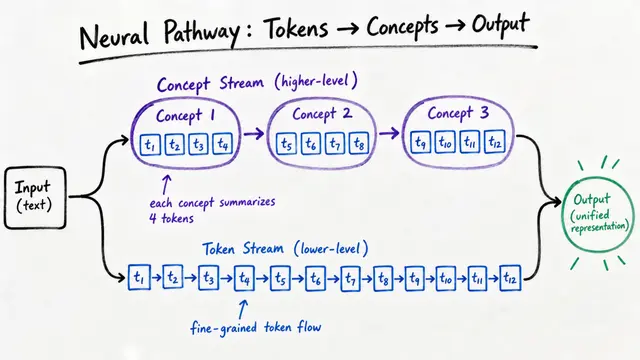
Next-Concept Modeling replaces token-space iteration with a multiscale hierarchy of discrete latent codes. A residual vector-quantized autoencoder compresses a token sequence into multiple levels, each with progressively finer resolution, where level 1 might have just 4 codes and the final level expands to the full sequence length.
The generator predicts all codes within a level in parallel, conditioned on the cumulative reconstruction of earlier levels. Because there are far fewer levels than tokens, and early levels are short, this requires dramatically fewer sequential model evaluations while still leveraging the transformer's parallel computation.
On the LM1B benchmark, Next-Concept Modeling uses 11 times fewer function evaluations than the diffusion baseline and runs 21 times faster, while achieving better generative perplexity. The speedup comes from two sources: fewer sequential steps, and cheaper computation during the coarse stages.
The method even handles constrained reasoning. On Sudoku puzzles, Next-Concept Modeling achieves 99.5 percent accuracy on easy puzzles and 86 percent on hard ones, outperforming autoregressive and diffusion baselines while using just 12 function evaluations per puzzle.
By learning a coarse-to-fine schedule in latent space, the authors demonstrate that parallel generation becomes far more efficient when the model itself determines what to reveal first. To explore this work further and create your own videos on emerging research, visit EmergentMind.com.