Exploring Local Hidden-Variable Models for Multipartite Entangled States and Arbitrary Measurements
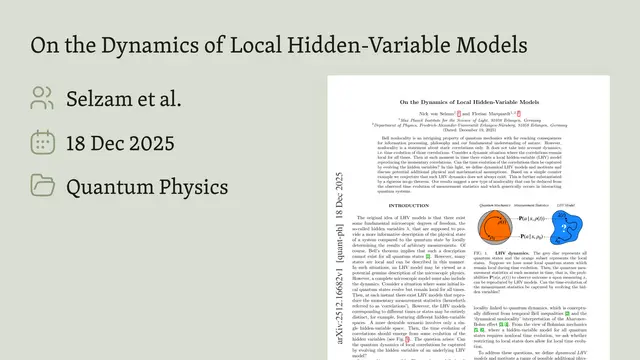
This presentation explores a groundbreaking machine learning approach to one of quantum mechanics' deepest puzzles: determining when quantum correlations can be explained by classical local theories. The authors develop gradient-descent algorithms that construct local hidden-variable models for arbitrary quantum states and measurements, providing quantitative tools to map the boundary between quantum non-locality and classical explainability. Their method reveals critical noise thresholds where entangled states transition from displaying genuinely quantum behavior to admitting local explanations, with implications for quantum information processing and our understanding of quantum foundations.Script
Quantum entanglement produces correlations so strong they seem to defy local explanations, yet for decades we've lacked systematic ways to determine exactly when those correlations cross the line from classical to genuinely quantum. This paper introduces a machine learning method that discovers local hidden-variable models for arbitrary quantum states, finally giving us quantitative tools to map that boundary.
The central question is whether particles that seem entangled are actually just sharing classical information we can't see. The authors treat this as an optimization problem, using gradient descent to search for hidden-variable distributions that reproduce quantum predictions while keeping each particle's behavior strictly local. Unlike previous approaches limited to specific cases, this framework handles any quantum state and any set of measurements.
The technique transforms a foundational physics question into a machine learning optimization task.
The architecture is elegant. Each particle's measurement outcome depends only on its own slice of a shared hidden state, guaranteeing locality by construction. The optimization adjusts the hidden-variable distribution until the model's predictions match quantum statistics, and when it succeeds, you've proven that particular quantum state admits a local explanation.
For two-qubit Werner states, the method reveals exactly where quantum non-locality breaks down. Below a critical noise level, the optimization fails to converge because no local model exists. Above that threshold, the deviation drops to zero, indicating the noisy state can be explained classically. This quantifies precisely how much decoherence is needed to erase quantum advantages, which matters deeply for quantum communication protocols that rely on violation of Bell inequalities.
The method's power lies in what happens when it fails. If gradient descent can't find a local model, that failure is evidence of genuine quantum non-locality, giving us a computational witness for entanglement. For quantum technologies, this offers a practical diagnostic: apply noise until the optimizer succeeds, and you've measured exactly how robust your quantum resource is against decoherence.
This work turns a philosophical question about quantum foundations into an algorithmic tool that measures the boundary between quantum and classical worlds. Visit EmergentMind.com to explore this paper further and create your own research videos.