DeepSeek-V2: Scaling Intelligence Without Breaking the Bank
DeepSeek-V2 represents a fundamental breakthrough in language model design, activating only 21 billion of its 236 billion parameters per token while supporting 128K context length. Through innovations like Multi-head Latent Attention and the DeepSeekMoE architecture, it slashes training costs by 42.5% and increases inference throughput by 5.76 times compared to its predecessor, all while achieving top-tier performance on English and Chinese benchmarks. This presentation explores how architectural ingenuity transforms the economics of large-scale AI.Script
A 236 billion parameter language model that activates only 21 billion parameters per token, cuts training costs by 42%, and runs nearly 6 times faster than its predecessor. DeepSeek-V2 doesn't ask you to choose between performance and efficiency; it delivers both through radical architectural innovation.
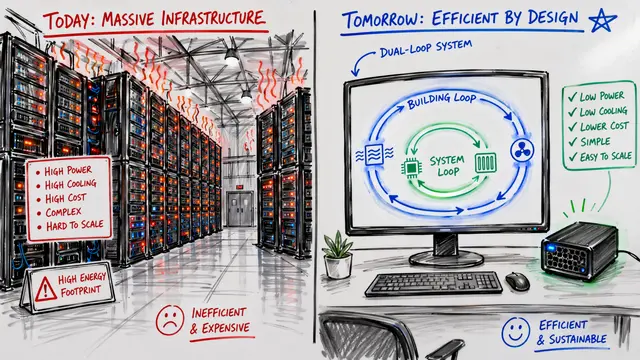
The language model landscape faces a stark reality. Attention mechanisms in traditional transformers create memory bottlenecks that strangle throughput, while training a frontier model can cost millions. Even sparse architectures squander resources when experts aren't properly specialized or balanced.
DeepSeek-V2 attacks these problems at their root with two complementary breakthroughs.
Multi-head Latent Attention transforms how models handle memory during inference. Instead of storing full key and value matrices like traditional Multi-Head Attention or even Grouped-Query Attention, MLA compresses both into a compact latent representation through low-rank joint compression. This reduces the KV cache to just one-tenth its typical size, directly translating to larger batch sizes and higher throughput without sacrificing the model's ability to attend across long contexts.
The DeepSeekMoE architecture operates on a principle of intelligent specialization. Experts are segmented into shared and routed categories, where shared experts learn universal patterns while routed experts develop deep specialization. The routing mechanism doesn't just assign tokens randomly; it balances computational load across experts to prevent the collapse where only a few experts do all the work, a common failure mode in other Mixture-of-Experts systems.
These architectural choices produce measurable advantages. DeepSeek-V2 doesn't just match its 67 billion parameter predecessor; it surpasses it decisively on standardized benchmarks in both English and Chinese. The throughput gains are dramatic: nearly 6 times faster inference. And perhaps most remarkably, it achieves superior results while consuming 42% less compute during training.
The model's practical capabilities extend beyond benchmark scores. With 128,000 token context support, it can process entire codebases or lengthy documents in a single forward pass. The sparse activation pattern means that despite having 236 billion parameters, only 21 billion are used for any given token, keeping inference costs manageable while retaining the expressive power of a truly massive model.
DeepSeek-V2's innovations have immediate implications. Organizations can now deploy models with frontier capabilities without frontier budgets. The architectural patterns demonstrated here, particularly the latent attention mechanism and expert specialization strategies, provide a template for future model development where performance and efficiency advance together rather than in opposition.
DeepSeek-V2 proves that the path to more powerful AI doesn't require exponentially more resources; it requires smarter architecture. Visit EmergentMind.com to explore more cutting-edge research and create your own AI video presentations.