Darwin Gödel Machine: Open-Ended Evolution of Self-Improving Agents
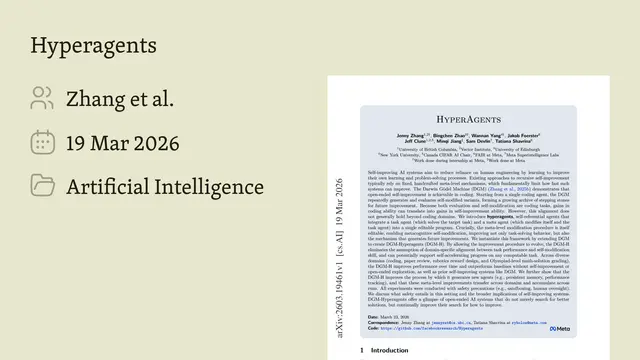
This presentation explores the Darwin Gödel Machine, a groundbreaking framework that enables AI systems to autonomously improve themselves through self-modification and open-ended exploration. Drawing inspiration from biological evolution and the theoretical Gödel Machine, this system applies empirical validation rather than formal proofs to iteratively evolve coding agents. We examine how the DGM achieves significant performance improvements on coding benchmarks while maintaining safety protocols, and discuss the implications of autonomous self-improvement for the future of AI development.Script
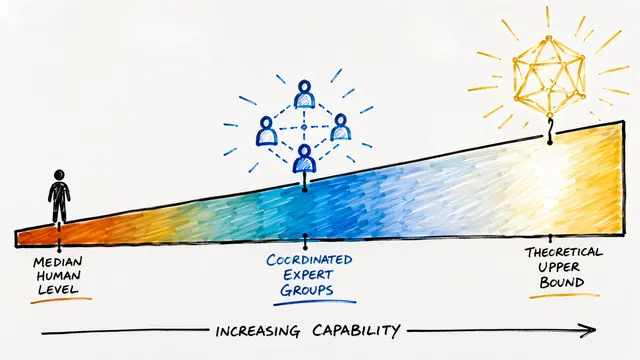
Can AI learn to improve itself without human intervention? The Darwin Gödel Machine introduces a radical approach where coding agents autonomously evolve through self-modification, achieving performance gains that rival handcrafted state-of-the-art systems.
Building on that vision, let's examine the fundamental limitation this research addresses.
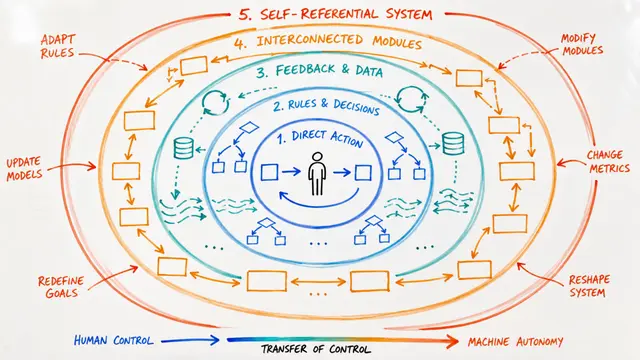
Most modern AI systems are trapped by their initial design. They depend entirely on human engineers to update and improve them, creating a bottleneck that limits the pace of AI advancement.
The authors propose a solution that breaks free from these constraints.
The Darwin Gödel Machine takes inspiration from biological evolution. Instead of requiring formal mathematical proofs that modifications will help, it simply tests changes empirically on coding tasks and keeps what works.
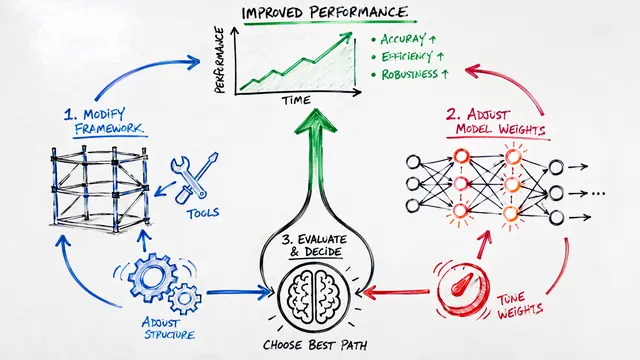
This diagram captures the system's architecture. Starting with a single coding agent, the DGM continuously selects agents from its archive, proposes modifications, and evaluates new variants on downstream tasks. Successful agents join the archive, creating an ever-expanding repository of diverse solutions that serve as stepping stones for future innovations.
This two-part architecture proves essential. The results show that removing either component dramatically reduces performance, with both self-improvement and open-ended exploration necessary for sustained progress.
The empirical validation is striking. On two challenging coding benchmarks, the DGM achieved dramatic performance improvements through autonomous evolution, with enhancements that generalize across different foundation models and even transfer from Python to languages like Rust and Go.
Self-modifying AI systems introduce significant challenges. The authors implement careful safety measures including sandboxing and human monitoring, but acknowledge that comprehensive safety assurance remains an open problem as these systems gain autonomy.
The Darwin Gödel Machine demonstrates that self-improving AI systems are not just theoretical—they're achievable today. This breakthrough raises profound questions about the future trajectory of AI development and the critical importance of ensuring these systems remain aligned with human values as they evolve.
The age of self-evolving AI has begun, bringing both extraordinary promise and responsibility. Visit EmergentMind.com to explore this research further and stay informed about advances in autonomous AI systems.