Compositional Game Theory
This presentation introduces a groundbreaking approach to game theory that applies compositional methods from computer science to strategic games. The authors propose 'open games' as a fundamental construct that allows complex strategic interactions to be built from smaller, composable units. Using string diagrams and categorical structures, this framework enables economists and game theorists to model intricate strategic scenarios in a modular, scalable way—moving beyond the monolithic treatment of games that has dominated the field.Script
What if we could build complex strategic games the same way software engineers build programs, by composing smaller pieces together? This paper brings compositional thinking from computer science into game theory, offering a radical new way to model strategic interactions.
Let's start by understanding why traditional game theory needs this shift.
Traditional game theory treats each game as a single, indivisible object, making it hard to scale up to complex real-world scenarios. Meanwhile, compositionality has revolutionized computer science by letting developers build large systems from reusable components, yet this powerful idea remains largely absent from economics and game theory.
The authors address this gap with a fundamental new construct.
Open games are the central innovation, designed as composable units with 4 key components. Each open game has strategies, a play function that converts what players observe into actions, a coplay function for environmental feedback, and a best response function grounded in Nash equilibrium concepts.
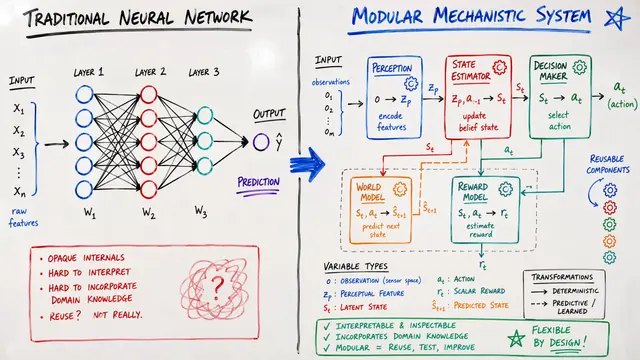
The mathematical machinery relies on category theory, where open games become morphisms that can be composed sequentially or in parallel. String diagrams provide both formal precision and intuitive visualization, showing exactly how information flows between strategic components.
This table captures the paradigm shift. Where traditional game theory offers no systematic way to combine games, the compositional framework provides formal operators that work like Lego bricks for strategic interactions, enabling economists to tackle previously intractable problems through modularity.
The authors demonstrate that their framework successfully captures familiar game types while offering unprecedented compositional flexibility. By aligning economic modeling with established computer science techniques, they open new pathways for tackling intricate strategic scenarios that were previously out of reach.
This is fundamentally theoretical work with important boundaries. The framework currently handles only pure strategies, and extending it to mixed strategies, repeated games, and incomplete information presents substantial challenges that remain open for future research.
This work represents a fundamental rethinking of how we model strategic behavior, importing proven compositional principles into economics. By making game theory modular, the authors provide tools for building and analyzing strategic systems at scales previously impossible, potentially transforming how economists approach complex real-world problems.
Compositional game theory offers a powerful new lens for understanding strategic interactions through the elegant principle of building complex systems from simple, composable parts. Visit EmergentMind.com to explore more cutting-edge research at the intersection of mathematics, computer science, and economics.