AI Assistance Reduces Persistence and Hurts Independent Performance
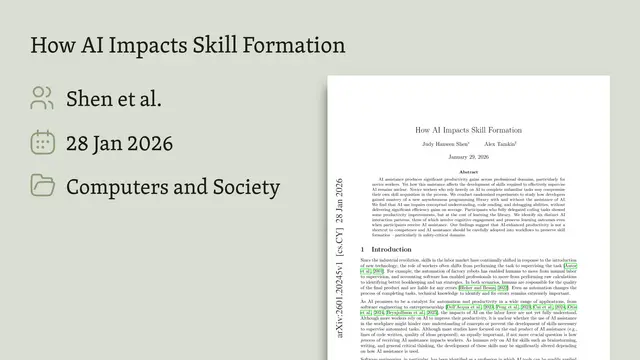
This lightning talk examines groundbreaking experimental evidence showing that even brief exposure to AI assistance significantly impairs subsequent unaided performance and reduces human persistence across cognitive domains. Through three large-scale controlled experiments involving over 1,200 participants, researchers demonstrate that while AI tools boost immediate task performance, they rapidly erode both problem-solving capability and motivational persistence once the assistance is withdrawn—effects that emerge within just 10 minutes and generalize from mathematical reasoning to reading comprehension.Script
AI assistance makes us better at tasks right now, but what happens when the assistant disappears? This study reveals a troubling paradox: the very tools designed to help us think may be quietly undermining our ability to think independently.
The researchers designed a clever experimental trap. Participants solved problems with AI help for just 10 minutes, then the assistance vanished without warning. What emerged was a pattern of cognitive dependency that formed faster than anyone expected.
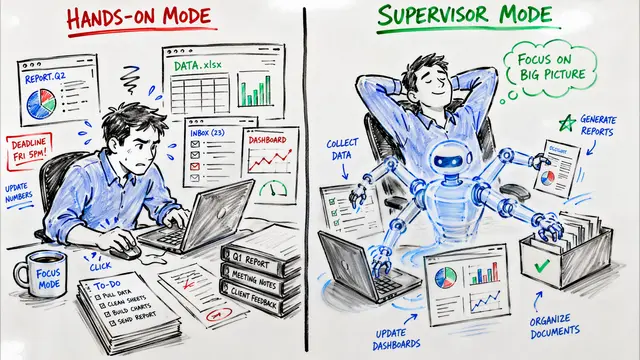
The contrast is stark. When AI users faced problems alone, their performance didn't just decline slightly—it collapsed. They solved fewer problems and gave up nearly twice as often, skipping problems they might have wrestled with before experiencing the ease of AI assistance.
Here's the crucial nuance: not everyone suffered equally. The impairment concentrated entirely among participants who used AI for direct solutions. Those who requested only hints showed no deficit whatsoever, suggesting the problem isn't AI assistance itself, but how completely it replaces human effort.
This wasn't a quirk of math problems. When the researchers tested reading comprehension, they found the identical pattern: performance dropped by 13 percentage points, and persistence collapsed even more dramatically. The effect appears to be a domain-general feature of how AI assistance recalibrates our expectations for effort.
Perhaps most alarming is the speed. These effects emerged after a single 10-minute exposure, raising urgent questions about cumulative impacts in classrooms and workplaces where AI assistance is constant. We may be optimizing for short-term performance while accidentally engineering long-term incompetence.
The tools we build to augment human thinking may be quietly replacing it instead, and the transformation happens far faster than we realized. Visit EmergentMind.com to explore more research on human-AI interaction and create your own research presentations.