How AI Agents Reshape Knowledge Work: Autonomy, Efficiency, and Scope
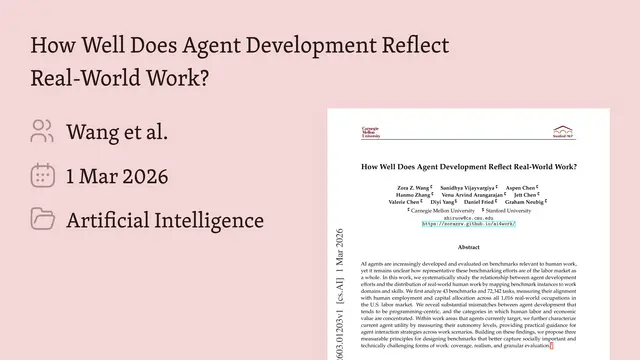
This presentation examines the empirical transition from conversational AI assistants to autonomous AI agents in knowledge work, using production data from Perplexity's Search and Computer platforms. We explore how agents fundamentally alter task selection, execution costs, and work scope through dramatic increases in autonomy, 87% reductions in completion time, 94% cost savings, and expansion into cross-occupational and cognitively complex tasks that were previously infeasible.Script
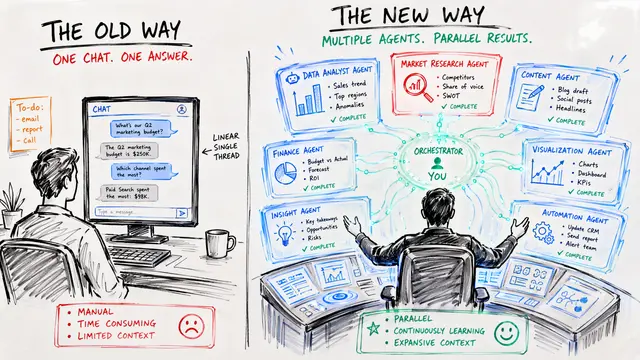
When you delegate a complex research task to an AI agent, the machine runs for 26 minutes while you wait 10. When you use a conversational assistant for the same task, you spend 4 hours orchestrating each step yourself. This 87 percent time reduction is not theoretical. It is happening right now in production knowledge work, and the authors of this study have the receipts.
Computer, Perplexity's general-purpose agent platform, saw cumulative query volume grow 84 times in just three months post-launch. Power users did not treat this as a novelty feature. They restructured their workflows around it, concentrating adoption in research, analysis, and document creation tasks that require deep autonomy and multi-step reasoning.
Matched user sessions reveal the mechanics of autonomy. For near-identical queries, Computer runs the machine for 26 minutes on average, while Search runs for 33 seconds. That is a 48 times increase in machine execution time per session, and the distributions barely overlap. The agent does not just answer faster. It takes over the entire workflow, executing tool calls, synthesizing outputs, and delivering near-complete artifacts without human orchestration.
The efficiency gains are staggering and consistent. Across 18 knowledge domains, the Computer plus Human regime cuts completion time by 87 percent and total cost by 94 percent, even though the agent itself incurs higher per-query inference costs. The savings come from substituting machine labor for human execution labor. Sensitivity analysis confirms these gains hold even when you stress-test the assumptions by inflating human oversight time 26 fold.
Agents do not just make existing work faster. They expand what users attempt. Computer queries are 9 percentage points more likely to address tasks outside the user's primary occupation, and this cross-boundary work is no longer concentrated in narrow technical lookup. Instead, it spans core professional domains like finance, legal, and healthcare, suggesting genuine occupational recomposition rather than shallow task spillover.
Along the vertical dimension of cognitive complexity, Computer queries concentrate at the Create level of Bloom's taxonomy, accounting for 50 percent of usage compared to 26 percent for Search. They are also nearly 3 times as likely to require expertise across three or more knowledge domains. The authors find that 23 percent of Computer queries engage fine-grained tasks essentially absent from Search logs, even among the same users. These are not incremental improvements. They are new tasks unlocked. If you want to see what that looks like in practice, visit EmergentMind dot com, where you can explore this paper further and create your own videos from the research you care about.