Nemotron-Labs-VisualCreation: Pixel as Code for Agentic Visual Creation
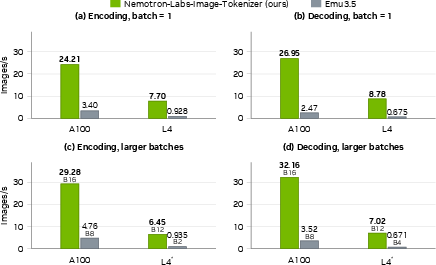
Abstract: Visual creation demands expressive imagery together with precise control over text, layout, and structure. We introduce Nemotron-Labs-VisualCreation, an agentic framework that connects these capabilities through Pixel as Code. Raster images are represented by learned discrete visual tokens, while structured artifacts use explicit programs. A shared generation-and-rendering interface connects these representations to visual feedback across images, vector graphics, webpages, and documents. A Nemotron-native harness coordinates planning and raster candidate selection, with targeted repair for editable structured and hybrid artifacts. To support this interface, we develop Nemotron-Labs-Image-Tokenizer, the autoregressive raster generator Nemotron-Labs-Image-30B-A3B, and the structured-code model family Nemotron-Labs-VisionCode. On approximately 178K images spanning six visual domains, our tokenizer improves reconstruction PSNR from 26.08 to 29.57 dB over Emu3.5 IBQ. It also provides 7.13x faster encoding and 10.93x faster decoding at batch size one on A100. In standalone evaluation, one Nemotron-Labs-VisionCode variant surpasses Kimi K3.1 Pro on the aggregate across Chart2Code, MMSVG, Design2Code, and Image2Struct. At the system level, the Nemotron-native configuration raises GenEval2 Soft-TIFA GM from 31.71 to 52.56 using the same raster generator. With our best setting, Nemotron-Labs-VisualCreation achieves performance competitive with GPT Image 2 and Nano Banana Pro across most benchmarks with available comparisons.





Paper Prompts
Sign up for free to create and run prompts on this paper.
Explain it Like I'm 14
1. What is this paper about?
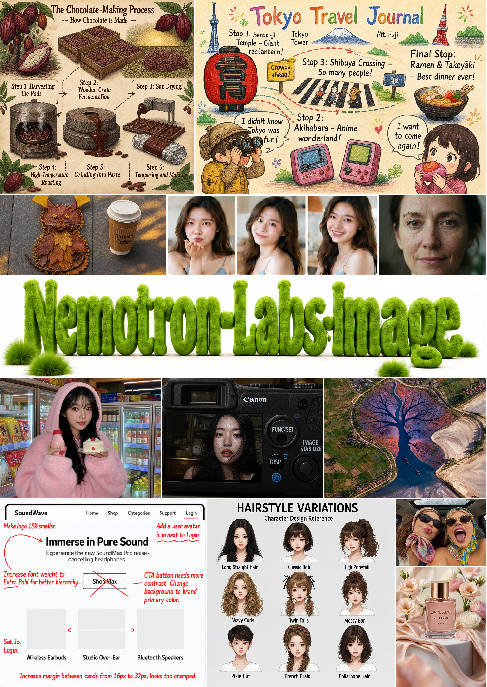
This paper introduces Nemotron-Labs-VisualCreation, an artificial intelligence system designed to create many kinds of visual content.
It can make:
- Ordinary images, such as portraits, landscapes, and product pictures
- Charts and diagrams
- Websites and mobile interfaces
- Presentation slides
- Scientific figures
- Documents
- Editable vector graphics
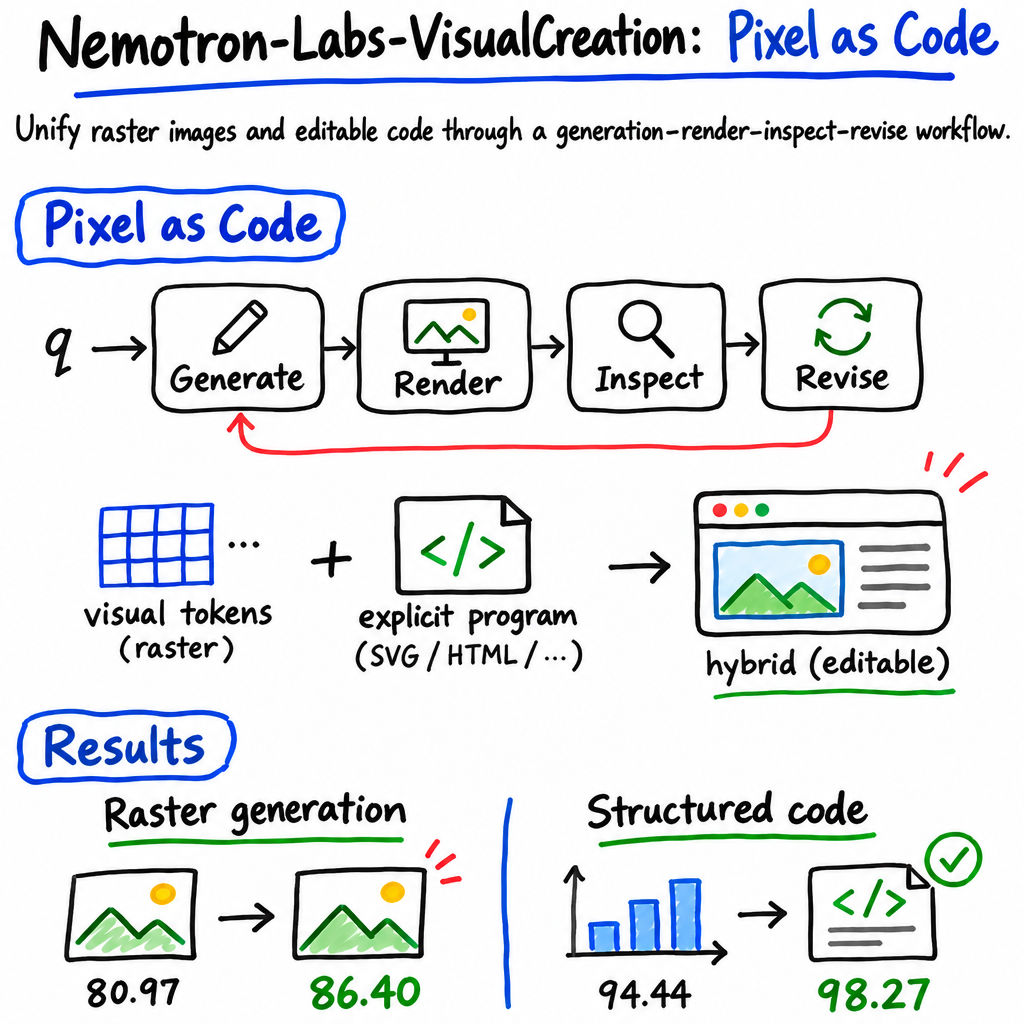
The main idea is called “Pixel as Code.” The researchers treat visual creations in two possible ways:
- As pixels, like a normal image file
- As code or structured instructions, such as HTML for a webpage or SVG for a diagram
This is useful because some images only need to look good, while other creations also need to contain exact text, organized layouts, and parts that people can edit later.
2. What questions are the researchers trying to answer?
The paper focuses on several main questions:
- Can one AI system create both normal images and editable designs?
- Can the system understand a request, make a plan, create a visual result, and check whether the result is correct?
- Can representing an image with special visual tokens make image generation faster and more accurate?
- Can AI-generated code create useful webpages, charts, diagrams, and documents?
- Can the system notice its own mistakes and repair them?
For example, if someone asks for a webpage about city populations, the system should not only make the page look attractive. It should also include the correct cities, numbers, labels, bars, and layout.
3. How does the system work?
The system follows a repeated process:
Plan → Generate → Render → Inspect → Repair if needed
This is similar to how a person might create a school project: first make a plan, then build it, look at the result, and fix mistakes.
Planning the request
First, another AI model studies the user’s request. It decides what kind of result is needed:
- A regular image
- A webpage
- A chart
- A document
- A presentation
- An editable drawing
It also decides how the result should be created and whether outside information or reference images are needed.
Creating ordinary images with visual tokens
For regular images, the system does not directly predict every individual pixel. Instead, it predicts discrete visual tokens.
A visual token is like a small piece of a picture, similar to a word in a sentence. A full image is represented as a long sequence of these pieces.
An image tokenizer changes an image into these tokens. A decoder then changes the tokens back into visible pixels.
A simple analogy is:
- A large picture is cut into special puzzle pieces.
- The AI learns how to describe the puzzle using those pieces.
- Later, it predicts a new sequence of pieces.
- The decoder puts them together to make a complete image.
The image generator creates several possible images. Another AI model looks at them and chooses the one that best matches the user’s request.
Creating editable designs with code
For webpages, charts, diagrams, and similar results, the system generates actual structured instructions, such as:
HTML/CSS/JavaScriptfor webpagesSVGfor vector drawings- Plotting code for charts
- Document or presentation markup
This is different from producing only a flat image. For example, an SVG drawing may store a circle as a circle, a line as a line, and text as editable text.
The generated instructions are sent to a renderer. A renderer is a tool that turns instructions into something visible:
- A browser renders webpage code.
- An SVG engine renders vector graphics.
- A document program renders a document.
- A plotting tool renders a chart.
The system then examines the rendered result. It can look for problems such as:
- Text covering an image
- Missing sections
- Incorrect spacing
- Objects outside the page
- Missing chart bars or labels
- Poor color contrast
- Broken interactions
When possible, it repairs only the part responsible for the problem instead of rebuilding everything.
Training the models
The researchers trained several components:
- Nemotron-Labs-Image-Tokenizer: changes images into visual tokens and back again
- Nemotron-Labs-Image-30B-A3B: generates raster images
- Nemotron-Labs-VisionCode: creates structured code for webpages, charts, SVGs, and other designs
The training used very large datasets, including:
- About 153 million images for the image tokenizer
- About 374 million text-and-image examples for image generation
- About 4.7 million examples for structured code generation
The researchers also used filtering systems to remove poor-quality, duplicated, or mismatched examples.
4. What did the researchers find?
The image tokenizer reconstructed images more accurately
The new tokenizer achieved a reconstruction score of 29.57 dB PSNR, compared with 26.08 dB for the older Emu3.5 IBQ tokenizer.
PSNR is a technical measurement of how closely a reconstructed image matches the original. A higher score generally means the reconstructed image has fewer visible differences.
In simple terms, the new system was better at turning an image into tokens and then rebuilding it.
The tokenizer was much faster
At batch size one on an NVIDIA A100 computer, the tokenizer was reported to be:
- 7.13 times faster at encoding
- 10.93 times faster at decoding
Encoding means turning an image into tokens. Decoding means turning tokens back into an image.
This matters because faster processing can make an AI system respond more quickly and handle more images.
The structured-code model performed strongly
One version of Nemotron-Labs-VisionCode achieved the best combined score among the models tested across several tasks, including:
- Creating charts from descriptions
- Creating SVG drawings
- Turning designs into webpages
- Converting images into structured representations
It performed better overall than Kimi K3.1 Pro in the comparison described by the paper, while using fewer total and active model parameters.
Planning and visual checking improved the full system
When the system used the Nemotron planning and visual-review setup, its score on the GenEval2 Soft-TIFA GM evaluation increased from 31.71 to 52.56, while using the same image generator.
This suggests that the planning and checking steps were important. The image generator itself was not the only factor determining quality.
The paper also reports an increase on the WISE Verified evaluation, from 46.30 to 88.60.
The system could repair some mistakes
The examples show the system correcting problems such as:
- Text overlapping an image
- A missing visual asset
- Poor organization of a webpage
- Missing chart bars
- Incorrect labels or legends
This is important because creating visual content is often not a one-step task. A useful system needs to recognize errors and improve its work.
Results were competitive with other advanced systems
With its best configuration, the system performed competitively with systems such as:
- GPT Image 2
- Nano Banana Pro
The paper says this was true across most benchmarks where comparisons were available.
5. Why are these results important?
Many image generators are good at making attractive pictures but may struggle with:
- Correct spelling
- Exact numbers
- Complex layouts
- Editable elements
- Webpage structure
- Charts and diagrams
This paper tries to solve that problem by combining two strengths:
- Visual generation for appearance, texture, and style
- Structured code for text, layout, geometry, and editing
For example, a generated poster could include a realistic background image made by the image model, while its title, boxes, and layout are stored as editable code.
The system’s checking and repair process could also make it more dependable. Instead of accepting the first answer, it reviews the result and attempts targeted fixes.
6. Possible impact of the research
If systems like this continue to improve, they could help people create:
- Websites without needing to write all the code themselves
- School presentations and posters
- Business advertisements
- Scientific diagrams
- Data visualizations
- Product designs
- Documents and reports
- Game or app interfaces
The biggest advantage is that the result does not always have to be a flat picture. Parts of it can remain editable, which makes it easier for a person to change the words, colors, sizes, or layout.
However, the system may still make mistakes. It can misunderstand a request, create inaccurate information, or produce code that looks correct but is not fully functional. People will still need to review important results, especially charts, scientific figures, and factual documents.
Overall, the paper presents a step toward AI systems that do more than generate pictures. They can plan a visual project, create it using images or code, inspect the result, and repair some of their own mistakes.
Practical Applications
Immediate Applications
- Rapid production of marketing and advertising assets — Marketing, media, and e-commerce. Organizations can use the raster-generation route to create product imagery, campaign concepts, social-media graphics, posters, illustrated infographics, and typography-rich advertisements from text prompts and reference images. The framework’s candidate-generation and visual-selection workflow can produce several alternatives and retain the one that best matches a campaign brief. Dependencies: human review remains necessary for brand compliance, factual claims, trademarks, safety, and image authenticity. Deployment also depends on access to suitable GPU infrastructure and on licensing of training data and generated assets.
- Automated creation of editable landing pages and web prototypes — Software, web development, and product design. A user can provide a product description, wireframe, or reference image and receive an HTML/CSS/JavaScript artifact rather than only a flattened screenshot. The layout contract, browser rendering, deterministic checks, visual audit, and targeted repair loop can identify and correct issues such as clipping, overlap, missing regions, poor hierarchy, or broken interactions. Dependencies: generated code must be sandboxed and security-tested before deployment. Browser compatibility, accessibility, responsive behavior, JavaScript correctness, and integration with existing APIs are not guaranteed by visual similarity alone.
- Design-to-code workflows for UI teams — User-interface engineering. Design teams can convert screenshots or visual mockups into editable web structures, then use visual comparison to refine the result. This can accelerate first-pass implementation, migration of legacy interfaces, and production of design variants. The system’s explicit separation of assets, layout, content, and code supports localized edits rather than regenerating an entire page. Dependencies: pixel-level resemblance does not ensure maintainable architecture, semantic HTML, accessibility, or adherence to a company’s component library. Integration with design-system metadata and testing frameworks would improve reliability.
- Chart and infographic generation — Business intelligence, journalism, and communications. Users can request charts, diagrams, and explanatory graphics from structured data or a natural-language specification. Plotting code, SVG, and other explicit representations can preserve editable labels, shapes, legends, and layout. The reported repair examples suggest practical support for recovering missing bars, values, labels, and legends after visual inspection. Dependencies: numerical correctness must be validated against the source dataset by deterministic software. The model should not be treated as the authority for financial, scientific, medical, or public-policy statistics.
- Creation of editable presentations and documents — Education, enterprise, and research communication. The native-format workflows can assist with slide decks, reports, scientific figures, tables, formulas, and document layouts. A workflow could generate a draft presentation from a brief, render each page, compare it with an acceptance checklist, and retain the strongest editable checkpoint. Dependencies: office-renderer compatibility, citation verification, accessibility, pagination, and exact preservation of equations and tables require specialized validation. Academic and regulated users need provenance tracking and human approval.
- Scientific visualization and figure preparation — Academia and research laboratories. Researchers can use visual-program generation for plotting code, SVG figures, formula transcription, table-to-LaTeX conversion, and diagram creation. Because the output is explicit code or markup, figures can be edited and regenerated when data or labels change. Dependencies: the generated visualization must be checked against the underlying data, statistical conventions, and journal formatting rules. Synthetic or inferred content must be clearly distinguished from measured results.
- Image editing and reference-conditioned creation — Creative tools and content production. The text-and-image-conditioned raster model can support iterative editing, multi-turn generation, style exploration, compositing, and creation from one or more visual references. The discrete tokenizer provides a compact interface for encoding references and decoding generated images. Dependencies: identity preservation, copyright, consent, watermark removal, and provenance are important operational constraints. Results may require manual retouching, especially for fine text, hands, logos, and exact object geometry.
- Visual quality assurance for generated artifacts — Software testing and content operations.
The
generate → render → inspect → repairpattern can be deployed as a review layer for webpages, dashboards, SVGs, slides, and other visual outputs. Deterministic renderer checks can catch execution failures, missing elements, out-of-bounds geometry, overlap, and clipping, while a multimodal judge can compare the rendered result with a fixed checklist. Dependencies: visual judges can miss subtle semantic, security, or accessibility defects. Stable selectors, reproducible rendering environments, and calibrated confidence thresholds are required for safe automated repair. - Internal design automation and prototyping — Enterprises and startups. Product teams can build an internal assistant that converts a product brief into a storyboard, visual assets, a web prototype, and editable presentation materials. The route-selection mechanism can decide whether a request is best represented as a raster image, SVG, browser artifact, or native document. Dependencies: organizations need private deployment or data-isolation controls for confidential product information. Consistent brand assets, approved fonts, design tokens, and retrieval systems would be needed for production-quality output.
- Education and everyday visual communication — Schools, teachers, and individuals. Teachers and students can generate classroom diagrams, visual explanations, posters, study guides, simple websites, and presentation drafts. Editable outputs are particularly useful for correcting terminology, changing language, adapting layouts, or adding local examples. Dependencies: educational users need fact-checking, age-appropriate content controls, accessibility support, and disclosure that materials were AI-assisted. Generated diagrams should not replace expert review in technical subjects.
Long-Term Applications
- End-to-end multimodal creative-production platforms — Creative software and digital media. A mature version could combine prompt understanding, asset retrieval, raster generation, vector layout, web composition, document authoring, and iterative visual review in one production environment. Pixel as Code provides a general abstraction for switching among learned visual tokens, SVG, HTML/CSS, and document representations while preserving a rendered preview. Dependencies: this requires robust interoperability, persistent artifact state, version control, deterministic rendering, professional editing controls, and stronger guarantees about exact text and geometry. The benchmark results demonstrate promise but do not establish reliability across all professional workflows.
- Autonomous campaign and content operations — Advertising, publishing, and e-commerce. With stronger brand and factual controls, an agent could generate product pages, promotional images, email layouts, localized campaigns, social variants, and accompanying charts from a structured campaign brief. The repair loop could automatically correct layout and asset problems across many output formats. Dependencies: brand governance, legal review, content provenance, localization quality, and protection against misleading product claims are essential. Scaling candidate generation and multimodal review may be computationally expensive.
- Personalized and adaptive educational materials — Education and training. The system could generate individualized diagrams, interactive lessons, accessible slide decks, and visual explanations adjusted to a learner’s level, language, or disability. Structured representations could support dynamic updates rather than static image generation. Dependencies: pedagogical validation, curriculum alignment, privacy protection, bias evaluation, and reliable factual grounding are required. Educational effectiveness cannot be inferred solely from visual-quality benchmarks.
- Clinical and public-health communication — Healthcare. After domain-specific validation, the framework could produce patient-facing diagrams, medication instructions, procedure illustrations, appointment materials, and editable public-health infographics. Structured layouts would make it possible to update dosage-independent text, translations, and accessibility features without recreating all visual assets. Dependencies: clinical approval, medical factuality, regulatory compliance, readability testing, multilingual validation, and strict separation between communication support and medical decision-making are necessary. The paper does not report medical-domain evaluation.
- Engineering, CAD, and robotics interfaces — Engineering, robotics, and manufacturing. The structured-code approach could evolve toward generating editable engineering diagrams, robot-task interfaces, simulation scenes, assembly instructions, and CAD-adjacent representations. A renderer-grounded repair loop could inspect spatial relationships and revise layouts or component assignments. Dependencies: visual correctness is insufficient for physical safety, geometric tolerances, kinematic validity, or manufacturability. Integration with CAD kernels, simulation environments, robotics middleware, and formal constraint solvers would be required.
- Interactive dashboards and decision-support systems — Finance, operations, and government. A future system could transform natural-language questions and validated datasets into editable dashboards containing charts, explanatory text, filters, and responsive layouts. The model could generate the presentation layer while deterministic data pipelines guarantee numerical values. Dependencies: strict separation is needed between data computation and visual generation. Audit logs, access controls, reproducibility, explainability, and protection against misleading chart choices are essential in financial and public-sector settings.
- Accessibility-aware document and interface transformation — Government, enterprise, and assistive technology. Structured generation could convert visual documents into semantically organized HTML, accessible SVG, tagged presentations, or alternative visual formats. A future audit could evaluate contrast, typography, reading order, keyboard navigation, and screen-reader structure in addition to appearance. Dependencies: the current framework emphasizes visual inspection and does not by itself guarantee semantic accessibility. Accessibility standards, assistive-technology testing, and expert-designed validators must be integrated.
- Long-lived editable visual agents — Personal productivity and knowledge work. An agent could maintain a presentation, report, website, or visual knowledge base over time, changing only affected assets or regions when new information arrives. Checkpoint retention and causal repair provide an initial foundation for preserving unaffected content and reverting undesirable changes. Dependencies: reliable memory, provenance, version control, conflict resolution, permissions, and robust change-impact analysis are needed. Long-running agents must avoid silently propagating outdated or incorrect information.
- Simulation and synthetic-data generation — Robotics, autonomous systems, and computer vision. The raster generator and structured artifact routes could produce varied visual scenes, diagrams, interfaces, or environmental assets for training and testing perception systems. Discrete visual tokens may also offer a compact representation for large-scale generation pipelines. Dependencies: synthetic data must be validated for realism, diversity, domain coverage, and absence of systematic artifacts. Transfer to real-world environments is not established by the paper’s image-generation benchmarks.
- Standardized visual intermediate representations — Software infrastructure and AI tooling. Pixel as Code could motivate a common orchestration layer in which agents select among raster tokens, SVG, HTML/CSS, plotting code, and document markup, render each through a backend, and expose the result to automated inspection. Such an interface could support plug-in generators, renderers, validators, and repair tools from different vendors. Dependencies: standard schemas for artifact state, layout contracts, asset manifests, renderer outputs, audit findings, and confidence scores would need to be defined. Cross-renderer determinism and interoperability remain substantial engineering challenges.
- Policy, compliance, and provenance workflows for generated media — Public policy and regulated industries. Organizations could use the structured representation and checkpoint history to record prompts, references, model versions, source assets, rendered outputs, repairs, and human approvals. This would support internal audits and emerging requirements for AI disclosure and media provenance. Dependencies: provenance metadata must be tamper-resistant and preserved through common editing and publishing pipelines. Legal rules concerning copyright, training data, likeness, disclosure, and responsibility for generated content remain jurisdiction-dependent and evolving.
- General-purpose visual software agents — Cross-sector automation. The broader long-term vision is an agent that can interpret a request, select a representation, call retrieval and generation tools, render an artifact, inspect it, assign defects to causal owners, and iteratively improve the result. This could automate portions of design, documentation, analysis, and communication across many sectors. Dependencies: the paper’s reported gains show the value of coordinated planning and visual selection, but autonomous operation still depends on better factual grounding, tool reliability, security isolation, calibrated evaluation, and domain-specific acceptance tests. Human oversight will remain necessary for high-impact or irreversible actions.
Glossary
- Adversarial learning: A training approach in which a model improves by competing against another model or objective designed to detect unrealistic outputs. “Training spans 670K steps and combines pixel reconstruction, perceptual supervision, feature distillation, and adversarial learning.”
- Agentic framework: A system in which an AI agent plans, uses tools, evaluates results, and iteratively modifies its outputs. “We introduce Nemotron-Labs-VisualCreation, an agentic framework that connects these capabilities through Pixel as Code.”
- Autoregressive generation: Sequential generation in which each token is predicted based on previously generated tokens. “Nemotron-Labs-Image-30B-A3B serves as the raster image generator: it autoregressively predicts discrete visual tokens”
- Causal owner: The component or layer judged responsible for producing a detected error. “Nemotron-3.5-Super-VL evaluates the visible artifact and proposes a diagnosis code, causal evidence, a confidence score, and an owner within the rendered structure.”
- Codebook: A finite collection of vectors or discrete codes used to represent continuous data such as image features. “Its codebook contains 196,560 normalized Leech-lattice vectors and remains fixed during training.”
- Codebook quantization: The process of mapping continuous feature vectors to entries in a finite codebook. “This separation between discrete representation learning and generation builds on vector-quantized autoencoders”
- Continuous visual representation: A real-valued feature representation of visual information, as opposed to a discrete token sequence. “HART~\citep{tang2025hart} further studies hybrid discrete and continuous visual representations.”
- Discrete visual tokens: Individual symbolic codes that compactly represent visual information. “Raster images are represented by learned discrete visual tokens, while structured artifacts use explicit programs.”
- Distillation: Training a model to reproduce useful behavior or representations learned by another model. “Training spans 670K steps and combines pixel reconstruction, perceptual supervision, feature distillation, and adversarial learning.”
- Dual Coder: A paired-model system in which two models independently generate or revise the same structured artifact. “For browser-based artifacts, the Nemotron-native configuration assigns code generation to a Dual Coder composed of Nemotron 3 Ultra and Nemotron-3.5-Super-VL.”
- Embedding: A numerical vector representation used to encode an object, token, or feature in a learned space. “The tokenizer uses patches and 24-dimensional quantized embeddings with L2 normalization.”
- Feature distillation: The transfer of internal feature representations from a teacher model or representation into a student model. “Section~\ref{sec:tokenizer_training} details the reconstruction, perceptual, distillation, and adversarial objectives.”
- Frozen checkpoint: A saved model or artifact state that is retained and not modified during a later process. “The browser-based workflow freezes the request checklist and resolved layout contract.”
- Hybrid artifact: An editable structured artifact that incorporates one or more generated raster images. “A hybrid route additionally embeds one or more generated raster assets within a structured artifact while preserving text, shapes, layout, and interactions in an editable representation.”
- Leech lattice: A highly structured mathematical lattice used here as a fixed set of image-representation vectors. “The dedicated image tokenizer, Nemotron-Labs-Image-Tokenizer, has approximately 642M parameters and uses a fixed Leech-lattice codebook”
- L2 normalization: Scaling a vector so that its Euclidean norm has a specified value, commonly one. “The tokenizer uses patches and 24-dimensional quantized embeddings with L2 normalization.”
- Layout contract: A formal specification of an artifact’s regions, geometry, ownership, and rendering requirements. “For structured and hybrid routes, this plan is resolved into a layout contract that specifies the layout mode, ordered regions, normalized bounds, component ownership, and rendering constraints.”
- Multimodal coding: Code generation or understanding that uses multiple modalities, such as text, images, and rendered visual outputs. “The multimodal-coding component generates representations with explicit content and structure”
- Multimodal review: Evaluation that combines visual information with language or other modalities. “For browser-based artifacts, the audit combines deterministic renderer evidence with a multimodal review against the frozen request and acceptance checklist.”
- Multistage mid-training: Continued model training conducted across multiple stages, often with progressively changed data or resolution regimes. “We adapt Nemotron 3 Nano into the autoregressive generator Nemotron-Labs-Image-30B-A3B through multistage mid-training and reinforcement learning”
- Mixture-of-Experts (MoE): A neural architecture that activates only selected expert subnetworks for each input. “The generator is initialized from Nemotron 3 Nano 30B-A3B and retains its hybrid Mamba2--Transformer MoE architecture”
- Normalized bounds: Coordinate limits represented in a standardized scale rather than raw pixels. “For structured and hybrid routes, this plan is resolved into a layout contract that specifies the layout mode, ordered regions, normalized bounds, component ownership, and rendering constraints.”
- Perceptual supervision: Training guidance based on similarity in learned perceptual features rather than only pixel-by-pixel error. “Training spans 670K steps and combines pixel reconstruction, perceptual supervision, feature distillation, and adversarial learning.”
- Pixel reconstruction: Reproducing an image’s pixel values from a compressed or encoded representation. “Training spans 670K steps and combines pixel reconstruction, perceptual supervision, feature distillation, and adversarial learning.”
- Raster image: An image represented as a grid of individual pixels. “Learned visual tokens capture raster appearance and are decoded into pixels.”
- Reinforcement learning: A training paradigm in which a model improves through reward signals associated with its actions or outputs. “Section~\ref{sec:bitmap_training} describes its multistage mid-training and reinforcement learning.”
- Renderer: A program or model that converts an abstract representation into a visible image or visual output. “A shared generation-and-rendering interface connects these representations to visual feedback across images, vector graphics, webpages, and documents.”
- Root-cause tree: A hierarchical organization of observed failures according to their underlying causes. “Findings associated with the same causal owner are grouped into a root-cause tree, allowing the harness to repair a shared cause while freezing unaffected pages or regions.”
- Semantic planning: High-level planning that translates a user request into intended content, structure, and actions. “Its harness coordinates semantic planning, raster generation, and visual selection.”
- Soft-TIFA GM: A reported evaluation metric based on the Soft-TIFA benchmark, with GM indicating the geometric mean aggregation of scores. “At the system level, the Nemotron-native configuration raises GenEval2 Soft-TIFA GM from 31.71 to 52.56”
- Structured artifact: A digitally editable output represented by explicit code, markup, or document objects rather than only pixels. “Structured and hybrid requests additionally establish a layout contract and produce editable representations.”
- Structured representation: An explicit, editable encoding of content, geometry, and layout. “Because the source representation remains accessible, localized edits can be applied after visual inspection.”
- Targeted repair: A localized modification directed at a diagnosed component or cause rather than regeneration of the entire artifact. “A shared generation-and-rendering interface connects these representations to visual feedback across images, vector graphics, webpages, and documents.”
- Text-and-image-conditioned generation (TI2I): Generation conditioned jointly on textual input and one or more images. “Training includes text-to-image generation and text-and-image-conditioned generation (TI2I) with flexible aspect ratios.”
- Tokenizer decoder: The decoding component that converts discrete tokens back into a visual image. “Its decoder is the learned image renderer that converts predicted tokens back to pixels.”
- Vector-quantized autoencoder: An autoencoder whose latent representations are discretized using a learned or fixed codebook. “This separation between discrete representation learning and generation builds on vector-quantized autoencoders”
- Vector graphics: Graphics described through geometric primitives and paths rather than fixed pixel grids. “Structured artifacts use explicit code or native document representations, while hybrid artifacts additionally request raster assets”
- Visual-token sequence: An ordered sequence of discrete tokens encoding visual content. “Given text and optional source or reference images, it predicts a discrete visual-token sequence that the tokenizer decoder renders into a raster image.”
- Vision transformer: A transformer architecture adapted to process image patches as tokens. “The encoder and decoder follow a vision-transformer design”
- Visual audit: A systematic inspection of a rendered artifact to identify visual, structural, or execution failures. “For browser-based artifacts, the audit combines deterministic renderer evidence with a multimodal review against the frozen request and acceptance checklist.”

