Speculative Self-Distillation enables Efficient Knowledge Internalization
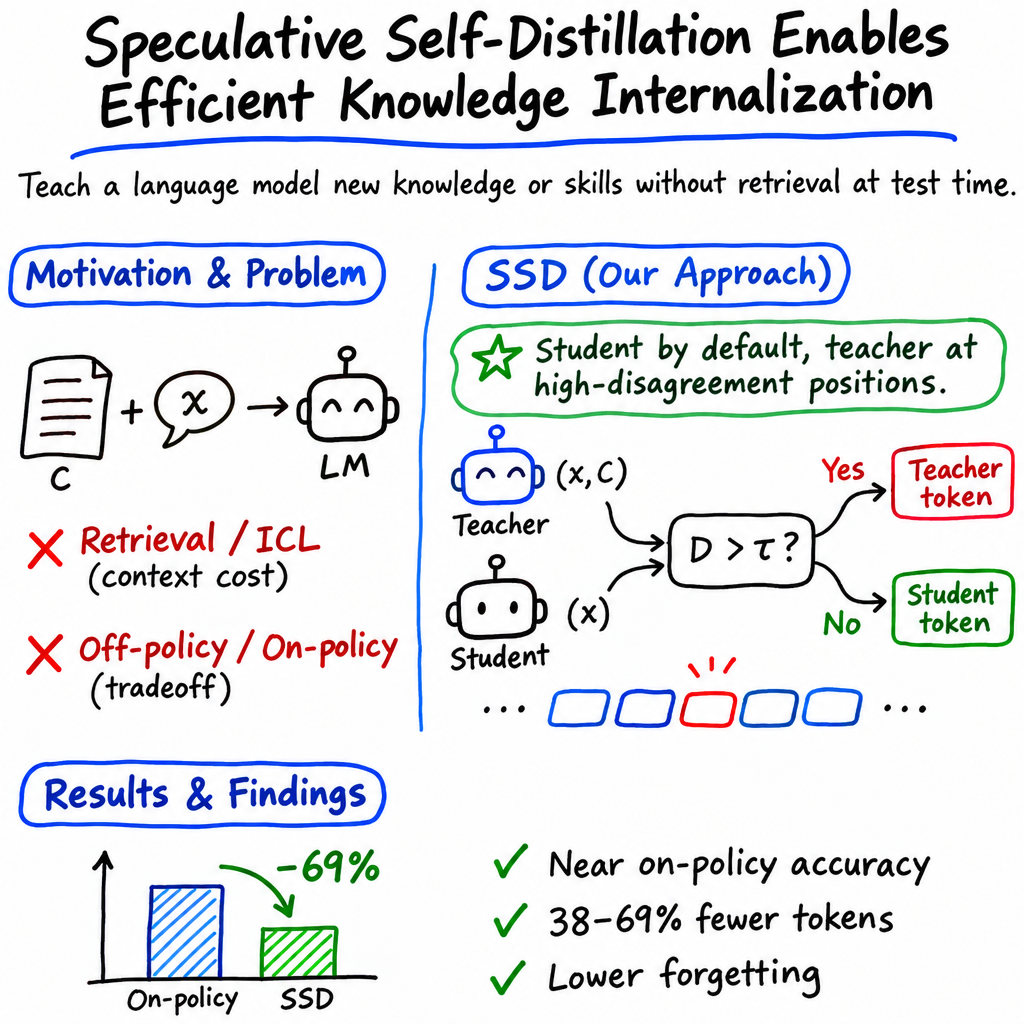
Abstract: Many real-world applications require LLMs to internalize knowledge that was absent from pretraining, to incorporate continually updated facts, or to learn new domain skills. Self-distillation has emerged as a natural approach for this task. A model conditioned on the source material acts as the teacher, and an unconditioned student is trained to reproduce the teacher's behavior closed-book. We propose Speculative Self-Distillation (SSD), an efficient per-token mixed-policy method for self-distillation. The student generates each rollout by default, while the teacher intervenes only at positions where its next-token distribution substantially diverges from the student's. Unlike off-policy distillation with teacher-generated prefixes, this design keeps training rollouts close to the student's test-time behavior, while avoiding the low-signal states that fully on-policy rollouts drift into. In effect, SSD lets the teacher steer the rollout exactly where the privileged context changes the prediction. On three closed-book QA benchmarks measuring fact recall, knowledge updates, and skill acquisition, SSD nearly matches on-policy distillation while using 38-69% fewer supervised tokens and consistently outperforms off-policy distillation on the held-out test set. On a forgetting stress test, SSD retains the most general capability while also achieving the best in-domain accuracy and using less supervision than the on-policy baseline. Overall, SSD establishes a new accuracy-efficiency-forgetting Pareto frontier for self-distillation.

Paper Prompts
Sign up for free to create and run prompts on this paper.
Explain it Like I'm 14
1. What is this paper about?
This paper introduces a new way to teach LLMs new information more efficiently. The method is called Speculative Self-Distillation, or SSD.
Imagine a student learning from a teacher:
- The teacher can see helpful information, such as a document or an answer.
- The student cannot see that information and must learn to answer on its own.
- During training, the student learns by copying the teacher’s useful behavior.
The goal is for the student to remember the new information inside its own “memory”—the model’s weights—so it can answer questions later without being shown the original document.
2. What questions did the researchers ask?
The researchers focused on a problem with two older teaching methods:
- Off-policy learning: The teacher writes the whole answer, and the student learns from it. This gives strong examples, but the student may not learn what to do when it makes its own choices.
- On-policy learning: The student writes the answer, and the teacher corrects it. This better matches how the student behaves during testing, but much of the teacher’s advice may be unnecessary or weak.
The paper asks:
- Can the model get the strong teaching signal from the teacher without copying the teacher all the time?
- Can training stay close to the student’s normal behavior?
- Can the model learn new facts using fewer training tokens?
- Can this method reduce forgetting, where learning something new causes the model to lose older abilities?
3. How does the method work?
The basic idea
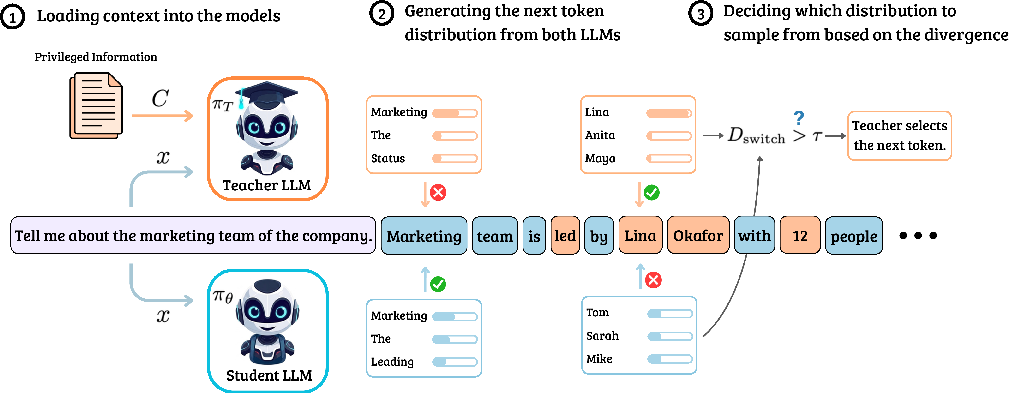
SSD lets the student generate most of the answer. However, the teacher watches the student’s next-word predictions.
If the teacher and student strongly disagree about what word should come next, the teacher takes control for that word.
For example:
- The student sees the question: “Who leads the marketing team?”
- Without the helpful document, it may begin giving a general explanation of marketing.
- The teacher has the document and knows the names of the team leaders.
- When the teacher notices that its prediction is very different from the student’s prediction, it supplies the next word or token.
This important disagreement is called an inflection point. It is a moment where the extra information available to the teacher really matters.
An everyday analogy
Suppose a student is writing a report with help from an expert.
- The student writes most sentences independently.
- The expert stays quiet when the student is doing fine.
- If the student reaches an important fact they do not know, the expert gives a correction.
- The student continues writing after that correction.
This is more efficient than having the expert write the entire report. It is also more helpful than waiting until the end to correct the student.
Technical terms in simple language
A token is a small piece of text, such as a word or part of a word.
A rollout is the sequence of tokens produced while the model writes an answer.
A distribution describes how likely the model thinks different next tokens are. For example, it might think:
| Possible next word | Student’s belief | Teacher’s belief |
|---|---|---|
| “leader” | 10% | 70% |
| “department” | 50% | 15% |
| “company” | 30% | 5% |
A divergence is a measure of how different these two sets of guesses are. If the difference is larger than a chosen threshold, SSD lets the teacher generate the next token.
The threshold acts like a control knob:
- A low threshold means the teacher steps in often.
- A high threshold means the student works mostly alone.
- With a very low threshold, SSD becomes similar to teacher-generated training.
- With a very high threshold, SSD becomes similar to student-generated training.
Importantly, the teacher still checks the student’s answer at every position. The difference is only who produces the next token.
4. What experiments did the researchers run?
The researchers tested SSD on three types of tasks:
- Company Memo: Learning information from a private fictional company document.
- Wikipedia: Learning about newer events that were not included in the model’s original training.
- Science questions: Learning chemistry knowledge and answering undergraduate-level questions.
They compared SSD with the two main alternatives:
- Off-policy distillation: The teacher generates the training answers.
- On-policy distillation: The student generates the answers, while the teacher gives advice throughout.
They also tested whether the model forgot its older skills after learning chemistry. To measure this, they evaluated it on several general tasks, including reading comprehension, coding, truthfulness, and reasoning.
5. What were the main results?
SSD learned almost as accurately as the best baseline
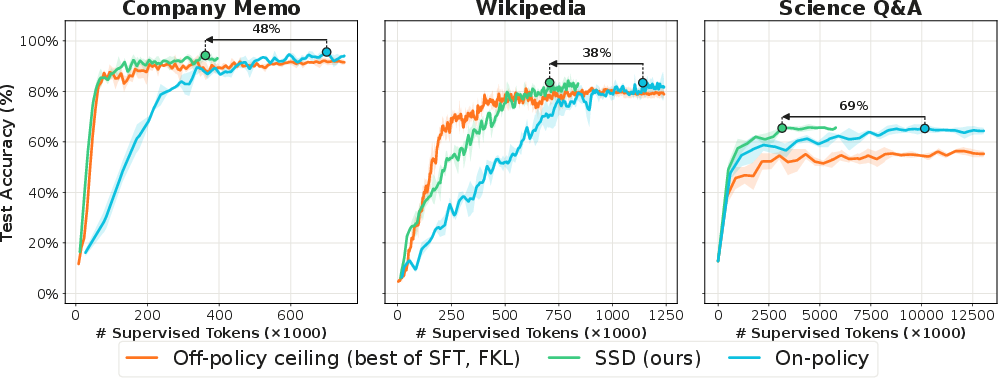
SSD nearly matched the accuracy of on-policy training on all three tasks.
Compared with on-policy training, SSD used:
- 48% fewer supervised tokens on the Company Memo task
- 38% fewer tokens on Wikipedia
- 69% fewer tokens on Science questions
A supervised token is a token for which the model receives a training signal from the teacher.
On the Science questions, SSD sometimes performed better than on-policy learning:
- On-policy accuracy: about 64.6%
- SSD accuracy: about 66.3%
The researchers also tested different model sizes. SSD used 23% to 55% fewer tokens than on-policy learning while reaching at least the same accuracy.
SSD trained faster
Because SSD needed fewer supervised tokens, it also reached its target accuracy more quickly.
On the Science task:
- On-policy training took about 414 minutes to reach its accuracy level.
- SSD took about 130 minutes.
That is about a 69% reduction in training time in that experiment.
SSD caused less forgetting
When the model learned chemistry, the other methods caused it to lose some of its older abilities.
The average performance drop was approximately:
- Off-policy training: 6.6 points
- On-policy training: 4.5 points
- SSD: 1.4 points
At the same time, SSD achieved the highest chemistry score in this test.
This is important because training a model on new information can sometimes damage knowledge it already had. SSD appeared to learn the new material while protecting more of the model’s older abilities.
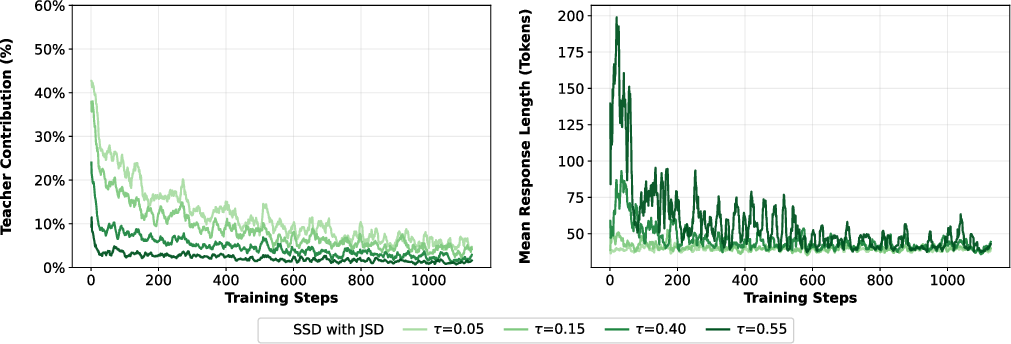
The teacher naturally became less necessary
At the beginning of training, the teacher often had to step in because the student knew little about the new information.
As training continued, the student improved. The teacher then needed to intervene less often:
- Early in training, the teacher generated as much as about 43% of the tokens.
- Near the end, the teacher generated only about 1% to 5%.
This suggests that SSD automatically adjusts as the student becomes better, without needing a human to create a special teaching schedule.
6. Why are these findings important?
The paper shows that teaching a LLM does not always require the teacher to generate an entire answer or supervise every step in the same way.
The most useful teaching often happens at a few key moments—especially when the student is about to make an important mistake or miss an important fact. SSD focuses the teacher’s effort on those moments.
This gives SSD a useful balance:
- It is more accurate than simply copying teacher-written answers.
- It is more efficient than having the teacher supervise every student-generated step.
- It stays closer to the student’s normal behavior.
- It may reduce the loss of older abilities.
7. Possible impact and limitations
SSD could make it cheaper and faster to update LLMs with:
- New facts
- Private company information
- New scientific knowledge
- Specialized skills
- Changing information that was not available during pretraining
Instead of repeatedly giving a model a document in every prompt, developers might train the information into the model so it can use it later without the document.
However, the research has some limits. The experiments mainly used short closed-book question-answering tasks. The authors do not yet know whether SSD will work as well for:
- Long, complicated reasoning
- Very long answers
- Tasks requiring many connected decisions
- Situations where the model needs to think carefully for a long time
Conclusion
Speculative Self-Distillation is a teaching strategy in which a LLM learns mostly by working on its own, while a knowledgeable teacher steps in only when the student’s prediction is far from the teacher’s prediction.
The experiments suggest that this approach can help models learn new information almost as accurately as slower methods, while using fewer training tokens, training faster, and forgetting less old knowledge. It could therefore become a practical way to update LLMs efficiently.
Practical Applications
Immediate Applications
- Efficient domain adaptation for enterprise LLMs — Industry, software
- Organizations can use SSD to internalize private documents, policies, product specifications, operating procedures, or internal terminology into a model’s parameters rather than supplying the documents at every inference request.
- A practical workflow would pair a context-conditioned teacher with a context-free student, compute the teacher–student divergence at each token, and allow the teacher to generate only at high-disagreement positions.
- Potential products include internal knowledge assistants, customer-support models, sales-enablement tools, and code assistants specialized to proprietary repositories.
- The reported results suggest approximately 38–69% fewer supervised tokens than on-policy distillation while remaining close to its accuracy, reducing adaptation cost.
- Dependencies and assumptions: the organization must possess reliable source documents and high-quality question–answer or instruction–context pairs. The method also assumes that the teacher’s privileged context is accurate and that the student can generalize from the training distribution to future queries. Sensitive information may become embedded in model weights, creating privacy, deletion, and access-control risks.
- Rapid incorporation of changing facts — Industry, journalism, public-sector information
- SSD can be used to update a model with information that was unavailable during pretraining, such as new regulations, product releases, disaster events, scientific findings, or organizational changes.
- A periodic update pipeline could distill newly curated documents into a deployment model, reducing dependence on retrieval for frequently requested facts.
- This is especially relevant for customer-service systems, regulatory-compliance assistants, news-analysis tools, and government information services.
- Dependencies and assumptions: the method does not by itself guarantee factual verification, temporal consistency, or reliable removal of obsolete facts. Updates should be accompanied by versioning, regression tests, provenance tracking, and potentially retrieval-based safeguards for high-stakes information.
- Lower-cost scientific and technical specialization — Healthcare, science, engineering
- Research institutions and companies can apply SSD to specialize general-purpose models in fields such as chemistry, medicine, engineering, or law using domain texts and expert-generated questions.
- A possible workflow is to use a context-rich expert model or prompt as the teacher, then train a smaller closed-book model for local deployment where low latency, offline operation, or limited context windows are important.
- The chemistry experiments indicate that SSD can acquire domain-specific performance while preserving more general capability than the evaluated alternatives.
- Dependencies and assumptions: the paper evaluates relatively short, structured QA tasks rather than clinical decision-making or unrestricted scientific reasoning. Expert review, domain-specific validation, and strict human oversight remain necessary before deployment in safety-critical settings.
- Compute-efficient model training and retraining — AI infrastructure
- SSD can reduce the number of supervised tokens and potentially shorten end-to-end training when models are repeatedly adapted to new domains.
- Training platforms could expose the switching threshold as a cost–quality control: lower thresholds favor more teacher intervention and efficiency, while higher thresholds favor student-generated trajectories and closer alignment with test-time behavior.
- The paper reports a roughly 69% reduction in training time in one Science QA comparison when SSD was implemented with concurrent teacher–student decoding.
- Dependencies and assumptions: wall-clock benefits require an optimized inference engine capable of concurrent execution. A naive implementation may incur teacher forward-pass costs at every token and eliminate much of the gain. GPU memory, communication overhead, batching, and teacher–student model placement are important engineering constraints.
- Continual learning with reduced catastrophic forgetting — Industry, academia
- SSD can serve as a safer fine-tuning procedure when a deployed model must acquire new capabilities without substantially degrading existing ones.
- Potential applications include updating coding models with a new programming framework, adding new compliance rules to an enterprise assistant, or adapting a general model to a specialist domain.
- In the reported forgetting stress test, SSD achieved the best in-domain accuracy and reduced the average general-capability decline relative to both off-policy and on-policy baselines.
- Dependencies and assumptions: the forgetting result is based on one model family and a chemistry adaptation task. Production systems should evaluate broad capability retention, bias, calibration, safety behavior, and performance on previously supported languages and tasks.
- Closed-book or low-connectivity assistants — Education, field operations, consumer software
- SSD can help produce models that answer domain-specific questions without repeatedly retrieving documents, which is useful for offline or bandwidth-constrained environments.
- Examples include educational tutoring applications, field-service manuals on remote devices, industrial maintenance assistants, and local-language knowledge tools.
- Reduced reliance on retrieval can lower per-query latency and context-window usage.
- Dependencies and assumptions: closed-book internalization increases the risk of stale or hallucinated information. The approach is most suitable where the knowledge base is relatively stable or where the model can clearly indicate its update date and uncertainty.
- Adaptive training diagnostics — Academia and model-development teams
- The teacher–student divergence can be used as a diagnostic for identifying where a model lacks knowledge or where a document materially changes its prediction.
- Developers could visualize high-divergence tokens, prioritize them for annotation, construct targeted evaluation sets, or identify portions of documents that are most valuable for training.
- This could support uncertainty-aware data curation and document-question selection rather than uniform distillation.
- Dependencies and assumptions: divergence measures disagreement, not necessarily error. High disagreement may reflect ambiguity, stylistic differences, prompt artifacts, or teacher mistakes; it should therefore be combined with factual evaluation and expert review.
- Reduced context and inference costs in everyday AI tools — Daily life, productivity software
- A user-facing assistant could learn recurring personal preferences, household procedures, work terminology, or course material through controlled distillation rather than receiving the same information in every prompt.
- Potential tools include personal study assistants, document-based note systems, email and scheduling assistants, and local productivity models.
- Dependencies and assumptions: personal-data distillation raises substantial privacy and consent issues. Users need mechanisms to inspect, correct, update, and delete internalized knowledge; otherwise erroneous or sensitive information may persist in the model.
Long-Term Applications
- Efficient long-horizon reasoning and planning — Robotics, agents, software engineering
- SSD could eventually be applied to multi-step planning, tool use, code generation, robotics policies, and extended reasoning by allowing teacher intervention only at critical decision points.
- In a robotics setting, a privileged teacher might access a simulator state, expert trajectory, map, or task specification, while the student learns to act from the observations available at deployment.
- In software engineering, the teacher could inspect a full repository or test suite while the student learns to generate code with limited context.
- Dependencies and assumptions: the paper explicitly leaves long-horizon reasoning underexplored. Token-level teacher intervention may disrupt uncertainty needed for exploration, and divergence at one step may have consequences many steps later. Safety constraints, credit assignment, temporal abstraction, and trajectory-level evaluation require further research.
- Teacher-guided autonomous agents — Robotics and enterprise automation
- An agent could operate primarily under its own policy while invoking a stronger, context-rich teacher only when its action distribution diverges substantially from an expert or privileged planning model.
- This could reduce calls to expensive frontier models in customer-service workflows, browser agents, logistics systems, or robotic control.
- A future product might implement SSD-like escalation: routine actions remain local and inexpensive, while ambiguous or high-impact decisions are routed to a stronger model.
- Dependencies and assumptions: language-token divergence does not directly translate to action risk. Real systems need calibrated intervention criteria that account for consequences, reversibility, uncertainty, and safety—not only distributional disagreement.
- Privacy-preserving local specialization — Healthcare, legal services, finance
- Institutions could distill sensitive records, case law, financial procedures, or patient-facing information into locally hosted models, reducing the need to transmit confidential context to an external inference provider.
- This could enable on-premise clinical documentation assistants, legal research tools, banking operations assistants, and secure enterprise copilots.
- Dependencies and assumptions: internalizing data into weights is not equivalent to anonymization. Memorization, extraction, model inversion, auditability, and right-to-erasure requirements must be addressed. Regulatory approval and formal privacy guarantees may be necessary.
- Policy and regulatory knowledge maintenance — Government and compliance
- Public agencies and regulated firms could use SSD to update specialized models as statutes, guidance, standards, or internal procedures change.
- A potential workflow would combine document validation, question generation, SSD adaptation, benchmark regression testing, and deployment gating.
- This could support tax assistants, benefits-navigation systems, safety inspectors, and compliance triage tools.
- Dependencies and assumptions: policy knowledge often contains exceptions, jurisdictional dependencies, and temporal validity conditions that may not be safely represented by parametric memorization alone. Retrieval, citations, provenance, and human review would likely remain necessary.
- Automated curriculum and tutoring-model construction — Education
- SSD could help schools or publishers specialize compact tutoring models on curricula, textbooks, laboratory procedures, or institutional policies.
- A teacher with access to complete lesson materials could transfer selected knowledge to a student model that operates with shorter prompts and lower inference cost.
- Divergence maps could identify concepts requiring additional exercises or teacher-authored explanations.
- Dependencies and assumptions: educational quality involves pedagogy, misconceptions, developmental appropriateness, and fairness—not just answer accuracy. The paper’s short-form QA benchmarks do not establish effectiveness for interactive tutoring or open-ended explanation.
- Adaptive data selection and active distillation — Academia and industrial research
- Future systems could combine SSD with uncertainty-aware sampling: questions would be selected from document regions where the student is most uncertain or where teacher–student divergence is highest.
- This could create a data-curation tool that ranks documents, questions, and tokens by expected learning value, reducing annotation and training requirements further.
- Dependencies and assumptions: the paper treats the training distribution as given. The benefits of combining SSD with active sampling remain unverified, and poorly designed selection criteria could overfit the model to narrow or adversarial examples.
- Model editing and targeted knowledge updates — Software and knowledge-management platforms
- SSD could become part of model-maintenance systems that apply narrow updates to specific facts, product lines, organizations, or technical skills while monitoring collateral changes.
- A maintenance platform might compare pre-update and post-update behavior, use divergence to focus training, and automatically test both the new knowledge and broad capabilities.
- Dependencies and assumptions: the paper studies broader knowledge acquisition rather than guaranteed surgical editing. Parametric updates may interfere with related facts, encode contradictions, or fail to remove obsolete information; robust editing guarantees and rollback mechanisms are still needed.
- Energy-efficient large-model development — Cloud infrastructure and sustainability
- By reducing supervised-token usage and training time, SSD may lower GPU-hours, energy consumption, and cost for repeated domain adaptation.
- Cloud platforms could offer SSD-based fine-tuning as a cheaper alternative to full retrieval augmentation or prolonged on-policy distillation.
- Dependencies and assumptions: total energy savings depend on teacher inference, hardware utilization, communication overhead, data preprocessing, and the number of retraining cycles. The paper demonstrates savings in selected experiments, not a complete lifecycle or carbon analysis.
Glossary
- Ablation: An experiment that removes or changes one component to measure its effect. “An ablation of the switching rule itself, comparing JSD and KL switches with token-level rules from prior work, is in Appendix~\ref{app:routing_protocol}.”
- Closed-book question answering (QA): Answering questions without retrieving external information at inference time. “On three closed-book QA benchmarks measuring fact recall, knowledge updates, and skill acquisition, SSD nearly matches on-policy distillation”
- Context distillation: Transferring behavior produced with additional contextual information into a model that does not receive that context. “In context distillation, the teacher and student share the same base model, but the teacher is given privileged context that the student will not receive at test time”
- Cross-entropy: A loss function measuring the difference between a target probability distribution and a model’s predicted distribution. “we evaluate SFT, which applies cross-entropy to teacher-sampled tokens”
- Distribution shift: A difference between the data distribution encountered during training and that encountered during evaluation or deployment. “The useful training signal is concentrated at positions where the privileged context changes the next-token distribution”
- Exposure bias: The discrepancy caused when a model is trained on reference prefixes but must generate from its own prefixes at test time. “a mismatch between training prefixes and the prefixes the student will produce at test time, a form of exposure bias studied in imitation learning and sequence prediction”
- Forward Kullback–Leibler divergence (forward KL divergence): An asymmetric measure of difference between two probability distributions that weights outcomes according to the first distribution. “For off-policy distillation~\citep{snell2023context_distillation, eyuboglu2025cartridges}, we evaluate SFT, which applies cross-entropy to teacher-sampled tokens, and FKL, which applies the forward KL divergence between teacher and student.”
- Greedy decoding: Selecting the highest-probability token at each generation step. “The headline Qwen3-4B comparisons use three independent training seeds and greedy evaluation.”
- Held-out split: A portion of a dataset reserved for evaluation or hyperparameter selection rather than direct training. “[PERSON_NAME] for every method, including the switch and threshold of SSD, are selected on the held-out split”
- In-context learning (ICL): Adapting a model’s behavior from information included in the prompt without changing its parameters. “A common solution is in-context learning (ICL), where the relevant information is supplied in the prompt at inference time”
- Imitation learning: Learning to reproduce the behavior of another policy or agent. “a form of exposure bias studied in imitation learning and sequence prediction”
- Inference engine: Software infrastructure that executes a trained model to generate predictions or text. “We instead modified vLLM to run the teacher and the student concurrently”
- Inflection position: A rollout position where the teacher’s and student’s next-token distributions differ substantially. “We call such a position where student and teacher disagree strongly an inflection position”
- Knowledge distillation: Training a smaller or target model to reproduce the outputs or behavior of another model. “Knowledge distillation trains a student model to match a teacher's outputs”
- Knowledge internalization: Incorporating externally supplied information into a model’s parameters so it can use that information without the original context. “Parametric learning offers a complementary approach by distilling new knowledge into the model's weights”
- Knowledge cutoff date: The point in time after which information is generally absent from a model’s pretraining data. “Wikipedia, uses articles about natural-disaster events that are available on the web but happened after the model's knowledge cutoff date.”
- Kullback–Leibler (KL) divergence: An asymmetric statistical measure of how one probability distribution differs from another. “When using JSD as ”
- Latent state: An internal representation that is not directly observable but encodes information used by a model. “Related work also compresses context into latent state rather than model weights”
- Mixed-policy method: A method that combines actions or generated tokens from multiple policies according to a routing rule. “We propose Speculative Self-Distillation (SSD), an efficient per-token mixed-policy method for self-distillation.”
- On-policy distillation: Distillation in which the student generates the training trajectories that the teacher supervises. “On-policy distillation uses student-generated sequences and asks the teacher to supervise them”
- Off-policy distillation: Distillation in which training trajectories are generated by a policy different from the student’s current policy, typically the teacher. “Off-policy distillation uses teacher-generated sequences”
- Parametric learning: Learning that stores information in a model’s parameters rather than relying on input context at inference time. “Parametric learning offers a complementary approach by distilling new knowledge into the model's weights”
- Pareto frontier: The set of solutions for which improving one objective would worsen at least one other objective. “SSD occupies a Pareto frontier: intermediate thresholds achieve higher accuracy than off-policy training while using fewer supervised tokens than on-policy training.”
- Privileged context: Information available to the teacher during training but withheld from the student at test time. “the teacher receives both and the privileged context ”
- Rollout: A generated sequence or trajectory produced by repeatedly applying a model or policy. “The student generates each rollout by default, while the teacher intervenes only at positions where its next-token distribution substantially diverges from the student's.”
- Rollout policy: The rule or model determining which tokens are generated during a rollout. “The rollout policy therefore controls the states on which dense supervision is applied”
- Scheduled sampling: A training strategy that gradually replaces reference inputs with model-generated inputs. “following earlier ideas from [PERSON_NAME], scheduled sampling, and imitation knowledge distillation”
- Self-distillation: Distillation in which a model transfers behavior from an informed version of itself to a less-informed version. “Self-distillation has emerged as one powerful tool for this setting”
- Signal-starved: Having insufficient informative supervision to produce effective learning updates. “On-policy rollouts match the student's test-time distribution, but are signal-starved”
- Speculative decoding: A generation strategy in which one model proposes tokens and another selectively verifies or replaces them. “Speculative Self-Distillation decoding loop.”
- Supervised-token accounting: The measurement of how many generated token positions receive a training loss. “Supervised tokens count response positions that receive the distillation loss, summed over training”
- Teacher forcing: Training a sequence model using a supplied preceding sequence rather than its own previous predictions. “Off-policy training gives stronger supervision.”
- Token-level objective: A training loss evaluated separately for individual generated tokens. “The methods we study use the same token-level objective below and differ only in how rollouts are generated”
- Train-test mismatch: A difference between the states or inputs encountered during training and those encountered at test time. “This removes the train-test mismatch.”
- Transient state: A temporary model-generated state that future versions of the policy are unlikely to revisit. “Several states reached by the original student rollout after the inflection position are therefore transient”
- Uncertainty: A model’s lack of confidence or ambiguity about its prediction. “document-grounded distillation becomes substantially more sample-efficient when questions target the parts of the document the student is most uncertain about.”

