ReproBridge: Building Reproducibility into ML Research Artifacts
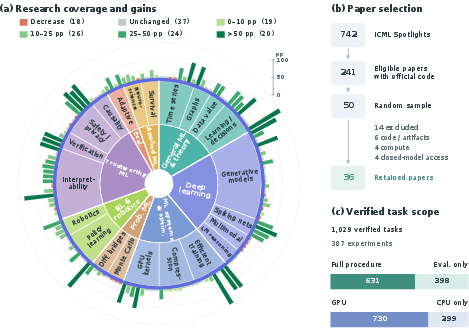
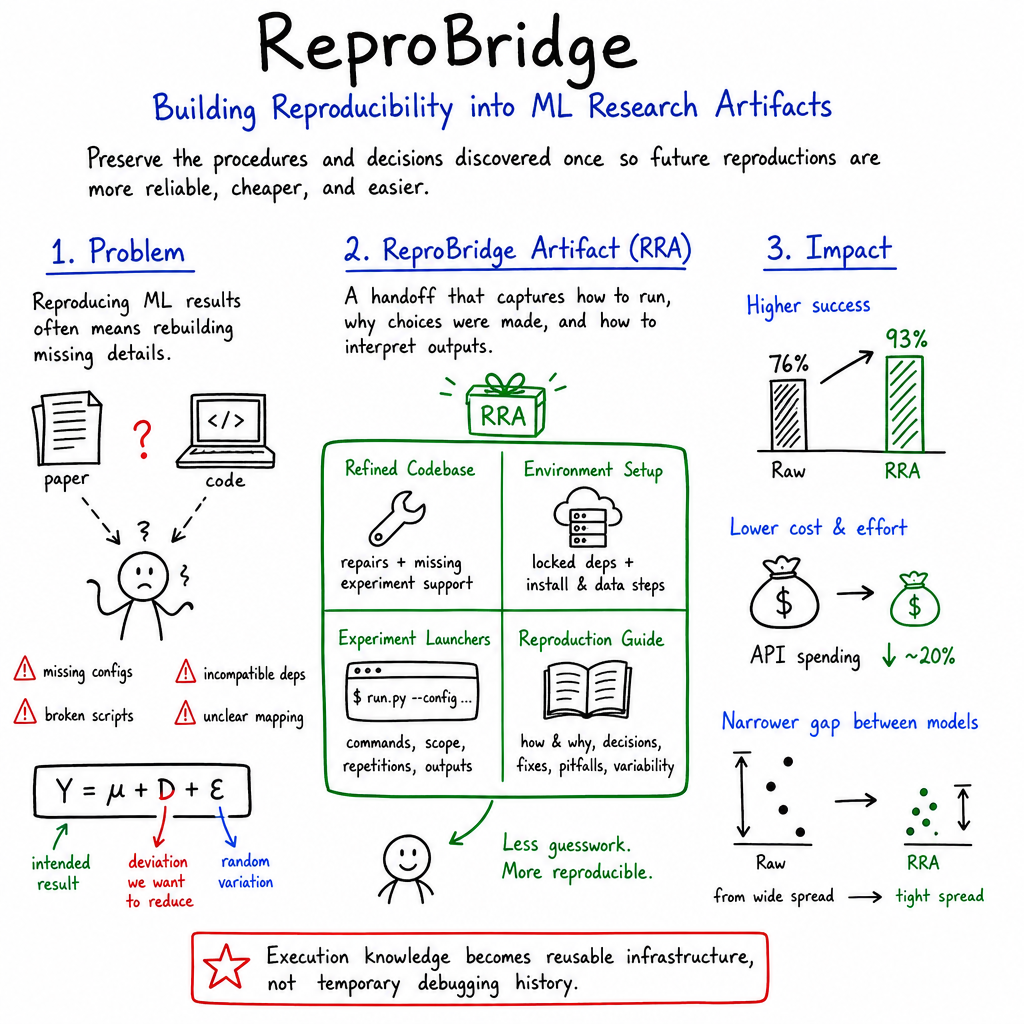
Abstract: Reproducing machine learning experiments requires reconstructing procedures from information scattered across papers, released code, and supporting artifacts. For coding agents, reproduction success can therefore depend on their ability to fill in missing details, rather than on the released artifacts alone. We ask whether preserving recovered procedures and decisions improves subsequent independent reproduction. We define a standardized artifact design comprising a refined codebase, environment setup, experiment launchers, and a reproduction guide, and introduce ReproBridge, an agent workflow for constructing these refined reproducible artifacts. ReproBridge-Bench provides 1,029 tasks from 387 experiments across 36 papers, anchored by five human-verified reference scores per task. Agents attempt tasks in fresh sessions with raw code or refined artifacts; a separate Auditor checks execution evidence. Across four evaluated models, refined artifacts raise mean reproduction success from 76.4% to 92.6% and reduce downstream API spending by 19.7% on average. The cross-model success-rate spread narrows from 21.6 to 3.9 percentage points, with all four models achieving mean success rates above 90%. Removing any component reduces success in the ablation study, with the largest losses from code and environment removal. These results suggest that preserving execution knowledge helps even models with lower raw-code success reproduce experiments more reliably and at lower API cost.
Paper Prompts
Sign up for free to create and run prompts on this paper.
Explain it Like I'm 14
1. What is the paper about?
This paper studies how to make machine-learning research easier to reproduce.
Reproducing an experiment means trying to run the same computer experiment described in a research paper and getting a similar result. This is important because scientists need to check whether published findings can be trusted.
However, research papers and code often leave out important details. For example:
- Which version of a software package should be installed?
- Which settings should be used?
- Which script actually produces the number shown in the paper?
- How should the final result be calculated?
- What should be done when the paper and the code disagree?
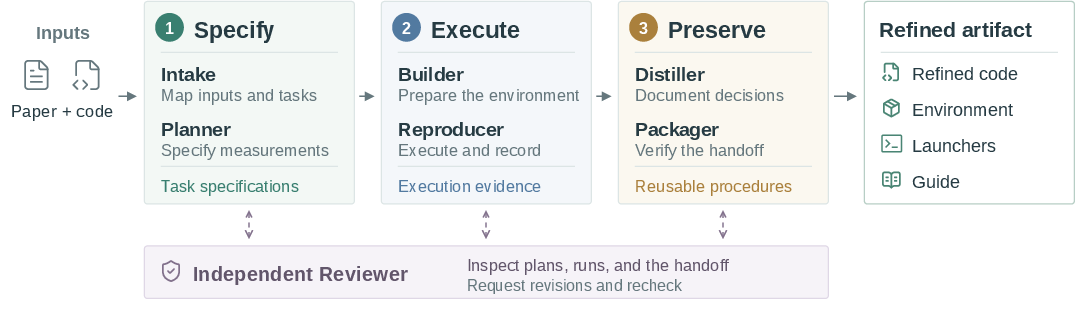
The paper introduces ReproBridge, a system designed to save all the useful knowledge discovered while reproducing an experiment. This information is placed into a clear, reusable package called a refined reproducible artifact.
2. What questions did the researchers ask?
The researchers mainly wanted to know:
- Does saving the solutions and decisions from one reproduction attempt help later attempts?
- Can improved code, setup instructions, launch scripts, and explanations help computer agents reproduce experiments more successfully?
- Do these improved materials reduce the time, number of computer messages, and money needed to reproduce experiments?
- Which parts of the improved package are most important?
The paper’s main idea is that simply releasing code is not always enough. A person or AI agent may need to solve several hidden problems first. If those solutions are written down, the next person does not have to solve the same problems again.
3. How was the research carried out?
Building the improved research packages
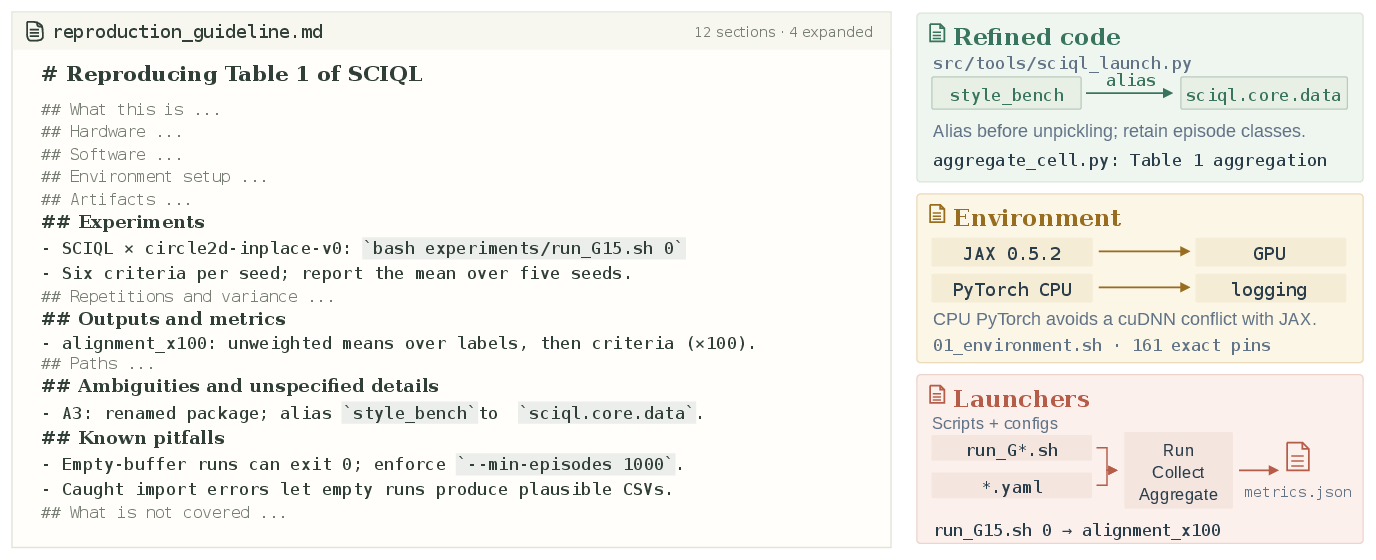
ReproBridge takes a research paper and its original code. It then creates a more complete package with four main parts:
| Part | What it means in simple language |
|---|---|
| Refined codebase | Original code that has been repaired, organized, or updated so it can run correctly |
| Environment setup | Instructions for installing the right software, libraries, data, and model files |
| Experiment launchers | Ready-to-use scripts that start the correct experiments and collect their results |
| Reproduction guide | A clear explanation of what to run, why certain choices were made, and what problems were fixed |
An analogy is preparing a science experiment for another student. Instead of only giving them a box of equipment, you also provide:
- Working equipment
- A list of materials
- Step-by-step instructions
- An explanation of common mistakes and how to avoid them
Creating the benchmark
The researchers created ReproBridge-Bench, a collection of reproduction tasks based on:
- 36 machine-learning papers
- 387 experiments
- 1,029 individual tasks
A task might ask an agent to reproduce one measurement from a paper, such as a model’s accuracy or error rate.
Before testing the AI agents, five human researchers independently tried to reproduce each task. Their results were used to create a reasonable range of expected answers. This was important because machine-learning experiments can produce slightly different results each time, especially when training involves randomness.
The researchers also used an Auditor. The Auditor checked whether a reported number really came from a new experiment, rather than being copied from the paper or produced using the wrong calculation.
Comparing two situations
The AI agents were tested in two conditions:
- Raw code: They received the original paper and released code.
- Refined artifact: They received the paper and the improved ReproBridge package.
Four different coding agents were tested. The researchers compared:
- How often the agents successfully reproduced results
- How many computer messages they used
- How much API money was spent
- How quickly they reached a usable experiment
The researchers also removed one part of the package at a time to see which parts mattered most. This is called an ablation study. It is like removing one ingredient from a recipe to see how much it affects the final dish.
4. What did the researchers find?
Reproduction success increased greatly
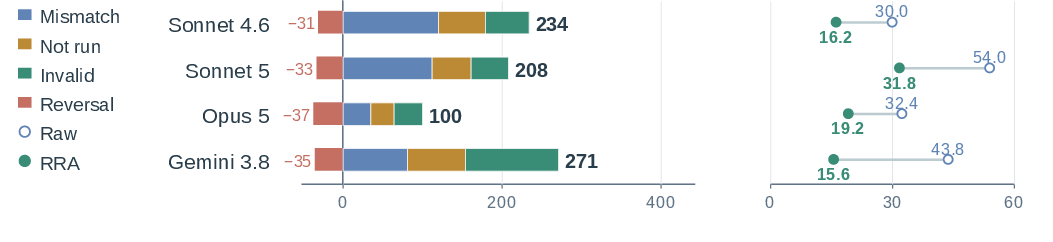
When using only the original code, the four agents had an average success rate of 76.4%.
When using the refined artifacts, their average success rate increased to 92.6%.
The improvement occurred for every tested model:
| AI agent | Success with raw code | Success with refined artifact |
|---|---|---|
| Sonnet 4.6 | 72.3% | 91.6% |
| Sonnet 5 | 76.5% | 93.3% |
| Opus 5 | 89.2% | 94.7% |
| Gemini 3.8 Flash | 67.6% | 90.8% |
The biggest improvement was for Gemini, whose success rate rose by 23.2 percentage points.
The agents spent less money
The refined artifacts also reduced the amount of computer usage and API spending. On average, downstream API costs fell by about 19.7%.
This happened because the agents spent less time searching through confusing code, fixing the same problems, and guessing which settings to use.
The gap between agents became smaller
With raw code, the difference between the best-performing and worst-performing agents was fairly large: 21.6 percentage points.
With the refined artifacts, the difference shrank to only 3.9 percentage points.
This suggests that clear instructions and working tools can help weaker agents perform much more like stronger agents.
All four parts were useful
Removing any part of the refined artifact lowered success:
| Removed part | Drop in success |
|---|---|
| Refined code | 5.2 percentage points |
| Environment setup | 4.5 percentage points |
| Reproduction guide | 3.8 percentage points |
| Experiment launchers | 3.1 percentage points |
The largest losses happened when the improved code or environment instructions were removed. This means that both working software and clear setup instructions are especially important.
Still, the guide and launchers also mattered. Even if the code works, people may not know which command to run, which settings to use, or how to turn raw output into the final result.
The improved package solved several kinds of problems
The study found that the refined artifacts helped agents:
- Repair broken data loaders
- Install compatible software versions
- Find the correct model settings
- Understand how to calculate reported results
- Avoid accidentally using empty or incorrect data
- Connect experiment outputs to the numbers in the paper
For example, in one case, the original code incorrectly treated thousands of images as belonging to the same class. The refined artifact included a repair and a check for correctly prepared data. The resulting measurement became much closer to the paper’s result.
5. Why are these findings important?
Machine-learning research is often difficult to reproduce because important knowledge is hidden in conversations, command histories, or the memory of the person who first got the code working.
ReproBridge treats that knowledge as something worth saving. Instead of forcing every new researcher or AI agent to start from the beginning, it creates a handoff that explains:
- What was changed
- Why it was changed
- Which command should be used
- How the result should be measured
- What problems might occur
This is similar to leaving detailed instructions for someone who must rebuild a complicated project after you are gone.
6. Implications and possible impact
The research suggests that machine-learning papers should provide more than source code. A useful research release should also include:
- A reliable software environment
- Easy-to-run experiment scripts
- Clear instructions for measuring results
- A record of bugs, disagreements, and important decisions
This could make scientific research more trustworthy and less wasteful. Researchers would spend less time fighting with software and more time checking ideas. AI coding agents could also reproduce experiments more reliably, even if they are not the most powerful agents.
The system could be especially useful before a paper is published. Authors could use it to discover missing instructions, broken code, or disagreements between the paper and the implementation.
However, the study also has limits. It tested selected papers and four particular AI agents, so the results may not apply to every machine-learning project. A matching number does not always prove that the experiment was scientifically correct. Also, a refined artifact could preserve an incorrect decision if the people creating it made a mistake.
Overall, the paper’s main message is simple:
Reproducibility improves when researchers save not only their code, but also the instructions, repairs, explanations, and decisions needed to use that code successfully.
Practical Applications
Immediate Applications
- Pre-submission reproducibility checks for ML researchers (Academia; Immediate Application). Authors can apply the four-component artifact format—refined codebase, environment setup, experiment launchers, and reproduction guide—before submitting a paper. Running the specified experiments can reveal missing dependencies, ambiguous metrics, paper–code inconsistencies, defective data loaders, and unreported configuration choices.
- Potential workflow: map each reported result to a task specification; execute it from a clean environment; record scripts, seeds, outputs, hardware, and aggregation procedures; then package the evidence and fixes.
- Dependency: authors must have access to the required data, checkpoints, compute, and model APIs. The paper’s evidence suggests that refinement does not eliminate failures caused by incorrect papers, high experimental variance, closed models, or insufficient resources.
- Standardized reproducibility packages for published ML papers (Academia and scientific publishing; Immediate Application). Research groups, conferences, and journals can require an RRA-style release alongside the manuscript. A package could include pinned dependencies, container or installation scripts, task-specific launchers, output schemas, metric extractors, known-pitfall documentation, and a change log.
- The study found that refined artifacts increased reproduction success from 76.4% to 92.6% on average, while reducing downstream API costs by approximately 19.7%.
- Dependency: the package must preserve the environment used to obtain the reported results; otherwise, the documentation may describe a procedure that cannot be reproduced.
- Reusable handoffs for coding agents and automated research assistants (Software and AI tooling; Immediate Application). Developers can use ReproBridge-style artifacts as inputs to coding agents tasked with reproducing, extending, or benchmarking published experiments. Launchers and explicit measurement rules reduce the need for agents to infer configuration, repair code, or search large repositories.
- Potential tools: agent-readable
reproduction_guide.mdfiles, structured task manifests, launcher registries, machine-readable output contracts, and execution ledgers. - This is particularly useful for lower-performing or less specialized models: the cross-model success-rate spread fell from 21.6 to 3.9 percentage points when refined artifacts were supplied.
- Dependency: agents must be prevented from using hidden reference scores or copied output files, and an independent audit should verify that submitted measurements came from fresh executions.
- Potential tools: agent-readable
- Lower-cost large-scale replication services (Research infrastructure and cloud computing; Immediate Application). Laboratories or cloud platforms can offer batch reproduction services that run launchers across papers and models, retain logs, and produce compatibility reports. The documented procedures can be reused across multiple replication rounds.
- Potential products: “reproducibility-as-a-service” pipelines, artifact registries, clean-shell verification systems, and dashboards reporting success, cost, runtime, and failure reasons.
- The reported savings were 16.8%–23.7% in API spending per model. Construction costs could be recovered after roughly 8–13 full reuse rounds, under the paper’s pricing assumptions.
- Dependency: repeated use must be sufficiently frequent to amortize artifact construction, and cloud GPU, auditing, storage, and maintenance costs may materially change the break-even point.
- Automated integrity auditing of experimental results (Academic review, benchmarking, and compliance; Immediate Application). The paper’s evidence-chain approach can be used to check whether a reported score is linked to the correct code, script, output file, configuration, and aggregation method.
- Potential checks: file hashes, timestamps, execution order, output provenance, metric recomputation, detection of substituted measurements, and validation that the requested statistic—not merely a numerically similar value—was computed.
- This can identify cases where a value matches the target but was generated by the wrong instrument, formula, input, or post hoc selection.
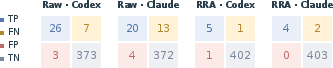
- Dependency: audit agents are imperfect. In the reported human validation, the primary Auditor achieved approximately 88.6% precision and 79.5% recall, so contested cases require human review.
- Detection of paper–code contradictions before publication or release (Academic quality assurance and research policy; Immediate Application). Institutions and venues can use agent-assisted analysis to compare explicit paper claims with implemented behavior, such as learning rates, model architectures, data-processing rules, and evaluation protocols.
- Potential output: contradiction reports identifying the source statement, conflicting code location, affected experiments, and whether the discrepancy was tested experimentally.
- The paper identified hundreds of potential contradiction findings, but explicitly cautions that these are not validated error rates or proof that the reported results are invalid.
- Dependency: the system must distinguish genuine contradictions from underspecified choices and should require controlled comparisons before making claims about scientific impact.
- Improved onboarding and maintenance of internal ML systems (Industry ML engineering; Immediate Application). Companies can apply the format to internal experiments, model evaluations, ablation studies, and benchmark suites. A reproduction guide can preserve why a dependency, hardware setting, dataset transformation, or metric definition was selected.
- Potential workflow: convert successful exploratory notebooks into refined code, lock dependencies, create launchers for standard evaluations, and attach a decision log to each model version.
- This can reduce repeated debugging when teams change engineers, repositories, hardware platforms, or model-serving environments.
- Dependency: documentation must be updated when datasets, libraries, accelerators, or model checkpoints change; stale artifacts can preserve outdated or incorrect procedures.
- Reliable evaluation of ML systems across hardware and software environments (Cloud, GPU infrastructure, and ML operations; Immediate Application). The environment component can preserve architecture-specific installation paths and known compatibility fixes, such as source builds or CPU/GPU library combinations.
- Potential tools: hardware-aware setup scripts, environment lockfiles, container definitions, smoke tests, and preflight checks for data and output structure.
- The WBMM example indicates that a documented dependency stack and build route can transfer a previously failing evaluation to a new GPU environment.
- Dependency: numerical compatibility may still vary with hardware, kernels, precision modes, stochasticity, and unavailable proprietary components.
- Transparent replication records for policy and funding decisions (Research policy and governance; Immediate Application). Funding agencies, institutional review boards, and conference reproducibility committees can request structured replication evidence rather than relying solely on code availability.
- Potential requirements: a task manifest, clean-environment test, execution evidence, resource limits, unresolved ambiguities, known failures, and a distinction between training and evaluation-only reproduction.
- This supports more informative classifications than “code released” versus “code unavailable.”
- Dependency: policy should avoid treating numerical agreement as proof of scientific validity; the paper emphasizes that reproduction confirms executable agreement under a protocol, not the truth of the underlying scientific claim.
- Practical reproducibility support for students and independent researchers (Education and daily research practice; Immediate Application). Reproduction guides and launchers can serve as instructional material for teaching experimental design, dependency management, statistical variability, and responsible reporting.
- Students can reproduce a selected task, inspect the change record, vary seeds, and compare stable versus high-variability results.
- Dependency: educational deployments should use appropriately sized experiments, since the original benchmark includes substantial GPU requirements and some tasks cannot be reproduced on ordinary hardware.
Long-Term Applications
- Machine-readable standards for agent-native scientific artifacts (Scientific infrastructure and software standards; Long-Term Application). The four-component RRA structure could evolve into a common interchange standard for papers, repositories, datasets, environments, experiments, and evidence.
- Potential standard: a schema linking each claim to task definitions, source citations, code commits, launch commands, configuration files, raw outputs, aggregation logic, and uncertainty information.
- Such a standard could allow different research agents, repositories, and evaluation platforms to exchange reproducible procedures without relying on informal prose.
- Dependencies: agreement among publishers, conferences, repository providers, and tool vendors; support for diverse fields beyond ML; versioning of datasets and proprietary dependencies; and robust security controls for executable artifacts.
- Automated “paper-to-experiment” compilation systems (AI research assistants; Long-Term Application). ReproBridge’s Specify–Execute–Preserve workflow could become a compiler-like system that converts a paper and repository into an executable, audited experiment package.
- Potential capabilities: identify reported claims, generate task manifests, resolve ambiguities, construct launchers, repair implementation defects, select compatible environments, and produce evidence-backed documentation.
- This could support large-scale replication of entire literature collections rather than isolated papers.
- Dependencies: agents must reliably interpret scientific intent, distinguish paper statements from implementation accidents, avoid silently changing protocols, and obtain human approval for consequential assumptions.
- Continuous reproducibility monitoring for living research artifacts (Academic repositories and software maintenance; Long-Term Application). Repositories could automatically rerun smoke tests and selected experiments whenever code, dependencies, datasets, or hardware support changes.
- Potential product: a “reproducibility CI” service reporting whether a paper’s claims remain executable, which tasks drifted, and whether changes affect numerical compatibility.
- The artifact’s launchers, output contracts, and evidence records provide a foundation for such monitoring.
- Dependencies: recurring compute and storage costs, stable access to datasets and checkpoints, evolving software ecosystems, and a policy for handling legitimate numerical drift caused by updated libraries or hardware.
- Evidence-based benchmarks for scientific coding agents (AI evaluation and model development; Long-Term Application). ReproBridge-Bench could be expanded into a broader benchmark for agents that measures not only whether a number is close to a reference, but also whether the correct procedure was executed.
- Potential evaluation dimensions: task success, integrity of execution, cost, time to first valid run, recovery from failures, quality of documentation, and uncertainty handling.
- This would encourage models to produce traceable experiments rather than merely imitate reported scores.
- Dependencies: larger and more diverse paper samples, independently verified reference executions, improved auditors, protections against benchmark leakage, and fair treatment of tasks with high stochastic variability.
- Reproducibility-aware model training and agent memory (AI systems and developer tooling; Long-Term Application). The persistent change records and execution decisions could form a reusable memory for agents, allowing them to learn environment repairs, measurement conventions, and common repository failure modes.
- Potential tools: institutional experiment-memory stores, retrieval systems for dependency fixes, libraries of verified launchers, and agent policies that preserve successful procedures as structured skills.
- Dependency: memories must be provenance-aware and scoped to compatible repositories and versions; otherwise, agents may transfer an incorrect fix or outdated configuration to a different experiment.
- Reproducible evaluation pipelines in regulated or high-stakes sectors (Healthcare, finance, public policy, and safety-critical engineering; Long-Term Application). The evidence-chain model could support independent validation of clinical ML, credit-risk models, public-sector algorithms, robotics controllers, or safety evaluations.
- Potential workflow: freeze the model and data versions, define the evaluation statistic in advance, execute in an isolated environment, preserve raw outputs, and obtain independent integrity review.
- This could improve auditability when model outputs influence treatment, lending, resource allocation, or safety decisions.
- Dependencies: privacy-preserving data access, regulatory approval, domain-specific validity criteria, secure execution, and the recognition that computational reproducibility does not establish fairness, clinical effectiveness, or causal validity.
- Reproducible robotics and embodied-AI experiment packages (Robotics and autonomous systems; Long-Term Application). Launchers and environment records could be extended to simulator versions, robot firmware, sensor calibration, hardware configuration, random seeds, and physical-world trial protocols.
- Potential product: portable simulator-to-robot replication packages with safety checks and traceable evaluation logs.
- The approach could reduce failures caused by hidden simulator settings, sensor-processing choices, or hardware-specific dependencies.
- Dependencies: hardware availability, safety constraints, nondeterministic physical environments, calibration reproducibility, and substantially greater cost than software-only experiments.
- Quantified uncertainty and reproducibility scoring for published claims (Research metrics and policy; Long-Term Application). The paper’s use of multiple reference executions and prediction intervals could inform richer reproducibility scores that report stable reproduction, variable reproduction, numerical mismatch, execution blockage, and resource limitation separately.
- Potential output: claim-level reproducibility cards showing the number of independent executions, variability, hardware conditions, unresolved ambiguities, and integrity-audit status.
- Dependencies: sufficient independent reference runs, appropriate statistical models for non-normal or highly stochastic experiments, and safeguards against reducing complex scientific quality to a single score.
- Large-scale scientific knowledge graphs linking claims to executable evidence (Academia and research discovery; Long-Term Application). A future platform could connect paper claims, datasets, code revisions, environments, launchers, measurements, and replication outcomes in a searchable graph.
- Researchers could identify which findings have been independently reproduced, which depend on fragile hardware or undocumented choices, and which artifacts remain runnable.
- Dependencies: interoperable metadata, durable identifiers, long-term repository preservation, licensing permissions, and community participation in maintaining evidence after publication.
- Automated experiment planning with cost-aware replication (Industry and research operations; Long-Term Application). Once artifacts expose task costs, resource requirements, and variability, schedulers could select the most informative replication set under a fixed budget.
- Potential workflow: prioritize claims with high downstream importance, large paper–code uncertainty, low reproduction cost, or evidence of numerical fragility; allocate additional repetitions only where variability warrants them.
- Dependencies: reliable cost and uncertainty estimates, domain-specific priorities, and careful separation between exploratory diagnostics and valid scored repetitions to prevent selective reporting.
Glossary
- Ablation study: An experiment that removes or alters components to measure their individual contributions. “Removing any component reduces success in the ablation study”
- Aggregation: The process of combining multiple measurements into a summary statistic. “unweighted aggregation, and checks for silently empty datasets”
- Artifact: A research output, such as code, data, checkpoints, or documentation, that supports a study. “Research artifacts comprise the code, data, checkpoints, environment specifications, and documentation supporting a study.”
- Auditor: An independent evaluator that verifies whether reported results arose from valid executions. “a separate Auditor checks execution evidence”
- Benchmark: A standardized collection of tasks and procedures used to evaluate systems. “ReproBridge-Bench provides 1,029 tasks from 387 experiments across 36 papers”
- Checkpoint: A saved model state that can be loaded for further training or evaluation. “An allowed checkpoint may serve as input”
- Compatibility interval: A statistical range defining whether a new measurement is sufficiently consistent with reference measurements. “The compatibility interval is”
- Confidence level: The specified probability level used when constructing a statistical interval. “The default is 𝑞 = 0.95.”
- Dependency resolution: The process of identifying and installing mutually compatible software packages and versions. “Dependency resolution can become an installation procedure”
- Execution integrity: The degree to which a reported result can be traced to an authentic and valid computational execution. “Execution-integrity audit.”
- Execution trace: A recorded sequence of commands, files, outputs, and decisions produced during an experiment. “downstream reproduction traces”
- Experimental ablation: A controlled evaluation in which one artifact component is removed to assess its effect. “Component removals test the contribution of each part”
- False negative: A valid case that an auditing system fails to identify. “Codex misses eight of these outcomes”
- False positive: An invalid flag assigned to a valid result. “Each Auditor falsely flags four of 779 valid outcomes”
- Heterogeneity: Variation in outcomes or effects across different datasets, papers, or experimental settings. “Paper-level heterogeneity.”
- Integrity audit: A systematic verification that reported measurements were generated by the claimed procedure. “combining intervals based on variability across five human-verified executions with an independent integrity audit”
- Launcher: A script or entry point that connects an experiment to its configuration, execution, and output-processing steps. “Experiment launchers connect tasks to configurations, execution scope, outputs, and measurement extraction”
- Macro-average: An average that assigns equal weight to each group, regardless of group size. “Paper-macro success gives equal weight to all 36 papers”
- Measurement extraction: The process of obtaining the target statistic from experiment outputs. “score-extraction or aggregation procedure”
- Monte Carlo: A computational method that uses repeated random sampling to estimate quantities or assess variability. “Monte Carlo”
- Numerical compatibility: Agreement between a reproduced measurement and a reference range according to a predefined statistical rule. “Numerical compatibility is assessed against observed executions and their variability”
- Numerical mismatch: A reproduced result that falls outside the permitted reference interval. “Executed, but numerically incompatible”
- Prediction interval: A statistical interval intended to contain a future observation while accounting for uncertainty in the estimated mean and random variation. “A prediction interval accommodates uncertainty in that estimated center and variation in a new observation 𝑌”
- Precision: The proportion of flagged cases that are actually invalid. “Codex achieves 88.6% precision and 79.5% recall”
- Reproducibility: The ability to independently execute an authors’ artifacts and obtain compatible results. “reproducibility means independent execution of authors’ artifacts”
- Recall: The proportion of all genuinely invalid cases that an auditing system successfully detects. “Codex achieves 88.6% precision and 79.5% recall”
- Reference observation: A measurement produced by an independently verified execution and used as a comparison standard. “We use five human-verified reference observations of the same statistic per task.”
- Refined reproducible artifact: A packaged research deliverable containing repaired code, environment setup, launchers, and procedural documentation. “The four-component refined reproducible artifact (RRA in figures and tables) addresses these needs.”
- Relative variability: The amount of variation among measurements expressed relative to a reference value. “We define 𝑉𝑗 = 100”
- Reproducer: A person or computational agent that independently reruns an experiment using the available research materials. “A reproducer may resolve incompatible dependencies”
- Sensitivity analysis: An investigation of whether conclusions change under alternative assumptions, thresholds, or evaluators. “Robustness analyses, component ablations, case studies, and human validation of the integrity checks examine the scope and mechanisms of these gains”
- Smoke test: A limited, inexpensive execution used to check whether software or an experiment pipeline functions. “including an inexpensive real repetition and checks on output structure and score extraction”
- Stochastic training: Model training whose results can vary because of randomness in initialization, data ordering, or other procedures. “Stochastic training can vary between runs”
- Stratified analysis: An analysis that divides data into predefined subgroups before comparing outcomes. “Paper-wise, stratified, and task-level diagnostics use the first evaluation.”
- Systematic effect: A persistent, directional deviation caused by consistent differences in execution or measurement conditions. “This working model draws on the distinction between systematic and random effects in measurement”
- Task-level analysis: Evaluation performed on individual experimental tasks rather than aggregated papers or datasets. “Task-level success uses the 80% interval on the same 1,029 tasks”
- Two-sided compatibility rule: A criterion requiring a measurement to fall within both the lower and upper bounds of an allowed interval. “all assessed by the same two-sided compatibility rule”
- Uncertainty estimation: The process of quantifying how imprecision or variation affects a reported measurement. “Five reference observations are a protocol choice, not a guarantee of adequate uncertainty estimation.”
- Variability: The degree to which repeated executions produce different measurements. “their spread characterizes 𝜀”
- Wall-clock limit: A maximum amount of elapsed real time allowed for an experiment or computational session. “Both raw-code and refined-artifact conditions use a 24-hour wall-clock limit per paper.”