Organizing Intelligence
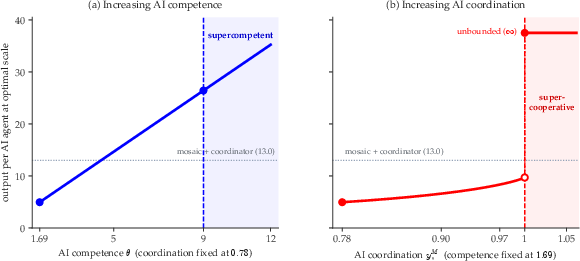
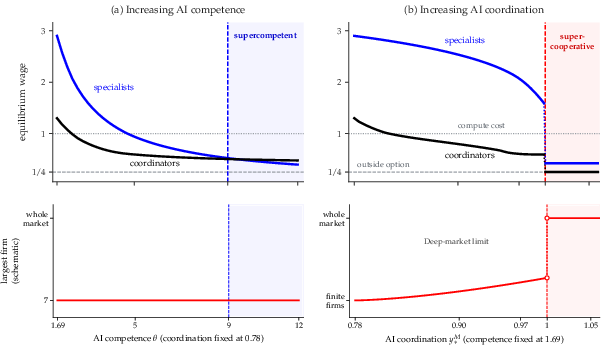
Abstract: When will advances in AI lead to economic transformation? We develop a model of how intelligence, the ability to achieve goals, matters for organizations, the key unit of economic production. Agents (human or AI) with multidimensional capabilities sort endogenously into competing firms. A firm's productivity depends on its agents' capabilities; we distinguish competence, which shifts productivity levels, from coordination, which governs how productivity scales with size. Two differences between AI and humans drive transformation: AI expertise is reproducible while humans' are in fixed supply, and AIs may not face the same human limits on coordination. We analyze how equilibrium market structure, productivity, employment, and wages evolve as AI capabilities improve. When AI is more capable than the average human, organizations of complementary humans can nonetheless outperform AI. Increases in AI competence can change the composition of workers within firms and decrease firm size. As AI coordination improves, however, this can break the Coasean ceiling on firm size and the market structure undergoes a phase transition toward large, concentrated AI-heavy firms. Changes in human employment are gradual when AI displaces workers within mixed human-AI firms, or sudden when AI firms outcompete human firms. We decompose wage changes into a technology effect, which changes the value of humans within existing firms, and a reorganization effect as firms adjust size and composition. Reorganization can reverse the technology effect on wages.
Paper Prompts
Sign up for free to create and run prompts on this paper.
Explain it Like I'm 14
1. What is the paper about?
The paper, “Organizing Intelligence,” asks a big question:
What will happen to businesses, jobs, wages, and the economy as artificial intelligence becomes more capable?
Many discussions treat AI as simply a tool that helps workers or replaces them. This paper argues that we also need to think about how people and AI work together inside organizations.
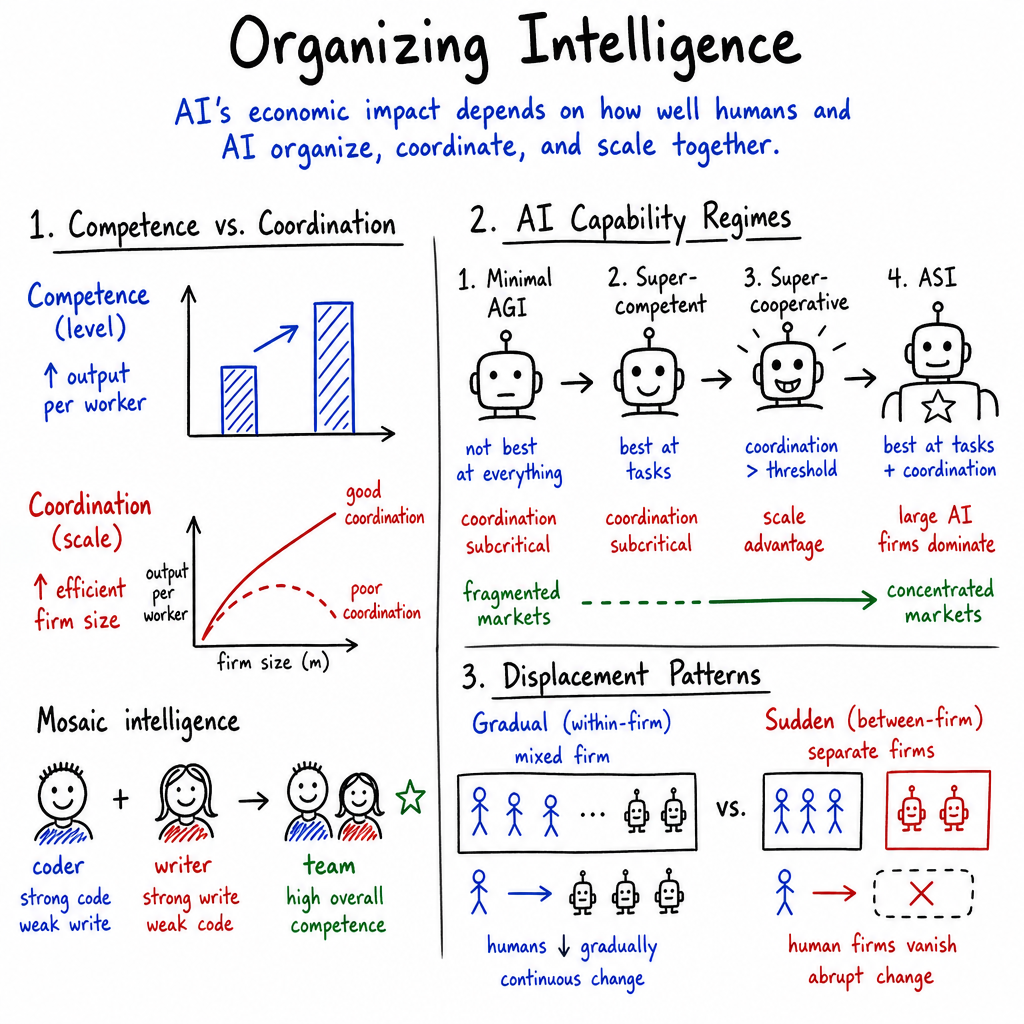
The authors focus on two parts of intelligence:
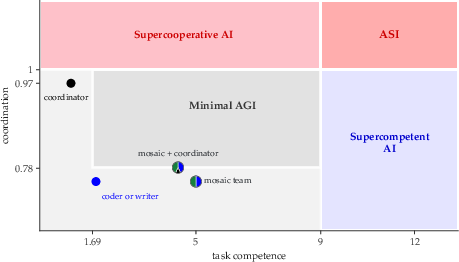
- Competence: How good an agent is at tasks such as coding, writing, mathematics, or problem-solving.
- Coordination: How well an agent works with other agents, shares information, and helps organize a large group.
The paper’s main idea is that AI might transform the economy not only by becoming better at individual tasks, but also by becoming better at coordinating large teams.
Important: This is a theoretical model. It is not a prediction of exactly what will happen. Instead, it shows what could happen under certain assumptions.
2. What questions does the paper ask?
The paper studies several related questions:
- When will AI cause major economic changes?
- Will companies become smaller, larger, or more concentrated?
- Which human skills will remain valuable?
- Will people lose jobs gradually or suddenly?
- How will wages change when AI becomes cheaper and more powerful?
- Can groups of humans still outperform AI because they have different and complementary skills?
The authors are especially interested in the difference between AI becoming better at tasks and AI becoming better at working with many other AI systems.
3. How did the researchers study this?
A mathematical model of an economy
The researchers built a simplified computer-like description of an economy using mathematics. They imagined an economy containing:
- Human workers with different skills
- AI workers that can be copied many times
- Firms that combine humans and AI
- Markets where firms sell their products
- Wages and prices determined by competition
This is similar to creating a strategy game with economic rules. The researchers can change the abilities of the AI and observe how firms and workers would respond.
Human capabilities
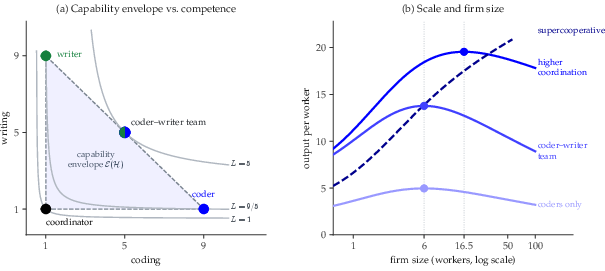
Each worker is described by a list of abilities. In the simple example, workers have:
- Coding skill
- Writing skill
- Coordination skill
For example:
- A coder is excellent at coding but weak at writing.
- A writer is excellent at writing but weak at coding.
- A coordinator is not especially good at either task but is good at helping people work together.
“Mosaic intelligence”
The paper uses the idea of mosaic intelligence. This means that a team can be smarter than any one member because its members have different strengths.
Imagine a puzzle-solving team:
- One person is good at numbers.
- One person is good at language.
- One person is good at organizing everyone.
Individually, none of them can do everything. Together, they may solve the problem better than one highly capable but less diverse AI system.
This is why a team of humans might outperform an AI that is better than the average individual human.
Firm size and coordination
The model also studies what happens when firms grow.
Small teams may become more productive because workers can divide tasks. But very large teams can become difficult to manage. Information may get lost, meetings may increase, and people may work toward different goals.
The paper represents this with a mathematical rule:
- Better competence increases how much a firm can produce.
- Better coordination determines how well productivity improves when the firm becomes larger.
A human firm may eventually become too large because coordination problems outweigh the benefits of adding more workers. The authors call this limit a Coasean ceiling, referring to the economic question of why all workers do not simply work for one giant company.
Human workers versus AI workers
Human workers are limited in supply. There are only so many people with a particular skill.
AI workers, however, can be copied. If one AI system is useful, a company might run thousands or millions of copies, as long as it can pay for the computing power.
The model therefore treats AI as a worker that is:
- Reproducible
- Available in large numbers
- Paid for through computing costs rather than ordinary wages
The researchers then examine what happens as AI improves in different ways.
4. What are the main findings?
Finding 1: Human teams can remain valuable even when AI is very capable
A group of humans with different skills may outperform a group of identical AI copies.
For example, coders and writers can divide tasks in a way that produces a strong overall team. An AI system may be better than one coder or one writer, but it may not benefit as much from combining different kinds of expertise.
This means that AI matching the average human worker does not automatically eliminate human jobs.
Finding 2: Better AI competence may make firms smaller
Suppose AI becomes much better at coding, writing, or other individual tasks, but does not become better at coordination.
In that case, firms may need fewer workers to produce the same amount of goods. Businesses could become more productive without becoming larger.
The paper suggests that this could lead to:
- Smaller teams
- Fewer routine specialist jobs
- Lower prices for products and services
- Continued demand for people who organize complex projects
In this situation, human managers and coordinators may become more valuable because AI still struggles to manage large groups.
Finding 3: Better AI coordination could create very large firms
The paper’s most dramatic result concerns coordination.
If AI becomes good enough at working with other AI systems, adding more AI workers could keep increasing productivity instead of creating confusion.
This could lead to a major change:
- Many small firms might be replaced by a few very large AI-heavy firms.
- Large companies could produce goods more cheaply than smaller competitors.
- The economy could become much more concentrated.
The authors describe this as a phase transition. This is like water suddenly changing into ice when the temperature crosses a certain point. The change may appear sudden even though the underlying improvement happens gradually.
Finding 4: AI progress can affect employment in different ways
The model shows two main paths.
Gradual displacement within mixed firms
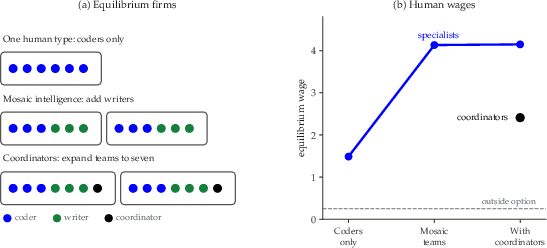
AI may first work alongside humans. As AI improves, the firm may use fewer human specialists while still keeping some human workers.
For example, a company might gradually reduce the number of human programmers as AI handles more coding, while humans continue supervising or combining different types of work.
Sudden displacement between firms
A different outcome can happen if AI-only firms suddenly become cheaper than human-run firms.
In that case, human firms may disappear, and many workers could lose their jobs at roughly the same time.
Thus, employment does not always decline smoothly. A small improvement in AI coordination could push the economy past a threshold and cause a large change.
Finding 5: Human wages can change for two different reasons
The paper separates wage changes into two effects.
Technology effect: AI changes how useful a human is inside an existing firm.
For example, an AI assistant may make a human writer less valuable for routine writing tasks.
Reorganization effect: Firms change their size and their mix of human and AI workers.
For example, if AI allows companies to become much larger, some human managers may no longer be needed.
These two effects can move in opposite directions. Better technology might make a human more productive, but changes in how firms are organized might reduce the demand for that worker.
Finding 6: Some human skills may become more valuable
The paper suggests that human workers may continue to be valuable when they provide abilities that AI lacks, such as:
- Coordinating people
- Understanding social situations
- Combining different kinds of knowledge
- Managing complicated projects
- Providing judgment and responsibility
However, if AI eventually becomes excellent at coordination too, these advantages may become weaker.
Finding 7: Markets of different sizes may react differently
The paper distinguishes between:
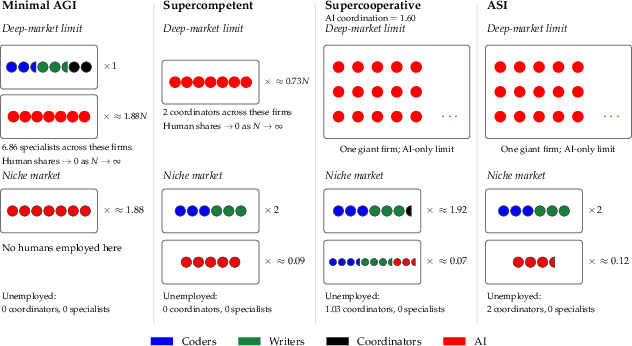
- Deep markets: Markets large enough to absorb a great deal of production
- Niche markets: Smaller markets with limited demand
Very large AI firms are especially likely to appear in deep markets because they can sell enormous amounts of output.
Niche markets may continue to support smaller human or mixed firms because there is not enough demand for a giant AI organization.
This means that human employment might survive longer in specialized or local markets than in large standardized industries.
5. Why are these findings important?
The research challenges the simple idea that AI progress will either cause immediate mass unemployment or have almost no effect.
Instead, the effects may depend on what kind of ability AI gains:
| AI improvement | Possible economic result |
|---|---|
| Better at individual tasks | More productive but smaller firms |
| Better at coordination | Larger firms and greater market concentration |
| Better than individual human specialists | Lower demand for routine specialist work |
| Able to copy itself cheaply | Lower wages for scarce human skills |
| Better than humans at coordinating large groups | Fewer human managers and more AI-only organizations |
The paper also shows why it is not enough to test AI by asking whether one AI system can beat one human on a task. The more important question may be:
How well can humans and AI organize themselves into productive teams and companies?
6. What could this mean for the future?
If the paper’s model is correct, the future of work may depend heavily on AI coordination.
In the near term, AI could make firms leaner while humans continue to manage projects and combine different skills. Human teams could remain strong because they contain varied abilities that AI copies do not naturally have.
Later, if AI becomes excellent at coordinating with other AI systems, the economy could change much more dramatically. A small number of very large AI-driven companies might produce much of the economy’s goods and services. Some workers could be replaced gradually, while others might lose jobs suddenly when human firms can no longer compete.
The paper does not prove that this future will happen. Its main lesson is that we should pay attention to more than AI’s individual intelligence. We should also study:
- How well AI systems cooperate
- How companies reorganize around AI
- Which human skills remain complementary to AI
- Whether markets become more concentrated
- How workers can adapt to changing job demands
In simple terms, the paper argues that AI may transform the economy not just when it becomes smart, but when it becomes able to organize smart systems at a large scale.
Practical Applications
Immediate Applications
El artículo es principalmente un modelo teórico, no una evaluación empírica ni una especificación de producto. Por tanto, las aplicaciones inmediatas consisten sobre todo en herramientas de diagnóstico, diseño organizativo y planificación de escenarios, no en asumir que sus umbrales económicos ya hayan sido observados.
- Auditoría de capacidades para equipos humano–IA — Industria, software, consultoría y operaciones empresariales.
- competencias específicas, como programación, redacción, análisis o razonamiento;
- capacidad de coordinación, como gestión de dependencias, transferencia de contexto, verificación y alineación de objetivos.
- Esto permite construir mapas de capacidades y decidir qué tareas asignar a humanos, agentes de IA o equipos mixtos. La aplicación se deriva de la distinción central entre competencia, que eleva el nivel de productividad, y coordinación, que determina cuánto puede escalar una organización.
- Diseño de equipos complementarios basado en “inteligencia mosaico” — Recursos humanos, educación, I+D y desarrollo de software. En lugar de seleccionar únicamente al individuo con mejor puntuación en un benchmark, las organizaciones pueden formar equipos con capacidades complementarias: por ejemplo, especialistas en código, dominio, comunicación, verificación y gestión. Un sistema de asignación podría maximizar una función de productividad con cuellos de botella, como la media armónica utilizada en el artículo, penalizando equipos débiles en alguna competencia esencial. Dependencia: requiere que las competencias sean realmente complementarias y que la función de producción estimada represente el trabajo real.
- Optimización de la proporción entre agentes de IA y coordinadores humanos — Empresas de software, centros de atención, laboratorios de investigación y operaciones administrativas.
- un coordinador humano supervisando varios agentes;
- agentes especializados agrupados alrededor de un gestor humano;
- equipos humanos–IA para tareas de alta interdependencia;
- agentes autónomos únicamente en flujos de trabajo estandarizados.
- El modelo predice que una mejora en la competencia de la IA no necesariamente elimina la necesidad de coordinación humana; de hecho, puede aumentar temporalmente el valor de quienes integran y supervisan sistemas complejos.
- Planificación del tamaño óptimo de equipos y unidades de negocio — Gestión empresarial y operaciones.
- ganancias de especialización;
- costes de comunicación;
- pérdida de contexto;
- alineación de incentivos;
- calidad de las herramientas de coordinación.
- Esto puede aplicarse ahora a la estructura de equipos de ingeniería, proyectos de investigación, departamentos de soporte y organizaciones distribuidas.
- Evaluación de herramientas de coordinación multiagente — Software, robótica y automatización.
- reduce errores de transferencia;
- permite compartir estados completos de trabajo;
- mejora la división de tareas;
- evita la duplicación de esfuerzos;
- mantiene objetivos consistentes al aumentar el número de agentes.
- Dependencia: la “capacidad de coordinación” debe operacionalizarse mediante métricas observables; no basta con medir el rendimiento de un único agente.
- Rediseño de benchmarks de IA para medir rendimiento organizativo — Academia, laboratorios de IA y organismos de normalización.
- rendimiento de equipos de agentes;
- escalabilidad con el número de agentes;
- robustez ante pérdida o transferencia de contexto;
- calidad de la coordinación humano–IA;
- productividad total y coste por unidad de producto.
- Un benchmark de este tipo sería más relevante para la economía que una puntuación aislada de competencia.
- Análisis de tareas y reasignación laboral — Recursos humanos, gobiernos y empresas.
- competencia técnica individual;
- complementariedad entre especialistas;
- coordinación y gestión;
- producción a gran escala;
- relaciones interpersonales o conocimiento tácito.
- Esta clasificación permite anticipar qué empleos podrían experimentar sustitución gradual dentro de equipos mixtos y cuáles podrían desaparecer abruptamente cuando una solución de IA haga inviable una organización humana independiente.
- Diseño de programas de formación para coordinadores y gestores técnicos — Educación superior, formación profesional y política laboral.
- descomposición y asignación de tareas;
- verificación de resultados;
- diseño de procesos;
- comunicación entre equipos;
- gobernanza y seguridad de agentes;
- integración de conocimiento multidisciplinar.
- La aplicación es especialmente relevante para formar gestores de proyectos técnicos y supervisores de sistemas de IA.
- Análisis de salarios y productividad dentro de las empresas — Finanzas corporativas, economía laboral y negociación salarial.
- efecto tecnológico: cambio en el valor de una persona dentro de una estructura existente;
- efecto de reorganización: cambio producido por la modificación del tamaño, la composición o la estructura de las empresas.
- Las empresas y analistas laborales pueden utilizar esta distinción para evitar atribuir todos los cambios salariales a la automatización directa. Un trabajador puede ganar valor tecnológico y, aun así, perder ingresos si la reorganización elimina su función o reduce la demanda de su organización.
- Planificación de escenarios para política pública — Gobiernos, bancos centrales y organismos laborales.
- adopción gradual de IA en empresas mixtas;
- desplazamiento abrupto cuando las empresas de IA superan a las humanas;
- concentración industrial por economías de escala;
- reducción de rentas de escasez humanas debido a la replicabilidad de la IA;
- persistencia de empleo humano en nichos donde la complementariedad sigue siendo valiosa.
- Dependencia: estos escenarios no son pronósticos empíricos. Requieren calibración con costes de cómputo, demanda, elasticidades, regulación y datos de productividad.
- Uso cotidiano de IA mediante equipos especializados y verificadores — Educación, productividad personal y trabajo del conocimiento. Un flujo de trabajo práctico puede combinar varios agentes con funciones distintas —planificación, ejecución, crítica y verificación— en lugar de solicitar una respuesta única a un modelo general. Los usuarios pueden conservar supervisión humana en tareas ambiguas, creativas o de alto riesgo. Dependencia: añadir agentes no garantiza mejores resultados; sin coordinación, puede aumentar la duplicación, los errores y la pérdida de contexto.
Long-Term Applications
Las siguientes aplicaciones requieren superar limitaciones técnicas, recopilar evidencia empírica o desarrollar instituciones y mercados adecuados.
- Plataformas de diseño automático de organizaciones — Software empresarial y consultoría estratégica.
- composición de equipos;
- número óptimo de agentes;
- distribución de tareas;
- niveles de supervisión;
- división o integración de unidades;
- combinación de trabajadores humanos y agentes autónomos.
- El sistema implementaría una versión operacional del modelo de clasificación endógena de trabajadores y formación de empresas.
- Dependencias: datos fiables sobre capacidades, medición de coordinación, explicabilidad y capacidad para modelar cambios estratégicos de los trabajadores y las empresas.
- Empresas autónomas basadas en agentes de IA — Software, comercio electrónico, finanzas, logística y servicios profesionales.
- contratar recursos computacionales;
- dividir proyectos;
- negociar con proveedores;
- verificar resultados;
- operar durante largos periodos;
- servir mercados amplios desde una única infraestructura.
- Esto podría producir una transición desde muchas empresas pequeñas hacia unas pocas organizaciones de IA de gran escala.
- Dependencias: coordinación robusta, objetivos estables, seguridad, responsabilidad legal, acceso a capital y ausencia de límites regulatorios o físicos que impidan la concentración.
- Sistemas de investigación científica multiagente — Academia, biomedicina, energía y ciencia de materiales. Miles de agentes podrían explorar hipótesis en paralelo, compartir estados completos de experimentos, reproducir resultados y asignar recursos automáticamente. La “inteligencia mosaico” sugiere que el mejor diseño podría combinar agentes especializados con investigadores humanos que aporten diversidad conceptual, conocimiento tácito y coordinación de alto nivel. Dependencias: verificación experimental, protección contra errores correlacionados, datos de calidad, acceso a laboratorios y mecanismos para distinguir descubrimientos válidos de resultados espurios.
- Automatización avanzada en robótica y manufactura — Robótica, logística, construcción y energía. Robots coordinados podrían formar equipos dinámicos para producción, almacenamiento, mantenimiento de infraestructuras o respuesta ante emergencias. La ventaja potencial no dependería únicamente de que cada robot fuera más competente, sino de que el sistema pudiera compartir mapas, planes y estados sin pérdidas de información. Dependencias: comunicación fiable, interoperabilidad, seguridad física, coordinación en entornos no estructurados y capacidad para actuar bajo incertidumbre.
- Modelos de concentración y competencia en mercados dominados por IA — Política de competencia, regulación digital y finanzas.
- fusiones;
- acceso a cómputo;
- concentración de datos;
- interoperabilidad;
- obligaciones de portabilidad;
- regulación de infraestructuras críticas.
- Dependencias: estimaciones realistas de rendimientos de escala, posibilidad de entrada de nuevos competidores y consideración de efectos de red, propiedad intelectual y restricciones de hardware.
- Políticas de transición laboral sensibles a desplazamientos abruptos — Gobiernos, seguros sociales y educación.
- seguros salariales;
- cuentas individuales de formación;
- programas de movilidad profesional;
- subsidios temporales de empleo;
- mecanismos de alerta temprana sectorial;
- apoyo específico para coordinadores o especialistas cuya función quede redundante.
- Dependencias: capacidad de detectar umbrales tecnológicos antes de que se produzcan despidos masivos y coordinación entre políticas laborales, fiscales y educativas.
- Mercados laborales basados en capacidades y complementariedades — Plataformas de empleo y contratación. En lugar de emparejar candidatos exclusivamente con puestos, las plataformas podrían formar equipos completos maximizando la complementariedad entre capacidades técnicas y de coordinación. Esto sería útil para proyectos temporales, investigación colaborativa y desarrollo de productos. Dependencias: privacidad, medición válida de capacidades, prevención de discriminación algorítmica y posibilidad de observar el desempeño colectivo, no solo el individual.
- Nuevos sistemas educativos orientados a la coordinación humano–IA — Universidades y formación continua.
- diseño de equipos híbridos;
- formulación de objetivos;
- evaluación y auditoría de agentes;
- integración de disciplinas;
- toma de decisiones bajo incertidumbre;
- responsabilidad y gobernanza tecnológica.
- La tesis del artículo implica que las capacidades humanas con mayor valor futuro podrían no ser las puntuaciones más altas en tareas aisladas, sino las que permitan organizar capacidades complementarias.
- Infraestructuras públicas o cooperativas de cómputo e IA — Política industrial, investigación y servicios públicos. Si la replicabilidad de la IA reduce las rentas de escasez pero aumenta la importancia del acceso a cómputo, podrían surgir infraestructuras compartidas para universidades, pequeñas empresas y administraciones. Esto reduciría la ventaja de las empresas capaces de financiar grandes volúmenes de cómputo y limitaría la concentración derivada de economías de escala. Dependencias: financiación sostenible, eficiencia energética, gobernanza, seguridad y reglas de acceso que no desincentiven la innovación.
- Sistemas de gobernanza para organizaciones de IA de gran escala — Sector público, servicios financieros, energía y defensa.
- auditoría continua;
- límites de autoridad;
- trazabilidad de decisiones;
- separación de funciones;
- detección de objetivos desviados;
- apagado y recuperación;
- supervisión humana independiente.
- Esta aplicación surge directamente de la posibilidad de que una coordinación superior a la humana rompa los límites tradicionales del tamaño empresarial.
- Dependencia crítica: demostrar que la coordinación puede escalar sin producir fallos correlacionados, comportamientos no autorizados o concentración excesiva de poder.
- Modelos macroeconómicos de una economía con IA replicable — Academia, bancos centrales y planificación económica.
- la demanda es profunda o limitada;
- la IA tiene capacidades heterogéneas;
- existen costes energéticos;
- los humanos conservan ventajas de diversidad;
- la coordinación mejora más rápido que la competencia técnica.
- Dependencias: evidencia sobre productividad real, elasticidades de demanda, costes de energía y cómputo, propiedad de los sistemas de IA y respuesta institucional.
En conjunto, la principal implicación práctica del artículo es que evaluar la IA únicamente por su rendimiento individual puede inducir a error. Las decisiones de inversión, contratación y regulación deberían medir también la complementariedad, la coordinación, el tamaño óptimo de las organizaciones y la posibilidad de que pequeñas mejoras en coordinación produzcan cambios discontinuos en la estructura del mercado.
Glossary
- Agency frictions: Difficulties arising when agents’ actions or objectives are not perfectly aligned within an organization. “This might comprise a better understanding of norms, reduced communication costs, reduced agency frictions, and so on.”
- Alignment breakdowns: Failures in which collaborating AI agents cease to pursue their intended shared objectives. “Scaling interacting swarms without tight organizational control can also trigger alignment breakdowns”
- Artificial superintelligence (ASI): AI that surpasses human capabilities across relevant tasks and coordination. “Finally, when capabilities cross both the supercompetent and supercooperative threshold, we reach the regime of ASI.”
- Capability envelope: The set of average capability profiles attainable by combining members of a given population. “For any collection of agents ---human workers, specialized AI models, or mixed human--AI teams---define its capability envelope as the closed convex hull of individual capability vectors”
- Capability profile: A vector representing an agent’s abilities across productive domains and coordination. “A capability profile is ”
- Coasean ceiling: The organizational limit on firm size caused by the costs of coordinating activity internally rather than through markets. “But past a coordination threshold, AI can break the Coasean ceiling and trigger a sudden phase transition toward a giant AI firm.”
- Comparative advantage: The relative efficiency of an agent or group in performing a task compared with alternatives. “The logic here is that of comparative advantage and gains from trade”
- Competitive equilibrium: A market outcome in which agents take prices as given and supply and demand are balanced. “In special cases with `interior' firms, our equilibrium concept coincides with competitive equilibrium.”
- Constant-elasticity-of-substitution aggregator: A production function that permits substitution between inputs at a constant elasticity. “The harmonic mean corresponds to a symmetric constant-elasticity-of-substitution aggregator”
- Convex hull: The smallest convex set containing a collection of points or vectors. “define its capability envelope as the closed convex hull of individual capability vectors”
- Coordination friction: A loss of productivity caused by communication, attention, incentive, or alignment problems among collaborators. “At small scale, the steep gains from dividing work dominate that net coordination friction”
- Coordination threshold: A capability level at which organizational returns change qualitatively, particularly when coordination exceeds one. “But past a coordination threshold, AI can break the Coasean ceiling”
- Diminishing returns: A condition in which adding more inputs produces progressively smaller increases in output. “human organizations run into decreasing returns”
- Elasticity of substitution: A measure of how readily one productive input can replace another. “giving an elasticity of substitution of $1/2$.”
- Endogenous sorting: The process by which agents’ assignments to firms or roles arise from equilibrium incentives rather than being fixed externally. “Agents (human or AI) with multidimensional capabilities sort endogenously into competing firms.”
- Equilibrium market structure: The distribution and organization of firms that results from market competition and resource allocation. “We analyze how equilibrium market structure, productivity, employment, and wages evolve as AI capabilities improve.”
- Factor substitutes: Inputs that can replace one another in production. “Economic models often treat new technology either as a tool that makes workers more productive or as a factor that substitutes for humans task-by-task.”
- Fixed supply: A condition in which the quantity of an input cannot expand in response to demand. “AI expertise is reproducible while humans' are in fixed supply”
- Harmonic mean: An average that disproportionately reflects low values and therefore penalizes bottlenecks across inputs. “A firm's competence is the harmonic mean of its members' average skills”
- Increasing returns to scale: A production pattern in which proportional increases in inputs produce more-than-proportional increases in output. “For instance, \cite{radner1993} shows that organizing information processing efficiently within the firm can generate increasing returns to scale”
- Inverse demand: A function giving the market price associated with each total quantity supplied. “Firms sell output into competitive markets with inverse demand”
- Leontief kinks: Nonsmooth points in a production function caused by strict complementarity among inputs. “an elasticity strictly below unity ensures that shortfalls in any essential domain bottleneck output without introducing strict Leontief kinks”
- Mosaic intelligence: Collective capability created by combining agents with complementary strengths. “sorting heterogeneous workers into organizations creates what we call mosaic intelligence”
- Monotonicity: A property describing whether an outcome consistently rises or falls as an input changes. “This can lead to rich non-monotonicities in market structure as AI capabilities increase.”
- O-ring production: A production framework in which failure or weakness in one essential task constrains total output. “Following \citet{kremer1993} on complementary O-ring production tasks”
- Outside option: The value an agent can obtain by not participating in the modeled production activity. “Any person who stays out of production takes an outside option worth .”
- Phase transition: A sudden qualitative change in the structure or behavior of a system after a threshold is crossed. “the market structure undergoes a phase transition toward large, concentrated AI-heavy firms.”
- Reservation wage: The minimum compensation at which a worker is willing to participate in employment. “Human type has mass , capability profile , and reservation wage .”
- Ricardian scarcity rents: Additional earnings generated by the limited supply of a productive resource. “human capabilities are fixed, which can generate Ricardian scarcity rents in the form of higher wages for increasing expertise”
- Returns to scale: The relationship between the proportional change in inputs and the resulting proportional change in output. “Coordination governs how productivity changes as a firm adds workers.”
- Shadow value: The marginal contribution of a resource to an objective such as total surplus. “Each worker's equilibrium wage equals the shadow value of how much she contributes to total surplus.”
- Span of control: The number of subordinates or organizational activities that a manager can effectively oversee. “Classic span-of-control theory formalizes how finite managerial attention bounds firm size”
- Supercompetent AI: AI that exceeds human performance in the relevant productive tasks while remaining below the supercooperation threshold. “Supercompetent AI exceeds every human on both tasks while remaining below or at that coordination threshold.”
- Supercooperative AI: AI whose coordination capability exceeds the threshold generating increasing returns to organizational scale. “Supercooperative AI crosses the coordination threshold but does not exceed the best human on every task.”
- Tacit knowledge: Knowledge that is difficult to articulate, codify, or transfer explicitly. “Second, much of human knowledge is tacit”
- Technology effect: The wage change caused by altered human value within otherwise existing firms. “We decompose wage changes into a technology effect, which changes the value of humans within existing firms”
- Weak links: Essential inputs or tasks whose low performance constrains the productivity of an entire production process. “on weak links in intermediate inputs”
- Welfare-relevant unit of production: The organizational entity whose performance determines economically meaningful output and competition. “But the economically relevant unit is the organization that competes in equilibrium under the forces of supply and demand”