- The paper develops a dynamic two-period model highlighting trade-offs in human fallback investment amid rising AI capability and worker mobility.
- It quantifies the skill erosion and rebuilding process influenced by AI reliability, training engagement, and labor market dynamics.
- The analysis reveals that worker mobility shifts engagement policies, prompting firms to target higher-skilled workers to maximize future fallback value.
Skill Investment and Human-AI Work Allocation Under Progress and Mobility
Introduction
This paper develops a rigorous analytical model for understanding firms’ decisions about human engagement in workflows increasingly dominated by advanced, yet imperfect, AI. The focus is on how worker engagement with AI-assisted tasks should be managed as AI systems increase in both capability (task performance when available) and reliability (availability/failure probability), especially when workers are mobile and can sort across firms. The model treats engagement as an intertemporal investment with the central friction that human skills decay (“erosion”) when disused but can be (partially) rebuilt through active engagement, and these skills are ultimately portable in the labor market.
This two-period principal-agent framework incorporates skill dynamics, labor market mobility, and distinct AI progress vectors. It is calibrated to empirical settings where the worker’s skill is below the current AI benchmark. The model’s primitives—such as skill trajectories, AI failures, and wage functions—are empirically grounded in contemporary evidence of deskilling through AI reliance and in measured productivity gains or losses from different task allocations.
Model Structure
The setting features a continuum of workers, each with period-t skill st<αt (with αt as AI's effective throughput). Firms choose engagement levels ht∈[0,1]—how much of the work is delegated to humans even when AI is available—incurring an operational cost, since AI alone is more productive for below-benchmark workers.
Skill dynamics follow a process where disengagement leads to skill erosion proportional to the frequency of AI utilization and learning is strongest when humans are exposed to both autonomous AI operation and fallback situations:
st+1=g(st,ht;At)=st+Γ(ht;At)(αt−st)for st<αt,
with Γ(ht;At) aggregating both learning and erosion. This yields an explicit tradeoff: higher engagement lowers current output (relative to full AI automation) but raises future skill, which matters both for potential future AI failures and for workers’ labor market value.
The labor market wage schedule W(s) is convex in skill (e.g., W(s)=sb, b>1), capturing increasing returns to skill acquisition. Worker mobility is enabled through a multinomial-logit sorting mechanism: workers select firms based on the skill trajectory (and thus future wage potential) each job offers, not on direct wage competition.
The Single-Firm Benchmark: Fallback Investment Logic
In the absence of mobility (i.e., when each firm has a captive workforce), optimal engagement policy is dictated solely by the value of human fallback. The firm chooses an interior engagement level only if doing so increases expected profit by enhancing fallback human skill for periods in which the AI is unavailable or fails.
Engagement is targeted exclusively at the least-skilled workers because:
- Skill improvements from engagement are largest for those furthest below the AI frontier.
- The variable cost of building skill is lowest when originating from a low base due to the convex wage function.
- For below-benchmark workers, engagement strictly reduces current operational revenues but can be justified by the value of improved fallback skill for future AI failures.
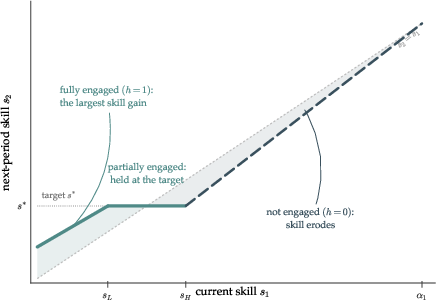
Figure 1: The single firm’s engagement policy under no worker mobility targets the lowest-skilled workers: engagement is maximal at the bottom of the skill distribution and monotonically decreases as initial skill rises.
This logic yields a corner solution: full engagement for the least skilled, decreasing engagement for intermediate workers (to achieve a fixed skill target s∗), and zero engagement for workers whose skills remain above fallback needs even without additional training investment.
Labor Market Mobility and the Sorting Motive
Introducing worker mobility fundamentally alters the engagement calculus. Firms recognize that their investment in general human skills may not be fully appropriable; skilled workers can be poached. Therefore, the engagement policy internalizes two new effects:
- Sorting Motive: Engagement attracts more and stronger workers, since high-engagement jobs create more valuable skill trajectories.
- Appropriability Loss: Some of the returns to upskilling spill over to other firms when workers move.
Under mobility, equilibrium engagement is no longer targeted at the least skilled. Instead, it's redirected toward higher-skill workers near the AI benchmark, who have the most to gain from skill increases in terms of labor market returns, and for whom engagement is least costly in terms of current productivity.
This engagement reversal is robust and persists across broad parameter ranges. The sorting motive can, for sufficiently strong labor mobility, more than offset the appropriability loss, yielding greater engagement investment among the most skilled below the AI-imposed ceiling.
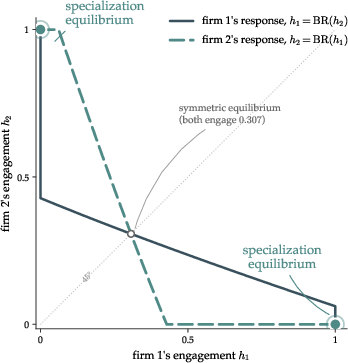
Figure 2: When worker mobility is present and sorting frictions are low, ex ante identical firms can specialize: one acts as a skill-builder, engaging workers heavily, while the other free-rides on the portability of skill, leading to asymmetric profit distribution.
AI Capability and Reliability as Distinct Levers
The model distinguishes sharply between the roles of improving AI capability and AI reliability:
- AI Capability: Higher st<αt0 (better AI output when available) increases the skill gap that can be closed, magnifying the appeal of high-engagement jobs for workers, which (under mobility) increases engagement investment.
- AI Reliability: As st<αt1 increases (failures become rarer), the fallback motive weakens (lowering engagement), but exposure-practice learning may be optimal at intermediate reliability levels. Engagement is maximized not for the most reliable nor the least reliable AI, but rather at an intermediate regime where skill is most efficiently accumulated.
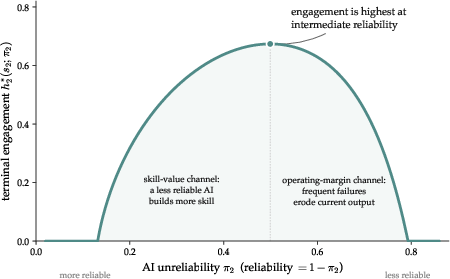
Figure 3: Under worker mobility, equilibrium engagement displays a non-monotonic relationship with AI reliability, peaking at intermediate values of unreliability st<αt2.
This constitutes a hump-shaped comparative static, separating the effect of AI progress into regimes by whether increasing reliability primarily reduces fallback needs or suppresses valuable engagement-driven learning.
Asymmetric Specialization and Equilibria
The model further demonstrates that when skill spillovers (due to mobility) are strong, pure strategy symmetric equilibria may not obtain. Instead, ex ante identical firms may endogenously specialize:
- One firm becomes a "skill-builder" (incurring the training cost),
- The other becomes a "free rider" (attracting skilled workers after their training period).
Despite investing less in upskilling, the free rider can realize higher profits because it benefits from the externalized training performed by its rival.
Empirical and Practical Implications
- The results clarify that the decision to “route residual work to the machine” is not purely operational; it is an intertemporal human capital investment problem, sensitive to labor mobility and the evolving structure of the labor market.
- Firms operating under wage compression and high mobility face a competitive imperative to engage and upskill the most capable human workers, both to retain them and to protect future fallback capability.
- Industry design parameters (e.g., compensation flexibility, market frictions) critically shape the equilibrium distribution of skill investment and the risk of long-run deskilling.
Future Directions
The presented framework admits several extensions:
- Longer time horizons and endogenous AI progress could add further realism and feedbacks.
- Introducing wage competition (relaxing the market wage schedule) or richer forms of contract design (e.g., joint incentives or multi-stage engagement/bonus contracts) would tighten the link with observed labor market dynamics.
- Empirical work could operationalize the model by measuring transition probabilities, skill decay, and engagement rates in real settings, such as software development, legal review, or medical practice.
Conclusion
Optimal engagement policy in AI-assisted workflows is mediated by a complex interplay among AI technical attributes, human skill formation dynamics, and labor market architecture. The model shows that worker mobility can invert canonical predictions about who is targeted for upskilling and that investment in human capital is sensitive to strategic complementarity and the appropriability of training investments. The findings have direct consequences for the design of work and training policies in the age of rapidly improving, but still fallible, AI.

