Solv3R: 3D Looped Transformer as a Multi-view Solver
Abstract: Classical structure-from-motion reconstruction proceeds iteratively, refining camera poses and scene geometry from a current estimate. This allows maps to easily expand without recomputing already computed views, or geometry estimates to improve as more observations are provided. Most geometric foundation models, however, predict entire geometry in a single forward pass or update a recurrent state as frames arrive sequentially, making this expansion and refinement non-trivial. We introduce Solv3R, a looped transformer that learns to continue solving multi-view geometry from its current state. Importantly, its update operator is independent of the iteration count, allowing previously refined and newly introduced views to be jointly updated regardless of how ``solved'' they are. We train the operator to preserve accurate reconstructions under continued iteration and correct inaccurate states, enabling refinement of fixed image collections and integration of new observations. Representations of solved views can also be cached once and reused as geometric context across iterations, enabling compact and efficient key-value caching. We analyze the solver dynamics and compare it with the state-of-the-art, demonstrating that a single learned solver supports offline reconstruction, incremental reconstruction, relocalization, and streaming without task-specific training or modules. The code and models will be made publicly available at https://ubc-vision.github.io/solv3r/.


Paper Prompts
Sign up for free to create and run prompts on this paper.
Explain it Like I'm 14
1. What is this paper about?
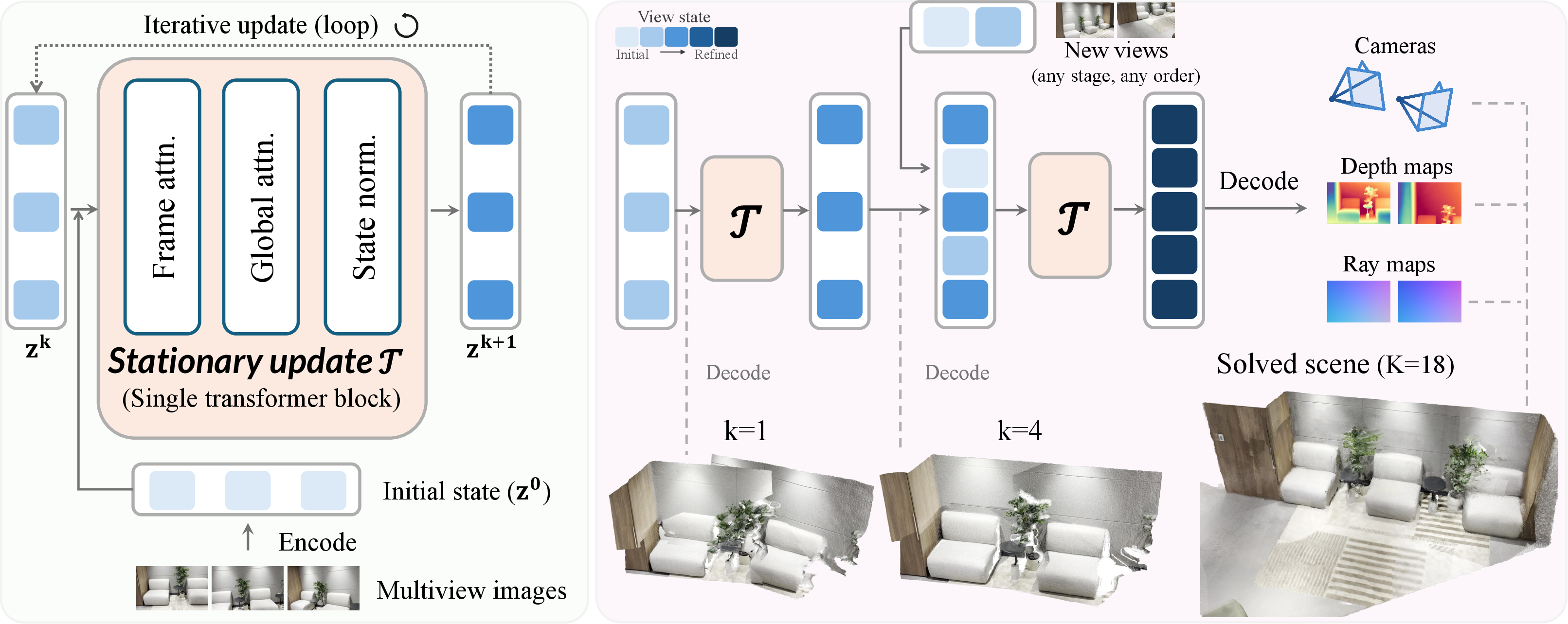
The paper introduces Solv3R, an AI system that builds a 3D map of a scene from several pictures or video frames.
For example, imagine taking photos of a room from different places. Solv3R tries to figure out:
- where each camera was located,
- how the cameras were rotated,
- the depth and shape of objects,
- and how all the pictures fit together into one 3D scene.
The main idea is that Solv3R does not solve the scene only once. Instead, it works like a person checking and improving a drawing again and again. It can keep refining its answer, add new pictures later, and correct earlier mistakes.
2. What questions does the research ask?
The researchers wanted to know whether one AI system could handle many different 3D-reconstruction situations without needing a separate tool for each one.
In simple terms, they asked:
- Can the system keep improving a 3D reconstruction over time?
- Can it leave a correct reconstruction unchanged instead of making it worse?
- Can it fix mistakes if its current answer is disturbed or inaccurate?
- Can it add new images without starting completely over?
- Can it process images as they arrive, like frames from a moving camera?
- Can it reuse information from an already-built map to quickly locate a new camera?
These abilities are important because real-world systems often receive new information gradually rather than receiving every image at once.
3. How did the researchers build and test Solv3R?
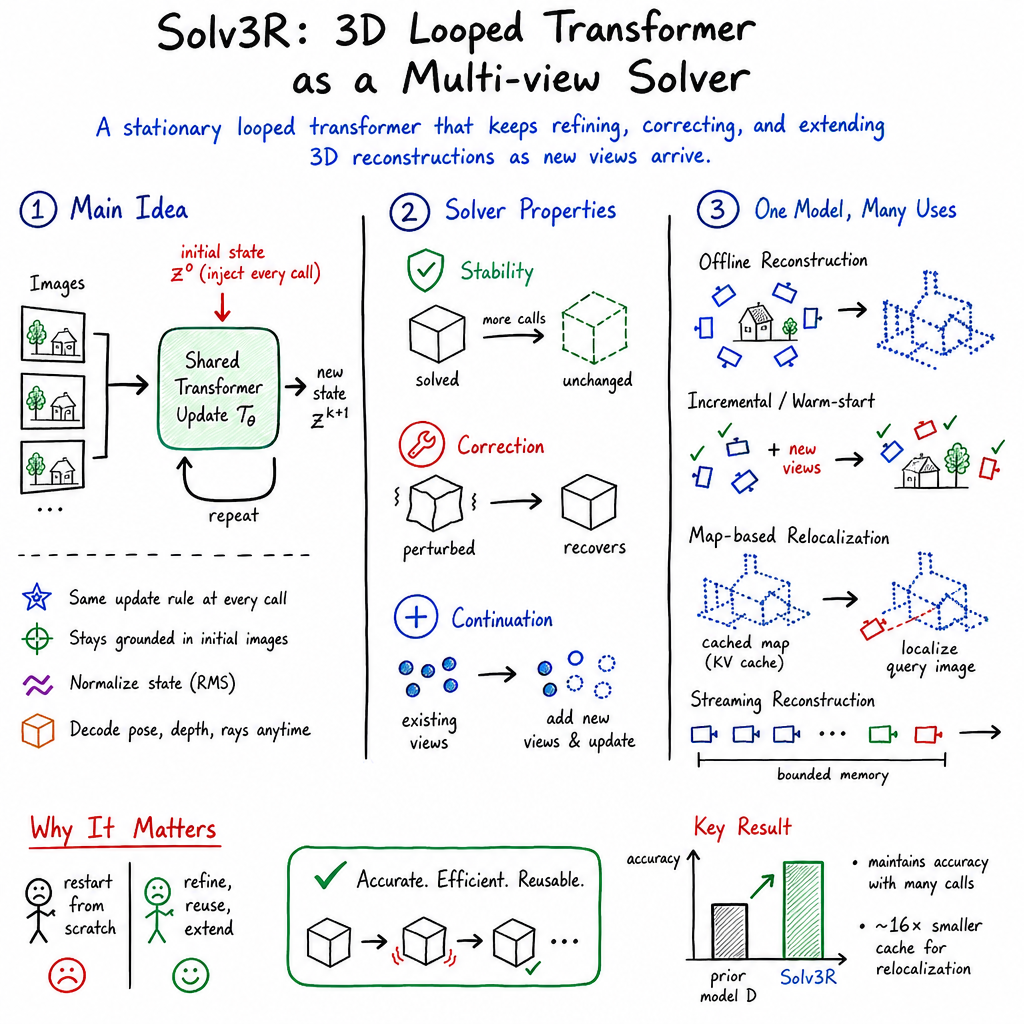
The main idea: a reusable update step
Solv3R uses a type of AI called a transformer. A transformer is a model that can compare many pieces of information and decide how they are related. In this case, it compares different images and their current 3D estimates.
The important part is that Solv3R repeatedly uses the same update operation. This is similar to solving a math problem by following the same improvement step many times:
- Make an initial guess.
- Check how well the guess fits the images.
- Improve the guess.
- Repeat until the answer changes very little.
The researchers call this a stationary solver. “Stationary” means that the system uses the same rules every time, regardless of whether it is on its first, tenth, or hundredth update.
This differs from many other AI systems, which use different rules at different stages. Such systems may work well for the exact number of steps they were trained for but become unstable if asked to continue longer.
Information about the original images
At every update, Solv3R receives both:
- its current estimate of the 3D scene, and
- information from the original images.
This is like a student repeatedly checking their answer against the original question. Without this check, mistakes could build up over time.
Training the system
The researchers trained Solv3R to have three important behaviors:
| Desired behavior | Simple meaning |
|---|---|
| Stability | If the answer is already correct, further updates should not ruin it. |
| Correction | If the answer is slightly wrong, more updates should repair it. |
| Continuation | If new images are added, the system should continue from the old answer instead of starting over. |
During training, the researchers sometimes added noise to the system’s current estimates or reset some images to their starting state. This taught Solv3R how to recover from imperfect conditions.
Testing on different tasks
The researchers tested Solv3R on:
- ordinary offline 3D reconstruction,
- adding new images to an existing reconstruction,
- locating a new camera in an existing map, called relocalization,
- and streaming reconstruction, where images arrive one at a time.
They compared it with other 3D-reconstruction systems, especially a previous method called D.
4. What did the researchers find?
Solv3R remains stable
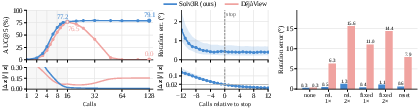
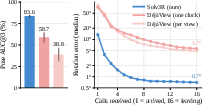
Solv3R kept its accuracy when it was run for more updates. In contrast, the earlier system D often became less accurate when it continued beyond the number of steps used during training.
In one test, 144 out of 148 reconstruction examples stopped successfully because their estimates had become stable. Of these, 143—about 99.3%—had camera rotation errors below 5 degrees.
This suggests that Solv3R can recognize when it has reached a reliable answer.
Solv3R can correct mistakes
The researchers deliberately disturbed Solv3R’s internal estimates by adding random noise or resetting some views. Solv3R was generally able to recover accurate camera positions afterward.
This is important because real-world data is rarely perfect. Images may be blurry, incomplete, or temporarily confusing.
It can add new views efficiently
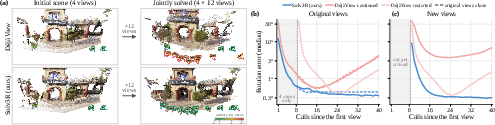
When new images were introduced, Solv3R used the existing reconstruction as a starting point. It improved both:
- the newly added views, and
- the estimates of the older views.
It usually needed fewer updates than rebuilding the entire scene from the beginning.
This is similar to adding new pages to a map without throwing away the old map. The new information can even help correct earlier parts.
It works when different views have received different amounts of processing
Some images may have been processed many times, while newly added images may have been processed only once. Solv3R could still update them together.
The paper reports that different starting points produced camera rotations differing by only about 0.08 degrees on average in one experiment. This shows that Solv3R is not overly dependent on every image being processed in exactly the same way.
It supports faster streaming reconstruction
Because previously processed information can be reused, Solv3R can handle video frames as they arrive. The researchers report that a pipelined version could process frames much faster than a method that repeatedly solves the entire window from scratch.
In one example, the system could process roughly 16 times more frames per second in part of the pipeline, and about 10 times more end-to-end.
It reuses maps with less memory
Solv3R can store a compact form of a solved map and reuse it when locating a new camera. This stored information is called a key-value cache. It is like keeping useful notes about a map so that the system does not need to reread all the original images every time.
The paper says Solv3R can reduce this cache storage by about 16 times compared with a stage-specific caching approach.
On relocalization tests, Solv3R achieved strong results while using a small cache. It had the highest reported localization recall on the two tested benchmarks.
Ablation results show which parts matter
The researchers also removed parts of Solv3R to see what would happen. This is called an ablation study—similar to taking parts out of a machine one at a time to discover what each part does.
The results showed that:
- using the same update rule at every step helps long-term stability;
- repeatedly providing the original image information is important;
- normalizing the internal state prevents it from growing or shrinking uncontrollably;
- training with disturbed or reset views helps the system combine old and new images;
- step-dependent rules may work for a fixed number of steps but are less flexible for long-term use.
The table included in the paper supports this conclusion. The full Solv3R model performs much better after many updates than versions with step-conditioned updates or without input injection.
5. Why are these results important?
Many existing 3D systems are good at producing an answer in one large operation. However, they may struggle when:
- more images arrive later,
- the scene is too large to process all at once,
- the system needs to correct an earlier mistake,
- or the system must run continuously on a video stream.
Solv3R is designed more like a reusable problem-solving engine. It can continue from its current state instead of starting from zero each time.
This could make 3D technology more useful for:
- robots exploring unfamiliar places,
- augmented-reality glasses,
- self-driving vehicles,
- camera tracking,
- video games and virtual worlds,
- indoor mapping,
- and systems that need to recognize their location on an existing map.
Conclusion
Solv3R is a new AI method for creating and updating 3D maps from multiple images. Its biggest contribution is not simply making a good first prediction. It is learning how to keep solving the problem.
The system uses the same update rules repeatedly, which helps it remain stable, repair mistakes, and include new views without rebuilding everything. The experiments show that it performs competitively on standard 3D tasks while also supporting incremental, streaming, and map-based reconstruction.
The potential impact is significant: future robots, cameras, and AR devices may be able to build 3D understanding more continuously and efficiently, just as a person gradually improves a map while discovering more about the world.
Practical Applications
Immediate Applications
The paper’s central innovation—a stationary, looped transformer that can refine existing 3D reconstructions, incorporate new views, and reuse cached geometric context—supports the following applications with currently available vision hardware and software infrastructure.
- Robotics: online visual SLAM and navigation
- Deploy Solv3R-like inference in mobile robots, drones, and autonomous vehicles to estimate camera poses, depth, and 3D structure while new frames arrive.
- Existing map states can be warm-started and periodically reactivated when new observations reveal inconsistencies, avoiding full reconstruction from scratch.
- Potential workflow: an initial set of anchor images establishes a coordinate frame; incoming camera frames are inserted into a sliding window; adaptive solver calls continue until the relative state update falls below a threshold.
- Dependencies: sufficient visual overlap, calibrated or reliably estimated camera intrinsics, adequate GPU/edge-accelerator capacity, and robustness to motion blur, dynamic objects, lighting changes, and textureless surfaces.
- Augmented reality and mixed-reality tracking
- Use cached map representations for rapid relocalization of headsets, smartphones, or wearable cameras after tracking loss.
- A device can retrieve nearby map views and refine its current pose against the frozen geometric context, rather than rebuilding the entire scene.
- The reported map-based relocalization results suggest a practical design for low-memory localization services using one reusable key-value cache per map view.
- Dependencies: a preconstructed map, an image-retrieval component for selecting relevant views, stable scene geometry, and privacy-compliant storage of visual maps.
- 3D scanning and digital-twin creation
- Apply the model to handheld image collections, construction-site captures, real-estate walkthroughs, cultural-heritage documentation, and industrial inspection.
- Operators can begin reconstruction with a small image set and append images later. Earlier camera and geometry estimates can be jointly revised when new evidence improves the scene.
- Potential product: an incremental 3D capture application with “add photos,” “refine map,” and “continue scan” operations instead of a fixed one-shot reconstruction pipeline.
- Dependencies: overlapping observations and appropriate scene coverage; the reported benchmarks do not guarantee accuracy for highly reflective, transparent, deformable, or rapidly changing environments.
- Video-processing and content-production tools
- Use streaming reconstruction to generate camera trajectories, depth maps, and coarse 3D assets during video capture.
- The solver’s pipelined mixed-progress operation can process new frames while older frames continue refining, potentially improving throughput without increasing output latency.
- Potential tools: automatic camera tracking, depth-assisted video editing, view synthesis preprocessing, and 3D-aware stabilization.
- Dependencies: deployment must meet the target video frame rate and memory budget; temporal consistency and failure detection are required for professional production workflows.
- Map-based localization for field operations
- Build visual maps for warehouses, factories, museums, campuses, and infrastructure sites, then localize workers, inspection cameras, or robots against those maps.
- The compact reusable cache is particularly relevant where many queries must be localized against a mostly fixed environment.
- Dependencies: maps must be periodically refreshed as the environment changes; localization should expose confidence estimates and fallbacks because the paper’s accuracy results are benchmark-dependent.
- Software infrastructure for reusable geometric inference
- Integrate Solv3R-style stationary updates into reconstruction libraries as a common backend for offline, incremental, out-of-order, and streaming inputs.
- Adaptive stopping based on the relative state update can provide a computation-quality trade-off: easy scenes terminate early, while difficult scenes receive additional solver calls.
- Potential product: an API supporting operations such as
initialize(images),add_views(images),refine(),relocalize(query), andstream(frame). - Dependencies: production use requires model packaging, hardware-specific optimization, memory management for long sequences, and validation outside the datasets reported in the paper.
- Academic research and benchmarking
- Use the stationary-solver formulation as a baseline for learned iterative refinement in multi-view geometry, visual SLAM, depth estimation, and neural scene reconstruction.
- The paper provides concrete evaluation dimensions beyond single-pass accuracy: stability under continued iteration, correction after state perturbations, continuation after adding views, mixed-progress solving, and cache reuse.
- Dependencies: researchers should reproduce results on diverse datasets and report failure cases, calibration sensitivity, dynamic-scene performance, and uncertainty—not only average pose or geometry metrics.
- Policy and public-sector mapping
- Government agencies could use incremental reconstruction for surveying buildings, roads, archaeological sites, disaster areas, or public infrastructure as new imagery becomes available.
- Existing maps could be revised with drone, vehicle, or citizen-collected imagery without recomputing every prior observation.
- Dependencies: imagery ownership, consent, data retention, geolocation privacy, cybersecurity, and human review are essential, especially for maps of private or sensitive locations.
Long-Term Applications
The following applications are technically plausible but require additional research, large-scale validation, or engineering before high-stakes deployment.
- Autonomous vehicles with continuously revisable world models
- A vehicle could maintain a persistent 3D map while jointly refining past and newly observed camera poses as road scenes evolve.
- This could support localization, obstacle mapping, map updates, and recovery from temporary sensor degradation.
- Required development: integration with LiDAR, radar, inertial sensors, and semantic prediction; certified uncertainty estimation; robust handling of moving vehicles and pedestrians; and safety validation under rare failure conditions.
- Long-duration robot fleets sharing geometric maps
- Multiple robots could contribute images to a shared map, with Solv3R-like continuation used to merge new observations and revise previously estimated geometry.
- Applications include warehouse automation, mining, agriculture, search and rescue, and planetary exploration.
- Required development: distributed state synchronization, conflict resolution, communication-efficient cache exchange, multi-camera calibration, and resilience to inconsistent or adversarial observations.
- Large-scale city and infrastructure digital twins
- Municipalities and utilities could maintain continuously updated 3D representations of streets, buildings, bridges, railways, and energy infrastructure.
- Incremental reconstruction would allow new drone flights, vehicle scans, and inspection images to update existing models rather than trigger full batch processing.
- Required development: scalable map partitioning, geographic coordinate alignment, semantic change detection, multi-sensor fusion, and governance for persistent geospatial surveillance.
- Robotic manipulation and spatial task planning
- A robot could use continuously refined camera geometry to construct and update a workspace model while manipulating objects or moving through clutter.
- Cached geometric context could reduce the cost of repeated localization and object-view alignment.
- Required development: object-level and deformable-scene modeling, real-time guarantees, collision-safe uncertainty handling, and tight coupling with motion planning and control.
- Medical and surgical imaging
- In principle, the iterative reconstruction strategy could support multi-view endoscopic, laparoscopic, dental, or orthopedic imaging when observations arrive incrementally.
- A solver could refine anatomy geometry as additional views become available.
- Required development and caution: medical validation is substantial. The current paper does not establish performance on anatomical imagery, deformable tissue, nonrigid motion, sterile clinical workflows, or patient-specific uncertainty. Any clinical use would require regulatory approval, interpretable confidence measures, and clinician oversight.
- Digital preservation and cultural heritage
- Museums, archives, and archaeological teams could maintain revisable 3D records that improve whenever new photographs or scans are collected.
- Out-of-order reconstruction is useful when images originate from different campaigns or institutions.
- Required development: photometric normalization, transparent provenance tracking, long-term format stability, and methods for distinguishing genuine geometry from reconstruction artifacts.
- Personal spatial memory and consumer devices
- Smartphones or glasses could maintain private, continually updated 3D models of homes, workplaces, or travel locations for navigation, accessibility, object finding, and immersive replay.
- Relocalization against cached maps could allow rapid recovery after a device loses tracking.
- Dependencies: on-device efficiency, battery consumption, secure encryption, user control over map retention, protection against unauthorized spatial surveillance, and reliable behavior in changing environments.
- Energy and industrial inspection
- Persistent 3D maps could support inspection of wind turbines, solar farms, pipelines, power lines, factories, and other large assets.
- New inspection images could be aligned with historical geometry to detect structural or surface changes.
- Required development: accurate metric scale, defect-sensitive reconstruction, multispectral or thermal fusion, weather robustness, and validated change-detection thresholds. Solv3R alone estimates geometry and does not constitute an inspection or fault-diagnosis system.
- Standardized learned-solver platforms
- The stationary update principle could become a general architecture for learned optimization in areas such as stereo, optical flow, inverse rendering, neural simulation, and scientific imaging.
- Training with stability, correction, continuation, state perturbations, and adaptive termination offers a reusable design pattern for models expected to operate beyond a fixed inference horizon.
- Required development: theoretical convergence guarantees, calibrated stopping criteria, robustness bounds, systematic scaling studies, and methods for detecting when an apparent fixed point is inaccurate rather than genuinely solved.
Overall, the most immediately actionable opportunities are incremental 3D reconstruction, streaming SLAM, map-based relocalization, AR tracking, and reusable reconstruction software. More safety-critical or large-scale uses depend on broader validation, uncertainty estimation, dynamic-scene robustness, sensor fusion, and privacy-preserving deployment.
Glossary
- Adaptive inference: A method that dynamically adjusts computation, such as stopping iterations when further refinement is small. “We use this measure for adaptive inference, stopping refinement when .”
- Attention context: Information supplied to an attention mechanism to guide the processing of a query or representation. “a fixed reconstructed map can provide a single KV cache reused across solver calls.”
- Chamfer distance: A metric measuring the average nearest-neighbor distance between two point sets. “reconstruction Chamfer distance (m)”
- Constraint satisfaction problem: A problem defined by variables that must satisfy a set of mathematical constraints. “consider a classical constraint satisfaction problem, solving a linear system with the Jacobi method”
- Corrective refinement: Iterative updating that moves an inaccurate estimate toward a correct solution. “These perturbations expose the operator to a broader range of states, encouraging corrective refinement beyond its usual trajectories.”
- Depth map: An image-like representation whose values encode distances from the camera to scene surfaces. “The refined state is decoded into depth and ray maps”
- Distillation: Training a model to reproduce predictions or representations generated by another model. “We also distill its predictions after 16 solver calls into the solver.”
- Equilibrium model: A model designed to represent or converge toward a stable fixed-point state rather than relying only on a fixed sequence of layers. “Related work on equilibrium and recurrent models investigates fixed-point behavior, stability, and extended computation”
- Feed-forward model: A model that processes inputs through a fixed forward computation without iterative state updates. “these models estimate geometry in a feed-forward manner.”
- Fixed point: A state that remains unchanged when an update operator is applied. “The accurate solution , which satisfies , is a fixed point”
- Foundation model: A broadly pretrained model intended to support multiple downstream tasks or settings. “Recent geometric foundation models (GFMs)”
- Geometric foundation model (GFM): A foundation model that predicts three-dimensional geometry and related quantities from images. “Most geometric foundation models, however, predict entire geometry in a single forward pass”
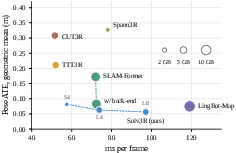
- Geometric-mean pose ATE: A combined evaluation measure based on the geometric mean of absolute trajectory error for camera poses. “Comparison of online reconstruction methods in terms of geometric-mean pose ATE”
- Geometric supervision: Training supervision based on geometric quantities such as camera poses, depths, or reconstructed points. “We supervise geometric predictions after varying numbers of solver calls”
- Global attention: An attention operation allowing representations from all views or tokens to interact. “with frame-wise and global attention.”
- Inlier ratio: The proportion of measurements or correspondences considered consistent with a geometric model. “and inlier ratio (IR, ).”
- Jacobi method: An iterative numerical algorithm for solving systems of linear equations by updating each variable using the previous iteration’s values. “solving a linear system with the Jacobi method”
- Key–value (KV) caching: Reusing attention keys and values computed earlier to avoid repeating computation. “key--value (KV) caching allows previously reconstructed views to serve as fixed attention context”
- Latent state: An internal, learned representation that summarizes the current computational or geometric estimate. “D \cite{burzio2026dejaview} formulates multi-view reconstruction as iterative refinement of a latent state.”
- Looped transformer: A transformer that repeatedly applies a shared block to update a representation over multiple iterations. “We present Solv3R, a looped transformer that learns to solve multi-view geometry from its current state.”
- Map-based relocalization: Estimating a query camera’s position and orientation relative to a previously reconstructed scene map. “We evaluate map-based relocalization on 7-Scenes~\cite{7scenes} and Cambridge~\cite{cambridge}”
- Multi-view geometry: The geometric relationships among multiple images observing the same three-dimensional scene. “We introduce Solv3R, a looped transformer that learns to continue solving multi-view geometry from its current state.”
- Normal consistency: A metric measuring the agreement between surface normals in a reconstruction and those in the reference geometry. “and normal consistency ([ADDRESS]).”
- Optical flow: The apparent motion of image pixels between frames, often used to estimate scene or camera motion. “Learned iterative refinement has been widely applied to optical flow”
- Perturbation training: Training on deliberately modified states so that a model learns to recover from errors or noise. “we occasionally perturb the state before the differentiable calls”
- Point map: A per-pixel representation associating image locations with three-dimensional points. “progressing from pairwise pointmap regression and matching”
- Pose estimation: The process of estimating a camera’s position and orientation. “They typically employ successive transformer blocks to progressively build geometry-aware representations and predict camera poses”
- Ray map: A representation encoding camera rays associated with image pixels, often used to infer scene geometry. “The refined state is decoded into depth and ray maps”
- Recurrent state: An internal representation carried across sequential inputs and updated over time. “or update a recurrent state as frames arrive sequentially”
- Relative state update: A normalized measure of how much a model’s internal state changes between successive iterations. “To measure solver stabilization, we define the relative state update between consecutive calls”
- Relocalization: Estimating the location and orientation of a camera within a previously mapped environment. “These results demonstrate that a single learned solver supports offline reconstruction, incremental reconstruction, relocalization, and streaming”
- Root-mean-square (RMS) norm: A magnitude measure calculated from the square root of the mean of squared values. “we rescale the updated state to a fixed root-mean-square (RMS) norm.”
- Scene geometry: The three-dimensional structure and spatial arrangement of objects and surfaces in a scene. “They typically employ successive transformer blocks to progressively build geometry-aware representations”
- Solver call: One application of an iterative update operator to the current state. “We call one iteration, that is, one application of , a solver call.”
- Stationary operator: An update function whose behavior does not depend on the iteration or timestep at which it is applied. “We replace the update of \cref{eq:[PERSON_NAME]} with a learned operator ”
- Structure-from-Motion (SfM): A computer-vision technique that jointly estimates camera motion and three-dimensional structure from multiple images. “Unlike classical Structure-from-Motion~(SfM), which relies on correspondence matching and iterative geometric optimization”
- Test-time adaptation: Adjusting a model or its representations during inference using the current test input. “Some approaches employ persistent scene representations or test-time adaptation”
- Throughput: The amount of data or number of inputs processed per unit of time. “Together, these capabilities support incremental reconstruction, map-based relocalization, and streaming reconstruction”
- Warm start: Initializing an iterative computation with a previously obtained solution rather than starting from scratch. “When a new frame arrives, a reusable solver should retain the states of previously reconstructed views rather than restarting the entire reconstruction.”
- Window-based reconstruction: Reconstruction performed over a limited, typically sliding subset of frames or views. “Window-based methods further integrate local reconstructions through registration and optimization”

