Proving and Improving the Platonic Representation Hypothesis with JEPAs
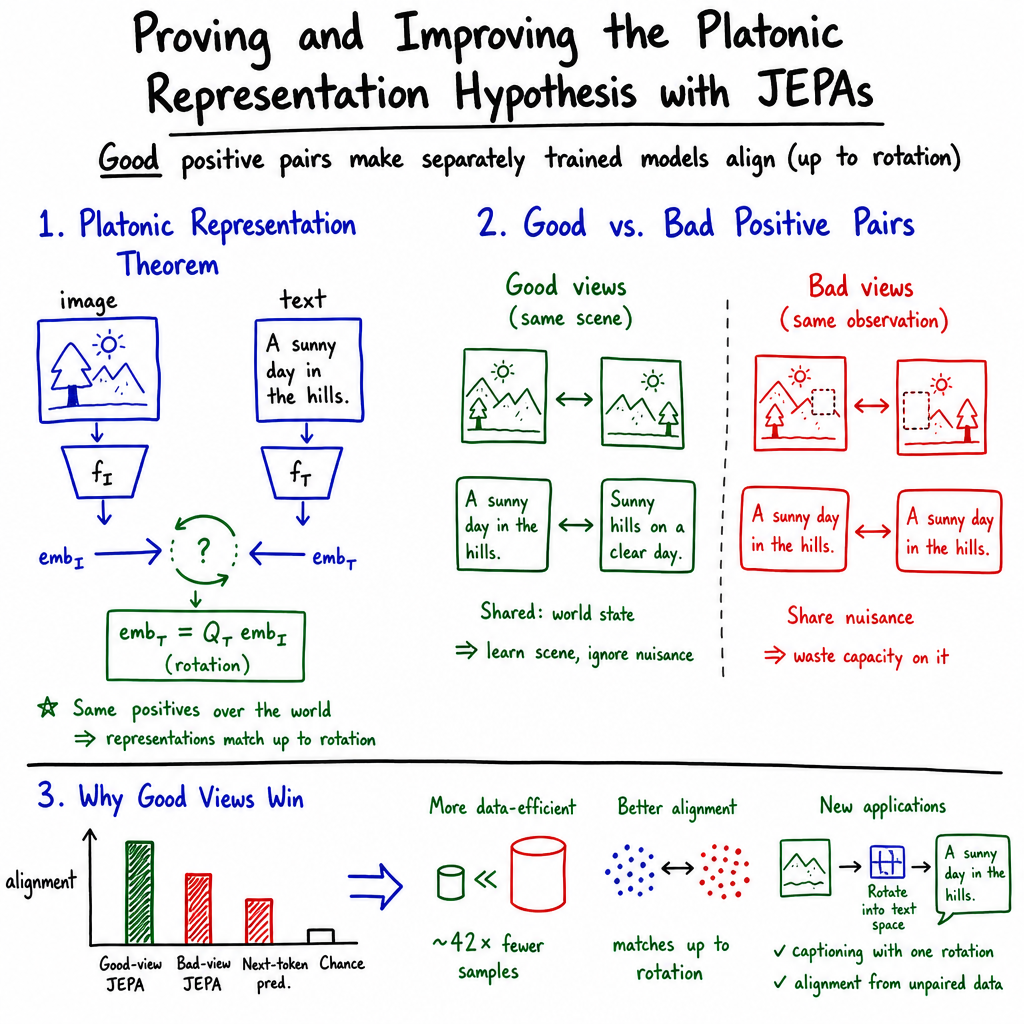
Abstract: Whether models trained on different modalities converge to the same representation of the world is central to AI. The Platonic Representation Hypothesis (PRH) conjectures that they do as they scale, but without a proof it offers neither a guarantee nor a recipe. We turn the hypothesis into a theorem. First, we prove a \emph{Platonic Representation Theorem}: Joint-Embedding Predictive Architectures (JEPAs) trained separately on any number of modalities learn the same representation up to one rotation whenever their positive pairs are two observations of one scene--\emph{good views}--and their misalignment is bounded otherwise. Second, we show that next-token prediction is a JEPA with \emph{bad views}, parts of a single document, which explains why LLMs align with vision only through scale. Third, we validate the theory from 145k captions to the texts of 940M web images, and uncover a scaling law of alignment that predicts unseen runs within seed noise. Good views need 42 times fewer training samples than next-token prediction on the same corpus to reach the same alignment, and a 109M-parameter text JEPA aligns with DINOv2 and CLIP's image encoders better than every LLM we evaluated, up to 72B parameters, and than CLIP's text encoder: next-token prediction is a remarkably inefficient route to platonic representations. As a showcase, one rotation turns separately trained encoders into an image captioner (CIDEr .838 on COCO). Even that rotation needs no pair: on the latest pair-free benchmark, our text JEPA beats every zero-shot accuracy reported with LLMs up to 8B parameters, e.g., 64\% against at most 56\% top-5 on ImageNet-100. Positive views, and not scale alone, are thus the lever to build platonic representations.
Paper Prompts
Sign up for free to create and run prompts on this paper.
Explain it Like I'm 14
1. What is this paper about?
This paper asks a big question about artificial intelligence:
If different AI models study the same world—for example, one model studies pictures and another studies words—will they learn similar ideas?
The authors study the Platonic Representation Hypothesis (PRH). This hypothesis says that, as AI models become better and larger, models trained on different kinds of information may develop a shared understanding of the world.
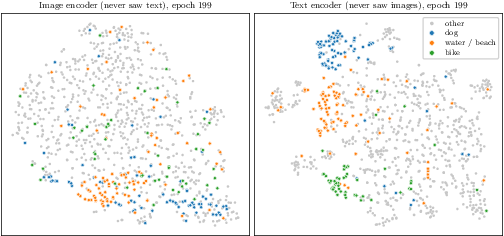
For example, an image model might learn that pictures of dogs are related to beaches, balls, and people. A LLM might learn similar relationships from sentences. The researchers want to know whether these two models can learn matching ideas without being trained together.
Their main claim is that this matching happens much more effectively when models are trained using good views: different observations of the same thing, such as two captions describing one picture.
2. What questions did the researchers investigate?
The paper focuses on several main questions:
- Under what conditions will models trained separately learn similar representations?
- Does the type of training example—called a positive pair—affect how well models align?
- Are two descriptions of the same scene better training examples than two pieces of the same sentence?
- Why do ordinary LLMs sometimes become similar to image models only when they are extremely large?
- Can separately trained image and text models be connected with only a simple mathematical transformation?
- Can this approach improve tasks such as image captioning and image classification?
Here, a representation means the internal information an AI model creates about something. It is like a map inside the model. Similar things should have nearby locations on this map.
3. How did the researchers study these questions?
The main idea: Joint-Embedding Predictive Architectures
The researchers use a type of self-supervised model called a Joint-Embedding Predictive Architecture, or JEPA.
In simple terms, a JEPA learns by looking at two related examples and placing them near each other in its internal map. It does not need a human to label every example.
For instance, a JEPA might be shown:
- two different captions for the same photograph, or
- two different parts of the same caption.
It then tries to give the two examples similar internal representations.
The authors compare two kinds of training pairs.
Good views
A good-view pair contains two different observations of the same real-world scene.
Examples include:
- two captions describing the same photograph;
- two photographs of the same event;
- two video frames showing the same activity.
These examples share the important information about the world, while differing in unimportant details such as wording, camera angle, or lighting.
Bad views
A bad-view pair comes from only one observation, usually by slightly changing or damaging it.
Examples include:
- two masked versions of one sentence;
- two cropped sections of one photograph;
- a beginning of a sentence and the words that come after it.
These examples may preserve details that belong only to that particular sentence or picture. For example, a model may learn an author’s writing style instead of the actual meaning of the text.
Comparing the models
The researchers trained image and text models separately. The models never directly saw each other during training.
They then measured how similar their internal representations were. They used methods such as:
- comparing whether similar images and captions had similar nearest neighbors;
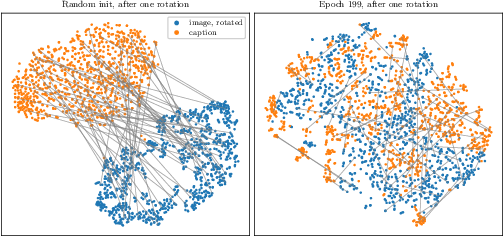
- finding the best rotation, which is like turning one map so it lines up with another map;
- testing whether an image could be matched to its correct caption;
- testing whether the image model and text model could work together for captioning or classification.
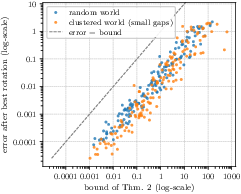
They also developed mathematical proofs. These proofs show that, under ideal conditions, separately trained models using the same good views should learn the same representation, except for a rotation.
This does not mean the models produce exactly the same numbers. It means their internal maps contain the same structure but may be turned, flipped, or rearranged in space.
4. What were the main findings?
Good views make models align better
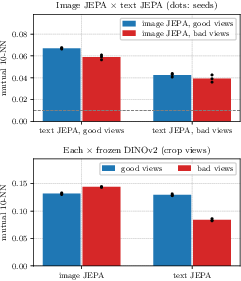
The strongest finding is that models trained with good views became more similar across images and text than models trained with bad views.
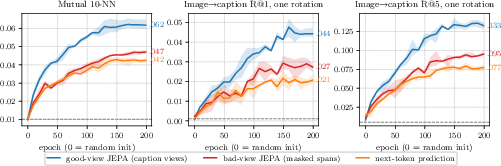
On the Flickr30k dataset, the researchers compared several text-training methods against a separately trained image model:
| Text-training method | Similarity of image and text representations | Correct caption ranked first |
|---|---|---|
| Good-view JEPA | 0.062 | 4.4% |
| Bad-view JEPA | 0.047 | 2.7% |
| Next-token prediction | 0.042 | 2.1% |
| Random starting model | 0.010 | 0.1% |
The numbers are not extremely large, but the good-view model was clearly better. Its correct caption was found first about 44 times more often than chance.
Good views need much less data
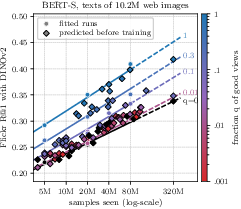
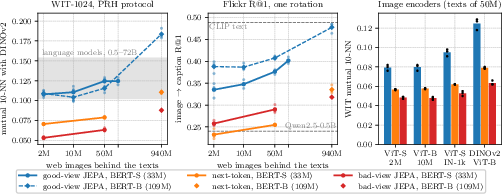
The researchers found that a good-view JEPA needed far fewer examples to reach the same level of alignment as ordinary next-token prediction.
According to the paper, good views needed about 42 times fewer training examples on the same type of text collection.
This is important because many current LLMs use enormous amounts of text and very large numbers of computer calculations. The results suggest that choosing better training examples may be more useful than simply making models bigger.
Next-token prediction is an inefficient way to learn world knowledge
Most LLMs learn by predicting the next word or token in a sentence.
The paper describes this as a kind of bad-view training. A sentence beginning and its continuation are connected, but they do not necessarily describe the same complete scene. They may also share writing style, common words, or information about the document’s author.
Because of this, a LLM may spend some of its internal space learning features that are useful for predicting text but not useful for matching images.
The authors argue that this helps explain why LLMs often need billions of parameters and huge datasets before their representations line up well with vision models.
A smaller text model beat much larger LLMs
In one experiment, a 109-million-parameter text JEPA aligned better with image models than every LLM tested, including models with as many as 72 billion parameters.
This suggests that the way a model is trained can matter more than its size for cross-modal alignment.
The authors summarize this idea as follows:
Better views can be more valuable than simply increasing model size.
The models can be connected with a simple rotation
The researchers also found that separately trained image and text encoders could be connected by learning a simple linear transformation.
This transformation is similar to rotating one map until it matches another. Only a small number of paired examples may be needed to find this alignment.
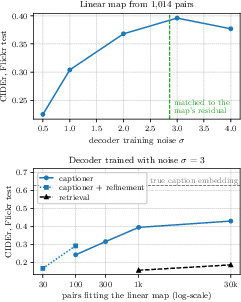
After doing this, the system could generate captions for images, even though the image and text models had not originally been trained together on image-caption pairs. It achieved a CIDEr score of 0.838 on the COCO image-captioning dataset.
The paper also reports that the models could sometimes be aligned without using any matching image-caption pairs at all, by comparing the overall shapes of their internal spaces.
The mathematical theory supports the experiments
The paper’s main theorem says that if different models:
- observe the same underlying world,
- use the same relationships between world states as their positive pairs, and
- use a suitable training objective,
then they should learn the same representation up to a rotation.
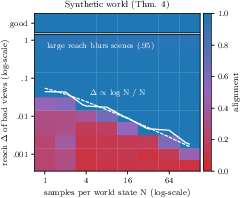
The theory also predicts that alignment will be worse when the positive pairs are different or contain too much irrelevant information.
This is important because the paper is not only reporting experimental results. It also gives a mathematical explanation for why the results occur.
5. Why do these findings matter?
The research suggests a new way to improve AI systems.
Today, increasing the size of a model is often the main way researchers try to make it more capable. This paper argues that the examples used during training may be just as important—or even more important.
Training models with good views could help AI systems:
- connect language, images, video, sound, and actions;
- learn useful world knowledge with less data;
- require fewer model parameters and less computing power;
- transfer knowledge between different types of information;
- improve image captioning and visual question answering;
- build a more unified understanding of the world.
The paper does have important limitations. The mathematical proof depends on simplified assumptions, such as ideal training, perfect data, and certain properties of the model. Real AI systems are more complicated. Also, the experiments focus mainly on images and text, so more research is needed for audio, video, robotics, and other kinds of information.
Overall, the paper’s main message is simple:
AI models may learn a shared understanding of the world more efficiently when they are trained on different observations of the same thing, rather than merely being trained to predict the next piece of data.
This means that carefully choosing what counts as a related pair may be a powerful way to build smaller, faster, and better-connected AI systems.
Practical Applications
Immediate Applications
- More sample-efficient multimodal representation learning (AI/software). Replace or supplement next-token prediction and single-observation augmentations with good-view JEPA training, where positive pairs are multiple observations of the same underlying event or scene. This can reduce the data and compute required to align image, text, audio, video, and other encoders. Potential workflow: collect several captions, frames, sensor readings, or audio descriptions for each event; train separate modality-specific JEPAs; align the resulting embeddings with a small orthogonal map. Dependencies: reliable identification of observations belonging to the same world state, sufficient coverage of the state space, stable anti-collapse regularization, gradient clipping, and a meaningful spectral gap.
- Low-data image captioning without end-to-end image–text training (computer vision). The paper demonstrates that a frozen image encoder and a separately text-trained JEPA can be connected through a learned orthogonal or orthonormal linear map. This supports captioning systems that require only a small number of paired examples for the alignment stage rather than full multimodal pretraining. Potential product: a lightweight captioning adapter for enterprise image repositories, medical imaging archives, or domain-specific visual databases. Dependencies: compatible semantic coverage between the image and text encoders, adequate embedding dimensions, and enough paired examples to estimate the rotation. In the equal-dimensional idealized case, at least linearly independent pairs are sufficient; practical unequal-dimensional mappings require more data.
- Pair-efficient or pair-free cross-modal retrieval (search and information management). Use good-view encoders plus orthogonal alignment to support image-to-text, text-to-image, video-to-caption, or audio-to-text retrieval. The reported pair-free alignment results suggest that shared geometric structure can sometimes identify the mapping without explicit paired examples. Potential tools: multilingual and multimodal search indexes, zero-shot catalog search, media deduplication, and retrieval over unlabeled archives. Dependencies: sufficiently distinctive higher-order geometry; pair-free alignment is not guaranteed by first- and second-order statistics because rotations preserve whitening. Explicit pairs remain necessary when the shared geometry is ambiguous.
- Better design of self-supervised data augmentations (computer vision, speech, NLP).
- multiple captions or descriptions of the same image;
- multiple frames or views of the same event;
- independently recorded sensor streams from the same episode;
- lightly masked and trimmed descriptions that retain shared scene content.
This can replace augmentations that primarily preserve camera viewpoint, author style, wording, lighting, or document identity. Dependencies: augmentations must not remove task-relevant state information, and “same scene” labels must be sufficiently accurate.
- Dataset and training-pipeline diagnostics (ML engineering). The alignment metrics, scene-explained fraction , mutual nearest-neighbor overlap, Procrustes retrieval, and kernel-mismatch perspective can be used to audit whether a multimodal dataset is learning world-relevant structure or modality-specific nuisance. Potential workflow: measure alignment after a single rotation, compare good-view and bad-view controls, estimate how much variance is explained by repeated observations of the same state, and monitor collapse during training. Dependencies: metrics can be misleading when datasets contain leakage, repeated templates, or weakly related observations; alignment does not by itself establish factual correctness.
- Efficient domain adaptation for industry-specific encoders (healthcare, manufacturing, robotics, finance).
- radiology images with multiple clinical descriptions;
- factory video with maintenance reports and sensor logs;
- robot camera observations with language instructions and action traces;
- financial charts with analyst commentary.
This may reduce the need to share raw data across departments or organizations. Dependencies: observations must refer to common states or events, privacy constraints must permit the required calibration pairs, and domain-specific nuisance variables must be controlled.
- Improved zero-shot classification and retrieval (education, commerce, accessibility). A text JEPA aligned to a visual encoder can provide zero-shot labels, visual question interfaces, image organization, and accessibility descriptions. The reported ImageNet-100 results indicate that a relatively small good-view text model can outperform much larger next-token LLMs in certain alignment-based classification settings. Dependencies: performance depends on the semantic breadth and literalness of the descriptions used for training; narrow or biased captions will produce correspondingly narrow representations.
- Practical training guidance for self-supervised models (academia and industry). The paper’s empirical recommendations can be directly incorporated into training recipes: use views from distinct observations of one state, trim views to shared content, use whitening or SIGReg-like anti-collapse terms, apply gradient clipping, and monitor spectral collapse. These recommendations are immediately testable in existing JEPA, VICReg, Barlow Twins, and related pipelines. Dependencies: the formal guarantees assume population optima, injective renderings, unique minimizers up to rotation, and often a spectral gap; finite data and optimization may violate these assumptions.
- Policy and standards for multimodal dataset construction.
Dataset curators can label and document whether pairs represent:
- the same world state,
- the same observation under corruption,
- merely related documents, or
- samples sharing superficial metadata. This distinction can inform procurement standards, model cards, dataset cards, and evaluations for multimodal foundation models. Dependencies: operational definitions of “world state” differ by application, and annotation of scene identity can be expensive or subjective.
Long-Term Applications
Unified world models across vision, language, audio, video, and action (robotics and embodied AI). The theorem suggests a route toward separately trained encoders that represent a common latent world rather than merely sharing information through a joint model. A future system could align camera images, spoken instructions, object trajectories, tactile signals, and motor actions in one representation space. Potential product: a modular robot whose perception, language, and control components can be upgraded independently while retaining a shared world embedding. Dependencies: the current theorem does not cover action-conditioned predictors or full world models; actions may alter the world rather than simply observe it, and temporal causality must be modeled.
- Cross-modal simulation and planning (robotics, autonomous vehicles, industrial control). If video, language, and sensor JEPAs learn aligned state representations, planners could transfer knowledge between modalities—for example, using textual procedures to guide visual manipulation or sensor histories to retrieve relevant maintenance instructions. Dependencies: representation alignment alone does not ensure dynamics, causality, uncertainty calibration, or control suitability. Additional action-conditioned JEPA theory and real-world validation are required.
- Universal multimodal retrieval and personal knowledge systems (daily life and enterprise software). A shared world representation could index photographs, messages, recordings, documents, calendar events, and sensor data by their underlying events. Users might search for “the meeting where the prototype overheated” across video, speech, notes, and images without manually tagging each file. Dependencies: privacy, consent, access control, temporal identity resolution, and robustness to ambiguous or contradictory observations are central unresolved issues.
- Lower-cost foundation models and sustainable AI infrastructure. The reported 42-fold sample-efficiency advantage over next-token prediction for a matched alignment target suggests that good-view objectives could reduce training tokens, energy use, and hardware requirements for multimodal systems. Dependencies: the comparison concerns alignment rather than general language generation; good-view JEPAs may not replace autoregressive models for generation, reasoning, or open-ended planning. Large-scale data collection with multiple views may also offset computational savings.
- Privacy-preserving collaborative learning (healthcare, finance, government). Institutions could train local modality-specific encoders and exchange only aligned embeddings or small orthogonal adapters. Shared representations might enable cross-institution retrieval or analysis without centralizing raw images, text, or sensor records. Dependencies: embeddings can still leak sensitive information; rotation invariance is not a privacy guarantee. Secure aggregation, differential privacy, access control, and formal leakage evaluations would be necessary.
- Automatic discovery of semantically meaningful latent dimensions (science and academia). The spectral interpretation could be used to study which directions in a representation correspond to stable world factors, which are modality-specific nuisances, and where alignment is protected by large eigengaps. This may yield tools for interpretability, representation auditing, and scientific analysis of multimodal datasets. Dependencies: spectral directions can reflect sampling artifacts or nuisance correlations; the connection between eigenstructure and human-interpretable concepts requires further empirical and theoretical work.
- New multimodal benchmarks based on world-state coverage rather than model scale.
- fraction of embedding variance explained by repeated observations of the same state;
- alignment after a single rotation;
- robustness to mismatched positive-pair kernels;
- sample efficiency at a fixed alignment level;
- transfer across unseen modalities.
Such benchmarks could shift progress measurement away from parameter count and token count alone. Dependencies: benchmarks need reliable repeated observations, balanced state coverage, protection against caption or metadata leakage, and metrics that distinguish semantic alignment from superficial correlation.
- Theoretical design of adaptive positive-pair selection (automated ML). A future training system could estimate whether candidate positives share a world state, quantify nuisance retention, and dynamically select or reweight pairs to minimize kernel mismatch. The robust bound suggests that reducing positive-pair mismatch and increasing spectral gaps should improve alignment. Dependencies: estimating world-state identity without supervision is difficult; inaccurate pair selection could amplify dataset biases or connect unrelated states.
- General-purpose cross-lingual and cross-cultural representation alignment. Multiple descriptions of the same event across languages could provide good views for aligning language encoders, potentially improving low-resource translation, multilingual retrieval, and cross-lingual educational tools without requiring large parallel corpora. Dependencies: descriptions must refer to sufficiently similar world states, cultural framing may introduce legitimate rather than nuisance differences, and linguistic encoders may have unequal dimensions or incompatible coverage.
- Safety and governance auditing for multimodal models. The framework could help identify whether a model relies on stable world information or on author identity, camera artifacts, demographic cues, document style, or other nuisance variables. Models whose representations align only through such shortcuts may be unsafe when deployed out of distribution. Dependencies: high alignment is not equivalent to fairness, truthfulness, or safety; dedicated subgroup, distribution-shift, and causal evaluations remain necessary.
Glossary
- Anti-collapse term: A regularization component that prevents learned embeddings from collapsing to identical or uninformative values. “an anti-collapse term that depends on only through the distribution of its embeddings”
- Augmentation graph: A graph whose nodes are samples and whose edges connect samples related by data augmentations or overlapping transformations. “In the augmentation-graph analyses of contrastive learning, such overlaps are what connect samples of one class”
- Bad-view JEPA: A JEPA whose positive pairs are corrupted versions of one observation rather than distinct observations of the same world state. “Call a JEPA good-view when its positives are two observations of world states that the world itself relates [...] and bad-view when they are corruptions of a single observation”
- Centering: The process of making an embedding have zero mean under a specified distribution. “For an encoder centered and whitened on its observations”
- Contrastive learning: A self-supervised learning approach that brings related examples together and separates or contrasts unrelated examples in representation space. “Spectral contrastive learning and whitened MSE fit this form”
- Covariance: A matrix describing how components of a random vector vary jointly. “let be the covariance of the part of its embedding that the world state explains”
- Cross-modal alignment: The degree to which representations from different modalities correspond or can be matched. “cross-modal alignment rises from chance throughout training for every text encoder”
- Eigenspace: The subspace spanned by eigenvectors associated with selected eigenvalues of a matrix or operator. “directions separated from the rest of the spectrum by large gaps are protected”
- Eigengap: The difference between adjacent eigenvalues, often used to establish uniqueness or stability of spectral embeddings. “let be the eigengap of $\mK_{\pi_2}$”
- Eigenvector: A nonzero vector whose direction is preserved by a linear transformation, changing only by a scalar factor. “a JEPA with second-order anti-collapse learns the top eigenvectors of the graph its positives draw”
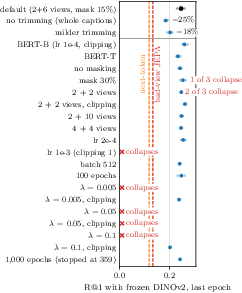
- Embedding collapse: A failure mode in which many or all inputs receive the same or nearly identical representation. “every run that does not collapse lands between .18 and .28”
- Embedding geometry: The structural relationships among points in a representation space, including distances, angles, and neighborhoods. “the rotation can be found from the geometry of unpaired images and captions”
- Finite-support conditional: A conditional probability distribution in which every relevant outcome has positive probability within a finite outcome space. “With full-support conditionals and large enough”
- Full-support conditional: A conditional distribution assigning nonzero probability to every possible target outcome. “With full-support conditionals and large enough, minimizers satisfy”
- Injective rendering: A mapping from world states or observations to representations in which distinct inputs remain distinct. “a modality through an injective rendering ”
- Inner-product prediction: Prediction based on the scalar product between two representation vectors. “inner-product prediction, positives drawn from within one sequence”
- Invariant: Unchanged under a specified transformation. “Both and are invariant to rotations $Q\inO$”
- Joint-Embedding Predictive Architecture (JEPA): A self-supervised architecture that predicts the representation of one input from the representation of another related input. “A JEPA with whitened second-order anti-collapse learns the spectral embedding of its positive pairs”
- Kernel mismatch: A difference between the pairwise relational structures induced by the positive examples of two learning systems. “Kernel Mismatch Bounds Misalignment”
- Laplacian eigenmaps: A spectral dimensionality-reduction method that represents data using eigenvectors of a graph Laplacian. “the population form of Laplacian eigenmaps”
- Linear map: A function preserving vector addition and scalar multiplication, used here to align representation spaces. “One linear map with orthonormal rows”
- Log-partition function: The logarithm of the sum of exponentiated scores, serving as a normalization term in probabilistic models such as softmax classifiers. “its anti-collapse term is the log-partition”
- Matrix factorization: The decomposition of a matrix into products of lower-dimensional matrices or vector representations. “Part (iii) is the matrix-factorization view of word embeddings”
- Mutual 10-NN: A metric measuring overlap between the ten-nearest-neighbor sets of two representation spaces. “Mutual 10-NN \citep{huh2024platonic} measures the overlap of the 10-nearest-neighbor sets in the two spaces”
- Neural collapse: A phenomenon in which representations of related examples converge toward highly structured, often class-specific configurations near the end of training. “the neural collapse that LLMs approach with scale”
- Nuisance variable: A feature of an observation that is specific to its modality and irrelevant or detrimental to cross-modal alignment. “We therefore let each observation carry a nuisance of its own modality”
- Orthogonal Procrustes: An optimization problem that finds the orthogonal transformation best aligning two sets of vectors. “(orthogonal Procrustes).”
- Orthonormal rows: Rows of a matrix that are mutually perpendicular and each have unit length. “We fit a linear map with orthonormal rows”
- Population optimum: The ideal solution obtained by minimizing an expected loss over the underlying data distribution rather than a finite sample. “population optima, and minimizers unique up to rotation”
- Positive pair: Two inputs treated as related examples during self-supervised training. “the pairs of inputs it declares to be views of each other”
- Platonic Representation Hypothesis (PRH): The conjecture that models trained on different modalities converge toward a common representation of the world as they scale. “The Platonic Representation Hypothesis (PRH) conjectures that they do as they scale”
- Spectral embedding: A representation constructed from selected eigenvectors of a matrix encoding relationships among data points. “a JEPA with second-order anti-collapse learns the spectral embedding of the graph its positives draw”
- Spectral gap: A separation between selected eigenvalues and neighboring eigenvalues that supports stability or uniqueness of spectral solutions. “which holds for JEPAs with second-order anti-collapse under a spectral gap”
- Spectral solution: A solution defined by the leading eigenvectors of a relational or kernel matrix. “a spectral JEPA learns, up to , the spectral solution of the world kernel”
- Softmax head: A neural-network output layer that converts scores into a probability distribution using the softmax function. “The next-token loss with a linear softmax head is”
- Stable-pretraining: A training procedure or recipe designed to prevent optimization instabilities during pretraining. “using stable-pretraining”
- Statistical model of reality: A probabilistic representation of regularities in the world inferred from observed data. “they converge to a shared statistical model of reality”
- Top- eigenvectors: The eigenvectors associated with the largest eigenvalues of a matrix or operator. “any orthonormal top- eigenvectors if $\mK_{\pi_1}$ has ties”
- Whitening: A transformation that centers features and makes their covariance matrix equal to the identity. “let whiten the embeddings (, $E_p hh^\top=\mI_k$)”
- World kernel: A matrix or probability structure describing which underlying world states are connected by positive pairs. “call its induced world kernel the probability that a positive pair joins an observation of to one of ”
- Zero-shot classification: Classification performed without task-specific training examples for the target classes. “scores the result by zero-shot classification”