System One models Are Not Better Rerankers
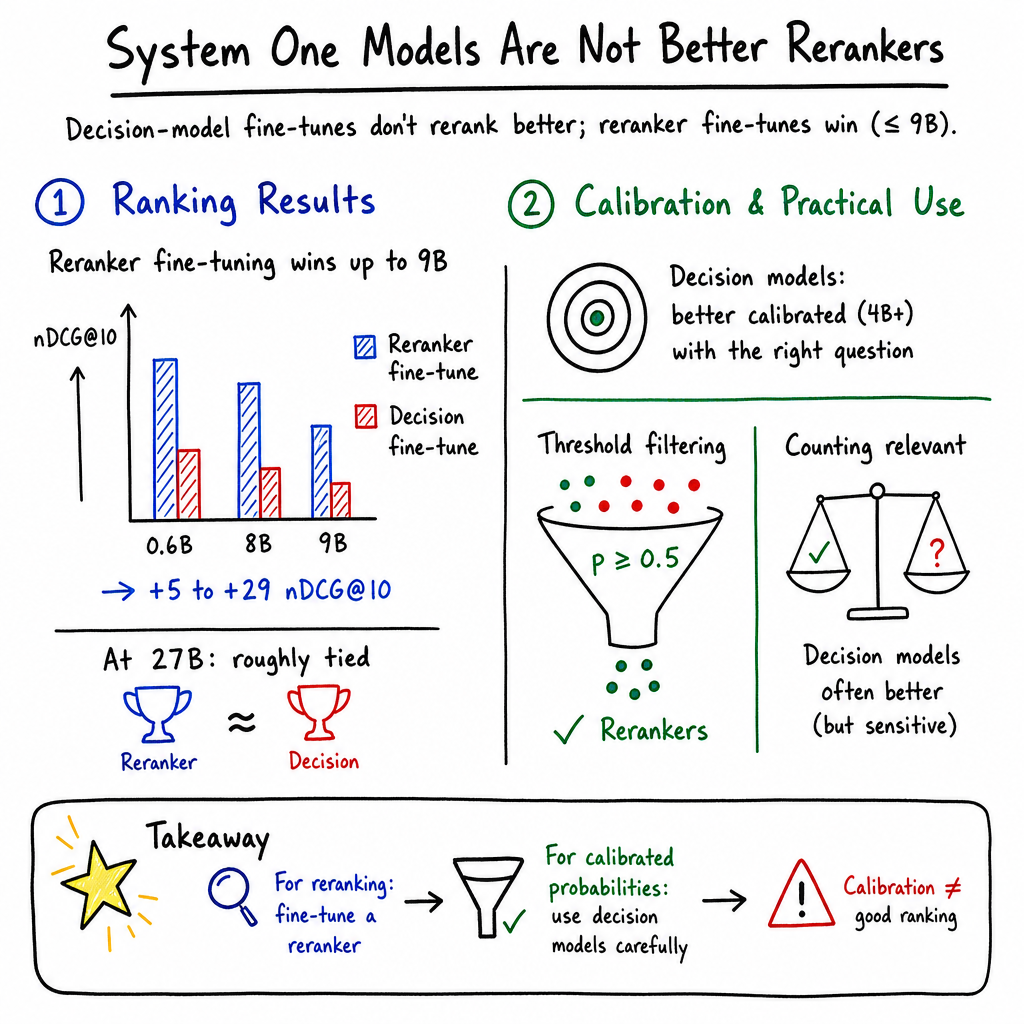
Abstract: System One models, or decision models, answer a question about an input with a calibrated probability instead of generated text. Within weeks of the first release, in September 2026, they were used as rerankers. We test whether the decision fine-tuning behind them makes a better reranker than plain reranker fine-tuning of the same model. For six Qwen backbones from 0.6B to 27B parameters and ten TREC DL and BEIR collections, we compare the untuned model, asked zero-shot, with its decision fine-tunes and its reranker fine-tunes, two of which we train ourselves. In our work, we draw the conclusion that decision fine-tuning never makes the better reranker. From 0.6B to 9B, reranker fine-tuning wins on every backbone by 5 to 29 points nDCG@10, also on zero-shot collections, and at 27B the two tie. Up to 9B, decision fine-tuning adds nothing over simply asking the untuned model. Moreover, we find that the calibration advantage of decision models depends on the question. Asked whether a passage answers the query, they are better calibrated than the published reranker fine-tunes from 4B on. Asked a slightly different question from prior work, they lose this advantage. Lastly, calibration does not make up for a worse ranking: up to 9B, a reranker fine-tune keeps the better passages at a fixed threshold. If you need a reranker, fine-tune a reranker.
Paper Prompts
Sign up for free to create and run prompts on this paper.
Explain it Like I'm 14
1. What is this paper about?
This paper studies whether a new kind of LLM, called a System One model or decision model, is better at organizing search results than a regular reranker.
Imagine searching for “How do volcanoes form?” A search engine might first find 100 possible passages. A reranker then puts the most useful passages at the top.
Decision models give each passage a probability, such as:
- Passage A: 90% likely to answer the question
- Passage B: 40% likely to answer the question
- Passage C: 10% likely to answer the question
The researchers wanted to know whether training a model to make these kinds of decisions produces better search results than training it specifically to rank passages.
Their main conclusion is simple:
If you need a reranker, train a model specifically for reranking. Decision-model training usually does not make a better reranker.
2. What questions did the researchers ask?
The paper focuses on two main questions:
- Do decision models rank search passages better than ordinary LLMs or specially trained rerankers?
- Are the probabilities produced by decision models more trustworthy?
The second question is about calibration. A model is well calibrated if its predictions match reality.
For example, if a model says that 70% of passages are likely to be useful, then about 70% of those passages should actually be useful. It is similar to a weather forecast: if the forecast says there is a 70% chance of rain on 10 different days, it should rain on roughly 7 of those days.
The researchers also asked whether better-calibrated probabilities are useful for:
- Deciding which passages to keep
- Removing passages that are probably irrelevant
- Estimating how many useful passages a search contains
3. How did the researchers conduct the study?
Comparing different kinds of models
The researchers used several versions of Qwen, a family of LLMs ranging from very small models with 0.6 billion parameters to a much larger model with 27 billion parameters.
A parameter is a setting learned during training. In general, more parameters allow a model to recognize more complicated patterns, although bigger does not always mean better for every task.
They compared three kinds of models:
- Untuned models: Ordinary Qwen models that had not been specially trained for ranking.
- Decision fine-tunes: Models trained to answer a question such as, “Does this document answer the query?”
- Reranker fine-tunes: Models trained directly to place useful passages above unhelpful ones.
Fine-tuning means taking a general-purpose model and giving it extra training for a particular job.
Reranking the same search results
First, the researchers used BM25, a traditional search method, to find the top 100 passages for each question. BM25 is like a fast first round of searching that looks for important words shared by the query and the passage.
Then every model examined exactly the same 100 passages. This made the comparison fair.
The decision models were tested in two ways:
- Isolated mode: The model looked at one question and one passage at a time.
- Joint mode: The model looked at the question and all 100 passages together.
In both cases, the passages were ordered according to the model’s score.
Testing on many collections
The researchers used:
- Five TREC Deep Learning collections
- Five BEIR collections
These collections covered different subjects, such as medical information, science, online discussions, and general knowledge. Some collections were not used to train the models, allowing the researchers to test how well the models worked on unfamiliar topics.
Measuring success
The main ranking measure was nDCG@10. This measures how many useful passages appear near the top 10 results, while giving extra importance to the very best positions.
A higher nDCG@10 score means that the search results are generally more helpful.
The researchers also measured calibration using:
- Expected Calibration Error (ECE): How far the model’s probabilities are from what actually happens. Lower is better.
- Brier score: Another measure of how accurate the probabilities are. Lower is better.
4. What did the researchers discover?
Reranker training produced better rankings
For models between 0.6 billion and 9 billion parameters, reranker fine-tuning clearly performed better than decision fine-tuning.
The improvement was between 5 and 29 nDCG@10 points, depending on the model size.
This means that reranker-trained models were much more likely to place useful passages near the top of the search results.
The difference was also found on collections that were not used during training. Therefore, the advantage was not simply because the rerankers memorized familiar topics.
At 27 billion parameters, the decision model and reranker were about equally good. However, decision fine-tuning still did not beat reranker fine-tuning.
Decision fine-tuning often added little
For models up to 9 billion parameters, decision fine-tuning usually performed almost the same as simply asking the original, untuned model whether a passage answered the question.
In other words, the special decision training did not provide much extra ranking ability.
By contrast, reranker fine-tuning gave a large improvement.
Decision models were sometimes better calibrated
Decision models often produced more trustworthy probabilities, especially when they were asked the exact question:
“Does this document answer the query?”
For models of 4 billion parameters or more, decision models were generally better calibrated than the published rerankers.
This could be useful if someone wants to use a probability as a cutoff. For example, a search system might keep only passages with at least a 50% chance of being useful.
Calibration depended heavily on the wording
A surprising result was that changing the question slightly could greatly change the calibration.
The researchers compared:
- “Does this document answer the query?”
- “Is this document relevant to the query? Relevant means it answers the query or contains information that directly addresses it.”
Although these questions sound similar, the second one produced much worse calibration in many cases.
This suggests that decision-model probabilities are strongly affected by the exact wording of the question. A small change in the prompt can make the model’s probabilities less trustworthy.
Better calibration could not fix poor ranking
Even when decision models had better-calibrated probabilities, they still often selected worse passages than reranker models.
For example, suppose a decision model gives more realistic percentages, but its list of passages is not ordered very well. Using a 50% cutoff may still leave the user with a less useful set of passages.
The researchers found that:
A trustworthy score does not automatically produce a good ranking.
However, when two models ranked passages equally well, better calibration could be useful for deciding how many passages to keep.
Looking at all passages together was not always helpful
Joint mode helped the largest models slightly. But it made smaller models much worse.
A likely reason is that the 100 passages can contain a huge amount of text. Smaller models may become confused or run out of space when trying to consider everything at once.
5. Why are these findings important?
The results give practical advice to people building search systems.
If the goal is to put the best search results first, the researchers recommend using a model trained specifically as a reranker. This worked better than decision fine-tuning for almost every model size tested.
Decision models may still be useful when a system needs meaningful probabilities. For example, they might help answer questions such as:
- Should this passage be sent to another LLM?
- Should this passage be removed?
- How many useful passages are probably available?
But users should be careful. The probabilities depend on:
- The exact question asked
- The meaning of “relevant”
- The kinds of examples used during training
- The number of relevant passages normally found in the data
Conclusion
This paper compares decision models with models trained specifically for reranking search results. The researchers tested models of several sizes on ten different search collections.
Their main finding is that decision models are not better rerankers. From 0.6 billion to 9 billion parameters, reranker fine-tuning produced much better rankings. At 27 billion parameters, the two approaches were roughly tied.
Decision models did show an advantage in calibration for some questions, meaning their probabilities were sometimes more realistic. However, this advantage disappeared or became smaller when the wording of the question changed. Better calibration also did not compensate for a poor ranking.
The overall lesson is:
Use reranker training when you want the best search order. Use decision models mainly when reliable probability estimates are especially important—and test their calibration carefully.
Practical Applications
Immediate Applications
- Deploy task-specific rerankers for search and retrieval systems — Industry, software, enterprise search
- Replace or supplement System One/decision-model rerankers with reranker fine-tunes trained directly on query–passage relevance data.
- A practical workflow is:
BM25 or dense retrieval → top-100 candidates → fine-tuned reranker → top-k results. - The paper reports that reranker fine-tuning improves nDCG@10 by approximately 5–29 points over decision fine-tuning for models from 0.6B to 9B parameters, while matching decision models at 27B.
- Potential products include enterprise document search, e-commerce search, legal search, scientific literature discovery, customer-support retrieval, and retrieval-augmented generation (RAG) pipelines.
- Dependencies: A representative relevance dataset, hard negatives, sufficient inference capacity, and evaluation on the target domain. The findings are strongest for BM25 top-100 passage reranking and may not directly transfer to other candidate sizes or modalities.
- Use released untuned models as low-cost zero-shot baselines — Industry, academia
- Before investing in decision fine-tuning, teams can prompt an untuned Qwen-family model with a relevance question such as “Does document X answer the query?” and use the probability of “yes” for ranking.
- Up to 9B parameters, decision fine-tuning added little over simply asking the untuned model the same question.
- This enables rapid prototyping of search and RAG systems without collecting labels or training adapters.
- Dependencies: Performance is substantially below dedicated rerankers, especially for smaller models; prompt wording, tokenization, model APIs, and inference cost must be validated for each application.
- Train lightweight LoRA reranker adapters — Industry, software engineering
- Organizations can create domain-specific rerankers using a relatively simple recipe: LoRA adaptation, hard negatives from BM25 and dense retrieval, a ranking loss, and an auxiliary binary classification loss.
- The authors’ 9B and 27B reranker fine-tunes demonstrate that a plain training recipe can match or approach stronger published rerankers.
- This can support specialized adapters for medical, financial, legal, agricultural, or internal corporate search without retraining a foundation model from scratch.
- Dependencies: Domain-specific labels or weak supervision are needed. The paper’s results use MS MARCO-style data, and performance may decline when relevance criteria differ substantially.
- Use calibrated probabilities for retrieval cutoffs and RAG context selection — Software, knowledge management
- A calibrated relevance score can determine how many retrieved passages to send to a downstream LLM instead of always passing a fixed number.
- It can also discard passages below a threshold, reducing prompt length, latency, and inference cost.
- Decision models from 4B parameters upward generally showed useful calibration when asked the question matching the evaluation label: whether a passage “answers the query.”
- Dependencies: Calibration is tied to the exact relevance definition and base rate. Thresholds should be validated on in-domain data rather than transferred directly from TREC DL or MS MARCO.
- Estimate the number of relevant passages before downstream processing — RAG, search operations, research tooling
- Summing calibrated passage probabilities can estimate how many relevant passages are present among retrieved candidates:
- This could support adaptive workflows, such as expanding retrieval when the estimated number of relevant passages is low or stopping early when enough evidence has been found. - The paper reports that several decision models from 4B parameters upward outperform a median-count baseline on this task. - Dependencies: The query–passage relevance definition and collection-level prevalence must remain stable. The approach is less reliable when the prompt uses a looser relevance definition.
Apply prompt and label audits when absolute scores are used — Industry, academia, policy
- Teams should distinguish between using a score only for ordering and using it as a probability.
- For ranking, prompt wording had relatively limited impact; for calibration, changing the question substantially altered ECE and passage-count accuracy.
- A practical evaluation workflow should test:
- ranking quality such as nDCG@10;
- calibration using ECE and Brier score;
- threshold performance such as F1;
- performance under alternative relevance definitions.
- Dependencies: Human relevance labels must explicitly define what counts as relevant. A probability calibrated for “answers the query” should not automatically be interpreted as calibrated for “contains related information.”
- Calibrate existing rerankers after training — Search infrastructure, model operations
- Temperature scaling can improve the reliability of reranker scores without retraining the entire model.
- This is useful when a strong reranker ranks well but its raw probabilities cannot support thresholding or resource allocation.
- The paper shows that temperature scaling reduced ECE for some rerankers, although post-hoc calibration was not uniformly successful.
- Dependencies: Calibration data should match the deployment domain and expected relevance prevalence. Platt scaling trained on MS MARCO produced poorly transferable absolute probabilities for TREC DL, illustrating the risk of dataset-shifted calibration.
- Reduce research and engineering costs by avoiding unnecessary decision fine-tuning — Academia, AI product development
- Researchers can use the paper’s comparison as a model-selection rule: if the goal is reranking, first test a dedicated reranker fine-tune on the same backbone before adopting a decision model.
- This prevents spending compute and annotation resources on a decision objective that may improve calibration without improving ranking.
- The released code and raw outputs can support reproducible replication and benchmarking.
- Dependencies: The conclusion applies to the tested Qwen-family models, datasets, tasks, and decision-model implementations. Newer decision models or unpublished RLCD variants may behave differently.
- Use isolated rather than joint scoring on smaller models — Software, search infrastructure
- For models below the largest tested scale, score each query–passage pair independently rather than placing all 100 candidates in one context.
- Joint mode reduced performance substantially for smaller decision models, with reported losses of roughly 12–13 nDCG points for some 0.6B–8B systems.
- Isolated scoring also avoids context-window overflow and simplifies batching.
- Dependencies: Joint mode may become useful for sufficiently large models and sufficiently long context windows; the paper found modest benefits at 27B parameters.
- Improve everyday search and question answering through better retrieval filtering — Daily life, education, public information
- Search engines, personal knowledge bases, and educational assistants can use rerankers to prioritize passages that directly answer a question rather than merely sharing keywords.
- This may improve literature searches, homework assistance, workplace knowledge retrieval, and personal document search.
- Dependencies: Results should be presented as retrieved evidence rather than authoritative conclusions, especially in medical, legal, and financial contexts. Domain-specific relevance and factuality evaluation remains necessary.
Long-Term Applications
- Adaptive, cost-aware RAG systems — Software, enterprise AI, cloud infrastructure
- A future RAG controller could combine calibrated passage probabilities with token budgets, latency targets, and answer-risk estimates.
- Such a system might dynamically choose among:
- no additional retrieval;
- retrieving more candidates;
- passing only high-probability passages to the generator;
- invoking a larger reranker or verifier.
- Dependencies: Reliable calibration under domain shift, query-specific base-rate estimation, and end-to-end validation that better retrieval actually improves generated-answer accuracy and reduces hallucinations.
- Relevance-aware agents for research, legal review, and compliance — Legal technology, scientific information, public administration
- Agentic systems could use probability scores to decide which documents deserve deeper reading, citation extraction, human review, or escalation.
- For example, a compliance workflow might prioritize documents with high probability of directly addressing a regulation, while retaining low-confidence cases for manual inspection.
- Dependencies: High-stakes deployments require auditability, fairness testing, provenance tracking, and domain-specific judgments. A calibrated relevance probability does not establish legal validity, scientific correctness, or policy compliance.
- Joint/listwise reranking for large models and long-context retrieval — Long-context LLMs, AI search
- The results suggest that joint mode may become viable as models support longer contexts and better inter-passage reasoning.
- A future system could assess the entire candidate set simultaneously, account for redundancy, identify complementary evidence, and produce calibrated scores for each passage.
- This could improve evidence diversification and reduce the problem of returning many near-duplicate passages.
- Dependencies: The current evidence shows benefits only at the largest tested scale. Memory usage, context length, passage ordering, attention dilution, and computational cost require further study.
- Task-specific calibration standards and governance — Policy, evaluation, responsible AI
- The paper supports developing deployment standards that require organizations to report not only ranking metrics but also calibration relative to an explicit relevance definition.
- Evaluation protocols could require:
- a written definition of relevance;
- in-domain calibration data;
- ECE and Brier scores;
- threshold utility;
- performance across different base rates and user groups.
- Dependencies: Calibration metrics can themselves be unstable under sparse judgments, changing prevalence, and different binning choices. Policy standards should therefore include confidence intervals and multiple evaluation datasets.
- Automated retrieval threshold and budget controllers — Cloud computing, energy efficiency
- If passage probabilities become robust across domains, systems could use them to reduce the number of reranking and generation operations.
- This could lower GPU usage, API spending, latency, and energy consumption in large-scale search and RAG services.
- A controller might stop scoring candidates when the cumulative probability of obtaining another relevant passage falls below a target.
- Dependencies: The controller must account for ranking errors, correlated passages, recall loss, and the asymmetric cost of missing a critical document. Energy savings should be measured end to end rather than inferred solely from fewer passages.
- Personalized relevance models — Education, healthcare information, consumer search
- Future systems could distinguish multiple relevance notions, such as “directly answers,” “provides background,” “is safe for a beginner,” or “supports a clinical decision.”
- A decision-model interface could allow users or applications to specify the desired relevance criterion in natural language.
- This could support personalized educational search, patient-facing information retrieval, and domain-specific recommendation systems.
- Dependencies: The paper shows that prompt wording can change calibration substantially, so natural-language relevance specifications require formal validation. Personalization also raises privacy, fairness, and reproducibility concerns.
- Hybrid ranking-and-decision architectures — Robotics, autonomous systems, tool-using agents
- A dedicated reranker could determine the ordering of candidate documents or actions, while a calibrated decision model estimates whether each candidate meets a safety or task criterion.
- In robotics or tool-use systems, this could support workflows such as ranking available actions and then applying a probability threshold before execution.
- In finance or operations, the same architecture could rank candidate reports or interventions and estimate whether they satisfy a predefined requirement.
- Dependencies: Passage relevance is not equivalent to action safety or outcome probability. Safety-critical systems require separate uncertainty estimation, formal constraints, simulation, and human oversight.
- Better training objectives combining ranking and calibration — Machine learning research
- The authors’ results suggest that ranking loss and probability calibration should be optimized jointly rather than assuming that decision fine-tuning automatically produces a superior ranker.
- Future research could investigate:
- ranking losses with explicit calibration regularization;
- domain-adaptive temperature scaling;
- multi-task objectives for relevance, evidence sufficiency, and uncertainty;
- calibration under changing query-level base rates;
- robust calibration for multilingual and multimodal retrieval.
- Dependencies: Improvements must be evaluated separately for ordering and absolute probabilities. A method that improves ECE may still harm nDCG, while a method that improves ranking may produce unusable thresholds.
- Large-scale reproducible benchmarks for decision models — Academia and standards organizations
- The paper’s controlled comparison motivates benchmarks that keep the backbone, candidate set, and evaluation protocol fixed while varying only the training objective.
- Future benchmark suites could include more domains, languages, modalities, candidate depths, context lengths, and query distributions.
- Such benchmarks would clarify whether the observed 27B-parameter convergence is caused by scale, full fine-tuning, training-state length, or data differences.
- Dependencies: Results should include newer System One models, unpublished or improved RLCD-style methods where possible, stronger reranker baselines, and statistically powered significance tests across diverse collections.
Glossary
- Absolute scale: A numerical scale whose values have direct, interpretable meaning rather than merely indicating relative order. “Calibration matters when a score is read on an absolute scale”
- BERT: A transformer-based language-model architecture commonly used for text understanding and ranking. “Passage Re-ranking with BERT”
- BEIR: A heterogeneous benchmark for evaluating information-retrieval systems in zero-shot settings. “five BEIR collections”
- Binary cross-entropy: A loss function for binary classification that penalizes incorrect probability estimates. “a yes/no classification loss (binary cross-entropy of every passage’s score)”
- BM25: A probabilistic term-weighting algorithm used to retrieve documents based on query–document lexical matching. “the BM25 top-100 of Pyserini”
- Brier score: The mean squared difference between predicted probabilities and binary outcomes. “the Brier score (the mean squared error of the probability against the binary label”
- Calibration: The agreement between predicted probabilities and the observed frequencies of events. “System One models, which we call decision models, promise something else. They answer a question about an input with a calibrated probability instead of generated text.”
- Calibration error: A measure of the discrepancy between predicted confidence and empirical outcome frequencies. “Calibration is the main promise of decision models.”
- Candidate set: The collection of documents retrieved by an initial retrieval system and subsequently reranked. “Every system reranks the BM25 top-100 of Pyserini”
- Checkpoint: A saved set of model parameters produced during training. “Kev-27B is a full fine-tune of the released chat model”
- Classification loss: An optimization objective that trains a model to assign inputs to discrete classes. “a ranking loss (InfoNCE over the group) plus a yes/no classification loss”
- Cross-encoder: A neural architecture that jointly encodes a query and document to produce a relevance score. “so that , as in a cross-encoder.”
- Dense retriever: An information-retrieval model that represents queries and documents as dense vectors for semantic matching. “eight from a dense retriever, seven from BM25”
- ECE (expected calibration error): A statistic that summarizes the difference between predicted probabilities and observed accuracies across confidence bins. “We compute the expected calibration error (ECE, 15 equal-width bins)”
- Fine-tuning: Further training a pretrained model on task-specific data or objectives. “We compare decision fine-tuning with plain reranker fine-tuning of the same backbone.”
- First-stage retriever: The initial retrieval component that produces a relatively large pool of candidate documents. “with candidates from a first-stage retriever”
- Foundation model: A large pretrained model that can be adapted to multiple downstream tasks. “Qwen3. Embedding: Advancing Text Embedding and Reranking Through Foundation Models”
- Hard negative: A non-relevant training example that closely resembles a relevant example and is therefore difficult to distinguish. “each with one relevant passage and 15 hard negatives”
- Holm correction: A multiple-comparison adjustment that controls the family-wise error rate when conducting several statistical tests. “Holm-corrected across the ten collections”
- InfoNCE: A contrastive learning loss that encourages a model to distinguish positive examples from competing negative examples. “a ranking loss (InfoNCE over the group)”
- Isolated mode: A reranking configuration in which the model evaluates each query–passage pair independently. “In isolated mode, the state holds the query and a single passage”
- Joint mode: A reranking configuration in which all candidate passages are provided to the model in one shared context. “In joint mode, the state holds the query and all candidates in first-stage order”
- Listwise reranker: A ranking model that considers or produces an ordering for an entire list of candidate documents. “Joint mode sees the same input as a listwise reranker such as RankGPT”
- Logit: An unnormalized model output that is commonly transformed into a probability through a function such as the sigmoid. “with temperature and Platt scaling of their logit fitted on 1,000 MS MARCO dev queries”
- LoRA (low-rank adaptation): A parameter-efficient fine-tuning method that trains low-rank update matrices instead of all model parameters. “Kev up to 9B is a LoRA fine-tune of the pretrained checkpoint”
- Mean absolute error: The average absolute difference between predicted and observed numerical values. “We report the mean absolute error of this estimate, in passages.”
- MS MARCO: A large machine-reading-comprehension and information-retrieval dataset derived from real search queries. “one epoch over 100k MS MARCO training queries”
- nDCG@10: Normalized discounted cumulative gain computed over the top ten ranked results, emphasizing highly relevant documents near the top. “We measure nDCG@10”
- Neural ranker: A neural-network model that assigns relevance scores or orderings to retrieved documents. “Neural rankers are no exception”
- Permutation-invariant: Unaffected by the order in which elements in a set are presented. “Set-Encoder: Permutation-Invariant Inter-Passage Attention”
- Platt scaling: A post-training calibration method that maps model scores to probabilities using a fitted logistic function. “Reranker fine-tunes are also calibrated after the fact, with temperature and Platt scaling”
- Pointwise reranker: A reranker that scores each query–document pair independently rather than comparing document lists directly. “so both are pointwise rerankers.”
- Probability calibration: The process of adjusting or evaluating whether predicted probabilities correspond to actual event frequencies. “Calibration of relevance scores.”
- Query–passage pair: A paired information need and candidate text segment used for retrieval or relevance prediction. “on the judged query–passage pairs of TREC DL 2019–2023”
- Relevance gate: A filtering mechanism that removes documents predicted not to be relevant before later retrieval or processing stages. “the open Laya as a relevance gate before recall”
- Relevance label: An annotation indicating how relevant a document or passage is to a query. “A reranker fine-tune is trained on the very task it is tested on: telling relevant from non-relevant passages of a query”
- Reranker: A model that reorders an initially retrieved set of documents according to estimated relevance. “If you need a reranker, fine-tune a reranker.”
- Retrieval system: A system that identifies documents or passages relevant to an information need. “they were evaluated or integrated in retrieval systems”
- RLCD (reinforcement learning for calibrated decisions): An unpublished reinforcement-learning method intended to train models to make calibrated decisions. “trained with an unpublished method called RLCD (reinforcement learning for calibrated decisions)”
- Sequence-to-sequence model: A neural architecture that generates an output sequence conditioned on an input sequence. “first with encoder or sequence-to-sequence models”
- Set encoder: A model that jointly processes a collection of passages while modeling interactions among them. “as in the Set-Encoder [28]”
- Sparse representation: A representation in which most feature values are zero, commonly used in lexical information retrieval. “A Python Toolkit for Reproducible Information Retrieval Research with Sparse and Dense Representations”
- State: The complete input context available to a decision model when answering a question. “A decision model takes an input, the state, together with one or more questions about it”
- Temperature scaling: A calibration technique that rescales model logits using a learned temperature parameter. “Temperature scaling fitted on MS MARCO dev lowers the ECE”
- Threshold: A cutoff applied to a score or probability to determine whether an item is retained or selected. “The fixed cutoff keeps every candidate with ”
- TREC Deep Learning Track: A benchmark series evaluating retrieval and ranking systems on large-scale passage-retrieval tasks. “We use TREC DL 2019–2023”
- Untuned model: A pretrained model used without additional task-specific fine-tuning. “The untuned model is the released chat model of the backbone”
- Zero-shot evaluation: Evaluation of a model on a task or dataset without task-specific training examples. “A Heterogeneous Benchmark for Zero-shot Evaluation of Information Retrieval Models”