- The paper finds that LLM rerankers can internally predict ranking quality using both training-free self-consistency and supervised strategies.
- Self-consistency leverages multiple stochastic decoding outputs to achieve competitive calibration with lower expected calibration error.
- Supervised methods (Verb-Num and Verb-List) further improve performance by offering higher discriminative power and better confidence estimation than traditional QPP baselines.
Estimating retrieval quality at the query level is a long-standing research challenge in IR, particularly necessary for user-facing and high-impact applications where catastrophic ranking errors must be anticipated. Classical query performance prediction (QPP) methods employ post-hoc models to estimate ranking effectiveness, relying on surrogate signals extracted from the retrieved list. However, with the advent of sequence-to-sequence (seq2seq) LLM rerankers that take queries and candidate passages as input and directly generate a ranked list, it is natural to ask: can the reranker itself predict the quality of its own ranking output? This paradigm, termed reranker-internal QPP, shifts QPP from an external module to an intrinsic property of the LLM reranker.
The paper proposes both training-free and training-based methods to probe reranker-internal QPP. Training-free approaches include self-consistency across sampled rankings and direct verbalized confidence, while training-based methods include two new supervised strategies: Verb-Num (scalar metric prediction) and Verb-List (binary relevance prediction).
Self-Consistency as an Internal Confidence Signal
Self-consistency refers to the agreement between multiple ranking lists generated for the same query (using stochastic decoding strategies). The hypothesis is that when the model is knowledgeable, its outputs should be stable; high variance may indicate uncertainty or unreliability.
Metric-driven consistency measures are designed to better capture ranking quality under different IR metrics:
- Precision@k: Consistency is the overlap ratio in the top-k.
- NDCG-I@k: Rank Biased Overlap (RBO), appropriately truncated and normalized, computes weighted agreement up to depth k.
- MRR@k: Consistency is defined as the reciprocal rank of the top item in one list as found in the other.
The derived self-consistency score aggregates pairwise consistencies between the greedy decoding output and N sampled outputs.
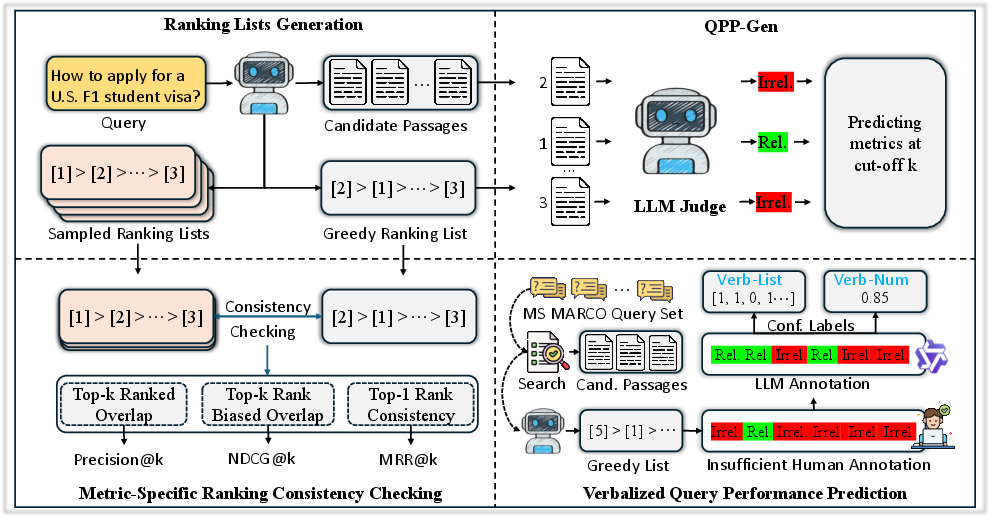
Figure 1: Schematic of the pipeline: initial ranking generation, QPP-Gen pointwise annotation, metric-specific self-consistency, and calibration through supervised training labels.
Empirical Results: Correlation and Calibration
Experiments utilize LLaMA3.1 and Qwen2.5 model families, tested on TREC Deep Learning 2019–2022 passage-ranking datasets. Performance is evaluated with both discriminative power (Spearman correlation between predicted and actual ranking performance) and calibration (Expected Calibration Error, ECE).
Verbalized Confidence: Failure Modes
The direct approach of asking the reranker to output its verbalized confidence score is also evaluated. The findings are unequivocal:
Supervised Methods: Verb-Num and Verb-List
To alleviate overconfidence and enhance calibration, the study introduces two supervised methods:
Verb-Num: The model is trained to output a single scalar (e.g., NDCG@10) reflecting ranking quality.
Verb-List: The model is trained to output a binary vector indicating the ground-truth relevance of each passage in the generated ranking (metric-agnostic).
This is realized through augmented MS MARCO data, with balanced DCG/precision distributions using additional Qwen3-32B-generated annotations to compensate for sparse human labels.
Empirical comparison yields:
- Verb-Num achieves the highest discriminative power (Spearman correlation), while Verb-List offers superior calibration (lowest ECE).
- Both methods outperform all unsupervised and classical supervised QPP baselines, including QPP-Gen, BERTQPP, and qppBERT-PL.
- The additional generation cost for confidence output is minimal compared to QPP-Gen, which requires independent passage scoring.
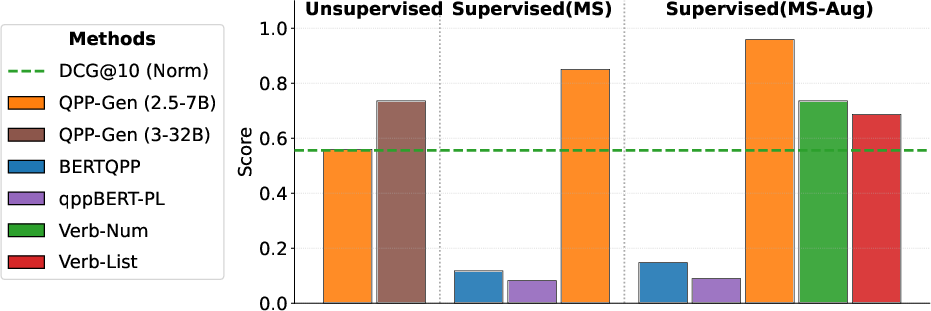
Figure 4: Comparison of average predicted ranking-quality scores for in-domain and OOD datasets, demonstrating better score calibration for Verb-List and more accurate discrimination for Verb-Num.
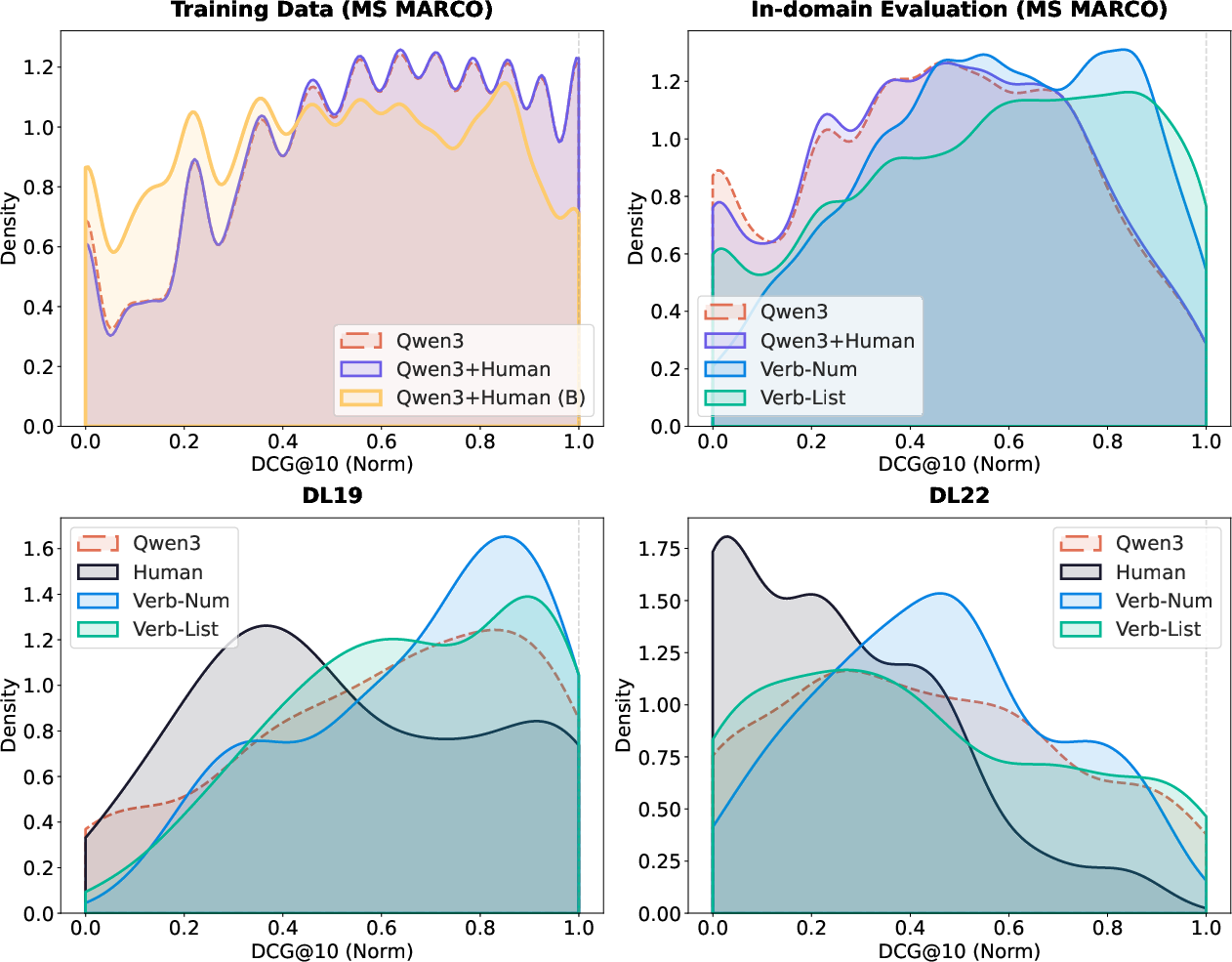
Figure 5: Histograms of actual and predicted query distributions for DCG@10, stratified by method, model, and data domain.
Practical and Theoretical Implications
Direct, well-calibrated confidence estimation by LLM rerankers is crucial for real-world applications in search, QA, and retrieval-augmented generation. Accurate QPP enables:
- Adaptive allocation of reranking resources;
- Fallback and user warning mechanisms when query difficulty is suspected;
- Improved trust and transparency in user-facing ranking systems.
Theoretical implications span both the introspective capabilities of LLMs in structured output domains and the generalization of confidence calibration paradigms from simple classification/QA to more complex, position-sensitive tasks like ranking.
Limitations and Future Directions
This study assumes binary ground-truth relevance and primarily evaluates on standard passage-ranking datasets. Open avenues include:
- Extension to multi-level/graded relevance and more complex ranking settings.
- Fully unsupervised reranker-internal QPP.
- Incorporation of long-context reasoning over larger candidate sets and user intent variability.
Conclusion
By rigorously formulating and evaluating reranker-internal QPP, this work advances our understanding of LLM introspection in ranking tasks. Training-free self-consistency offers a surprisingly competitive baseline for calibration, but reliable verbalized confidence requires explicit supervision—effectively brought about via the Verb-Num and Verb-List methods. These results highlight the nuanced distinctions between knowledge, uncertainty perception, and reliable self-evaluation in large-scale language-based ranking systems. Future work extending these findings to more realistic and challenging IR settings will further clarify the theoretical boundaries of LLM self-knowledge and practical deployment in retrieval-centric applications.



