HiP3R: Hierarchical Pose Graphs for Long-Horizon 3D Reconstruction
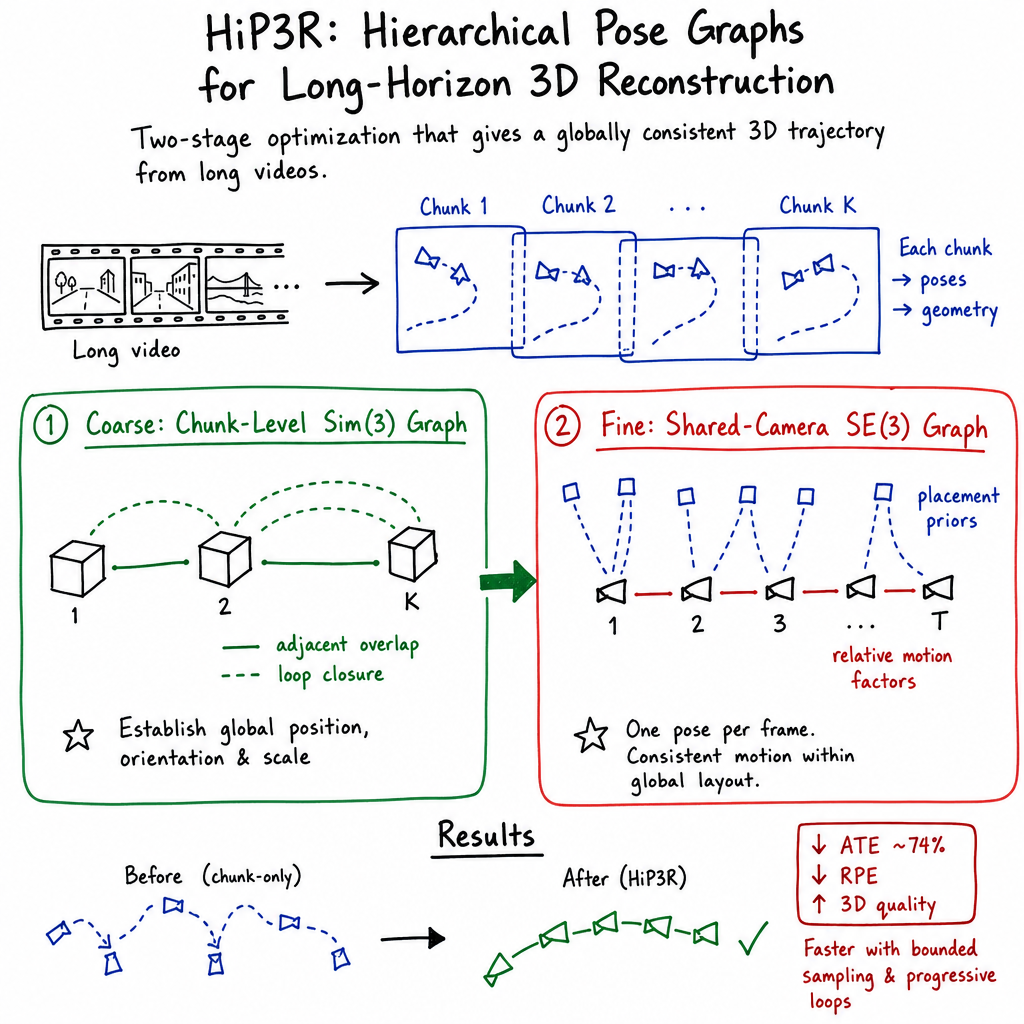
Abstract: Feed-forward models accurately estimate camera motion and 3D geometry from short video windows. However, computational and memory costs prevent direct inference on sequences containing thousands of frames. Long videos must therefore be processed as overlapping chunks. This division produces independent local reconstructions with inconsistent coordinate frames and duplicate estimates of shared cameras. Achieving global consistency requires propagating constraints from adjacent overlaps and distant revisits across the sequence. This requirement naturally motivates pose graph optimization. However, the choice of graph level creates a trade-off. Chunk-level graphs efficiently resolve scale drift and close large loops. Yet, their rigid transformations cannot correct internal errors or conflicting frame predictions. Conversely, frame-level optimization offers local flexibility, but scaling it globally is computationally expensive and can break metric scale. HiP3R resolves this trade-off using a hierarchical pose graph. HiP3R first optimizes a robust chunk-level graph to establish the global layout and scale. It then holds this layout fixed and estimates one shared camera per frame, turning overlapping window predictions into a single trajectory. Experiments across multiple benchmarks demonstrate the effectiveness of HiP3R in improving camera trajectories and 3D reconstruction. Our method applies to both chunk-based and streaming backends without additional training or fine-tuning. The codes are available at https://kkakkkka.github.io/HiP3R.
Paper Prompts
Sign up for free to create and run prompts on this paper.
Top Community Prompts
Explain it Like I'm 14
1. What is this paper about?
This paper introduces HiP3R, a method for building accurate 3D maps from very long videos.
Imagine walking through a large building or driving through a city while recording video. A computer can use the video to estimate:
- where the camera was at each moment, and
- what the surrounding 3D world looks like.
This works well for short videos. However, very long videos contain thousands of frames, which are too expensive for many computer models to process all at once.
HiP3R solves this problem by splitting the video into smaller, overlapping sections called chunks. It then carefully joins these sections into one consistent 3D reconstruction.
2. What questions does the research ask?
The researchers focus on several problems:
- How can separate video chunks be joined correctly? Each chunk may use its own coordinate system, so two chunks might disagree about where an object is.
- How can the system stop errors from building up over time? Small mistakes in camera movement can add up, causing the reconstructed world to slowly stretch, rotate, or drift.
- How can repeated views of the same place be used? If a camera returns to a location, this is called a loop closure. The repeated view can help correct earlier mistakes.
- How can conflicting camera estimates be combined? The same video frame may appear in several overlapping chunks. Each chunk may give that frame a slightly different camera position, but the real camera had only one position.
3. How does HiP3R work?
Splitting the video into chunks
First, the video is divided into overlapping pieces. For example, a 1,000-frame video might be divided into chunks of 60 frames, where neighboring chunks share 30 frames.
A pre-trained 3D vision model examines each chunk and predicts:
- the 3D points visible in the images,
- the confidence of those predictions, and
- the camera position for each frame.
The original model is not retrained. HiP3R works as an additional improvement step.
Stage 1: Creating the large-scale layout
In the first stage, HiP3R treats each chunk like a large puzzle piece.
It builds a pose graph:
- Each chunk is a point, or node, in the graph.
- Connections between chunks describe how neighboring chunks should fit together.
- Extra connections are added when two distant chunks appear to show the same place.
The method uses a transformation called Sim(3). In simple terms, this transformation can:
- rotate a chunk,
- move it,
- change its size or scale.
Allowing scale changes is important because small scale errors can accumulate during a long journey. For example, a computer might slowly think that each hallway is slightly longer than it really is.
HiP3R first uses nearby chunks to create an initial layout. It then adds distant loop-closure connections gradually, starting with easier, shorter loops. This is more stable than adding every difficult connection at once.
The method also uses robust optimization. This means that if one measurement is clearly wrong, it is given less influence instead of ruining the whole map. This is similar to ignoring one wildly inaccurate measurement when many other measurements agree.
Stage 2: Finding one camera position per frame
After arranging the chunks, HiP3R performs a second, finer correction.
A frame that appears in several chunks may have several different predicted camera positions. HiP3R creates one shared camera position for that physical frame and combines all the predictions.
It uses two kinds of information:
- Position clues: keep the camera near the already-corrected global layout.
- Movement clues: make the camera move smoothly from one frame to the next.
This second stage uses SE(3) transformations. Unlike Sim(3), SE(3) allows movement and rotation but does not freely change scale. This keeps the scale found in the first stage stable.
For extremely long videos, HiP3R does not optimize every frame directly. Instead, it uses selected keyframes, such as every fifth frame, and estimates the positions between them. This saves time while preserving smooth motion.
4. What did the researchers find?
The researchers tested HiP3R on 61 video sequences from seven public datasets. These included:
- indoor rooms,
- buildings and campuses,
- streets,
- driving scenes, and
- large outdoor environments.
They tested HiP3R with two different 3D vision systems: VGGT-Omega and LingBot-MAP.
More accurate camera tracking
When used with VGGT-Omega, HiP3R reduced the main camera-position error, called ATE, from 18.555 meters to 4.906 meters. This is a reduction of about 74%.
With LingBot-MAP, the error fell from 8.288 meters to 4.017 meters, a reduction of about 52%.
In a comparison on long outdoor routes, the average error decreased from 17.71 meters for a previous method to 11.25 meters with HiP3R.
Better local camera movement
HiP3R also improved the accuracy of how the camera moved between neighboring frames. This is important because a reconstruction can have a roughly correct overall shape but still contain sudden jumps in the camera path.
Better 3D maps
The method improved the quality of the reconstructed surfaces. With VGGT-Omega:
- the Chamfer distance, a measure of 3D reconstruction error, decreased from 0.0759 meters to 0.0272 meters;
- the F1 score increased from 65.92 to 91.26.
A higher F1 score means that the reconstructed surface matched the real surface more closely.
Visually, the improvements helped prevent problems such as:
- duplicated walls,
- buildings appearing in two nearby locations,
- streets being stretched,
- gaps in loops, and
- “ghost” surfaces caused by conflicting predictions.
Faster optimization
The researchers also tested limiting the number of 3D points used during alignment. This reduced graph-building and optimization time by about 84%, while barely changing accuracy.
This matters because long videos can contain millions of possible 3D points. Using every point would waste time because many points repeat similar information.
The two stages have different jobs
The experiments showed that the first stage is mainly responsible for fixing large errors, such as scale drift and incorrect global placement.
The second stage mainly improves:
- smoothness between neighboring frames,
- agreement between overlapping chunks, and
- short-distance camera accuracy.
This supports the paper’s main idea: solving the problem at two different levels works better than trying to solve everything at once.
5. Why is this research important?
HiP3R makes it easier to create reliable 3D maps from long videos without retraining the original vision model.
This could help in areas such as:
- self-driving cars, which need accurate maps of long roads;
- robots, which need to understand where they are in large buildings or cities;
- virtual and augmented reality, where digital objects must line up with the real world;
- drone mapping, especially over large outdoor areas; and
- spatial AI, where computers need to understand the shape and layout of real places.
The main lesson is that a long video should not be treated as thousands of unrelated images. It should be viewed as a connected set of observations. HiP3R first creates a reliable large-scale map and then makes the camera path locally consistent.
The method is not perfect. It can still struggle if loop closures are unreliable or if the video contains very confusing scenes. The researchers suggest that future work should improve how the system works online while the video is being recorded and make it more resistant to incorrect matches.
Overall, HiP3R provides a practical way to turn long, difficult videos into more accurate and complete 3D reconstructions.
Knowledge Gaps
Knowledge gaps, limitations, and open questions
- Dependence on reliable loop-closure retrieval: The method assumes that visual place recognition can identify sufficiently accurate revisits, but its sensitivity to missed, repetitive, ambiguous, or incorrect loop candidates is not systematically evaluated.
- Robustness to false loop closures: Although loop weights and Huber losses reduce the influence of poor constraints, the paper does not quantify failure rates or characterize behavior when many loop measurements are systematically wrong.
- No online or incremental formulation: HiP3R is presented primarily as an offline optimizer. The computational and algorithmic requirements for incorporating new frames, loop closures, and revised layouts incrementally remain unresolved.
- Fixed coarse layout during fine refinement: Stage II cannot revise chunk poses or scale after frame-level optimization. The paper does not examine whether jointly or iteratively optimizing chunk and frame variables would correct errors caused by an inaccurate coarse layout.
- Limited analysis of global scale accuracy: The evaluation uses per-sequence alignment for ATE and related metrics, which can absorb scale errors. Consequently, the method’s absolute metric-scale accuracy is not clearly established.
- Unclear behavior in scenes without loop closures: The contribution of HiP3R when sequences contain no revisits, weak visual overlap, or only short-range constraints is not separately reported.
- Insufficient stress testing under challenging visual conditions: Performance under illumination changes, weather variation, motion blur, dynamic objects, textureless surfaces, occlusions, rolling shutter, and substantial viewpoint changes is not analyzed in depth.
- Static-scene assumption is not examined: The pointmap and pose constraints may be inconsistent in environments with moving people, vehicles, changing furniture, or other temporal scene changes, but the method’s robustness to dynamic content is not evaluated.
- Limited backend coverage: The method is demonstrated mainly with VGGT-Omega and LingBot-MAP. Its effectiveness with other feed-forward, recurrent, monocular, stereo, or metric-scale backends is left uncertain.
- No training or domain-adaptation study: The paper claims that no retraining or fine-tuning is required, but it does not investigate how performance changes across domains substantially different from the evaluated benchmarks.
- Hyperparameter sensitivity is incompletely characterized: The effects of chunk size, overlap, keyframe stride, Huber threshold, edge weights, loop scheduling, scale bounds, and the placement-to-motion weighting ratio are not comprehensively studied.
- Dependence on chunk partitioning: It remains unclear how sensitive reconstruction quality is to chunk boundaries, nonuniform chunk lengths, overlap sizes, or unfavorable alignment between boundaries and rapid camera motion.
- Keyframe interpolation may miss high-frequency motion: For long sequences, unsolved frames receive interpolated corrections. The method does not establish guarantees or evaluate failure cases involving abrupt rotations, stops, acceleration, or irregular camera motion between keyframes.
- No uncertainty estimation: The backend does not provide analytical pose covariances, and the proposed scalar edge weights are heuristic. The paper leaves open whether probabilistic uncertainty modeling would improve weighting, loop rejection, or failure detection.
- Potential bias from confidence and residual weighting: The relationship between pointmap confidence, registration residuals, edge weights, and actual measurement reliability is not validated quantitatively.
- Limited comparison with full bundle adjustment or global SfM: The paper argues that bundle adjustment is too expensive, but does not provide a systematic accuracy–runtime comparison against optimized global SfM, pose-graph-plus-BA pipelines, or methods that jointly optimize camera poses and 3D tracks.
- Geometry optimization is restricted to rigid pointmap correction: HiP3R transforms predicted pointmaps without optimizing their depths, structure, or cross-view correspondences. The remaining geometric errors after pose correction and the benefits of jointly refining geometry are not determined.
- Sparse point sampling may discard critical geometric evidence: Bounded sampling substantially reduces runtime, but the paper does not analyze how sampling strategy, spatial coverage, depth distribution, or scene scale affect accuracy, especially in thin, repetitive, or sparsely textured structures.
- Scalability beyond the reported sequence lengths is unknown: Although sequences with approximately 12,000–14,000 frames are included, memory usage, runtime growth, and solver stability for substantially longer or multi-kilometer sequences are not established.
- Runtime comparisons are not fully standardized: Reported times depend on hardware, cached predictions, backend inference policies, and solver configurations. The paper does not provide a complete end-to-end resource analysis across all baselines and sequence lengths.
- Convergence guarantees are absent: Progressive loop scheduling and trust-region optimization are empirically motivated, but there is no theoretical analysis of convergence, local-minimum behavior, or conditions under which the hierarchy fails.
- Failure recovery is unspecified: The method does not describe how to detect and recover from divergent optimization, disconnected pose graphs, severely inconsistent constraints, degenerate geometry, or incorrect initial sequential alignment.
- Graph connectivity requirements are unclear: The minimum overlap, loop density, and graph topology needed for stable recovery of rotation, translation, and scale are not characterized.
- Degenerate-motion cases are not studied: Pure rotation, near-planar motion, low-parallax trajectories, stationary-camera segments, and very small camera baselines may make similarity alignment or translation constraints ill-conditioned, but these cases are not evaluated.
- Evaluation is concentrated on benchmark averages: Macro-averaged results can hide sequence-level failures and variability. Per-sequence distributions, worst-case performance, confidence intervals, and statistically repeated trials are not reported sufficiently to assess reliability.
- Ground-truth and metric limitations remain: Dense geometry metrics are computed after Umeyama and ICP alignment, potentially masking global pose or scale discrepancies. The relationship between improved trajectory metrics and task-level reconstruction usefulness is not investigated.
- No downstream task evaluation: The paper does not test whether HiP3R improves navigation, localization, mapping, planning, novel-view synthesis, object measurement, or other applications motivated in the introduction.
- Interaction with dynamic online loop discovery is unresolved: The proposed progressive loop schedule is described for retrieved candidate loops, but how loop retrieval, verification, and graph optimization should interact continuously in an online system remains an open problem.
- The optimal hierarchy is not established: The paper uses two levels—chunks and frames—but does not investigate multilevel graphs, adaptive spatial/temporal hierarchy, or joint optimization at intermediate segment or keyframe levels.
- Metric-scale preservation across heterogeneous chunks is not fully explained: The method estimates chunk-level transformations and then freezes them before applying rigid frame corrections; the conditions under which this preserves physically meaningful scale across all local reconstructions remain uncertain.
- Reproducibility is potentially limited by missing implementation details: Several important choices, including loop retrieval thresholds, restart policies, weighting schedules, and solver settings, are delegated to appendices or described only briefly, making independent reproduction and fair reimplementation difficult.
Practical Applications
Immediate Applications
The method can be integrated as a post-processing and reconstruction module on top of existing feed-forward or streaming 3D vision systems. Its main near-term value is improving long-sequence camera trajectories, loop closure, metric scale consistency, and dense geometry without retraining the underlying model.
- Robotic mapping and navigation — globally consistent maps from long RGB videos.
Robotics teams can run a model such as
VGGT-OmegaorLingBot-MAPon overlapping video windows, then apply HiP3R to correct accumulated drift and reconcile duplicate camera estimates. This can produce more coherent maps for indoor service robots, inspection robots, and mobile platforms operating over corridors, campuses, warehouses, or industrial sites. The coarseSim(3)stage is particularly useful when scale drift accumulates, while the shared-cameraSE(3)stage smooths motion at chunk boundaries. Dependencies: reliable visual place recognition, sufficient scene overlap for loop closures, adequate texture and lighting, and a backend capable of producing usable pointmaps and pose estimates. - Autonomous-driving and vehicle-survey pipelines — offline trajectory correction. HiP3R can be added to post-processing workflows for dashcam, vehicle-mounted RGB, or RGB-D sequences. It can reduce long-range drift and improve the consistency of reconstructed roads, buildings, and repeated street segments before generating maps, localization databases, or 3D assets. The reported improvements on KITTI, VBR, and Oxford-style traversals indicate immediate relevance to offline mapping and dataset generation. Dependencies: loop closures must be correctly retrieved; dynamic objects, severe viewpoint changes, weather variation, and weakly textured roads may reduce registration reliability. Safety-critical real-time control should not rely on the method without additional validation because the paper evaluates reconstruction accuracy rather than control performance.
- 3D asset and digital-twin creation for buildings and infrastructure. Surveying companies, construction firms, and facilities teams can use the system to merge long handheld or vehicle-mounted video captures into a single reconstruction. Applications include building interiors, campuses, bridges, roads, warehouses, and public spaces. The shared-frame formulation can reduce duplicated walls, offset surfaces, and ghosting that arise when independently reconstructed chunks are stitched together. Dependencies: the resulting scale and geometry remain dependent on the feed-forward backend and visual observations. For engineering-grade surveying, the workflow would still require calibrated sensors, control points, LiDAR, or other independent measurements.
- 3D reconstruction for cultural heritage, museums, and real-estate visualization. A practical workflow is: capture a long walkthrough, infer overlapping local pointmaps, apply progressive loop closure, refine the shared camera trajectory, and export a globally aligned mesh or point cloud. This is suited to rooms, galleries, historic buildings, and large properties where the camera revisits spaces. Improved surface F1 and reduced Chamfer error suggest better visual quality for virtual tours and inspection interfaces. Dependencies: static scenes are assumed. Visitors, moving furniture, reflective surfaces, and lighting changes may create false loop constraints or inconsistent geometry.
- Software libraries for scalable visual-geometry post-processing.
The paper’s sparse pose-graph design, bounded point sampling, robust Huber losses, progressive loop scheduling, keyframe subgraphs, and closed-form Jacobians can be incorporated into SLAM, SfM, and 3D reconstruction toolchains. Developers could expose HiP3R as a reconstruction backend or command-line stage that accepts chunk poses, pointmaps, confidence maps, and loop candidates. Bounded sampling is especially actionable because the reported experiments substantially reduce graph construction and solve time with little accuracy change.
Dependencies: implementation requires careful handling of
SO(3),SE(3), andSim(3)parameterizations, sparse Jacobians, robust initialization, and numerical safeguards for poor loop measurements. - Dataset generation and quality control for computer-vision research. Research groups can use HiP3R to turn long RGB videos into more consistent camera trajectories and pointmaps for training or evaluating 3D perception, visual localization, neural rendering, and embodied-AI systems. It can also serve as a diagnostic tool: large corrections in the coarse graph or disagreement among shared-camera priors can identify difficult segments, loop-retrieval failures, or backend weaknesses. Dependencies: the method should not automatically be treated as ground truth. Its outputs require independent validation, especially when used to label datasets or compare other reconstruction algorithms.
- Post-capture stabilization of streamed or windowed reconstruction systems. Teams already using streaming systems can apply HiP3R after recording, without retraining or fine-tuning. This provides a practical upgrade path for existing systems: retain the causal or windowed inference architecture for efficient capture, then perform global correction when compute and the complete sequence are available. Dependencies: ordinary offline HiP3R requires access to later frames and therefore is not itself a fully causal solution. Memory, storage, and delayed processing remain necessary.
- Academic baselines and ablation framework for long-horizon 3D vision. Researchers can use the two-stage design as a controlled baseline for comparing chunk alignment, loop closure, frame-level refinement, keyframe selection, and point-sampling strategies. The separation between global layout and local trajectory refinement also provides a clear experimental framework for studying scale drift, pose inconsistency, and reconstruction quality independently. Dependencies: comparisons should use identical backends, chunk sizes, overlap policies, and loop-retrieval settings because these factors strongly influence results.
- Daily-life capture applications such as room scanning and travel reconstruction. Consumer or prosumer software could apply the method to long smartphone walkthroughs for room inventories, home renovation planning, travel site capture, or personal 3D archives. It could reduce duplicated geometry when users revisit the same room or street. Dependencies: consumer deployment would require substantial optimization, robust handling of motion blur and moving people, privacy-preserving storage, and an interface that communicates uncertainty rather than presenting all reconstructions as exact.
Long-Term Applications
The following applications are enabled by the paper’s architectural direction but require further research, larger-scale engineering, stronger robustness, or integration with additional sensing and decision systems.
- Online global correction for autonomous robots. A future version could incrementally update the chunk-level graph as new frames arrive, activate loop constraints when revisits are detected, and refine only affected portions of the trajectory. This would combine streaming inference with delayed global consistency, enabling robots to maintain coherent maps over multi-hour or multi-day missions. Dependencies: incremental solvers, bounded-latency loop verification, map versioning, recovery from incorrect loop closures, and guarantees that global updates do not destabilize active navigation.
- Long-horizon SLAM for large-scale autonomous driving and logistics. HiP3R could evolve into a mapping layer for fleet-scale road networks, mines, ports, warehouses, or delivery campuses. Multiple traversals could be merged into a shared metric map, with chunk-level similarity graphs representing route segments and frame-level refinement preserving locally smooth motion. Dependencies: multi-session calibration, seasonal and illumination changes, dynamic-scene modeling, semantic landmark association, distributed optimization, and reliable uncertainty estimates.
- Photorealistic digital twins and neural rendering. More consistent camera poses and pointmaps can improve downstream construction of neural radiance fields, Gaussian-splat scenes, textured meshes, and interactive digital twins. The method could provide a geometry-and-pose preprocessing stage for large environments that are too long for direct end-to-end transformer inference. Dependencies: consistent color and exposure, view-dependent effects, handling of transient objects, accurate intrinsics, and extensions that jointly optimize appearance, geometry, and pose rather than only correcting pose placement.
- Multi-sensor and metric-grade surveying. The hierarchical graph could be extended to fuse RGB video with LiDAR, IMU, GPS/GNSS, wheel odometry, depth cameras, or total-station control points. Such factors could anchor the otherwise relative global scale and improve reliability in textureless or visually repetitive regions. Dependencies: sensor time synchronization, extrinsic calibration, statistically meaningful uncertainty models, and an objective that supports heterogeneous measurement units and failure modes.
- Robust reconstruction in dynamic and changing environments. Future research could attach semantic or temporal consistency weights to loop and frame factors, downweighting people, vehicles, foliage, and moved objects. This would expand the method from mostly static scenes to urban environments, warehouses, hospitals, and public spaces. Dependencies: accurate dynamic-object detection, persistent landmark modeling, scene-change reasoning, and protection against false loop closures caused by visually similar but physically different locations.
- Infrastructure inspection and change detection. Globally consistent reconstructions from repeated drone, vehicle, or handheld surveys could support monitoring of bridges, railways, power facilities, construction sites, and pipelines. Aligning observations across time would make it possible to detect cracks, deformation, missing components, or construction progress in a common coordinate frame. Dependencies: centimeter-level accuracy may require external geometric control; the current results do not establish performance for small structural changes, aerial motion, adverse weather, or safety-certified inspection.
- Large-scale spatial AI and embodied-agent training. HiP3R-generated trajectories and reconstructions could provide spatially coherent environments for training navigation agents, robot simulators, augmented-reality systems, and multimodal spatial assistants. A globally consistent map would allow agents to reason about revisited places, route topology, and object locations over long temporal horizons. Dependencies: semantic labeling, object permanence, uncertainty representation, sim-to-real validation, and safeguards against propagating reconstruction errors into learned policies.
- Augmented and virtual reality over extended spaces. A hierarchical pose graph could support persistent AR anchors across buildings, campuses, exhibitions, or city walks by aligning long capture sequences and repeated visits. It may also help create large navigable VR environments from ordinary video. Dependencies: low-latency relocalization, device-specific tracking, accurate scale, privacy controls, and robustness to seasonal or architectural changes.
- Policy and standards for trustworthy 3D mapping. The method’s explicit confidence weighting, robust losses, loop scheduling, and measurable trajectory and surface metrics could inform evaluation protocols for long-video reconstruction systems. Policymakers and infrastructure owners could require uncertainty reporting, independent checkpoints, and failure audits when reconstructed maps are used for public planning, digital twins, or autonomous systems. Dependencies: standardized benchmarks covering dynamic, adverse, and safety-critical conditions; transparent reporting of loop failures; and clear distinctions between visually plausible reconstruction and legally or engineering-valid survey data.
- Privacy-preserving personal and institutional 3D archives. Long-term systems could reconstruct homes, workplaces, museums, or campuses while processing video locally, retaining only compressed pointmaps, pose graphs, or selectively anonymized geometry. Hierarchical optimization is compatible with storing compact graph variables rather than all raw imagery. Dependencies: protection against re-identification from 3D geometry, secure deletion and access control, privacy-aware loop retrieval, and methods for removing faces, screens, documents, and other sensitive details without damaging global consistency.
Glossary
- Automatic differentiation: A method for computing derivatives of program-defined functions mechanically. “We compute the corresponding Jacobian blocks using automatic differentiation.”
- Bundle adjustment: Joint nonlinear optimization of camera poses and 3D structure. “Conversely, full bundle adjustment is too expensive”
- Chamfer distance: A distance measuring the average nearest-neighbor discrepancy between two point sets. “Reconstructed 3D pointmaps are evaluated using the mean of accuracy and completeness (Chamfer, meters) after Umeyama and ICP.”
- Chromatic number: The minimum number of colors needed to color a graph so adjacent vertices have different colors. “The number of residual sweeps equals the chromatic number.”
- Confidence map: A map assigning reliability values to predicted geometric elements. “the backend predicts dense pointmaps , confidence maps , and camera-to-chunk poses .”
- Coordinate frame: A coordinate system used to represent the positions and orientations of objects. “This division produces independent local reconstructions with inconsistent coordinate frames”
- Dense pointmap: A representation assigning a 3D point to many or all image pixels. “For chunk , the backend predicts dense pointmaps ”
- Dense reconstruction: A reconstruction that estimates geometry throughout most of an observed scene rather than only at sparse features. “Experiments across multiple benchmarks demonstrate the effectiveness of HiP3R in improving camera trajectories and 3D reconstruction.”
- Divergence: Failure of an iterative optimization procedure to approach a stable solution. “The solver may diverge or converge to poor local minima.”
- Exponential map: A mapping from a Lie-algebra vector to a corresponding Lie-group transformation. “Let and denote the exponential and logarithm.”
- Feed-forward model: A model that produces predictions in one forward inference pass without iterative scene-specific optimization. “Feed-forward models accurately estimate camera motion and 3D geometry from short video windows.”
- Finite differences: Numerical derivative approximations obtained by evaluating a function at perturbed inputs. “Without closed-form derivatives, can be approximated via finite differences.”
- Frame-level optimization: Optimization in which individual video frames, rather than chunks, are represented as variables. “Conversely, frame-level optimization offers local flexibility”
- Graph coloring: Assignment of colors to graph vertices to group structurally independent computations. “Coloring the column-intersection graph groups mutually orthogonal columns together.”
- Graph topology: The structural arrangement of vertices and edges in a graph. “This depends on graph topology instead of total parameter count.”
- Huber loss: A robust loss that is quadratic for small errors and approximately linear for large errors. “where denotes the Huber penalty, applied coordinate-wise to suppress large outliers.”
- Iteratively reweighted least squares (IRLS): An optimization procedure that repeatedly solves weighted least-squares problems while updating the weights. “We estimate relative similarities with confidence-weighted iteratively reweighted least squares (IRLS)”
- Jacobian: A matrix of partial derivatives describing how residuals change with respect to optimization variables. “Each edge residual depends only on the transformations of the two connected chunks, yielding a sparse Jacobian.”
- Keyframe: A selected representative frame used to reduce the number of variables in temporal optimization. “For long sequences, we optimize a keyframe subgraph for efficiency.”
- Lie algebra: A vector-space representation of infinitesimal transformations associated with a Lie group. “Derivative identities follow standard Lie-group calculus”
- Lie group: A group of transformations that also has a differentiable manifold structure. “We then derive closed-form blocks for residuals”
- Local minimum: A solution that is optimal only within a nearby region of the search space. “The solver may diverge or converge to poor local minima.”
- Loop closure: A constraint indicating that a trajectory has revisited a previously observed location. “Loop closures are essential to eliminate cumulative drift”
- Metric scale: A physically meaningful scale in which distances correspond to real-world units. “This stage establishes a globally consistent layout and eliminates accumulated scale drift.”
- Motion factor: An optimization constraint encoding relative motion between camera poses. “within-chunk motion factors resolve conflicting predictions from overlapping windows.”
- Non-convex optimization: Optimization in which the objective may contain multiple local optima. “Activating all distant loops on an unaligned chain can make the non-convex optimization unstable.”
- Pairwise alignment: Estimation of a transformation relating two sets of geometric or visual observations. “Appendix D specifies loop retrieval and window settings, point sampling, pairwise alignment, and loop weighting.”
- Permutation invariance: A property whereby changing the ordering of inputs does not change the output. “Subsequent models explore permutation invariance”
- Place recognition: Identification of previously observed locations from visual observations. “Visual place recognition proposes candidate loop closures across temporal separations”
- Point correspondence: A matched pair of points believed to represent the same scene location in two reconstructions. “We bound alignment cost by limiting the number of point correspondences used in each fit.”
- Pose graph: A graph whose nodes represent poses and whose edges encode relative-pose constraints. “HiP3R resolves this trade-off using a hierarchical pose graph.”
- Pose prior: A constraint encouraging an estimated pose to remain close to a reference pose. “Each placed prediction also provides a unary chunk pose prior on its shared camera”
- Quadratic complexity: Computational complexity proportional to the square of an input size. “the quadratic complexity of visual attention limits them to short temporal windows.”
- Radiance field: A representation describing the emitted or observed appearance of a scene from spatial locations and viewing directions. “The Oxford Spires dataset: Benchmarking large-scale LiDAR-visual localisation, reconstruction and radiance field methods.”
- Reprojection: Projection of reconstructed 3D points into an image using an estimated camera model. “Recovering globally consistent 3D geometry and camera trajectories from video is fundamental to computer vision.”
- Residual: The discrepancy between a predicted relationship and a measured or desired relationship. “We define the residual vector as”
- Robust loss: An objective function designed to reduce the influence of outlying observations. “The coarse layout objective minimizes the robust loss”
- Rotation logarithm: The inverse of the rotation exponential map, converting a rotation into a minimal vector representation. “the rotation residual uses the standard rotation logarithm”
- Scale drift: Gradual error in the estimated size of reconstructed geometry over a trajectory. “pairwise alignment errors compound along the sequential chain, causing severe scale and orientation drift.”
- Similarity transformation: A transformation combining rotation, translation, and uniform scaling. “This transformation maps local chunk coordinates to a common world coordinate system”
- Sim(3): The seven-degree-of-freedom group of 3D similarity transformations. “HiP3R first optimizes a robust chunk-level graph”
- Sparse attention: An attention mechanism that computes interactions only between selected input elements. “Subsequent models explore permutation invariance ..., sparse attention”
- Sparse Jacobian: A Jacobian containing mostly zero entries because each residual depends on only a few variables. “Each edge residual depends only on the transformations of the two connected chunks, yielding a sparse Jacobian.”
- Slerp: Spherical linear interpolation between two rotations. “$R \left(\Delta_{t}\right) = \operatorname {S l e r p} \left(R \left(\Delta_{t _{i}\right), R \left(\Delta_{t _{i + 1}\right), \alpha\right)$”
- Structure-from-Motion (SfM): Reconstruction of camera motion and 3D structure from multiple images. “Feed-forward 3D models have emerged as an alternative to classical Structure-from-Motion (SfM).”
- Temporal neighborhood: A set of frames near a selected frame in a video sequence. “we combine temporal neighborhoods from both endpoints into one backend input.”
- Trust-region reflective least squares: A constrained nonlinear least-squares method that limits each update to a trust region and respects parameter bounds. “We solve Eq. (2) with bounded trust-region reflective least squares”
- Unary factor: An optimization constraint involving a single variable and an observation or prior. “Unary uses overlapping pose observations in a robust unary-only objective”
- Umeyama alignment: A least-squares method for estimating a similarity transformation between corresponding point sets. “Each iteration runs a weighted Umeyama alignment”
- Visual attention: A mechanism allowing a model to assign different importance to elements of visual input. “the quadratic complexity of visual attention limits them to short temporal windows.”
- Visual odometry: Estimation of camera motion from sequential visual observations. “This capability supports autonomous navigation, robotic mapping, and spatial artificial intelligence.”
- Windowed inference: Processing a long sequence using separate temporal subsets or windows. “LingBot-MAP uses windowed inference with a chunk size of 120 frames”
- World coordinate system: A common reference frame in which reconstructed scene geometry and camera poses are expressed. “This transformation maps local chunk coordinates to a common world coordinate system”
- : The six-degree-of-freedom group of rigid 3D transformations comprising rotation and translation. “The shared pose is rigid with no scale variable.”
- : The group of three-dimensional rotations. “The rotation residual uses the standard rotation logarithm”
- : Relative Pose Error, a metric comparing estimated and ground-truth relative motion between frames. “We evaluate trajectory accuracy using ATE, RPE_{rot}, and RPE_{trans} (lower is better).”
- : Absolute Trajectory Error, measuring the discrepancy between an estimated and reference camera trajectory after alignment. “ATE is translation RMSE after a per-sequence alignment”
- : Iterative Closest Point, an algorithm that repeatedly matches and aligns two geometric point sets. “Reconstructed 3D pointmaps are evaluated using the mean of accuracy and completeness (Chamfer, meters) after Umeyama and ICP.”