Are We Overthinking One-Step Generation?
Abstract: Diffusion and flow matching are now dominant frameworks for generative modeling in continuous domains, but they typically require multiple network evaluations at inference. This has motivated extensive research on one-step generative modeling primarily built on diffusion and flow, though existing approaches often rely on complex training machinery. In this work, we introduce Priming Models, a simple two-stage framework for training one-step generators. Motivated by the difficulty of distributional training from scratch, Priming Models are first trained on a reconstruction objective, e.g., pixel-space denoising at a fixed noise level, before undergoing feature-space distributional post-training. Our central scientific finding is that this simple reconstruction stage is already enough to entirely alleviate the difficulty of distributional training. Empirically, across class-conditional image generation, text-to-image generation, and world modeling, Priming Models significantly advance the Pareto frontier of training compute vs. generation quality. On ImageNet at resolution, we achieve a state-of-the-art FID of $1.19$ among one-step generators using approximately one-tenth the training compute of prior methods with comparable FID. We open-source our codebase at https://github.com/JaeyeonKim01/priming.





























Paper Prompts
Sign up for free to create and run prompts on this paper.
Top Community Prompts
Explain it Like I'm 14
1. What is this paper about?
This paper asks a simple question:
Do we really need complicated training methods to make an AI that can create an image in just one step?
Many modern image-making AI systems begin with random noise and slowly turn it into an image through many steps. This can make high-quality pictures, but it takes time because the neural network must be used repeatedly.
The researchers introduce a method called Priming Models. Their method trains an AI generator in two stages:
- First, teach it to clean up noisy or damaged images.
- Then, teach it to make its collection of generated images look like real images.
The main idea is similar to preparing a student before a difficult lesson: learning an easier related task first makes the harder task much easier.
2. What questions did the researchers investigate?
The paper focuses on several main questions:
- Can a model create high-quality images with only one network evaluation?
- Does teaching the model to reconstruct clean images help it learn to generate images?
- Can this simple method reduce the amount of computing power and training time needed?
- Does the method work for different tasks, such as:
- Creating images from class labels
- Creating images from text descriptions
- Predicting what the next frame of a robot video will look like
- Is the method better than more complicated one-step generation techniques?
3. How did the researchers do this?
Stage 1: Reconstruction pretraining
First, the model sees an image that has been mixed with noise. It must try to reconstruct the original clean image.
For example, imagine giving a student a very blurry photograph and asking them to redraw the clear version. The student may not get it perfect, but they learn useful information about shapes, colors, objects, and how images are structured.
The researchers usually used a noise level of 0.8. This means the input was very noisy, but it still contained enough information to guide the model toward the correct image.
The model could also be trained using other reconstruction tasks, such as:
- Replacing many image patches with noise and asking the model to fill them in
- Reconstructing a useful internal representation of an image instead of the image itself
Stage 2: Distributional post-training
After pretraining, the model is used as a one-step generator. It receives random Gaussian noise and produces an image immediately.
However, the first images are not yet very good. The researchers then improve the model by comparing groups of generated images with groups of real images.
They compare the images using features rather than only individual pixels. A feature is a useful description of an image, such as whether it contains a face, a wheel, or a certain texture. The researchers use already-trained image-recognition networks to measure these features.
The model is then adjusted so that:
- Generated images become more similar to real images.
- The generated images remain varied instead of all looking the same.
Optimal transport: a matching method
One important tool is called optimal transport. The researchers use it like a matching game.
Suppose there are several generated images and several real images. Optimal transport tries to match each generated image with a suitable real image while keeping the total difference as small as possible.
It is similar to finding the cheapest way to move a group of boxes from one set of locations to another set of locations.
The researchers also tested simpler comparison methods, including pairwise distances and a method called maximum mean discrepancy. These alternatives worked, but optimal transport usually performed best.
How was the method tested?
The researchers tested Priming Models in three settings:
| Task | What the model had to do |
|---|---|
| ImageNet generation | Create a picture based on a class, such as “otter” or “arctic fox” |
| Text-to-image generation | Create an image based on a written description |
| World modeling | Predict the next image in a robot’s interaction with its surroundings |
They compared the method with other one-step models and with slower models that use many steps.
The researchers measured both:
- Image quality, using scores such as FID, where a lower score generally means the generated images are closer to real images.
- Training cost, measured by the amount of computer work required.
4. What did they find?
ImageNet results
On ImageNet at a resolution of pixels, the strongest Priming Model reached an FID of 1.19.
This was the best result among the compared one-step generators in the paper. It also used roughly one-tenth of the training compute used by a previous method with similar quality.
The model initially produced noisy images after reconstruction pretraining. However, during post-training, its quality improved quickly. After further training, it could produce clear images using only one network pass.
Text-to-image results
For text-to-image generation, Priming Models performed better than the one-step MeanFlow model.
The best one-step Priming Model achieved:
- A GenEval score of 0.818
- A DPG-Bench score of 82.16
These scores measure how well the generated image follows the text description.
The results came close to models that use several generation steps, even though Priming Models used only one step. The researchers also showed that a two-step version of Priming could perform competitively with a four-step model.
World-model results
The researchers used Priming Models to predict the next frame in robot-manipulation videos.
On two robot datasets, Priming Models:
- Produced better predicted frames than the main one-step comparison model.
- Often performed better than a 32-step flow-matching model.
- Used much less training compute.
- Generated each frame faster.
For example, on one dataset, the Priming Model used about 60% less training compute, and on another it used about 74% less than the comparison model.
Why did reconstruction pretraining help?
The researchers believe that reconstruction pretraining teaches the model the basic structure of the data.
Without pretraining, the model starts with no useful understanding of images. When the researchers try to improve it directly by comparing generated images with real images, the model may not know how to change its output effectively.
With pretraining, the model already understands many useful image patterns. Its parameters are better prepared to respond to later corrections.
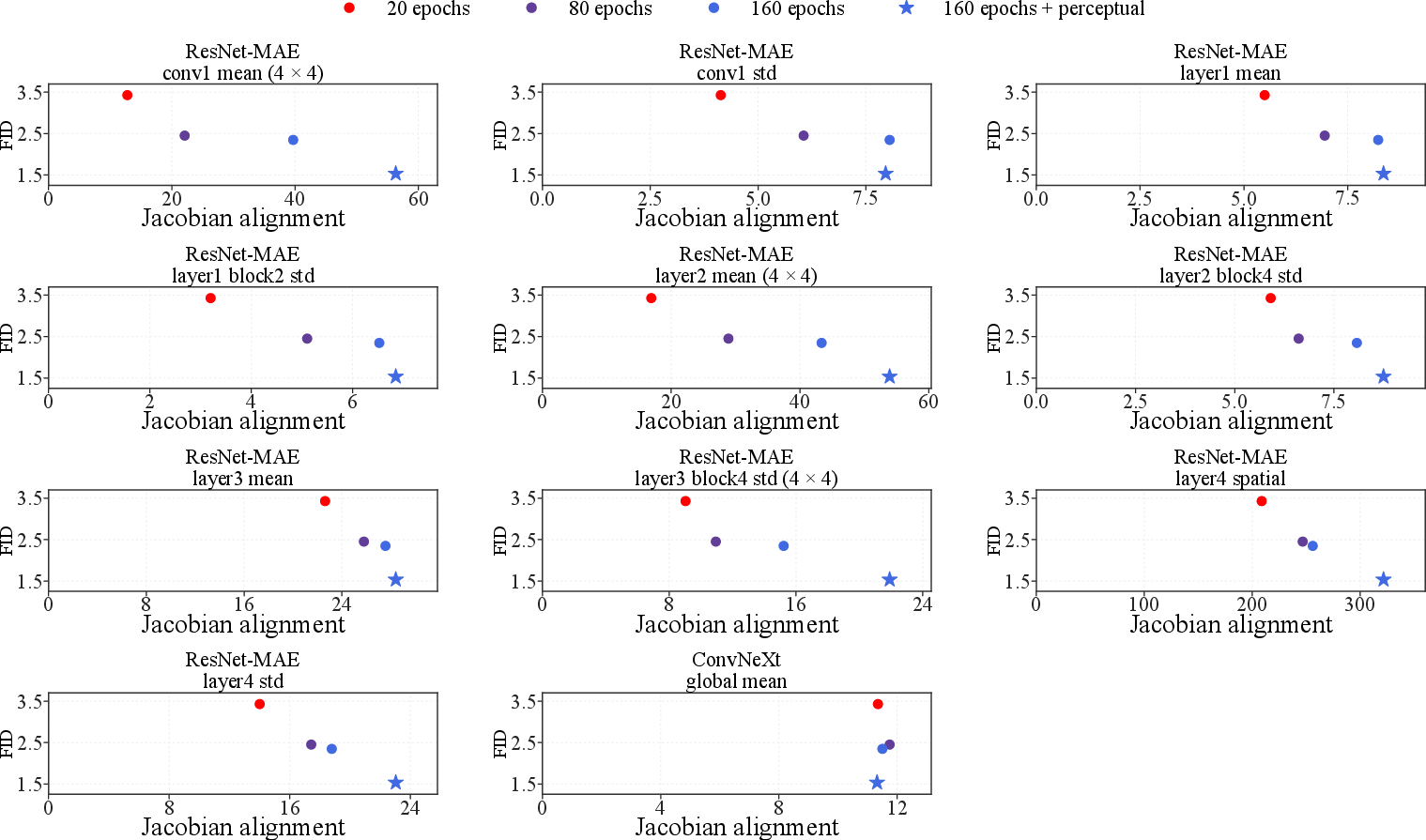
The paper describes this using the idea of Jacobian alignment. In simple terms, this means that the model’s internal controls are pointed in useful directions. When training gives the model a correction, the model can actually use that correction to improve its images.
Other findings
The researchers also found that:
- A fixed noise level can be enough for pretraining; the model does not always need many different noise levels.
- A noise level of
0.8worked better than using completely random noise with no remaining image information. - Adding a perceptual loss, which compares image features as well as pixels, improved results.
- Other reconstruction methods and other distribution-comparison methods also worked, suggesting that the general idea is flexible.
5. Why is this research important?
The paper suggests that high-quality one-step generation may be simpler than researchers previously thought.
Many existing methods depend on complicated ingredients, such as:
- A teacher model
- Special diffusion or flow paths
- Guidance systems
- Extra stabilization tricks
- Learned style controls
Priming Models do not require most of these additions. Instead, they use a straightforward recipe:
First learn to repair noisy images; then learn to match the distribution of real images.
If this approach continues to improve, it could make generative AI:
- Faster to use
- Cheaper to train
- Easier to build
- More practical on phones, robots, and other devices with limited computing power
There are still limitations. The method depends on pretrained feature encoders, and the researchers have not completely explained why reconstruction pretraining works so well. Also, multi-step diffusion and flow models can still be better in some situations.
Overall, the paper’s main message is that researchers may have been making one-step generation too complicated. A simple preparation stage followed by distribution matching can produce powerful generators with much less training effort.
Knowledge Gaps
Knowledge gaps, limitations, and open questions
- Dependence on pretrained feature encoders remains unresolved: The method’s distributional post-training relies on frozen encoders such as ResNet-MAE, ConvNeXt, SigLIP, ViT-MAE, and Inception-V3; it is unclear whether comparable performance is possible without external representations or with randomly initialized, jointly trained, domain-specific, or learned feature spaces.
- The causal role of reconstruction pretraining is not fully established: The experiments show that pretraining improves post-training efficiency, but they do not isolate whether the benefit comes from denoising specifically, exposure to image structure, improved optimization conditioning, perceptual supervision, reduced output scale mismatch, or simply additional compute.
- The Jacobian-alignment explanation is correlational: The reported relationship between normalized Jacobian response and later FID does not demonstrate that Jacobian alignment causes faster or better distributional learning. Controlled interventions that directly modify Jacobian spectra or alignment are still needed.
- The mechanism by which a single fixed noise level works is unclear: Although performs well on ImageNet, the paper does not derive why this value is effective, how the optimal noise level depends on architecture, resolution, dataset, conditioning modality, or latent space, or whether it can be selected automatically.
- The trade-off between pretraining and post-training compute is underexplored: Results compare several pretraining durations, but do not establish an optimal allocation of a fixed compute budget between the two stages or determine whether longer pretraining eventually becomes inferior to additional distributional post-training.
- The contribution of the perceptual loss is confounded with feature-space dependence: Removing the perceptual loss substantially degrades ImageNet performance, but the study does not determine whether this loss improves semantic structure, optimization geometry, low-level fidelity, or simply aligns the model with the same representations later used during post-training.
- The optimal distributional objective is not systematically characterized: OT, pairwise-distance, Laplacian-kernel, and FD-loss variants are compared under limited configurations. The effects of batch size, entropy regularization, stop-gradient sampling, kernel bandwidth, transport solver accuracy, and feature normalization are not comprehensively analyzed.
- Finite-minibatch bias and stability are insufficiently investigated: Distributional losses are estimated from relatively small online sample sets, but the sensitivity of training and final quality to minibatch size, sample reuse, correlated samples, and Sinkhorn approximation error remains unknown.
- The method’s robustness across architectures and parameter scales is uncertain: Experiments use a small number of transformer and U-Net configurations. It is unclear whether the approach transfers to substantially larger models, convolutional or hybrid architectures, different patch sizes, or models with limited parameter counts.
- Scaling beyond the tested image resolutions and datasets is unresolved: The main image-generation evaluation uses ImageNet at and a specific text-to-image setting at . Performance at higher resolutions, on larger and more diverse datasets, and under long-tail or highly multimodal distributions is not established.
- Text-to-image evaluation is limited in scope: The text-to-image experiments rely mainly on GenEval and DPG-Bench and compare against a narrow set of baselines. Broader tests of compositionality, typography, rare concepts, prompt robustness, aesthetic quality, diversity, and safety are needed.
- The conditioning mechanism’s limitations are unclear: The paper does not analyze how Priming Models handle ambiguous, lengthy, compositional, or out-of-distribution class and text conditions, nor whether one-step generation amplifies conditioning failures.
- One-step quality still trails strong multistep models: The paper acknowledges a remaining performance gap, but does not identify whether the limitation arises from the one-step mapping, the feature-space objective, insufficient training, architectural capacity, or the reconstruction initialization.
- The multi-step extension is only lightly validated: The two-step text-to-image experiment suggests that Priming Models can support multiple steps, but there is no systematic study of step count, noise schedules, error accumulation, or whether the same model can smoothly interpolate between one-step and many-step generation.
- Autoregressive world-model evaluation does not test long-horizon behavior: World-model experiments re-anchor on real trajectories every eight frames, limiting conclusions about compounding errors, temporal consistency, controllability, and planning over realistic rollout horizons.
- World-model generality is not demonstrated: The evaluation covers only RT-1 and Bridge-V2 robot-manipulation datasets. Transfer to other embodiments, action spaces, environments, video dynamics, stochastic transitions, and substantially longer temporal contexts remains unexplored.
- Distributional matching may obscure conditional correctness: In the world-model and text-to-image settings, feature-space distributional losses may improve aggregate metrics without ensuring that each generated sample matches its specific action history, text prompt, or target condition. Conditional fidelity requires more targeted evaluation.
- Memorization and privacy risks are only partially assessed: Nearest-neighbor comparisons on ImageNet do not rule out memorization, training-data leakage, or prompt-specific reproduction, particularly for text-to-image and world-model datasets.
- Compute comparisons may not be fully standardized: Reported EFLOPs include different encoder costs, sampling procedures, EMA operations, and training schedules across methods. Hardware utilization, wall-clock time, memory requirements, and inference-time feature costs are not consistently compared.
- The role of style embeddings and classifier-free guidance is not isolated fairly: The paper argues that Priming Models avoid these components, but does not provide matched ablations showing whether adding or removing style conditioning and guidance from competing methods accounts for the observed performance differences.
- Statistical uncertainty is incompletely reported: Although some ImageNet results use three seeds, confidence intervals, significance tests, and seed variability are not consistently provided across datasets, ablations, or evaluation metrics.
- Evaluation metrics may be affected by representation overlap: Some training feature encoders are also related to commonly used evaluation representations, and the paper notes that parts of are not independent for certain ablations. More extensive evaluation with genuinely unseen, human-aligned, and task-specific metrics is needed.
- The method’s behavior under distribution shift is unknown: There is no systematic evaluation on corrupted data, domain-shifted datasets, unseen classes, altered caption distributions, or changing world-model dynamics.
- Optimization stability and failure modes are not characterized: The paper emphasizes simplicity but does not report how often training diverges, collapses, loses diversity, or becomes sensitive to learning rate, EMA decay, initialization, feature normalization, and post-training duration.
- Theoretical guarantees are absent: It remains unclear under what conditions reconstruction pretraining ensures that distributional post-training can reach a desirable solution, whether the two-stage procedure improves the optimization landscape, and how the learned mapping relates to transport maps or conditional data distributions.
- The scalability of feature-space post-training is uncertain: Computing multiple frozen encoders and pairwise transport costs may become a bottleneck at higher resolutions, larger batch sizes, video inputs, or multimodal conditions; the paper does not establish how this cost scales.
- The reproducibility of the strongest results needs further evidence: The headline ImageNet result depends on particular preprocessing, perceptual losses, feature normalization, OT settings, and training schedules. Independent reproduction across implementations and hardware configurations would clarify how robust the reported gains are.
Practical Applications
Immediate Applications
- Low-latency image generation for consumer and enterprise software — Sector: software, media, design. Priming Models can serve as one-step image generators, reducing inference latency and potentially lowering serving costs compared with diffusion models requiring many network evaluations. Practical products include thumbnail and banner generation, rapid concept-art tools, game-asset prototyping, e-commerce imagery, and interactive creative assistants. Dependencies: The reported results are strongest on ImageNet-like distributions; deployment would require validation for the target domain, prompt adherence, safety filtering, and suitable conditioning interfaces.
- Efficient class-conditional image synthesis — Sector: computer vision, education, research, synthetic data. The ImageNet results suggest an immediately usable workflow for generating labeled synthetic images with a single forward pass. Such data could support classifier stress testing, rare-class augmentation, benchmarking, and rapid visualization of class-conditioned samples. Dependencies: Synthetic data must be checked for class fidelity, diversity, bias, and memorization. The paper reports no obvious nearest-neighbor memorization on ImageNet, but this does not establish privacy or copyright safety for other datasets.
- Real-time or near-real-time text-to-image generation — Sector: creative tools, advertising, e-commerce, human-computer interaction. The text-to-image variant can generate images in one step and can be extended to two steps. This enables interactive prompt editing, rapid layout exploration, real-time personalization, and image generation on devices or servers with strict latency budgets. The reported one-step model outperforms the compared one-step MeanFlow baseline and approaches multi-step methods on text-image metrics. Dependencies: Text alignment remains below the strongest multi-step baselines. Production systems would need stronger evaluation on compositional prompts, typography, safety, and culturally diverse content.
- Fast autoregressive world-model prediction for robot systems — Sector: robotics, autonomous systems, simulation. The method can predict the next visual observation from recent observations and action histories using one network evaluation. This can reduce the computational cost of model-predictive control, trajectory scoring, policy evaluation, and simulated rollouts. The RT-1 and Bridge-V2 experiments indicate lower frame-generation latency and lower training compute than the cited DriftWorld baseline. Dependencies: The experiments re-anchor rollouts on real trajectories in 8-frame chunks, so fully autonomous long-horizon deployment remains unverified. Error accumulation, action-distribution shift, temporal consistency, and safety must be evaluated before use in closed-loop control.
- Deployment of visual generators on resource-constrained hardware — Sector: edge AI, mobile computing, robotics, embedded systems. Single-pass inference can reduce latency, memory traffic, and energy consumption in applications such as robotic cameras, mobile creative applications, augmented reality, and industrial inspection interfaces. A practical workflow would use a Priming generator as a fast proposal model, optionally followed by a higher-quality verifier or refinement model. Dependencies: One-step inference does not guarantee low total energy use if the model is very large. Quantization, pruning, distillation, and hardware-specific benchmarking are still required.
- Simplified training pipeline for research and industrial prototyping — Sector: academia, AI engineering. Teams can use the two-stage recipe—fixed-noise reconstruction pretraining followed by feature-space distributional post-training—as an alternative to teacher distillation, prescribed diffusion trajectories, classifier-free guidance, or style embeddings. The open-source implementation can support reproducible experimentation with OT, MMD-like, or pairwise-distance objectives. Dependencies: The method still requires careful selection of corruption schedules, feature encoders, batch construction, normalization, EMA settings, and distributional-loss hyperparameters. The reported compute savings may vary by architecture, dataset, and hardware.
- Synthetic visual data generation for testing and benchmarking — Sector: software quality assurance, computer vision, policy and safety research. One-step models can generate large batches of visual cases quickly for robustness tests, distribution-shift analysis, red-team evaluation, and regression testing of image-understanding systems. Feature-space post-training may make it easier to adapt generators to a target data distribution. Dependencies: Feature-space similarity may not capture task-specific hazards, rare failure modes, or semantic correctness. Generated examples should supplement, not replace, real-world test data.
- Educational demonstrations of generative modeling — Sector: education and academia. The method provides a relatively accessible teaching example: students can compare reconstruction learning, distribution matching, Jacobian alignment, and one-step versus multi-step generation within one framework. The fixed-noise denoising stage is simpler to explain and implement than a full diffusion or flow-matching pipeline. Dependencies: The complete high-quality results still require substantial compute and pretrained feature encoders. Classroom implementations would likely use smaller datasets and models.
Long-Term Applications
- Low-latency medical and scientific image synthesis — Sector: healthcare, biomedical imaging, scientific computing. A validated Priming Model could support rapid augmentation of radiology, microscopy, pathology, or experimental-imaging datasets; interactive visualization; and generation of candidate images for downstream algorithm testing. One-step inference could be valuable where clinicians or instruments require immediate feedback. Dependencies: The paper does not evaluate medical data or clinical validity. Deployment would require domain-specific validation, calibration, uncertainty estimation, privacy protection, regulatory approval, and safeguards against generating clinically misleading images.
- Real-time robotics simulation and planning — Sector: robotics, manufacturing, autonomous vehicles. Scaling the world-model results could produce fast learned simulators for manipulation, navigation, warehouse automation, and interactive robot training. A planner could use the model to compare many candidate actions under a fixed latency budget, while a slower simulator or real-world execution system performs final verification. Dependencies: Long-horizon stability is unresolved. Research is needed on uncertainty-aware prediction, multimodal futures, action-conditioned consistency, closed-loop evaluation, and robustness to states outside the training distribution.
- Interactive video and environment generation — Sector: games, virtual reality, digital twins, entertainment. The one-step visual-transition capability could evolve into real-time generation of game frames, VR environments, or controllable digital twins. A hybrid architecture could use Priming for most frames and selectively invoke multi-step refinement for keyframes or difficult scenes. Dependencies: The current evidence concerns next-frame prediction in robot datasets rather than long videos or complex 3D environments. Temporal coherence, identity preservation, physical consistency, controllability, and persistence over long sequences require further research.
- Energy-efficient large-scale generative AI serving — Sector: cloud computing, data centers, sustainability. If the compute-quality trade-off transfers to large production models, one-step generators could reduce GPU-hours, response time, and potentially data-center energy consumption for high-volume image-generation workloads. The training procedure may also reduce the cost of adapting a generator to a new domain. Dependencies: The paper reports training-compute improvements, but full lifecycle energy savings depend on model size, feature-encoder overhead, hardware utilization, request volume, and the quality gap relative to multi-step systems.
- Domain-adaptive generators without diffusion or flow teachers — Sector: industrial inspection, agriculture, remote sensing, finance, public policy. Organizations could train specialized generators from domain data using reconstruction pretraining and distributional post-training, avoiding the need to obtain or distill from a large pretrained diffusion teacher. Possible uses include synthetic inspection defects, satellite-image scenarios, crop-condition images, or stress-test visualizations. Dependencies: The method assumes adequate real training data and useful pretrained feature encoders. For specialized domains, general-purpose encoders may provide poor similarity metrics; domain-specific encoders and task-aware distributional objectives may be necessary.
- Uncertainty-aware decision support and simulation — Sector: finance, healthcare, public policy, engineering. Because the generator maps multiple Gaussian inputs to samples, future systems could produce ensembles of plausible outcomes for scenario analysis, risk assessment, or policy simulation. The one-step speed would make it feasible to sample many alternatives interactively. Dependencies: The paper primarily evaluates distributional quality, not calibrated uncertainty. Practical use requires measuring coverage of rare events, dependence structure, calibration, and sensitivity to the choice of feature space and transport loss.
- Learned feature-free distributional training — Sector: foundational AI research. A major longer-term direction is eliminating or reducing dependence on frozen feature encoders. This could yield a self-contained training method whose notion of similarity is learned jointly with the generator or defined in task-specific spaces. Such a development would simplify deployment on new domains and reduce biases inherited from ImageNet, CLIP, or other encoders. Dependencies: Jointly learned representations may become unstable, collapse, or permit gaming of the distributional objective. Research is needed on stable feature learning, perceptual validity, and evaluation with independent held-out representations.
- Adaptive one-step/multi-step generation systems — Sector: software platforms, robotics, edge AI. The paper’s multi-step extension suggests a flexible system that selects the number of evaluations based on latency, quality, prompt difficulty, or uncertainty. Easy requests could use one step, while difficult images or uncertain world-model states could receive two or more refinement steps. Dependencies: An effective confidence or difficulty estimator is required. The quality-latency relationship must be characterized across domains, and adaptive computation must not introduce inconsistent outputs or exploitable failure cases.
- Policy and infrastructure planning through fast visual scenario generation — Sector: government, urban planning, disaster response. Once validated on geospatial or infrastructure data, Priming Models could rapidly generate alternative visual scenarios for flooding, construction, land use, transportation, or emergency-response planning. Fast sampling could support interactive workshops and large-scale stress tests. Dependencies: Such outputs must be treated as simulations rather than forecasts unless properly calibrated. Geographic fidelity, causal validity, fairness, provenance, and human oversight are essential, especially for high-consequence decisions.
- Commercial model products and developer tooling — Sector: AI platforms and MLOps.
The findings could motivate libraries, training templates, and hosted services offering
reconstruction pretraining + distributional post-trainingas a reusable recipe. Tooling could automate corruption schedules, feature extraction, Sinkhorn optimization, EMA management, and evaluation across independent feature spaces. Dependencies: Robust abstractions are needed for varying modalities, conditioning types, data scales, and hardware. Reproducibility also depends on the paper’s future code quality, licensing, documentation, and confirmation of results beyond the reported benchmarks.
Glossary
- Ablation study: An experiment that removes or changes one component of a method to measure its contribution. “Ablation study: Perceptual loss.”
- Autoregressive: A process that generates each output using previously generated outputs or states. “Both datasets are evaluated in 8-frame autoregressive chunks”
- Backpropagation: Computing gradients through a neural network to update its parameters. “backpropagate through to update .”
- Classifier-free guidance: A conditioning technique that strengthens a generative model’s adherence to labels or prompts without requiring a separately trained classifier. “classifier-free guidance”
- Consistency model: A generative model trained to produce consistent outputs from different noise levels, enabling few-step generation. “Inspired by Consistency Models”
- Coupling: A joint distribution specifying how probability mass from one distribution is paired with mass from another. “A transport specifies a coupling between endpoint measures”
- Denoising autoencoder: An autoencoder trained to reconstruct clean data from corrupted inputs. “A connection between score matching and denoising autoencoders”
- Distributional distillation: Training a model to reproduce a target probability distribution, often using information transferred from another model. “distributional distillation”
- Distributional objective: A loss function that compares probability distributions rather than individual corresponding examples. “Distributional objectives, such as Sinkhorn divergence or Wasserstein distance”
- Distributional post-training: Additional training that aligns a generator’s output distribution with the data distribution after an initial training stage. “Distributional post-training”
- Drifting Model: A one-step generative model trained using distributional distances and velocity fields. “Drifting Models”
- EMA (exponential moving average): A running average of model parameters that usually produces a more stable evaluation model. “with an EMA decay of $0.999$.”
- Entropic regularization: An entropy-based penalty added to an optimization problem to make transport plans smoother and computationally tractable. “the entropically regularized problem has a unique minimizer”
- F-dimensional distance (FID): A metric that compares generated and real image distributions using statistics of deep feature representations. “We report FID~\citep{heusel2017gans} as our primary metric.”
- Feature encoder: A neural network that transforms raw data into a learned representation used for comparison or conditioning. “Given a frozen feature encoder ”
- Feature space: The representation space produced by a neural network’s internal features. “matching generated and real distributions in feature space.”
- Feature queue: A stored collection of feature statistics or representations accumulated across training iterations. “accumulating feature statistics across training steps through a feature queue”
- Frobenius norm: A matrix norm equal to the square root of the sum of the squared entries. “Normalizing by the total squared Frobenius norm”
- Flow matching: A generative modeling method that trains a vector field to follow a continuous transformation between noise and data distributions. “Diffusion and flow matching are now dominant frameworks”
- Flow-map learning: Learning a mapping that transports samples along a flow from an initial distribution to a target distribution. “flow-map learning”
- Fréchet distance: A distance between distributions based on differences in their means and covariance structures. “Fréchet distance~\citep{dowson1982frechet}”
- Generative adversarial network (GAN): A generative model trained through competition between a generator and a discriminator. “has a long history in GANs”
- Gradient-descent step: An optimization update that changes parameters in the direction opposite to the loss gradient. “A small gradient-descent step with learning rate ”
- Jacobian: A matrix of derivatives describing how a vector-valued function changes with respect to its inputs. “where is the Jacobian of the generated features with respect to the network parameters.”
- Jacobian alignment: The degree to which useful optimization directions correspond to directions to which a model’s Jacobian responds strongly. “Pretraining strengthens the Jacobian alignment”
- Kernel: A function that measures similarity between pairs of data points, often defining a reproducing-kernel comparison. “A Laplacian kernel”
- Kernel-based distributional distance: A distance between distributions computed from similarities induced by a kernel function. “kernel- and entropic OT-based distributional distances”
- Laplacian kernel: A kernel based on the negative exponential of a distance between two feature vectors. “a Laplacian kernel ”
- Latent space: A lower-dimensional representation space in which a model performs computation instead of operating directly on raw data. “including W-Flow~\citep{han2026one}, and improved MeanFlow (iMF)~\citep{geng2026improved}.”
- Maximum mean discrepancy (MMD): A kernel-based statistical distance that compares the mean feature embeddings of two distributions. “maximum mean discrepancy (MMD)”
- Mean squared error (MSE): The average squared difference between predicted and target values. “we minimize the mean squared error between the output and the real image”
- Minibatch: A small subset of training examples used for one optimization update. “During training, we estimate these objectives using minibatches of samples”
- Motion weighting: A technique that assigns different training importance to motion-related examples or regions in video modeling. “such as motion weighting or self-forcing.”
- Multi-step generation: Generation that uses multiple network evaluations rather than producing a sample in one evaluation. “We extend Priming Model to support multi-step generation.”
- Optimal transport (OT): A framework for finding the least-cost way to move probability mass between two distributions. “Optimal transport. Given a function measuring the cost of moving between samples”
- Pareto frontier: The set of solutions that cannot improve one objective without worsening another. “significantly advance the Pareto frontier of training efficiency vs. generation quality”
- Perceptual loss: A loss computed in a learned feature space to measure semantic or perceptual similarity rather than only pixel-level error. “We add an auxiliary perceptual loss”
- Pixel space: The representation of an image using its original pixel values. “Priming Models directly in pixel space”
- Pushforward distribution: The distribution obtained by applying a function to samples from another distribution. “We denote the resulting pushforward distribution by ”
- Reconstruction objective: A training objective that requires a model to reproduce an original input from a corrupted or transformed version. “We pretrain the network with a simple reconstruction objective”
- Representation distillation: Training a student model to reproduce representations generated by a teacher model. “We next demonstrate that representation distillation provides an alternative initialization”
- Score matching: A method that trains a model to estimate the gradient of the log probability density. “A connection between score matching and denoising autoencoders”
- Self-forcing: A training strategy in which a model is trained using its own generated outputs or predicted states. “such as motion weighting or self-forcing.”
- Sinkhorn algorithm: An iterative matrix-scaling algorithm used to approximate entropy-regularized optimal transport. “which we approximate as using the Sinkhorn algorithm”
- Sinkhorn divergence: A debiased, entropy-regularized optimal-transport divergence between probability distributions. “The choice of is simple but also flexible, accommodating several established objectives: Sinkhorn divergence”
- Stop-gradient: An operation that prevents gradients from flowing through a tensor during backpropagation. “the second provides a repulsive self-interaction among generated samples.”
- Style conditioning: Conditioning a generator on a learned style representation to control or diversify its outputs. “This suggests that style conditioning is an important source of sample diversity”
- Style embedding: A learned vector representation encoding stylistic variation in generated samples. “Both also augment Gaussian inputs with learned style embeddings”
- Surrogate loss: An alternative objective that is easier to optimize but is intended to approximate another objective. “We implement these objectives through the following surrogate”
- Transport plan: A matrix describing how much probability mass is moved between individual samples under optimal transport. “compute an entropy-regularized transport plan”
- U-Net: An encoder–decoder neural network architecture with skip connections, commonly used for image and video generation. “the architecture choice of U-Net with action conditioning”
- Velocity field: A function assigning a direction and speed to points along a continuous transformation of a distribution. “using velocity fields trained based on kernel- and entropic OT-based distributional distances”
- Wasserstein distance: A distributional distance defined by the minimum cost of transporting mass between two probability distributions. “Sinkhorn divergence or Wasserstein distance”
- World model: A model that predicts how an environment evolves, often conditioned on actions and observations. “Finally, we apply Priming Models to action-conditioned world models”
- -regularization: The use of a positive parameter to control the strength of entropy smoothing in optimal transport. “The regularization strength controls transport sharpness”