What the Machine Invented: Mining New Mathematical Instruments from OpenAI's October 2026 Release of AI-Generated Mathematics
Abstract: On 6 October 2026 OpenAI published an initial 722 AI-written mathematical manuscripts, organized into 372 problem families, in the public repository github.com/openai/math. The release includes claimed solutions to many prominent open problems. We approach this collection as a treasure mine of mathematical ideas. Our aim is to extract new lemmas, constructions, inequalities and proof mechanisms introduced in the source arguments, and to distinguish them from established tools and new combinations of those tools. We call these mathematical instruments. Extraction comes first; their validity, novelty and possible reuse then become subjects for further study. The resulting descriptions also help readers understand the selected papers without having to reconstruct every argument at the outset. We examine 38 families in two groups of 17 and 21, spanning number theory, geometry, analysis, combinatorics, complexity, algebra, operator algebras, topology and mathematical physics. Each entry records the claim, extracted instruments, antecedents and caveats. Eleven cross-cutting patterns connect the entries, and a scoreboard records formalization status and dependencies. Novelty assessments are provisional and sometimes mixed. Selected source comparisons correct mathematical statements, hypotheses and counts; they do not independently establish priority or certify the underlying proofs. No Lean development was compiled or kernel-checked for this survey. We also briefly describe a subsequent application of the signed restriction lemma from family 112 to circuit lower bounds at every fixed depth.
Paper Prompts
Sign up for free to create and run prompts on this paper.
Top Community Prompts
Explain it Like I'm 14
1. What is the paper about?
This paper studies a large collection of 722 mathematics manuscripts written by AI and released by OpenAI in October 2026. These manuscripts were grouped into 372 “problem families,” each focused on a difficult mathematical question.
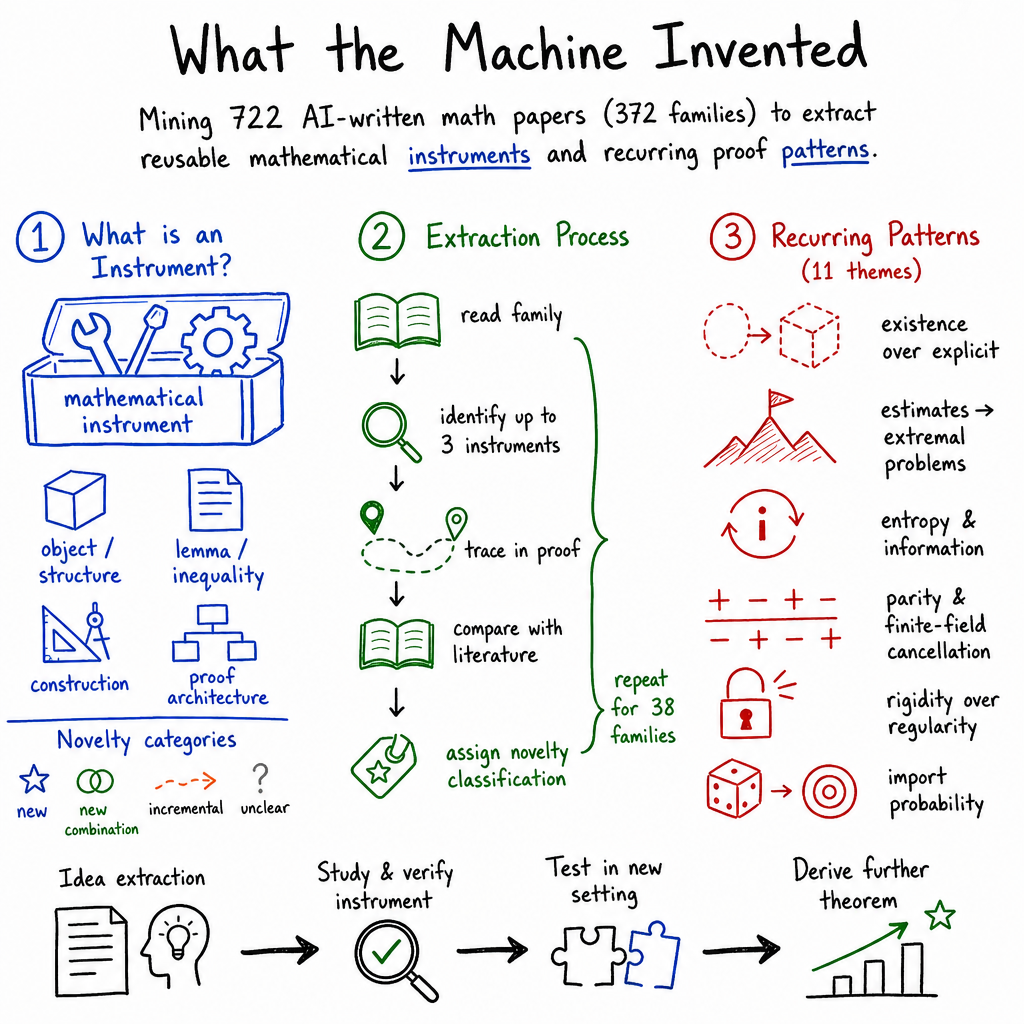
Instead of trying to check every entire proof, the author treats the collection like a treasure chest of ideas. The paper looks for useful mathematical tools hidden inside the AI-written arguments. These tools might be:
- new lemmas, which are smaller mathematical facts;
- new constructions, meaning objects designed for a particular problem;
- new inequalities, which compare mathematical quantities;
- new proof strategies or “architectures.”
The author calls these tools mathematical instruments. An instrument is like a new tool in a toolbox: it may be useful for solving problems beyond the one where it first appeared.
The paper examines 38 of the 372 problem families, covering areas such as number theory, geometry, computer science, algebra, topology, and mathematical physics.
2. What questions does the paper ask?
The main questions are:
- What new mathematical tools appear in the AI-written papers?
- Which tools are genuinely new, and which are older methods used in a new combination?
- Can these tools be explained clearly without requiring readers to reconstruct hundreds of pages of proof?
- Can some of the tools be reused to prove other results?
- How trustworthy are the claims, given that the original manuscripts had not been peer-reviewed?
The author is careful to separate three different ideas:
- A tool may be completely new.
- It may combine several known ideas in a new way.
- It may simply be an existing method used in a different area.
The paper also asks readers to be cautious. Finding an interesting idea inside a proof does not automatically mean that the full proof is correct.
3. How was the research carried out?
Selecting and reading the manuscripts
The author selected 38 problem families because they involved famous or important mathematical questions. Each family was studied using available materials, such as:
- the manuscript’s LaTeX source or PDF;
- related Lean files, when available;
- reasoning summaries;
- earlier mathematical literature.
For each family, the initial analysis usually identified up to three possible instruments. The author then traced each instrument through the argument and searched for similar ideas in earlier research.
This is similar to examining a complicated machine, identifying its important parts, and checking whether those parts had already been used in other machines.
Classifying possible discoveries
Each extracted instrument was given one of four labels:
| Label | Meaning in simple language |
|---|---|
| New | No earlier example of the idea was found |
| New combination | The individual parts are known, but putting them together appears new |
| Incremental | The idea is a small improvement or variation of an existing method |
| Unclear | There was not enough information to decide |
These labels are provisional. They do not prove that an idea is truly original, because the literature search was not complete for every case.
Mathematical review
After the initial extraction, the author checked selected theorem statements and supporting arguments against a fixed version of the repository. This review corrected some claims, assumptions, and numerical counts.
However, the author did not independently verify every proof. No Lean program was compiled and checked by Lean’s proof-checking system for this survey.
A useful analogy is a book report that checks important quotations and major facts but does not reproduce every experiment or verify every calculation in the original book.
4. What did the paper find?
Many different kinds of instruments
The paper identifies a wide variety of possible tools. For example:
- An entropy inequality for studying matrix multiplication. Entropy is a way of measuring uncertainty, similar to asking how many possible choices remain.
- A latent alphabet gadget for the Unique Games Conjecture. This hides information in a larger secret system while allowing the intended decoder to recover it.
- A signed restriction lemma for proving that certain computer circuits must be very large. A restriction is like simplifying a problem by fixing some of its inputs.
- A coupled purity bootstrap for studying the energy gap in a quantum spin system.
- A momentum increment argument for controlling particle motion in the Vlasov–Maxwell equations.
These instruments come from very different areas, but they often follow similar patterns.
Eleven recurring patterns
The paper finds several strategies that appear repeatedly. Important examples include:
Using existence instead of construction
Some proofs show that an object must exist without actually giving a practical way to build it. This is like proving that a treasure is somewhere in a large forest without saying exactly where.
Turning estimates into extremal problems
Some arguments study the “best possible” example. If that example would have certain properties, the proof then shows that those properties are impossible.
Using information and entropy
Several proofs measure dependence between objects using ideas related to information theory. If one part of a system cannot contain enough information to explain another part, a contradiction may result.
Importing methods from another field
A theorem developed for one subject may be used in a completely different subject. For example, a theorem about maps without fixed points may be applied to a problem about groups.
Adding auxiliary structures
Some proofs create a new hidden structure—such as a random system, a larger alphabet, or an extra hierarchy—to make the original problem easier to control.
Rediscovering earlier ideas
The author found cases where an AI-written argument seemed close to previous work that was not cited in the manuscript. This is important because an idea that looks new may actually be a rediscovery or adaptation of an older result.
The instruments were not all equally reliable
The paper does not claim that all 38 source manuscripts are correct. Some contain formalizations, but many do not. Even when a Lean file is supplied, the survey did not compile and kernel-check it.
The author also found that some impressive-sounding claims were more limited than their titles suggested. For example, a result might work only under special assumptions, or a computation might depend on computer arithmetic rather than a completely formal proof.
Therefore, the paper’s results are best understood as a research map rather than a final list of proven mathematical discoveries.
One tool was used in a later application
The paper briefly describes a later use of the signed restriction lemma from family 112. Combined with other known methods, that lemma was used to obtain stronger lower bounds for certain fixed-depth computer circuits.
In simple terms, the original tool showed that some circuits need to be large at depth three. The later work investigated how the same tool could help show that circuits must also be extremely large at several other fixed depths.
The paper says that the full proof of this application belongs in a separate manuscript.
5. Why are these findings important?
The paper’s most important contribution is not necessarily proving one famous conjecture. Instead, it creates a way to search through a huge collection of AI-generated mathematics for reusable ideas.
This could be useful because:
- Long mathematical papers can be hundreds of pages long.
- A short description can help experts decide which papers deserve closer attention.
- A failed proof may still contain a correct and useful lemma.
- An idea from one field may help solve a problem in another.
- The catalogue can show which claims depend on other unverified claims.
- It can help researchers decide where formal verification should be attempted.
For example, discovering a useful lemma is like finding a strong new building block. Even if the original building made from it collapses, the block might still be useful in a different structure.
6. What are the limitations?
The author emphasizes several important limitations:
- Only 38 of 372 families were examined.
- The source manuscripts had not been peer-reviewed.
- The full proofs were not independently checked.
- The novelty searches were not equally thorough for every family.
- Some results depend on other AI-written manuscripts that are themselves unverified.
- No Lean development was compiled and checked during the survey.
- The labels “new” and “new combination” are temporary judgments, not official claims of priority.
This means readers should not treat the paper as proof that the AI has solved dozens of major mathematical problems. Instead, it is a preliminary investigation into whether the manuscripts contain ideas worth studying.
7. Overall impact and conclusion
The paper presents AI-generated mathematics as both a possible source of discoveries and a difficult problem for human researchers to evaluate.
Its main message is:
Even when an AI-written proof is incomplete or incorrect, the proof may contain useful mathematical instruments.
The paper offers a systematic way to find, describe, compare, and eventually test those instruments. If this approach works, it could help mathematicians examine future large collections of AI-generated research more efficiently.
However, the most important next step is careful human verification. Researchers would need to check whether each proposed instrument is correct, whether it is genuinely new, and whether it can really be reused in other problems.
So, the paper is best viewed as a catalogue and research guide, not as a final certification of the AI manuscripts. It suggests that AI may generate valuable mathematical ideas, but it also shows that those ideas must still pass through the usual processes of checking, formal proof, peer review, and independent research.
Knowledge Gaps
Knowledge gaps, limitations, and open questions
- The source proofs are not independently verified. The survey checks selected theorem statements and supporting arguments, but it does not establish the correctness of the 38 headline results or certify the extracted instruments.
- No Lean development was compiled or kernel-checked. Reported formalization statuses therefore do not demonstrate that the associated statements, proofs, or dependencies compile in Lean.
- The selection is not representative of the full release. Only 38 of 372 problem families are examined, with an emphasis on prominent problems; the mathematical instruments and recurring patterns may not generalize to the remaining 334 families.
- The literature search is incomplete and uneven. Some second-group entries were assessed using directly retrieved sources and existing model knowledge without a fresh search, so several “new” or “new combination” classifications may reflect undiscovered prior work.
- Novelty and priority are not established. The four-grade verdicts are provisional comparisons against the literature examined during the initial extraction and do not constitute exhaustive prior-art searches or priority claims.
- The extraction protocol has not been independently audited. Each family was generally read by one AI process, with up to three candidate instruments selected; the reproducibility of the selection, interpretation, and classification decisions remains untested.
- The criteria for identifying an “instrument” remain partly subjective. The paper does not provide operational tests that reliably distinguish a genuinely new mathematical device from a new presentation, a routine adaptation, or a combination of known tools.
- The reliability of AI-generated extraction is unknown. The paper does not measure extraction accuracy, omission rates, hallucinated dependencies, or sensitivity to the choice of source format, prompt, or reasoning trace.
- The survey does not systematically evaluate the extracted instruments independently of their source proofs. It remains unclear which candidate lemmas or constructions survive if the headline proof containing them is invalid.
- The scope of each instrument is often unresolved. Many extracted devices are described in the specific settings of the source manuscripts, without determining their sharp hypotheses, optimal constants, dimensional range, or generalization to related problems.
- The practical effectiveness of nonconstructive arguments is not established. Several constructions use compactness, ultrafilters, random choices, or terminating searches without explicit bounds, algorithms, or feasible parameter values.
- Quantitative dependencies are frequently left unexplored. The survey identifies enormous or unspecified parameters in several arguments but does not determine whether the bounds can be reduced or whether the results remain meaningful at realistic scales.
- The claimed cross-field transfers require independent validation. Applications of established results to amenability, Chowla correlations, Bloch’s conjecture, Mahler’s conjecture, and other settings may involve hypotheses or compatibility conditions that the survey does not fully check.
- The paper does not establish that the recurring cross-cutting patterns are mathematically significant. It identifies eleven patterns descriptively, but does not quantify their frequency, compare them with patterns in human-generated mathematics, or show that they predict successful proof strategies.
- The relationship between extracted instruments and later mathematical reuse is only demonstrated narrowly. The signed restriction lemma from family 112 is connected to a separate depth- circuit application, but the application is not proved in this paper and no systematic reuse study is conducted for the other instruments.
- The proposed extension of the argument is unresolved. The possible generalization from to for rational , , lacks the required interpolation, height, and determinant estimates.
- The claimed consequences of several results are not fully analyzed. For example, the implications for the Connes–Shlyakhtenko -Betti conjecture and Kadison’s transitive-algebra problem are noted but not developed or independently established.
- Computationally supported claims remain insufficiently reproducible. The dimension-six mutually unbiased bases result relies on a binary64 computation and hand-proved margins, but the survey does not provide a formally verified implementation, compiler-independent certificate, or exact-arithmetic replacement.
- The status of the Navier–Stokes construction is incomplete. Defining the forcing as a residual ensures the equation formally, but the required mean, regularity, time-dependence, and eventual-stationarity properties of the force remain to be proved.
- Several headline statements require sharper formulation. The survey records restrictions omitted by titles—such as model assumptions, coefficient choices, asymptotic regimes, and computational semantics—but does not determine whether the restricted results imply the advertised broader interpretations.
- Dependencies on other unverified OpenAI manuscripts remain unresolved. Some arguments rely on results from other release papers whose correctness, formalization status, and independence have not been established.
- Uncited antecedents identified by the survey are not systematically reconciled with the source manuscripts. The paper notes possible rediscoveries or omitted citations, but does not determine whether the similarities reflect direct dependence, independent discovery, or merely analogous proof structure.
- The survey’s mathematical review is incomplete for long and technically dense arguments. Only selected identities, statements, and load-bearing steps were checked; errors in unexamined sections could still invalidate the reported instruments or conclusions.
- The supplied paper text itself is incomplete for evaluating all 38 families. The excerpt ends within the card for family 004, so the unresolved details, caveats, and verification status of later family-specific analyses cannot be assessed from the provided text alone.
Practical Applications
Immediate Applications
- Mathematical literature triage and research navigation — Academia
- Use the paper’s extraction protocol to create structured summaries of large mathematical repositories: identify the main claim, candidate lemmas, proof dependencies, novelty status, formalization status, and caveats.
- A practical tool could be a searchable catalogue in which researchers query instruments such as the “shared-leg entropy inequality,” “triangular polynomial cells,” or “coupled purity bootstrap” independently of the headline theorem.
- Dependencies: The summaries should be treated as reading aids rather than verified mathematical results. Human experts, reliable literature searches, and source-level checking remain necessary.
- Prioritization of formal verification — Academia and software
- Use the paper’s dependency scoreboard to decide which claims should be formalized first in Lean or another proof assistant.
- A useful workflow would rank statements by mathematical importance, number of downstream dependencies, absence of existing formalization, and vulnerability to hidden assumptions.
- For example, the signed restriction lemma from family 112 could be formalized before attempting to formalize the much larger circuit lower-bound argument.
- Dependencies: Formalization requires precise theorem statements, complete definitions, machine-readable source material, and independent kernel checking. The paper explicitly reports that no Lean development was compiled or kernel-checked for this survey.
- Automated proof-audit and review assistance — Academia and publishing
- Adapt the two-stage process—AI extraction followed by mathematical review—for journal submissions, grant reviews, or large theorem-proving projects.
- The resulting review report could flag:
- unverified dependencies on other manuscripts;
- corrected hypotheses or theorem statements;
- possible uncited antecedents;
- non-effective existence arguments;
- computational steps dependent on floating-point arithmetic;
- claims that are consequences rather than results actually proved.
- Dependencies: Such systems can identify review priorities but cannot replace peer review or establish correctness and novelty.
- Reusable proof-pattern databases — Academia and AI-assisted mathematics
- Build a database of proof mechanisms rather than only theorems. Examples include:
- replacing pointwise force estimates with signed, time-integrated increments;
- using entropy or mutual information to rule out extremal configurations;
- transferring deterministic problems to measurable or probabilistic formulations;
- introducing auxiliary latent structures to satisfy controllable invariants;
- using compactness to obtain existence without an explicit construction.
- This could support mathematicians searching for analogous strategies in unfamiliar fields.
- Dependencies: The database must distinguish genuinely new methods from rediscoveries, known tools used in new settings, and combinations of established results.
- Educational resources for advanced mathematics — Education
- Convert the family cards into graduate-level case studies showing how a proof is decomposed into claims, instruments, reused results, and unresolved risks.
- Students could compare, for example, the use of entropy in Kakeya-type arguments, matrix multiplication, graph constructions, and operator-algebra problems.
- Dependencies: Examples should be clearly labelled as claimed, partially checked, or verified; otherwise students may mistake provisional arguments for established mathematics.
- Research project planning and collaboration — Academia and industry R&D
- Use the paper’s distinction between “new,” “new combination,” “incremental,” and “unclear” to assign projects more realistically.
- A team could separate:
- theorem verification;
- literature and priority searches;
- formalization;
- construction of explicit examples;
- investigation of downstream applications.
- Dependencies: The four-grade classification is qualitative and based on incomplete literature searches, so it should guide discussion rather than determine priority or intellectual-property claims.
- Methodology for evaluating future AI-generated research — Policy and research governance
- Adopt the paper’s protocol as a governance template for AI-generated scientific outputs:
- preserve the source snapshot;
- record model and tool usage;
- separate extraction from verification;
- report formalization and compilation status;
- disclose dependencies on other AI-generated work;
- identify computational assumptions and unproved extensions.
- Dependencies: Effective policy would require agreed standards for provenance, reproducibility, authorship, peer review, and liability.
- Public-facing explanation of advanced research — Science communication
- Produce accessible summaries that explain what a long technical paper attempts, which ideas appear reusable, and which claims remain unverified.
- This is particularly useful for research institutions, funding agencies, and interdisciplinary collaborators who need an initial orientation without relying on exaggerated headline claims.
- Dependencies: Communication must preserve the paper’s important distinctions between claimed results, extracted instruments, and independently established consequences.
Long-Term Applications
- AI systems for mathematical discovery and proof transfer — Academia and software
- Develop systems that do more than summarize proofs: they could detect a reusable instrument, match it to problems in another field, and generate candidate transfer arguments.
- The paper’s case study suggests a concrete pipeline: extract the signed restriction lemma from family 112, combine it with depth reduction and sparsification, and test whether it yields circuit lower bounds at additional depths.
- Similar systems could search for transfers of entropy inequalities, rigidity arguments, compactness schemes, or spectral-gap criteria.
- Dependencies: This requires verified formal libraries, semantic understanding of hypotheses, reliable novelty searches, and safeguards against transferring a lemma outside its domain of validity.
- Computer-assisted discovery of circuit lower bounds — Software and theoretical computer science
- The signed restriction lemma could contribute to automated or semi-automated searches for lower bounds against bounded-depth circuits.
- A potential tool would combine restriction lemmas, switching-lemma estimates, sparsification, and depth-reduction transformations to test candidate hard languages and optimize quantitative parameters.
- Dependencies: The source lemma and its stated language must first be independently verified. The advertised extension to every fixed depth is described as belonging to a separate application manuscript, not as a fully established result of this paper.
- Formal libraries of cross-disciplinary proof instruments — Academia and AI
- Create interoperable libraries in which a mathematical device is encoded with:
- its formal statement;
- required hypotheses;
- proof;
- examples and counterexamples;
- known antecedents;
- permitted transformations;
- computational complexity or effectivity information.
- Instruments from analysis, combinatorics, operator algebras, geometry, and complexity theory could then be searched and reused systematically.
- Dependencies: This requires common representations across mathematical domains and substantial expert labour to formalize definitions, not merely theorem conclusions.
- New algorithms inspired by entropy and information-based arguments — Software, communications, and data science
- The recurring use of entropy, mutual information, and relative-entropy projections suggests possible algorithmic methods for:
- detecting dependence in high-dimensional data;
- designing compression or sparsification schemes;
- identifying infeasible configurations;
- certifying bounds in combinatorial optimization;
- constructing adversarial or pseudorandom test distributions.
- These would be inspired by the mathematical mechanisms, not direct engineering consequences of the headline conjectures.
- Dependencies: A proof inequality does not automatically yield an efficient algorithm. Explicit finite-dimensional formulations, numerical stability analysis, and complexity bounds would be required.
- Robust control and kinetic simulation from signed-increment estimates — Engineering, robotics, and physics
- The signed momentum-increment method in the Vlasov–Maxwell family could motivate numerical schemes that estimate accumulated impulse rather than bounding instantaneous force.
- Potential uses include long-horizon particle simulation, collision avoidance, electromagnetic control, and stability monitoring in plasma or robotics systems.
- Dependencies: The extracted estimate concerns a highly specialized relativistic PDE setting. Any engineering use would require discretization error bounds, robustness to noisy measurements, computable constants, and validation outside the idealized model.
- Quantum-information and many-body-physics diagnostics — Quantum computing and energy
- The “coupled purity bootstrap” and the area-law argument suggest possible diagnostics relating transfer-matrix spectra, Rényi purity, conditional mutual information, and excitation energy.
- A future software package could estimate whether a quantum spin system is likely to exhibit a spectral gap or area-law behaviour from finite-size numerical data.
- Dependencies: The source arguments are mathematical and may rely on thermodynamic limits, exact identities, or assumptions not available in experiments. Finite-size scaling, noise tolerance, and computational cost must be established.
- New optimization and certification methods for graph problems — Software and operations research
- The paper’s graph-theoretic instruments—algebraic hole relations, entropy-minimizing containers, parity constructions, and separator arguments—could inspire certificates for:
- non-colorability;
- forbidden subgraph structure;
- graph-product obstructions;
- approximate extremal configurations.
- A practical outcome could be a solver that produces human-readable algebraic or entropy-based certificates rather than only numerical infeasibility reports.
- Dependencies: Some source constructions use enormous, non-explicit, or probabilistically selected parameters. Efficient generation of finite certificates is not established.
- Analytic continuation and number-theoretic computation — Finance, cryptography, and scientific computing
- If the zero-free-region and character-sum architectures are validated and made effective, they could improve bounds used in prime-distribution computations, explicit prime searches, and arithmetic algorithms.
- Possible downstream uses include faster verification of prime-related hypotheses, improved estimates for arithmetic progressions, and better parameter selection in number-theoretic cryptographic routines.
- Dependencies: These applications depend on the correctness of delicate automorphic, sieve, and twist-bookkeeping steps. The paper itself identifies such dependencies as central points requiring further verification; no production use is justified presently.
- Automated generation of adversarial test cases — AI safety and software testing
- The paper’s use of latent alphabets, hidden structure, unusual group actions, and measurable-versus-constructible transfers could inspire benchmarks designed to expose weaknesses in AI reasoning systems.
- Tests could evaluate whether a model:
- distinguishes existence from explicit construction;
- tracks quantifiers and uniformity;
- notices missing hypotheses;
- identifies dependence on unchecked manuscripts;
- avoids treating numerical evidence as proof.
- Dependencies: Benchmark designers must prevent the tests from measuring only memorization of the paper and should use independently generated mathematical examples.
- Long-term policy standards for AI-generated science — Research governance
- The paper supports a future certification framework in which AI-generated mathematical work is accompanied by machine-readable provenance, formal verification status, dependency graphs, literature comparisons, and uncertainty labels.
- Such standards could be extended beyond mathematics to AI-generated results in physics, biology, economics, and engineering.
- Dependencies: Adoption would require coordination among publishers, universities, repositories, proof-assistant communities, and funding agencies. Standards must also address false confidence, attribution, and responsibility for errors.
- Everyday and professional decision-support tools based on calibrated uncertainty — Daily life and general productivity
- Although the paper has no direct consumer application, its distinction between claimed, partially checked, formalized, and verified results could inform general-purpose AI assistants.
- A future assistant could present answers with explicit evidence states—for example, “source summary,” “checked calculation,” “formally verified,” or “requires expert review”—rather than giving a single undifferentiated confidence score.
- This could improve use of AI for personal finance, education, software development, and technical decision-making.
- Dependencies: The approach depends on meaningful and auditable verification labels. A model’s internal confidence alone is insufficient evidence of correctness.
Glossary
- Amenability: A property of a group expressing the existence of an invariant mean on bounded functions over the group. “Thompson's group F is not amenable”
- Asymptotic spectrum: A structure used to compare the asymptotic complexity of mathematical objects through homomorphisms into an ordered semiring. “The proof bounds every point of Strassen's asymptotic spectrum”
- Atkin–Lehner group: A group of automorphisms acting on modular or Shimura curves through involutions associated with divisors of the level. “the Shimura curve , genus 5, modulo its Atkin--Lehner group”
- Benyamini–Sternfeld map: A Lipschitz map on an infinite-dimensional space that has no approximate fixed point. “with f a Benyamini--Sternfeld Lipschitz map having no approximate fixed point”
- Borsuk–Ulam theorem: A topological theorem stating that every continuous map from an -sphere to identifies a pair of antipodal points. “degree analysis at the tight Borsuk--Ulam bound”
- Chowla conjecture: A conjecture concerning the cancellation of correlations among values of the Liouville function. “Ordinary two-point Chowla; corrected binary Elliott”
- Crouzeix conjecture: A conjecture bounding the numerical range functional calculus of a matrix by a constant, conjectured to be . “Complete (matrix-valued) Crouzeix conjecture”
- Csiszár I-projection: The relative-entropy projection of a probability distribution onto a specified convex set of distributions. “a Csiszár I-projection as its progress measure”
- Dirichlet -function: A complex analytic function formed from a Dirichlet character and a Dirichlet series, generalizing the Riemann zeta function. “Every Dirichlet L-function and every finite-order Hecke L-function over ”
- Eilenberg swindle: An argument showing that an object is zero in a Grothendieck group by expressing it as an infinite direct-sum cancellation. “an Eilenberg swindle makes the embedded torus class vanish”
- Elliptic height: A height function measuring the arithmetic complexity of points on an elliptic curve. “a height bound against ”
- Entropy inequality: An inequality relating entropy or information quantities, often used to control combinatorial or probabilistic dependencies. “a ‘shared-leg entropy inequality’”
- Exact Lagrangian: A Lagrangian submanifold on which the Liouville one-form restricts to an exact differential. “an embedded exact Lagrangian”
- Faber coefficients: Coefficients in expansions involving Faber polynomials, used to represent analytic functions associated with conformal maps. “Parseval over Faber coefficients”
- Følner set: A finite subset of a group whose boundary is small relative to its size, characterizing amenability. “Color each element of a Følner set”
- Fox derivative: A noncommutative derivative used in the study of free groups and group presentations. “a Fox-derivative cocycle”
- Free Poisson law: A probability distribution from free probability theory that serves as an analogue of the classical Poisson distribution. “the limiting free Poisson law has no atom at 0”
- Fundamental group: An invariant recording the possible trace-scaling factors of a von Neumann algebra under amplifications. “fundamental group ”
- Gauss sum: A finite sum involving an additive or multiplicative character over a finite field or ring. “Poisson fuses with Gauss sums into cubic Gauss sums”
- Hadamard matrix: A matrix whose entries have equal modulus and whose rows are mutually orthogonal. “Represent every order-6 complex Hadamard matrix”
- Haldane gap: The predicted positive spectral gap above the ground state in certain integer-spin Heisenberg antiferromagnets. “Haldane gap for the spin-1 Heisenberg ring”
- Hecke -function: A generalization of a Dirichlet -function associated with a Hecke character of a number field. “every finite-order Hecke L-function over ”
- HNN extension: A group construction that adjoins an element identifying two subgroups of a given group. “a reduced HNN adjunction along peaking projection sequences”
- Iwasawa variable: A parameter in Iwasawa theory used to encode arithmetic information across a tower of number fields. “use as extra Iwasawa variables to force integrality”
- Kakeya set: A set containing a unit line segment in every direction, central to problems concerning geometric measure and harmonic analysis. “Kakeya sets in have dimension 4”
- KMS inverse theorem: A rigidity theorem characterizing structures that exhibit approximate extremality in a degree-two or noncommutative setting. “so the degree-two KMS inverse theorem applies unchanged”
- Kubota–Patterson automorphy: Automorphic transformation behavior associated with cubic theta functions and metaplectic forms. “whose Kubota--Patterson automorphy moves the thin sextic family”
- Lelong number: A local numerical invariant measuring the singularity or concentration of a complex analytic or plurisubharmonic object. “push Lelong-number Jacobian mass to the boundary”
- Mahler conjecture: A conjecture concerning lower bounds for the volume product of a convex body and its polar. “Mahler conjecture, symmetric and general”
- Mézard–Parisi formula: A variational formula describing the limiting free energy of certain disordered systems, especially spin glasses. “Mézard--Parisi formula for diluted spin glasses”
- Mutual information: A quantity measuring the dependence between random variables through the reduction in uncertainty from observing one variable. “a mutual-information bound”
- Naimark’s problem: A problem concerning the classification and extension of pure states on operator algebras. “Naimark's problem in ZFC”
- Nef divisor: A divisor whose intersection number with every curve is nonnegative. “proved by a Dyson-type curve inequality pushed through nef/ample”
- Perfectoid space: A highly structured nonarchimedean geometric object defined using a perfectoid field and designed to support characteristic-changing techniques. “asymptotic perfectoid data”
- Quot scheme: A parameter space classifying quotient sheaves of a fixed coherent sheaf with prescribed numerical data. “a torus-localized Quot-scheme count”
- Rényi-2 purity: The quantity obtained from the order-two Rényi entropy, commonly measuring the purity of a quantum state. “a Rényi-2 purity bootstrap”
- Schrödinger–Poisson law: A mathematical framework coupling quantum-mechanical wave equations with electrostatic interactions. “full Schrödinger theory”
- Selmer group: An arithmetic group encoding locally soluble points and obstructions to global points on algebraic varieties. “Full BSD formula in Selmer corank 0 and 1”
- Shimura curve: An arithmetic algebraic curve parametrizing structures associated with quaternion algebras or related Shimura data. “the Shimura curve ”
- Strassen calculus: A framework for analyzing tensor rank and matrix multiplication through asymptotic algebraic methods. “the spectral argument for follows a template in Alman--Li's 2026 ‘Strassen calculus’”
- Tate spectral sequence: A spectral sequence used to compute equivariant or stable homotopy-theoretic invariants. “imposes a deadline on the Tate spectral sequence”
- Ultrafilter: A maximal filter on a set, often used to define generalized limits and compactness arguments. “The Hadwiger argument selects m through an ultrafilter”
- Van Kampen diagram: A planar combinatorial diagram encoding a relation in a group presentation. “separators for diagrams of van Kampen type”
- Verdier duality: A duality theory for sheaves on a space or stratified space, generalizing Poincaré duality. “while retaining invertible Verdier duality”
- Witt group: An algebraic group classifying quadratic or bilinear forms up to stable equivalence. “Witt-group ‘signature’ of a sphere's orientation form”
- ZFC: The standard axiomatic system of set theory consisting of Zermelo–Fraenkel axioms with the axiom of choice. “Naimark's problem in ZFC”

