TheoPhysEval: Assessing AI agents at autonomous theoretical physics problem solving
Abstract: We present a suite of 50 unpublished research-level theoretical physics problems with verifiable answers. Without AI assistance, a typical problem in our collection could be solved by a world expert in about a day or less but would take considerably longer for experts in adjacent specialties. We test the ability of off-the-shelf AI agents to tackle these problems autonomously, without human hints. When given access to tools available in a realistic setting, including the ability to search the literature and write scripts for numerical and symbolic work, the best-performing agent, GPT-6-Astra harnessed in Codex, obtains the final answers with a near-perfect accuracy of 98% at an average cost under USD 3 per problem. On average, agents show only small changes in accuracy when denied web search and access to background research papers, suggesting significant memorization of the literature. These results suggest that state-of-the-art agents can accurately perform concrete calculations required across theoretical physics research. We comment on the broader implications of these findings and discuss possible explanations for the current lack of agent-led breakthroughs in theoretical physics despite their outstanding problem-solving abilities.
Paper Prompts
Sign up for free to create and run prompts on this paper.
Top Community Prompts
Explain it Like I'm 14
1. What is this paper about?
This paper tests how well modern AI agents can solve difficult problems in theoretical physics.
An AI agent is more than a chatbot. It is a LLM connected to useful tools, such as:
- internet searches,
- scientific papers,
- computer programs,
- calculators,
- code for numerical experiments.
The researchers created a collection called TheoPhysEval containing 50 challenging physics problems from many areas, including quantum physics, gravity, particle physics, fluid dynamics, and statistical physics.
The main goal was to find out whether AI agents can solve the kinds of smaller, technical problems that physicists often face during research.
These were not famous unsolved mysteries or huge scientific breakthroughs. Instead, they were more like difficult research assignments using known ideas in a new situation.
2. What questions did the researchers ask?
The paper focused on several main questions:
- Can AI agents solve advanced, research-level physics problems without human help?
- How accurate are they compared with expert physicists?
- Does giving an AI access to the internet and scientific papers improve its performance?
- Can AI use tools such as computer code and numerical calculations effectively?
- What kinds of mistakes do AI agents make?
- Does being good at calculations mean that an AI can do all parts of physics research?
The researchers were especially interested in the difference between:
- solving a clearly stated problem with a checkable answer, and
- deciding which important scientific questions should be asked in the first place.
3. How was the research carried out?
Building the problem collection
Experts in theoretical physics contributed 50 problems. The problems had to meet three important conditions:
- They had to be connected to modern physics research.
- Their answers had to be difficult to guess but easy to check.
- Their answers should not already be publicly available.
The problems covered 11 broad areas. For example, some involved the behavior of fluids near surfaces, quantum materials, black holes, particle physics, and biological systems.
A typical problem might ask an AI to:
- Find a useful equation from an earlier research paper.
- Change the equation for a new situation.
- Write a computer program to solve it.
- Check the result and give a final number.
This is similar to giving someone a complicated building plan and asking them to adjust it for a different building.
Testing the AI agents
The researchers tested five AI systems:
- GPT-6-Astra with Codex,
- Opus 5.5 with Claude Code,
- Gemini 3.8 Flash with Antigravity,
- DeepSeek-V4.1-Flash with Codex,
- GLM 5.3 with Claude Code.
Each AI was allowed to work independently. It could read the problem, use computer tools, write programs, and perform calculations.
The researchers used two testing conditions:
Realistic track
The AI could use:
- web searches,
- scientific papers,
- local computer tools,
- numerical and symbolic software.
This was meant to imitate how a real physicist might use an AI research assistant.
Isolated track
The AI could use local computer tools, but it could not search the internet.
This tested whether the AI already knew enough physics and could recreate the needed calculations without looking things up.
How answers were graded
Many physics answers can be written in different but equivalent mathematical forms. Comparing these forms directly can be difficult.
To avoid this problem, the researchers usually gave the AI specific numerical values. The AI then had to produce a numerical answer, such as a value in scientific notation.
The answer was marked correct or incorrect by comparing it with the researchers’ reference answer.
This is similar to checking whether two students get the same answer to a math problem, even if they show their work differently.
4. What were the main results?
The best AI solved almost every problem
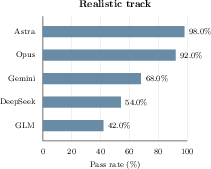
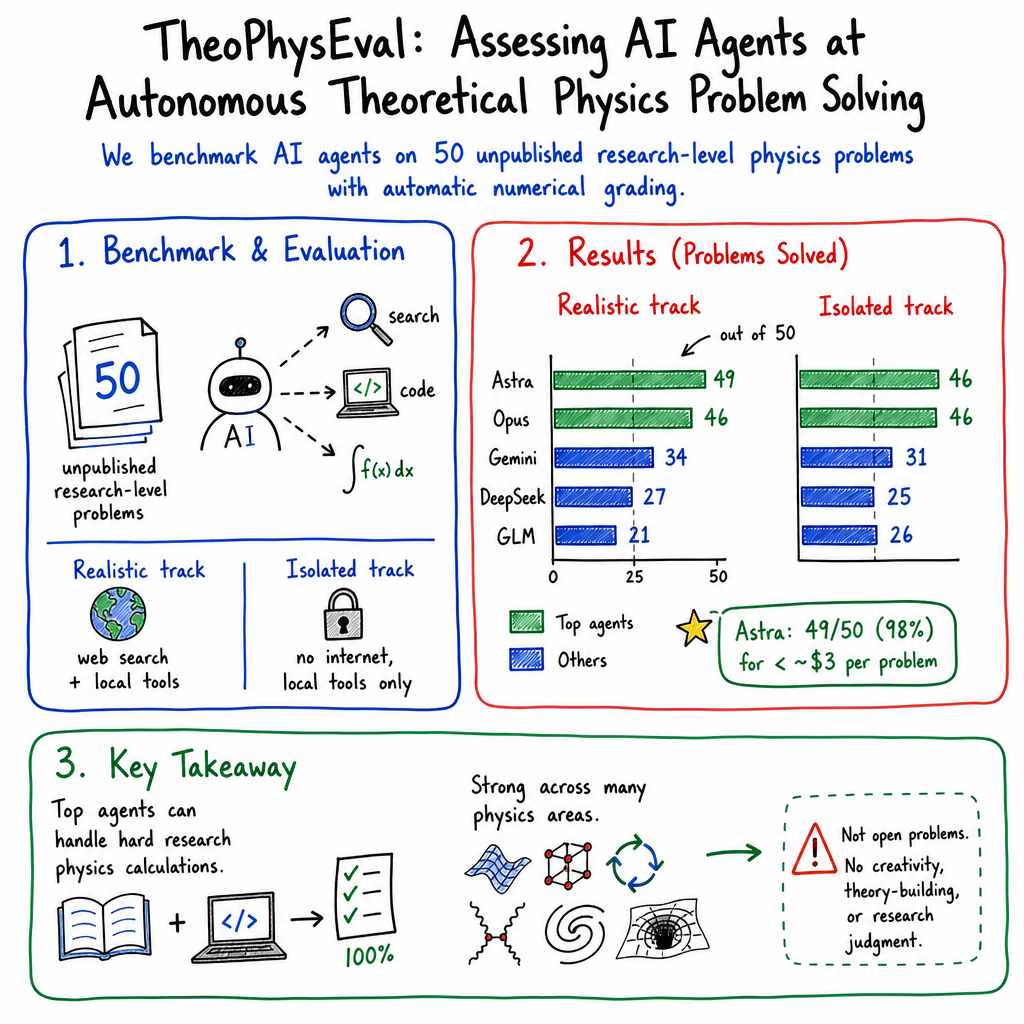
On the realistic track, the results were:
| AI agent | Problems solved correctly |
|---|---|
| Astra | 49 out of 50 |
| Opus | 46 out of 50 |
| Gemini | 34 out of 50 |
| DeepSeek | 27 out of 50 |
| GLM | 21 out of 50 |
Astra therefore achieved an accuracy of about 98% when it could use the internet and computer tools.
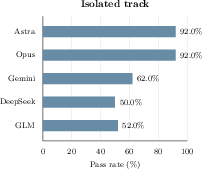
On the isolated track, where internet searches were not allowed:
| AI agent | Problems solved correctly |
|---|---|
| Astra | 46 out of 50 |
| Opus | 46 out of 50 |
| Gemini | 31 out of 50 |
| GLM | 26 out of 50 |
| DeepSeek | 25 out of 50 |
The strongest agents still performed very well without web access.
Internet access made less difference than expected
The researchers expected the AI systems to perform much worse without internet access. Surprisingly, their scores changed only a little.
This suggests that the strongest AI models may have already learned or memorized a large amount of physics knowledge from scientific papers.
For example, an AI could sometimes remember an equation from a research paper even when it was not allowed to search for that paper.
However, this does not prove that the AI truly understands physics in the same way a human does. It may also be very good at recognizing familiar patterns and reproducing learned formulas.
AI agents could combine several skills
The hardest problems often required several steps:
- understanding specialized scientific language,
- finding or remembering relevant physics,
- adapting an existing method,
- writing computer code,
- solving equations numerically,
- checking whether the result made sense.
The strongest AI agents were often able to complete this entire chain by themselves.
For instance, a problem about black holes required the AI to adapt equations from a different situation and then use a numerical computer program to solve them.
Some problems still confused the AI
The agents did not succeed at everything.
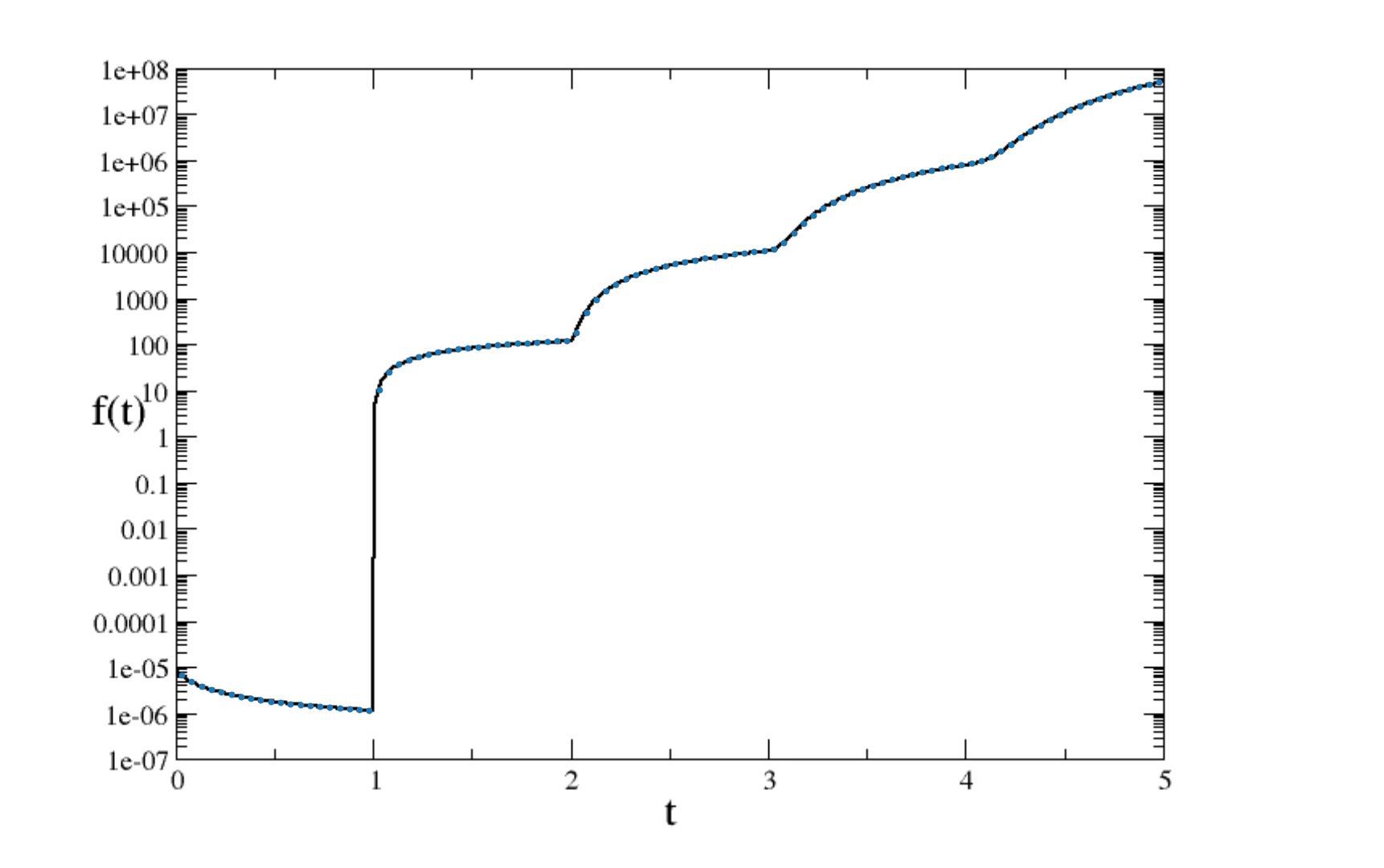
One particularly difficult problem was an inverse problem. In a normal, or “forward,” problem, you start with rules and calculate what happens. For example:
If a ball is thrown with a certain speed, where will it land?
In an inverse problem, you start with what happened and try to discover the rules that caused it:
If you know where the ball landed, what throwing conditions might have produced that result?
All the tested AI agents failed at this problem.
The weaker agents also made mistakes such as:
- using a formula that applied to the wrong number of dimensions,
- choosing the wrong type of mathematical object to calculate,
- using incorrect starting information from a research paper,
- making an early sign error that affected every later calculation,
- deciding incorrectly that a solvable problem was impossible.
These mistakes show that AI can produce impressive answers while still making serious errors that an expert must check.
5. Why are these results important?
The results show that AI agents are becoming extremely capable at technical problem solving.
A single human physicist usually specializes in one or a few areas. For example, an expert in black holes may not know much about electronic structure or microbial systems.
The AI agents, however, were able to attempt problems across many different fields. Their broad knowledge gives them an advantage when a problem requires ideas from several specialties.
The results also suggest that AI could help physicists by:
- performing long calculations,
- writing and testing computer programs,
- searching scientific literature,
- adapting old methods to new problems,
- checking calculations,
- exploring many possible approaches quickly.
The paper reports that the best agent could solve these problems at an average cost of less than a few dollars per problem, although the total evaluation costs were higher because several systems and testing conditions were used.
6. What does this mean for the future?
The paper’s most important warning is that solving technical problems is not the same as doing all of science.
Research requires more than calculating an answer. A scientist must also:
- notice important patterns in nature,
- choose worthwhile questions,
- invent useful theories,
- decide which assumptions are reasonable,
- understand why a result matters,
- connect the result to the real world.
The tested AI agents were excellent at the later, calculation-heavy part of research. But the paper does not show that they can independently choose the most important research questions or create major new theories.
Therefore, the authors believe that human scientists are still needed. AI may act like a very fast research assistant, but people must guide it and carefully check its work.
Possible effects on education and careers
The results may change how physics is taught. Some smaller research projects that once trained graduate students might now be completed quickly by AI.
Students may need to focus less only on carrying out standard calculations and more on:
- understanding concepts,
- judging whether an answer is reliable,
- designing good questions,
- explaining results,
- developing creativity and scientific judgment.
The paper also raises concerns about fairness. If advanced AI tools become necessary for high-level research, wealthy universities and countries may benefit more than those with fewer resources.
Conclusion
This paper shows that the best current AI agents can solve many difficult, specialized theoretical physics problems with remarkable accuracy. They can search for information, write code, perform calculations, and produce correct numerical answers.
However, the study tests mainly whether AI can complete well-defined problems. It does not prove that AI can independently carry out every part of scientific discovery.
The likely future is not simply “AI replaces physicists.” Instead, AI may become a powerful tool that allows physicists to investigate more ideas, perform more calculations, and work across more areas. Human researchers will still be needed to ask the right questions, recognize important discoveries, and make sure the answers are genuinely meaningful.
Knowledge Gaps
Knowledge gaps, limitations, and open questions
- The benchmark’s representativeness is unresolved. The 50 problems were selected through expert networks and concentrated in areas where concise, verifiable calculations are easier to construct; it remains unknown how performance would change on less represented fields, qualitative theory-building, experimental interpretation, or problems without closed-form or numerical answers.
- The small sample size limits statistical precision. With only 50 problems and one run per agent, reported differences in accuracy may reflect problem-specific effects or sampling noise rather than stable differences between models.
- Run-to-run variability was not quantified. The study acknowledges nonzero-temperature variation but does not report repeated trials, confidence intervals, or per-problem variance estimates for any agent or track.
- The benchmark lacks independent external validation. Most reference solutions were supplied or checked by contributors, and several original solutions were later found to contain subtle errors; systematic double-blind verification by independent experts is still needed.
- The reliability of automated numerical grading remains uncertain. Converting symbolic answers into numerical instances can conceal algebraic or conceptual errors, while tolerance choices, rounding, unit conventions, and accidental agreement are not fully analyzed.
- Ambiguity in problem statements may affect scores. At least two problems had unspecified conventions, and the paper notes that other undetected ambiguities may remain; a formal ambiguity audit and revised, independently tested prompts are needed.
- The benchmark does not distinguish partial understanding from lucky numerical success. Agents receive credit primarily for final answers, so the evaluation does not establish whether a correct result arose from valid physical reasoning, memorized formulas, numerical experimentation, or accidental cancellation.
- Solution trajectories were not systematically assessed for scientific validity. The qualitative analysis identifies several errors, but there is no comprehensive expert rating of assumptions, derivations, code correctness, numerical stability, or reproducibility for every run.
- The claim of literature memorization is not conclusively established. Similar isolated- and realistic-track scores may reflect memorization, general physical reasoning, latent training-data exposure, or benchmark structure; controlled tests with novel notation, synthetic theories, or temporally held-out literature are needed.
- Data leakage cannot be ruled out. Contributors sometimes used AI tools, and the paper acknowledges that solutions may have entered model training or other accessible resources; provenance audits and contamination tests are absent.
- The isolated track may not measure “innate” model knowledge cleanly. Models may still rely on pretrained information, provider-side retrieval, cached context, or hidden system behavior, and the exact provider-level restrictions are not independently verifiable from the paper.
- The realistic track is not fully representative of professional research practice. It permits web search and local tools but omits common human-agent interaction, domain-specific databases, private codebases, collaborative review, and iterative correction by experts.
- The effect of human feedback is unmeasured. The paper predicts that multi-turn expert feedback would substantially improve weaker agents, but does not quantify how much assistance is required or whether such assistance changes the nature of autonomous performance.
- Harness and model pairing effects remain unexplored. Each model was paired with a particular coding or agent framework, and alternative pairings, prompts, tool policies, and orchestration strategies were not systematically compared.
- The evaluation does not separate model capability from harness capability. Because agents combine LLMs, coding environments, browsing tools, and execution policies, the reported scores cannot identify which component is responsible for successes or failures.
- Resource scaling is not characterized. Tasks had fixed virtual-machine limits and an eight-hour cutoff, but the relationship between accuracy, token budget, computation, search time, and monetary cost was not evaluated.
- Cost comparisons are difficult to interpret. Provider pricing, caching, coding-plan billing, and runtime conditions differ across agents; the reported costs therefore do not provide a controlled measure of computational efficiency.
- The benchmark may reward adaptation of known research templates. Many problems deliberately modify published calculations, so performance may overestimate agents’ ability to formulate genuinely new models, identify unexplored mechanisms, or design original research programs.
- No breakthrough or open-ended research capability is tested. The study explicitly excludes important open problems, leaving unresolved whether strong performance on “turn-the-crank” calculations transfers to hypothesis generation, theory construction, conjecture formation, or discovery of qualitatively new phenomena.
- The relationship between calculational accuracy and research productivity is unknown. The paper infers implications for autonomous research, but does not measure whether agents can produce publishable, robust, or scientifically significant results beyond the benchmark answers.
- Generalization beyond the benchmark’s narrow task formats is untested. It is unclear how agents perform when prompts are incomplete, noisy, contradictory, experimentally motivated, or presented through figures, data, code, or informal discussions rather than terse textual questions.
- Robustness to adversarial or misleading context is unresolved. The study notes failures caused by applying formulas from the wrong dimension or using incorrect initial data, but does not systematically test resistance to plausible distractors, inconsistent references, or deliberately misleading assumptions.
- Error propagation in multi-stage calculations is insufficiently evaluated. The electronic-structure example shows that an early sign error can affect multiple linked tasks, but the benchmark does not quantify agents’ ability to detect, localize, and repair such cascading mistakes.
- The treatment of inverse problems is too limited to support general conclusions. All models failed on the highlighted inverse ODE problem, but the suite appears to contain too few inverse, underdetermined, or ambiguity-resolution tasks to determine whether this is a broad capability gap.
- Scientific reproducibility of agent outputs is not established. The paper does not provide independent reruns of generated code, environment hashes, complete execution logs, or artifact-level verification sufficient to reproduce every reported answer.
- The benchmark’s future contamination risk is unresolved. Because the problems and answers are publicly released, subsequent model evaluations may measure memorization of the benchmark rather than problem-solving ability; future versions need private test sets or scheduled refreshes.
- Human baseline comparisons are missing. The paper estimates that experts could solve problems in roughly a day or less, but does not report controlled human accuracy, time, cost, error types, or performance across specialties.
- The claim that agents match or surpass world experts is therefore under-supported. Without standardized expert baselines and matched access to tools, the comparison between agent accuracy and expert capability remains indirect.
- Field-level performance differences are not analyzed deeply. Aggregate accuracy obscures whether agents are systematically stronger in quantum field theory, holography, electronic structure, classical physics, or other themes, particularly given the unequal number of problems per category.
- The benchmark does not test conceptual explanation quality. Correct numerical answers are insufficient to determine whether agents can communicate assumptions, identify limitations, explain physical interpretation, or teach the result to another researcher.
- Safety and epistemic calibration are unexplored. The study does not evaluate whether agents appropriately express uncertainty, flag ill-posed questions, distinguish reliable derivations from speculation, or avoid confidently presenting physically invalid results.
- The educational consequences are asserted rather than measured. Claims about changing graduate training and research assignments are not supported by studies of learning outcomes, student dependence, skill retention, or the value of solving such problems without AI assistance.
- Equity implications lack empirical analysis. The paper raises concerns about unequal access to advanced agents and computational resources but does not examine how performance varies with budget, infrastructure, model access, institutional support, or geographic availability.
- The temporal stability of the findings is unknown. Rapidly changing models, pricing, tool ecosystems, and training data may make the reported rankings and accuracy rates obsolete; longitudinal evaluation is needed.
Practical Applications
Immediate Applications
- Automated research-assistant workflows for theoretical physics — Academia, research laboratories, software
- Deploy tool-using AI agents to perform literature searches, reproduce equations, adapt published calculations, write numerical or symbolic scripts, and return verifiable numerical results.
- Suitable tasks include boundary-value problems, perturbation calculations, lattice-model computations, electronic-structure calculations, scattering-amplitude manipulations, and holographic minimal-surface problems.
- A practical workflow would combine an LLM agent with a terminal sandbox, Python/SymPy, numerical solvers, plotting tools, and literature retrieval. Human researchers should review assumptions, dimensional consistency, boundary conditions, and code outputs.
- Dependency: The paper demonstrates high performance on well-posed, “turn-the-crank” problems, not autonomous theory construction or major scientific discovery.
- Rapid adaptation and replication of published calculations — Academic research, computational physics
- Agents can modify an existing calculation for new dimensions, parameters, initial conditions, coupling constants, or material properties. This can accelerate replication studies, parameter sweeps, and incremental extensions of published work.
- Potential outputs include reusable notebooks, simulation scripts, symbolic derivations, and automatically generated comparison plots.
- Dependency: Agents may incorrectly reuse formulas outside their domain of validity, as illustrated by errors involving five-dimensional formulas applied to a four-dimensional problem. Expert validation remains necessary.
- Automated numerical-problem solving and parameter evaluation — Physics software, engineering research
- The benchmark’s practice of converting symbolic answers into numerical test cases can be used in production pipelines to validate agent-generated solutions.
- Example applications include calculating axion-conversion rates in dielectric media, Page times in gravitational models, attractor locations in dynamical systems, or instability thresholds in fluid flows.
- Dependency: Numerical grading is reliable only when conventions, units, boundary conditions, and parameter definitions are fully specified. Ambiguous prompts can produce apparently inconsistent but defensible answers.
- Scientific code generation and debugging — Software engineering, computational science
- Agents can generate scripts for ordinary and partial differential equations, shooting methods, exact diagonalization, symbolic algebra, Monte Carlo calculations, and data extraction from simulations.
- They can also inspect failed runs, identify numerical singularities, and propose alternative discretizations or bases.
- Dependency: The paper reports occasional sign errors, incorrect basis choices, and propagation of early mistakes. Code should therefore be tested against limiting cases, conservation laws, analytical solutions, and independent implementations.
- Cross-specialty access to technical methods — Academia, interdisciplinary research
- Because the evaluated agents cover many specialized areas, a researcher could use them as an initial technical guide when entering an unfamiliar subfield—for example, moving from condensed matter to quantum field theory or from statistical mechanics to biological modeling.
- A tool could explain unfamiliar notation, locate related papers, identify standard equations, and construct a minimal working calculation.
- Dependency: Apparent breadth may partly reflect memorization of the literature. Agents may reproduce formulas without reliably understanding when they apply.
- Benchmarking and quality assurance for scientific AI systems — AI developers, research institutions, policy
- The 50-problem suite and its realistic/isolated tracks can serve as an evaluation protocol for scientific agents, especially systems that claim autonomous reasoning, coding, and literature use.
- Organizations can extend the benchmark with repeated trials, hidden test parameters, adversarial inverse problems, and expert-verified intermediate checks.
- Dependency: The reported scores are based largely on one run per agent, so stochastic uncertainty is not fully characterized. Some problem statements also contain convention ambiguities and possible data leakage.
- Human-in-the-loop research productivity tools — Academia, industry R&D
- Researchers can delegate routine calculations to agents while retaining responsibility for problem formulation, interpretation, and validation.
- A practical interface could require the agent to provide: assumptions, cited sources, derivation steps, executable code, test results, uncertainty estimates, and a final answer.
- Dependency: The paper explicitly finds that solving concrete calculations does not establish the ability to identify important questions, construct theories, or recognize breakthroughs.
- Physics education and graduate training redesign — Education
- Instructors can use agents as interactive tutors for advanced exercises, asking students to critique generated derivations, reproduce calculations independently, or compare multiple solution strategies.
- Graduate courses could shift from routine calculation toward problem formulation, model selection, numerical verification, error diagnosis, and interpretation.
- Benchmark problems can be used for oral examinations or process-based assessments in which students must defend assumptions and code.
- Dependency: If students simply outsource solutions, traditional take-home problem sets lose diagnostic value. Assessment must emphasize reasoning traces, oral defense, and independently generated checks.
- Research-literature exploration and onboarding — Academia, daily professional workflows
- An agent can help a researcher identify the relevant background paper, summarize its notation, map an old calculation to a new problem, and generate a reproducible starting notebook.
- This may reduce the time required for researchers in adjacent specialties to become productive.
- Dependency: Literature retrieval must include provenance and version checking. The paper’s finding that isolated agents perform well also raises concerns that model memorization can obscure whether a result is genuinely derived or recalled.
- Policy and institutional assessment of AI readiness in science — Research policy and governance
- Funding agencies, universities, and laboratories can use research-level benchmarks to evaluate the capabilities and limitations of scientific AI before changing authorship, training, or grant-review practices.
- Institutions can establish requirements for disclosure of agent use, reproducible code, source citations, and human verification.
- Dependency: Results from theoretical physics should not be generalized automatically to experimental science, clinical research, or fields lacking easily verifiable answers.
Long-Term Applications
- Semi-autonomous computational research platforms — Theoretical physics, materials science, engineering
- A mature platform could decompose a research task into literature review, model construction, symbolic derivation, simulation, parameter exploration, validation, and report generation.
- Such systems could search large spaces of model parameters and identify unusual behavior, candidate phase transitions, instability mechanisms, or analytically tractable limits.
- Dependency: Progress requires reliable task decomposition, persistent memory, provenance tracking, robust numerical verification, and safeguards against compounding errors. Human experts would still need to select scientifically meaningful objectives.
- AI-assisted discovery of new physical phenomena — Fundamental physics and materials research
- Once agents move beyond benchmark-style calculations, they could propose new effective theories, identify unexpected dualities, discover phase diagrams, or generate experimentally testable predictions.
- The benchmark provides evidence that the calculational layer of this pipeline may already be automatable, potentially allowing researchers to focus on hypothesis generation and interpretation.
- Dependency: The paper does not demonstrate autonomous theory building or breakthrough discovery. New methods are required to evaluate novelty, physical plausibility, explanatory power, and experimental relevance.
- Automated symbolic and numerical verification of research papers — Publishing, peer review, reproducible science
- Agents could reconstruct key derivations, run supplied code, test limiting cases, and compare reported numerical values with independently generated results.
- Journals or repositories might attach machine-readable verification reports to computational and theoretical papers.
- Dependency: Verification systems must distinguish mathematical equivalence from superficial numerical agreement and handle unstated conventions, gauge choices, regularization schemes, and approximation regimes.
- AI-generated research software and reusable scientific libraries — Scientific computing and industry R&D
- Repeated agent solutions could be aggregated into tested libraries for boundary-value problems, quantum many-body calculations, electronic-structure methods, scattering amplitudes, cosmological models, and stochastic dynamics.
- These libraries could provide domain-specific APIs that convert a physical problem statement into validated computational workflows.
- Dependency: Generated code needs long-term maintenance, licensing review, security auditing, performance optimization, and validation against expert-maintained reference implementations.
- Large-scale automated parameter and model surveys — Energy, materials, particle physics, quantum technologies
- Agents could run thousands or millions of simulations to explore material parameters, coupling constants, lattice geometries, device designs, or cosmological scenarios.
- Potential products include automated phase-diagram generators, candidate-material screening systems, and design-space exploration tools.
- Dependency: The benchmark used modest virtual machines and relatively small tasks. Realistic large-scale applications require substantial compute, efficient scheduling, uncertainty quantification, and methods for avoiding redundant or physically irrelevant searches.
- Discovery and design of quantum and topological devices — Quantum technology and condensed matter
- The benchmark’s coverage of fermion-parity pumps, Dirac nodes, Chern numbers, and quantum phases could support future agents that design Hamiltonians with desired topological or transport properties.
- Such systems might propose candidate models for protected states, quantum sensors, topological circuits, or error-resistant qubits.
- Dependency: Symbolic correctness is insufficient: proposals must survive disorder, interactions, finite-size effects, fabrication constraints, thermal noise, and experimental validation.
- AI-assisted detector and sensor modeling for dark matter searches — Astroparticle physics and instrumentation
- Calculations such as axion conversion in dielectric media could be incorporated into agent-assisted workflows for optimizing target materials, resonant frequencies, detector geometries, and expected event rates.
- A future tool could connect microscopic response functions to detector-level sensitivity forecasts.
- Dependency: Feasibility depends on accurate dielectric data, background modeling, detector calibration, and reliable treatment of relativistic and non-relativistic regimes. The paper itself only evaluates the calculation, not an operational detector design.
- Autonomous generation of benchmark and examination problems — Education and AI evaluation
- Agents could generate novel, parameterized problems with known solutions, hidden numerical answers, and controlled difficulty levels for advanced physics education and AI testing.
- This could produce continuously refreshed assessments that are harder to solve through memorization or benchmark contamination.
- Dependency: Problem generators must prevent ambiguity, data leakage, trivial pattern matching, and incorrect reference solutions. Expert review remains important, particularly for inverse problems and convention-sensitive topics.
- New models of scientific training and authorship — Academic institutions and professional practice
- If agents reliably perform routine research calculations, early-career training may increasingly emphasize conceptual framing, experimental design, proof and code auditing, communication, and scientific judgment.
- Research groups may adopt explicit roles for AI-assisted calculation, human validation, and attribution of intellectual contributions.
- Dependency: This transition could widen inequality because well-funded groups may access more capable agents, larger context windows, and greater compute. Institutions would need shared infrastructure, open benchmarks, and equitable access policies.
- Policy frameworks for autonomous scientific agents — Research governance and public policy
- Governments and scientific organizations may need standards for reproducibility, disclosure, model provenance, data licensing, cybersecurity, and responsibility for AI-generated scientific claims.
- High-stakes domains could require auditable logs of prompts, tool calls, source documents, code versions, and human approvals.
- Dependency: Governance should reflect the distinction demonstrated by the paper: high accuracy on verifiable calculations does not imply reliable autonomous judgment, originality, or accountability.
Glossary
- AdS (anti-de Sitter) spacetime: A spacetime with constant negative curvature, widely used in gravitational and holographic theories. “The setup of \cite{Geng:2020fxl} involved a five-dimensional spacetime”
- Axion: A hypothetical pseudoscalar particle proposed to address the strong-CP problem and studied as a dark-matter candidate. “Compute the rate for axion conversion to photons via scattering off the electrons in a dielectric medium.”
- Boundary layer: A thin region near a surface in which viscous effects produce strong velocity gradients. “A fluid is flowing in the direction over a flat plate of length .”
- Chern–Simons theory: A topological quantum field theory containing a Chern–Simons term, often characterized by a level or beta function. “Chern--Simons beta function”
- Chern number: An integer topological invariant obtained by integrating Berry curvature over a closed parameter space. “Maple-leaf Chern number”
- Codex: A software-oriented AI harness or agent interface used to execute coding and computational tasks. “GPT-6-Astra harnessed in Codex”
- Conformal field theory: A quantum field theory invariant under conformal transformations, including local rescalings of the metric. “What is the central charge of the critical theory at the diabolical point?”
- Dielectric function: A frequency- and momentum-dependent quantity describing a medium’s linear electromagnetic response. “Consider the case when the dielectric function of the medium satisfies”
- Diabolical point: A parameter-space point at which energy levels become degenerate, often with conical dispersion. “What is the central charge of the critical theory at the diabolical point?”
- Dirac node: A momentum-space band-touching point with approximately linear, Dirac-like energy dispersion. “Maple-leaf Dirac nodes”
- Docker sandbox: An isolated containerized computing environment used to restrict an agent’s access to system resources. “For the isolated track, agents ran in local Docker sandboxes managed by Harbor”
- Double-trace deformation: A quantum-field-theory interaction formed from the product of two single-trace operators. “Double-trace renormalization”
- Dynamical system: A mathematical model describing the evolution of a state over time according to specified rules. “find an autonomous differential equation that would lead to a given curve.”
- Electrodynamics: The theory of electric and magnetic fields and their interactions with charged matter. “Two-body electrodynamics”
- Electronic structure theory: The computational study of the electronic states and energies of atoms, molecules, and solids. “The higher overall accuracy of GLM on the isolated track compared to the realistic track is largely due to a set of linked electronic structure problems”
- Entanglement entropy: A measure of quantum entanglement obtained from the von Neumann entropy of a subsystem’s reduced density matrix. “Holography and entanglement”
- Euclidean wormhole: A wormhole solution formulated using a Euclidean-signature metric, often appearing in quantum-gravity calculations. “IIB Euclidean wormholes”
- Fermion parity: The conserved distinction between states containing an even or odd number of fermions. “Consider one-dimensional class D fermionic systems, with no microscopic symmetries other than fermion parity.”
- Fermion-parity pump: An adiabatic cycle that transports fermion parity through a one-dimensional system. “Fermion parity pump”
- Floating-point number: A computer representation of a real number using a fixed number of significant digits and a variable exponent. “These numerical modifications lead to floating-point numbers or sequences of whole numbers that cannot be guessed easily.”
- Geodesic: A curve that locally extremizes distance in a curved geometric space or spacetime. “Gemini, GLM and DeepSeek evaluated geodesic lengths rather than the minimal areas that are required.”
- Holography: A correspondence relating a gravitational theory in a higher-dimensional space to a nongravitational theory on its boundary. “The statement of the problem is deliberately terse and it requires a deep understanding of recent developments in holography to decipher the statement.”
- Imaginary time: A Euclidean time coordinate obtained by analytically continuing real time, commonly used in finite-temperature quantum theory. “Hubbard imaginary-time energy”
- Inertial-particle attractor: A stable set of particle trajectories toward which inertial particles converge in a dynamical flow. “Inertial-particle attractors”
- Inverse problem: A problem in which an underlying model or parameters are inferred from observed outcomes. “This problem (\problemref{problem:autonomous-ode}) is an inverse problem”
- Lagrangian: A function encoding the dynamics of a physical system, typically as the difference between kinetic and potential energies. “the axion only interacts via an coupling.”
- LLM: A neural LLM trained on large text collections to generate and transform language. “AI agents --- by which we refer to a combination of a LLM and a harness that gives it access to tools”
- Lorentz structure: A tensorial or spinorial form describing how a quantity transforms under Lorentz transformations. “Tetraquark Lorentz structures”
- Minimal surface: A surface that locally minimizes area, often used in variational geometry and holographic entanglement calculations. “By comparing minimal surfaces that extend from the defect to the brane”
- Modular differential equation: A differential equation whose coefficients and solutions are related to modular forms. “it produced no valid output on the realistic track by hitting the maximum token output limit repeatedly; it solved this problem successfully on the isolated track.”
- Navier–Stokes equations: Nonlinear partial differential equations governing viscous fluid motion. “Solve the unsteady incompressible Navier--Stokes equations numerically.”
- Nonequilibrium statistical mechanics: The study of systems away from thermodynamic equilibrium and the processes governing their evolution. “Nonequilibrium statistical mechanics”
- Norm-conserving pseudopotential: An effective ionic potential designed to reproduce valence-state scattering while preserving the norm of reference wavefunctions. “Norm-conserving potentials”
- Page time: The time at which the entropy of Hawking radiation becomes comparable to the entropy of the remaining black hole. “find the Page time for this configuration”
- Pseudopotential: An effective potential that replaces the complicated interaction between core electrons and nuclei. “Pseudopotential ghost states”
- Quantum field theory: A framework combining quantum mechanics with special relativity to describe fields and their excitations. “While some fields, such as quantum field theory, naturally lend themselves to a number of hard calculations”
- Quantum phase: A distinct macroscopic regime of a quantum system characterized by particular order or topological properties. “Quantum phases of matter”
- Radion: A scalar field associated with fluctuations in the size or shape of an extra-dimensional space. “Radion effective action”
- Refractive index: A dimensionless quantity describing how electromagnetic waves propagate through a medium relative to vacuum. “refractive index ”
- Renormalization: The procedure of absorbing ultraviolet divergences into redefined physical parameters. “Double-trace renormalization”
- Reynolds number: A dimensionless ratio measuring inertial effects relative to viscous effects in fluid flow. “The Reynolds number based on and is .”
- Schur index: A protected quantity in certain supersymmetric quantum field theories, often encoded by a generating function. “Schur-index MLDE”
- Scattering amplitude: A quantum-mechanical quantity whose squared magnitude determines probabilities for scattering processes. “Scattering amplitudes”
- Self-consistent field (SCF): An iterative method in which particles move in an effective field generated by their own collective distribution. “Magnesium diboride SCF”
- Seiberg duality: An equivalence between distinct supersymmetric gauge theories that have the same infrared physics. “Seiberg duality: 13 nodes”
- SLLOD algorithm: A nonequilibrium molecular-dynamics equation set for simulating homogeneous shear flow. “SLLOD thermostat”
- Soft theorem: A relation constraining scattering amplitudes when one or more external particles have vanishingly small energy. “Nested triple-soft photons”
- Shooting method: A numerical technique for solving boundary-value problems by converting them into repeated initial-value problems. “then use a ``shooting'' routine \cite{press1992numerical} to obtain the full solution.”
- Singular boundary-value problem: A boundary-value problem whose differential equations or boundary conditions are singular at one or more points. “They give rise to a singular boundary-value problem.”
- Subdivergence: A divergence arising from a subdiagram within a larger Feynman diagram. “Two-loop subdivergences”
- Suspension construction: A topological construction that raises the dimension of a space or phase by forming a suspension. “Using the suspension construction, construct a two-parameter Hamiltonian corresponding to a fermion parity pump.”
- Tetraquark: A hadronic state composed of four quarks or, equivalently, two quarks and two antiquarks. “Tetraquark Lorentz structures”
- Thermostat: A computational mechanism that regulates a system’s temperature during a molecular-dynamics simulation. “SLLOD thermostat”
- Topological compactification: A compactification procedure in which extra dimensions are arranged to produce nontrivial topological or geometric structure. “Hyperbolic compactification”
- Topological near-horizon geometry: A near-horizon gravitational geometry with nontrivial topological features. “Topological near-horizon geometry”
- Tropical ultraviolet behavior: An asymptotic or combinatorial description of ultraviolet properties using tropical mathematical structures. “Double-trace renormalization”
- Two-loop calculation: A perturbative quantum-field-theory calculation involving Feynman diagrams with two independent loop integrations. “Two-loop subdivergences”
- Variational problem: A problem of finding a function or geometric object that extremizes a specified functional. “By comparing minimal surfaces that extend from the defect to the brane”
- Virtual machine: A software-emulated computer environment providing isolated computational resources. “the final evaluation was carried out on e2-standard virtual machines on Google Cloud.”
- Wormhole: A hypothetical spacetime geometry connecting separated regions through a tunnel-like structure. “IIB Euclidean wormholes”

