UniForge3D: Joint 3D Reconstruction and Generation in a Shared Anchor-Guided Space
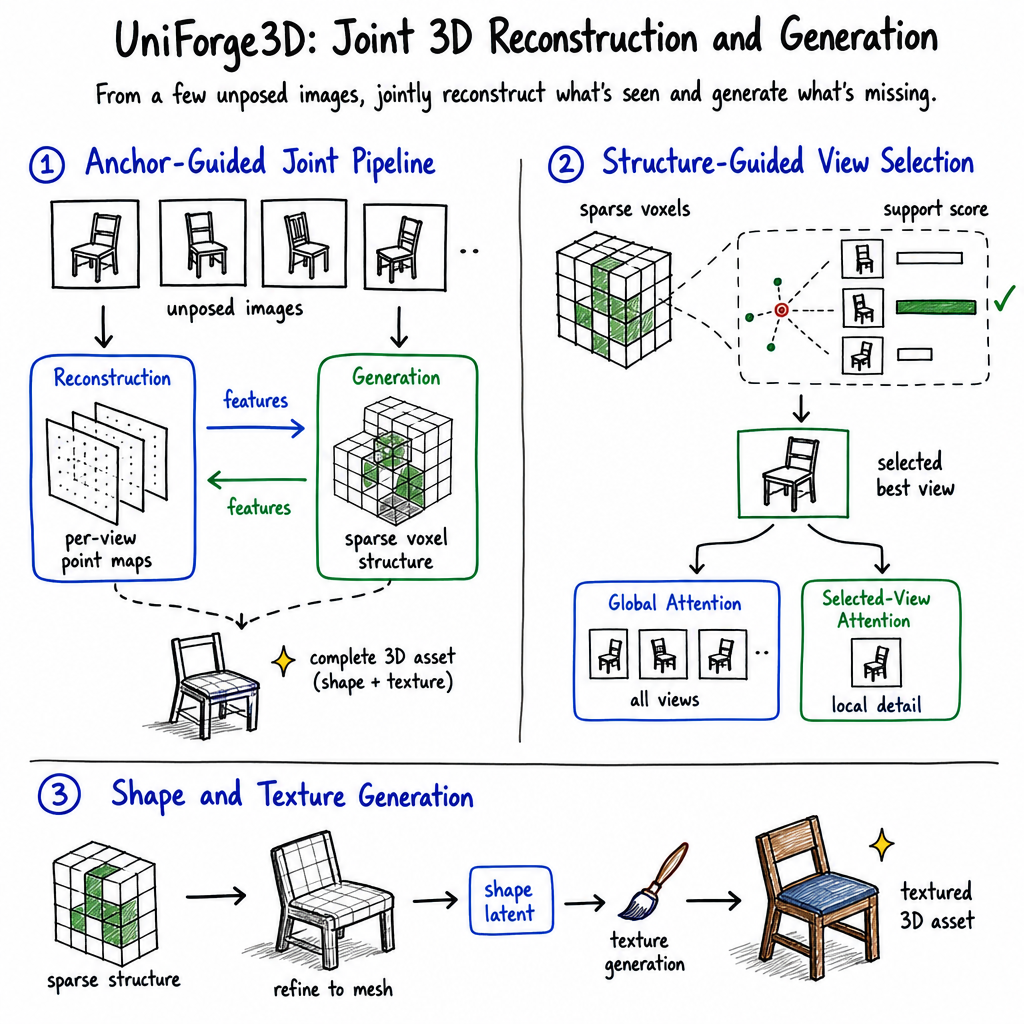
Abstract: Generating complete 3D assets from sparse, unposed images requires preserving observed geometry while completing unseen regions. Joint reconstruction and generation offers a way to address both goals: reconstruction recovers the geometry observed in the input images, while generation contributes learned shape priors. However, combining camera-relative reconstruction with canonical-space generation introduces a coordinate mismatch that makes direct geometric interaction more difficult. Moreover, conditioning each 3D location on all views without accounting for their relevance may mix useful geometric evidence with unrelated image content, hindering local detail recovery. We present UniForge3D, which jointly models reconstruction and generation in a shared anchor-guided space, resolving their coordinate mismatch. This space follows the anchor view's azimuth while keeping the object upright. The two branches exchange features bidirectionally to predict per-view point maps and a complete sparse voxel structure. We further condition point-map prediction on the generated structure to establish pixel-to-voxel correspondences and select the most informative input view for each voxel. Features from the selected views then guide detailed shape generation, helping preserve observed geometric details. Our method achieves state-of-the-art appearance and geometry results on Toys4K and GSO, generating complete 3D assets with improved fidelity. Project webpage: https://xishuxishu.github.io/uniforge3d-project/
Paper Prompts
Sign up for free to create and run prompts on this paper.
Explain it Like I'm 14
1. What is this paper about?
This paper introduces UniForge3D, an artificial intelligence system that turns a small number of ordinary pictures into a complete 3D model of an object.
For example, if you give it four pictures of a toy taken from different directions, it tries to create a 3D version that:
- Matches the parts visible in the pictures,
- Fills in parts that were hidden,
- Keeps the object’s colors and appearance,
- Works even when the camera positions are unknown.
This could be useful for video games, virtual reality, augmented reality, online shopping, film-making, and robots that need to understand objects.
2. What questions are the researchers asking?
The researchers are mainly trying to solve two problems:
- How can an AI make a complete 3D object from only a few pictures? Pictures usually show only some sides of an object. The system must guess the unseen parts without damaging the parts that are clearly visible.
- How can the AI preserve small details from the pictures? A detail may be easy to see in one picture but hidden or blurry in another. The system needs to know which picture is most useful for each part of the object.
- How can reconstruction and generation help each other?
- Reconstruction means measuring the 3D information that can be directly seen.
- Generation means using learned knowledge to create missing parts.
The paper asks whether combining these two abilities can produce more accurate 3D models than using either one alone.
3. How does UniForge3D work?
The system has two main parts that work together.
A. It creates a shared 3D coordinate system
Different computer programs may describe the same object using different coordinate systems. This is like two people using different maps: one may say “north” is toward the camera, while the other uses a fixed direction.
UniForge3D solves this by creating a shared space. The system chooses one input image as an anchor view. The object is then arranged so that:
- The anchor image determines the object’s horizontal direction.
- The object remains upright.
Both parts of the AI use this same space. This makes it easier for them to agree about where each part of the object is.
B. Reconstruction and generation exchange information
The reconstruction branch looks at the images and estimates the 3D position of visible pixels. In simple terms, it tries to answer:
“Where is this point in the picture located in 3D space?”
The generation branch creates a rough, complete shape using small 3D blocks called voxels. A voxel is like a tiny cube in a 3D version of graph paper.
The two branches share information:
- The pictures help the generation branch create a shape that matches what is visible.
- The complete generated shape helps the reconstruction branch understand where image pixels belong in 3D.
This is called bidirectional interaction because information travels in both directions.
C. It chooses the best image for each 3D region
Not every picture is equally useful for every part of an object. For example:
- The front of a toy may be clear in one image.
- The side may be clearer in another.
- Some parts may be hidden in certain views.
UniForge3D connects pixels in the images to nearby 3D voxels. For each voxel, it selects the image that gives the strongest evidence. It then uses that image to add fine details to that local region.
This is similar to asking several photographers for information about an object, then choosing the photographer with the clearest view of each individual part.
D. How was it tested?
The researchers trained the system using a large collection of 3D objects and computer-generated images. They then tested it on:
- Toys4K, a dataset of toy objects,
- GSO, a dataset of scanned household objects.
For testing, the system received four images of each object. The images were taken from different viewpoints, and the system was not told where the cameras were located.
The researchers compared UniForge3D with several other advanced 3D-generation systems. They measured:
- Geometry: How closely the 3D shape matched the real object.
- Appearance: How closely the colors and visual details matched.
- Completeness: Whether the system successfully created missing parts.
Some technical measurements included:
- Chamfer Distance: How far the predicted surface is from the correct surface. Lower is better.
- F-score: How much the predicted shape agrees with the correct shape. Higher is better.
- PSNR and SSIM: Measures of how similar generated images are to the correct images.
- LPIPS: A measure of how similar images look to people. Lower is better.
4. What did the researchers find?
UniForge3D performed better than the other methods
UniForge3D achieved the best results on both test datasets for all the major appearance and geometry measurements.
For example, on the Toys4K dataset:
| Measure | UniForge3D result | What it suggests |
|---|---|---|
| PSNR | 27.428 | Very good image similarity |
| SSIM | 0.9616 | Strong preservation of structure |
| LPIPS | 0.0401 | Close visual appearance |
| Chamfer Distance | 1.4196 | Accurate 3D geometry |
| F-score | 0.8899 | Strong agreement with the real shape |
Its geometry was also better on the GSO household-object dataset. The paper reports that UniForge3D preserved details such as small parts, object outlines, and surface structures more faithfully than the comparison systems.
The shared coordinate system helped
The researchers tested different ways of arranging the reconstruction and generation branches. The proposed anchor-guided shared space worked better than:
- Keeping the two branches in completely different spaces,
- Using only a standard object-centered space,
- Connecting the branches without proper shared alignment.
This shows that both branches benefit from using the same geometric reference.
The two branches improved each other
The experiments showed that:
- Reconstruction became more accurate when it received information from the generation branch.
- Generation became better when it received geometric information from reconstruction.
- Training the two branches together worked better than training them separately.
This is important because reconstruction is good at using visible evidence, while generation is good at guessing complete shapes.
Choosing a different image for each voxel improved details
The researchers compared two strategies:
- Give every part of the object information from all images.
- Choose the most useful image separately for each voxel.
The second strategy performed better. This means that carefully selecting the best view for each local region helps the system preserve small details and create more accurate shapes.
Structure-guided reconstruction was especially helpful
When the rough generated shape was used to guide the reconstruction process, the predicted 3D points became more accurate and complete.
In other words, the system first makes a rough guess about the whole object, then uses that guess to better understand the visible image details.
5. Why is this research important?
UniForge3D shows that an AI can create high-quality 3D objects from only a few unordered pictures by combining two abilities:
- Careful measurement of what the pictures show, and
- Reasonable guessing about what is hidden.
The most important idea is that the AI does not treat all images as equally useful. Instead, it asks which image gives the clearest information about each part of the object.
This could make it easier to create 3D models for:
- Video games and movies,
- Virtual and augmented reality,
- Online stores,
- Robot vision,
- Digital museums,
- Product design.
However, the system still has weaknesses. It was trained mostly on computer-generated images, so it may struggle with real-world situations involving:
- Heavy shadows,
- Strong reflections,
- Very bright or unusual lighting,
- Large parts of an object being blocked.
Overall, the paper suggests that combining reconstruction and generation in one shared 3D system can produce models that are both complete and faithful to the original pictures. Future improvements could help the method work more reliably with messy, difficult real-world photographs.
Practical Applications
Immediate Applications
- Rapid 3D asset creation for e-commerce and product visualization — Retail, advertising, and digital commerce. A workflow could accept four or more casual, unposed product photographs and automatically produce a complete mesh with appearance-preserving novel views. Retailers could use the output for interactive product viewers, virtual showrooms, configurable catalogs, and augmented-reality previews. The method’s voxel-wise view selection is particularly useful for preserving details visible in only one photograph, such as handles, logos, or small attachments. Dependencies: Performance may degrade for reflective, transparent, highly occluded, or unusually lit products; production use would require mesh cleanup, texture/PBR validation, and copyright checks for input imagery.
- 3D asset prototyping for games, animation, and virtual production — Entertainment and digital content creation. Artists could use UniForge3D as an asset-blockout tool: photograph a physical prop from sparse viewpoints, generate a complete 3D approximation, and refine it in Blender, Maya, Unreal Engine, or Unity. The generated structure can provide a consistent starting point for retopology, rigging, UV unwrapping, and material authoring. Dependencies: The reported results focus on object geometry and appearance fidelity rather than animation-ready topology, watertightness, semantic part labeling, or physically based materials.
- Augmented- and virtual-reality object digitization — AR/VR and spatial computing. A mobile application could convert a small set of photographs into an inspectable 3D object for AR placement, virtual museums, remote demonstrations, or VR environments. Because the input views need not be pre-posed, the capture process could be simpler than conventional photogrammetry workflows. Dependencies: The generated asset must be reliably scaled and oriented in the user’s environment. The paper’s evaluation uses alignment during testing, so deployment would need additional camera calibration, scale estimation, and quality-control steps.
- Robotics and embodied-AI object modeling — Robotics, warehouse automation, and manipulation. Robots could use sparse RGB observations to create a more complete object model than conventional visible-surface reconstruction provides. The model could support object recognition, grasp planning, collision checking, bin-picking, and simulation scene construction, especially when one view reveals a graspable feature that other views obscure. Dependencies: The paper does not establish metric accuracy under operational conditions, temporal consistency, or safety-critical reliability. Robotics deployments would require depth or tactile validation, uncertainty estimates, and testing on cluttered scenes and non-rigid objects.
- Industrial inspection and maintenance pre-modeling — Manufacturing, infrastructure, and field service. Technicians could capture several images of a component and obtain a preliminary 3D model for remote expert review, documentation, spare-part identification, or comparison with CAD references. Structure-guided correspondences could help retain localized defects or distinctive geometry visible from particular angles. Dependencies: Generated geometry should not be treated as a certified inspection measurement without independent metrology. Reflective metal, low texture, severe occlusion, and unusual lighting are explicitly relevant failure modes.
- Cultural-heritage and museum documentation — Museums, archives, and digital humanities. The method could support low-cost digitization of small artifacts when only a few photographs are available, enabling online exhibits, educational visualization, and preliminary archival records. Researchers could use the generated model to identify which additional view would most improve coverage. Dependencies: Fragile, glossy, translucent, or intricately occluded artifacts may require controlled illumination and additional views. Provenance, conservation standards, and uncertainty documentation would be necessary for scholarly use.
- Interactive educational materials — Education and academia. Instructors could photograph laboratory equipment, anatomical models, historical objects, or classroom artifacts and create 3D models for web-based lessons, virtual labs, and student exploration. The reconstruction/generation combination is useful where students need both observed detail and a complete object rather than only a partial point cloud. Dependencies: Educational deployments require accessible inference costs, reliable web rendering, and clear labeling that generated unseen regions are inferred rather than directly observed.
- Research tool for multi-view reconstruction and 3D generation — Computer vision and graphics research. The shared anchor-guided space, bidirectional feature exchange, point-map supervision, and voxel-wise view selection provide reusable components for new reconstruction or generation systems. Researchers could adapt the pipeline to compare view-selection policies, uncertainty-aware fusion, or domain-specific 3D priors. Dependencies: Reproduction requires substantial GPU resources, pretrained VGGT/TRELLIS-like models, large-scale 3D data, and compatible implementations of DINOv3, sparse voxels, and flow-based generation.
- Capture guidance and image-quality assessment — Consumer imaging and professional scanning. The voxel-support score can be used as a practical diagnostic: after an initial capture, a system could indicate which regions lack reliable pixel-to-voxel support and recommend another photograph from a better angle. This creates a semi-automated workflow combining generation with active image acquisition. Dependencies: The current method selects among supplied views; turning it into an active capture system requires camera-pose estimation, view-planning, and calibrated confidence scores.
Long-Term Applications
- Production-grade “photo-to-CAD” and digital-twin pipelines — Manufacturing, construction, logistics, and industrial software. A future system could combine UniForge3D-style completion with semantic part decomposition, CAD constraint fitting, dimensional calibration, and version tracking. This could convert field photographs into editable assets for inventory, equipment monitoring, facility management, and simulation. Dependencies: The current work generates complete assets but does not demonstrate engineering tolerances, parametric CAD structure, temporal change detection, or certified metric accuracy. Real-world training data and uncertainty-aware geometry would be required.
- Autonomous robot exploration and active perception — Robotics and embodied intelligence. A robot could use the current model to maintain a partial object hypothesis, identify voxels supported by weak or missing evidence, and deliberately move its camera or manipulator to acquire the most informative next view. This would extend voxel-wise selection from passive fusion to closed-loop perception. Dependencies: The model must support sequential observations, changing viewpoints, real-time inference, object tracking, and calibrated uncertainty. Occlusion by other objects and non-rigid motion remain major challenges.
- Medical and anatomical visualization from sparse clinical imaging or photographs — Healthcare and medical education. With appropriate domain-specific training, the shared reconstruction-generation design could help create complete anatomical or prosthetic models from sparse views for planning, education, or patient communication. View-specific conditioning could preserve localized structures while learned priors complete unseen regions. Dependencies: This is a high-risk extension. Clinical deployment would require validated medical datasets, strict privacy controls, regulatory approval, anatomical accuracy guarantees, and explicit separation between visualization and diagnosis. The paper provides no medical validation.
- Policy, public-sector, and disaster-response mapping of objects or infrastructure — Government, emergency management, and urban planning. Field workers could generate preliminary models of damaged equipment, buildings, road objects, or archaeological sites from rapidly captured images when full scanning is unavailable. Models could support triage, remote coordination, and prioritization of further inspection. Dependencies: Severe lighting, debris, occlusion, weather, and scale variation may exceed the tested domain. Operational systems would need geospatial registration, provenance tracking, human review, and uncertainty visualization.
- Digital-twin maintenance with change-aware 3D generation — Energy, utilities, transportation, and facilities management. Repeated sparse image captures could be converted into comparable 3D asset states, allowing teams to monitor wear, missing parts, corrosion, or structural changes. The shared geometric reference could help align observations across inspection rounds. Dependencies: UniForge3D is not designed for temporal consistency or quantitative change detection. Future work would need stable coordinate frames, calibrated scale, sensor fusion, and explicit modeling of genuine changes versus generative artifacts.
- Personalized virtual goods, avatars, and household-object libraries — Consumer software, gaming, social VR, and home robotics. Users could create digital versions of toys, furniture, collectibles, or personal belongings from a few phone images. These assets could populate virtual homes, games, social environments, or robot simulators. Dependencies: Commercial products would require fast inference, mobile or cloud optimization, content moderation, ownership protection, and robust handling of transparent, deformable, and reflective objects.
- Synthetic-data generation for computer vision and robotics — AI development and simulation. Faithful reconstructed assets could be inserted into simulators to generate multi-view images, segmentation masks, depth maps, and manipulation scenarios. The model’s ability to preserve observed details while completing unseen surfaces could improve the diversity of training assets. Dependencies: Synthetic assets may inherit reconstruction errors or biased priors. Their usefulness depends on domain randomization, sim-to-real validation, material realism, and accurate physical properties such as mass, friction, and collision geometry.
- Uncertainty-aware 3D generation and human-in-the-loop editing — Professional 3D software and safety-sensitive applications. A next-generation tool could distinguish directly observed surfaces from generated completions, expose per-voxel confidence, and let users lock high-confidence regions while editing uncertain areas. This would make the method more suitable for inspection, research, and archival workflows. Dependencies: The present confidence and support mechanisms are used mainly for reconstruction and view selection, not as fully calibrated uncertainty estimates. Calibration studies, provenance metadata, editable representations, and user-interface research are needed.
- Robust real-world deployment under difficult imaging conditions — General-purpose 3D capture platforms. Training with reflections, transparency, extreme illumination, motion blur, clutter, and severe occlusion could extend the approach from household-style objects to vehicles, machinery, outdoor assets, and complex retail products. Dependencies: The paper explicitly identifies synthetic training and sensitivity to severe occlusion, strong reflections, and extreme lighting as limitations. Progress requires representative real-world datasets, simulation of adverse conditions, domain adaptation, and systematic failure detection.
- Policy and standards for provenance of generated 3D assets — Regulation, intellectual property, and digital governance. As reconstructed assets enter commerce, education, and public records, systems could attach metadata indicating source images, observed versus inferred regions, model version, confidence, and human edits. Standards could help distinguish measured geometry from plausible generative completion. Dependencies: Adoption would require interoperable metadata formats, audit procedures, privacy protections, and legal clarification concerning ownership of photographed objects and generated derivatives.
Glossary
- Anchor-guided shared object space: A common 3D coordinate system oriented according to a selected anchor view while preserving the object’s upright direction. “We therefore introduce a shared anchor-guided space that follows the anchor view’s azimuth while preserving the canonical vertical direction.”
- Azimuth: The horizontal angle describing a viewing direction around a vertical axis. “This space follows the anchor view’s azimuth while keeping the object upright.”
- Canonical object space: A standardized coordinate system used to represent an object independently of a particular camera. “native 3D generation (Xiang et al., 2026) operates in a canonical object space.”
- Chamfer Distance (CD): A geometric similarity measure based on nearest-neighbor distances between two point sets. “Chamfer Distance (CD) (Fan et al., 2017) is computed as the sum of the bidirectional mean nearest-neighbor distances between points sampled from the reconstructed and ground-truth surfaces.”
- Classifier-free guidance: A generative-modeling technique that controls conditional generation without requiring a separately trained classifier. “To enable classifier-free guidance, we randomly drop the image condition with probability 0.1.”
- Confidence map: An image-sized array assigning a reliability value to each predicted pixel-level geometric estimate. “The network predicts point maps and confidence maps .”
- Canonicalized point cloud: A point cloud transformed into a standardized object-centered coordinate system. “while RecGen3D additionally incorporates canonicalized point clouds.”
- Cross-attention: An attention mechanism in which queries from one representation attend to keys and values from another representation. “The generation tokens attend to through the cross-attention layers of the generation branch.”
- DINOv3 patch features: Visual representations extracted from image patches by the DINOv3 self-supervised vision model. “For each view, we spatially align the reconstruction tokens with the DINOv3 (Simeoni et al., 2025) patch features.”
- Diffusion model: A generative model that produces data by gradually denoising a noisy representation. “The other paradigm employs image or video diffusion models to synthesize multiple views of an object.”
- Embodied intelligence: Artificial intelligence concerned with agents that perceive and act through physical or simulated bodies. “High-quality 3D assets are essential for digital content creation, gaming, augmented and virtual reality, and embodied intelligence.”
- Explicit geometry: A directly represented geometric structure, such as a mesh, point cloud, or voxel grid. “A straightforward approach is to reconstruct geometry from multi-view images and use the resulting implicit features or explicit geometry to condition generation.”
- Feed-forward reconstruction: Reconstruction performed by a model that directly predicts geometry from input images in a single forward computation. “However, errors in these upstream reconstruction estimates can propagate into generation.”
- F-score: A metric combining precision and recall, here calculated using a geometric distance threshold. “We compute F-score using a distance threshold of 0.01.”
- Gaussian splatting: A scene-representation and rendering technique that models visual content using collections of 3D Gaussian primitives. “Neural rendering and feed-forward Gaussian prediction further support reconstruction and novel-view synthesis.”
- GICP-based Sim(3) transformation: A similarity transformation estimated using generalized iterative closest point alignment, allowing rotation, translation, and uniform scaling. “All appearance and geometry metrics are computed after aligning each reconstructed mesh with its ground-truth mesh using a GICP-based Sim(3) transformation.”
- Implicit feature: A learned representation encoding geometric or semantic information without explicitly storing a surface or volume. “use the resulting implicit features or explicit geometry to condition generation.”
- Latent flow matching: A generative-training objective that learns a vector field transporting noise distributions toward data distributions in latent space. “The training objective combines latent flow matching with point-map supervision.”
- LoRA (Low-Rank Adaptation): A parameter-efficient fine-tuning method that learns low-rank updates to pretrained neural-network weights. “fine-tune them using LoRA (Hu et al., 2021) with ranks 64 and 32.”
- LPIPS: A perceptual image-quality metric based on distances between deep neural-network features. “We evaluate appearance quality using PSNR, SSIM (Wang et al., 2004), and LPIPS (Zhang et al., 2018).”
- Multi-view stereo: The recovery of 3D geometry by matching corresponding visual features across multiple images. “Classical multi-view reconstruction combines Structure-from-Motion and multi-view stereo.”
- Novel-view synthesis: The generation of an image of a reconstructed scene or object from a viewpoint not present in the input images. “Neural rendering and feed-forward Gaussian prediction further support reconstruction and novel-view synthesis.”
- Occlusion: The blocking of one object or surface region by another from a particular viewpoint. “the same region may be fully visible with clear details in one view, but difficult to distinguish in another because of an oblique viewing angle or occlusion.”
- Point map: An image-aligned representation in which each pixel is associated with a 3D point. “The predicted point maps provide per-pixel 3D coordinates in the same coordinate system as the generated voxels.”
- Point-map supervision: Training a model against target 3D coordinates associated with image pixels. “The training objective combines latent flow matching with point-map supervision.”
- PSNR (Peak Signal-to-Noise Ratio): An image-fidelity metric derived from the mean squared error between corresponding images. “We evaluate appearance quality using PSNR, SSIM (Wang et al., 2004), and LPIPS (Zhang et al., 2018).”
- Quantization: Mapping continuous values to discrete bins or grid locations. “After confidence filtering, we quantize the predicted points onto the voxel grid.”
- Rectified flow: A generative modeling framework that learns relatively direct transport trajectories between noise and data distributions. “Triposg: High-fidelity 3d shape synthesis using large-scale rectified flow models.”
- Sparse voxel structure: A voxel representation that stores only occupied or relevant cells rather than a dense 3D grid. “The branches exchange features bidirectionally to predict per-view point maps and a complete sparse voxel structure in this space.”
- Structure-from-Motion: A computer-vision method that jointly estimates camera motion and 3D structure from multiple images. “Classical multi-view reconstruction combines Structure-from-Motion and multi-view stereo.”
- Structural similarity (SSIM): An image-quality metric comparing luminance, contrast, and local structural patterns. “We evaluate appearance quality using PSNR, SSIM (Wang et al., 2004), and LPIPS (Zhang et al., 2018).”
- Similarity transformation (Sim(3)): A geometric transformation combining rotation, translation, and uniform scaling. “For point-map reconstruction, predictions from all input views are jointly aligned with the visible ground-truth position maps using a shared object-level Umeyama Sim(3) transformation.”
- Voxel-wise view selection: Choosing the most informative input image separately for each voxel in a 3D representation. “Our Voxel-Wise View Selection and Conditioning alternates full multi-view layers with voxel-specific selected-view layers.”
- Vector Set (VecSet): A 3D representation that encodes a shape as a collection of latent vectors rather than an explicitly organized grid. “VecSet-based methods encode 3D shapes as collections of latent vectors.”
- VGGT: A visual-geometry transformer used to predict geometric quantities such as point maps from images. “The generation and reconstruction branches are built upon pretrained TRELLIS.2 (Xiang et al., 2026) and VGGT (Wang et al., 2025a) models, respectively.”
- Voxel grid: A discretized three-dimensional array whose cells represent volumetric regions. “After confidence filtering, we quantize the predicted points onto the voxel grid.”
- Zero-initialized output projection: A projection layer whose parameters are initialized so that its initial output is zero, allowing new conditioning effects to be introduced gradually during training. “An MLP adapter with a zero-initialized output projection fuses spatially aligned features from four VGGT layers into a residual.”

