Next-Concept Modeling: Fast, Parallel Coarse-to-Fine Text Generation
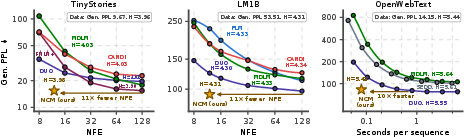
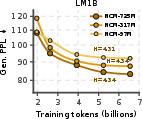
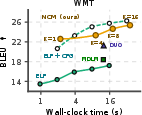
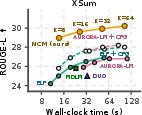
Abstract: Diffusion LLMs (DLMs) offer parallel sampling for faster generation than autoregressive models, an increasingly important advantage as inference becomes a dominant computational workload. However, DLMs degrade quickly with fewer sampling steps, process the full sequence at every step, and require many passes over the dataset to reach good quality. We introduce Next-Concept Modeling (NCM), a two-stage, coarse-to-fine framework: a multiscale residual VQ-VAE encodes text into a hierarchy of discrete codes, and a transformer generates one level at a time, predicting all codes within a level in parallel. At matched parameter scales, NCM achieves better generative perplexity than the strongest DLM baseline on LM1B while running faster. On OpenWebText, NCM is competitive with the strongest DLM while running faster; on XSum, it matches the strongest DLM's ROUGE-L while being faster. On the reasoning task of Sudoku, NCM outperforms autoregressive and diffusion baselines across all difficulty levels, using fewer function evaluations. On the reasoning task of Sudoku, NCM outperforms autoregressive and diffusion baselines across all difficulty levels, using fewer function evaluations.
Paper Prompts
Sign up for free to create and run prompts on this paper.
Top Community Prompts
Explain it Like I'm 14
1. What is this paper about?
This paper introduces a new way for computers to generate text called Next-Concept Modeling (NCM).
Most LLMs create text one word, or token, at a time. Other newer models, called diffusion LLMs, create many words at once but must repeatedly improve the whole sentence. Both approaches have drawbacks:
- Creating one word at a time can be slow.
- Diffusion models can be faster, but they often need many improvement steps.
- Each diffusion step may process the entire text, which is expensive.
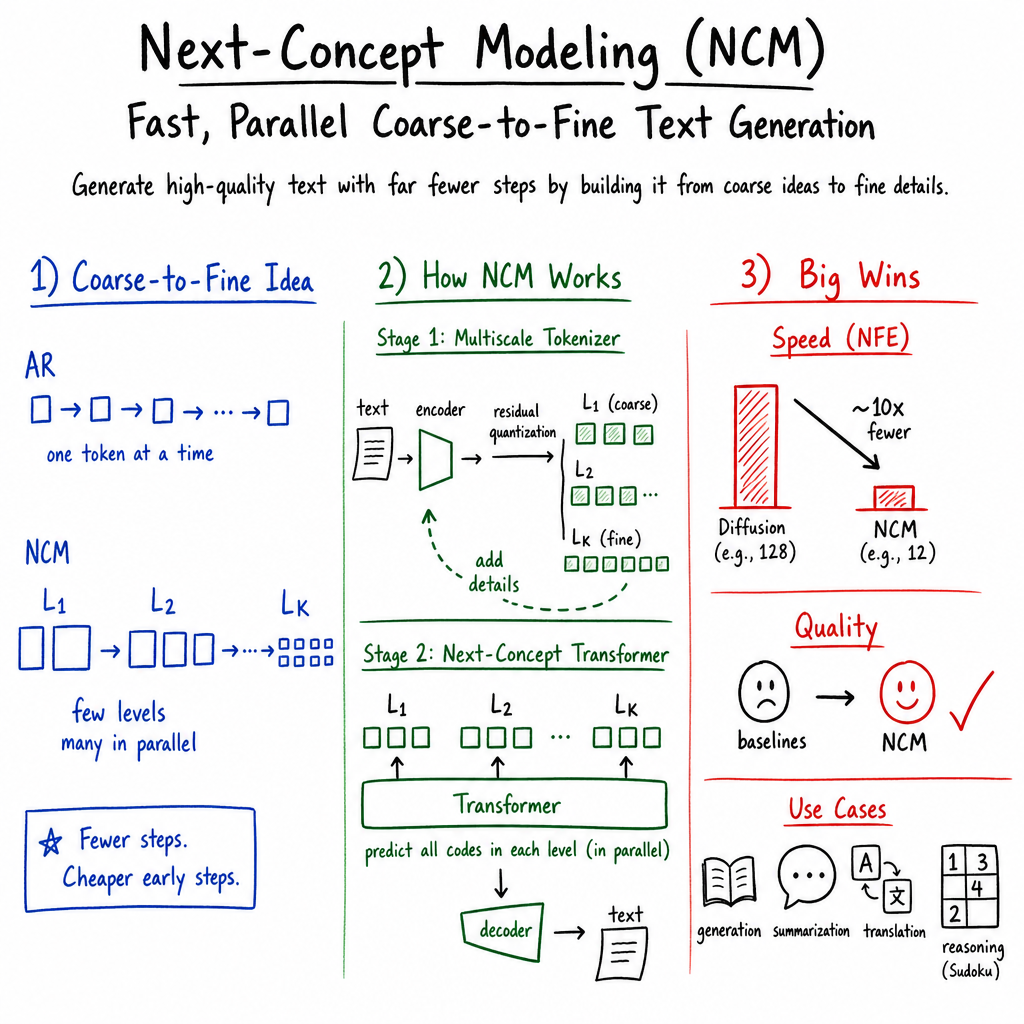
NCM tries to get the best of both ideas. It first creates a rough version of the text, then adds more detail step by step. This is similar to making a pencil sketch before filling in the details of a drawing.
2. What questions did the researchers ask?
The researchers mainly wanted to know:
- Can text be generated in fewer steps?
- Can a model produce text that is just as good as, or better than, diffusion and traditional LLMs?
- Can the model use less computer time during generation?
- Can it be trained using fewer examples?
- Does the method work for different tasks, such as:
- writing stories,
- translating languages,
- summarizing news,
- solving Sudoku puzzles?
The researchers also wanted to understand whether early parts of the model’s generation represent broad ideas, while later parts add smaller details.
3. How does the method work?
NCM has two main stages.
Stage 1: Making a coarse-to-fine representation
First, the researchers train a special text “compressor” called a multiscale residual VQ-VAE.
That name sounds complicated, but the basic idea is fairly simple:
- The system reads a piece of text.
- It creates a short, rough description of the text.
- It adds extra codes to correct mistakes and add detail.
- After several levels, the codes can be turned back into the original text.
This works somewhat like describing a picture:
- Level 1: “A dog is outside.”
- Level 2: “A brown dog is outside near a house.”
- Level 3: “A small brown dog is sitting near a red house.”
- Final level: Add exact words and small details.
The paper calls these hidden descriptions discrete codes. A code is simply a symbol chosen from a limited list, like choosing one colored tile from a box of tiles.
The first levels contain broad information. Later levels contain more precise information.
The system uses residual quantization, which means that each new level focuses on what the earlier levels got wrong or left out. If the first level gives a rough sketch, the next level fills in the missing parts.
Stage 2: Generating the codes
After learning this code system, the researchers train a transformer to predict the codes.
Instead of predicting every word separately, NCM predicts:
- The broadest level first.
- The next level with more detail.
- Additional levels until the text is complete.
Importantly, all the codes within one level are predicted in parallel, meaning at the same time.
For example, rather than generating 100 words in 100 separate steps, NCM might generate the text in only a few levels:
| Generation stage | What is produced |
|---|---|
| Early stage | The general meaning or structure |
| Middle stages | Important words and phrases |
| Final stage | Exact wording and small details |
At the end, a decoder changes the completed codes back into ordinary text.
Important technical terms
- Transformer: A type of neural network that learns how words and ideas relate to one another.
- Token: A small piece of text, such as a word or part of a word.
- Parallel generation: Producing many pieces at the same time.
- Function evaluation (NFE): One use of the model to make or improve a prediction. Fewer NFEs usually mean faster generation.
- Perplexity: A measurement of how well a LLM predicts text. Lower is generally better.
- ROUGE and BLEU: Scores used to judge summaries and translations by comparing them with good reference answers.
4. What did the researchers find?
The researchers tested NCM on text writing, translation, summarization, and Sudoku.
Faster text generation
NCM needed far fewer model evaluations than the diffusion models it was compared with. In the reported experiments, it was:
- About 21 times faster on the LM1B language-generation task.
- About 10 times faster on OpenWebText.
- About 31 times faster on the XSum summarization task.
This speed came from two ideas working together:
- NCM uses fewer generation stages.
- Early stages process short, compressed code sequences instead of the entire text.
Similar or better quality
NCM usually produced text with quality similar to, or better than, strong diffusion baselines.
For example:
- On XSum summarization, NCM achieved better ROUGE scores than the strongest diffusion model listed in the paper.
- On German-to-English translation, it performed better than most non-autoregressive models, although one diffusion model scored higher.
- On ordinary text-generation datasets such as LM1B and OpenWebText, it achieved competitive results while remaining much faster.
The researchers also checked diversity. This matters because a model could get good scores by producing the same safe sentences repeatedly. NCM kept a level of variety close to the real data, suggesting that its speed did not come mainly from repeating boring answers.
Strong Sudoku performance
Sudoku is a difficult test because every number must fit with all the others. A single wrong number can make the whole answer invalid.
NCM performed better than both traditional word-by-word models and diffusion models across easy, medium, and hard Sudoku puzzles. It also used fewer model evaluations.
This suggests that NCM may be useful not only for writing text, but also for tasks where many parts of an answer must work together.
Less training data and computer work
The paper reports that NCM reached competitive quality using about four to five times fewer training tokens than some strong diffusion models.
In simple terms, NCM may learn useful behavior from fewer total examples or fewer passes through the training data.
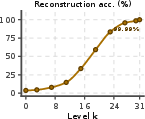
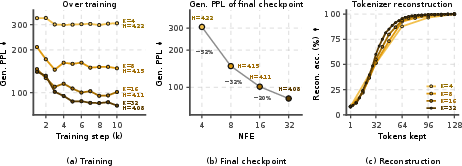
The tokenizer worked accurately
Before testing generation, the researchers checked whether the code system could reconstruct text correctly.
The tokenizer recovered:
- About 99.79% of tokens on the summarization task.
- About 99.86% on LM1B.
- 100% of the Sudoku text in the reported experiments.
This is important because the code system must preserve exact details. A small error may change the meaning of a sentence or make a Sudoku solution incorrect.
5. Why are these findings important?
Generating text uses a great deal of computer power. Faster models could make chatbots, translation systems, summarizers, and other AI tools cheaper and quicker to run.
NCM’s main contribution is the idea of generating language in a coarse-to-fine order:
- Decide what the text is generally about.
- Add important structure and words.
- Fill in the exact details.
This resembles how people often plan writing. We may first decide what we want to say, then choose the important points, and finally polish the sentences.
The results suggest that LLMs do not always need to choose every token independently and in strict order. They may be able to work with larger meaningful groups of information first.
However, the paper does not prove that NCM is best for every possible task. The experiments used relatively small models of around 100 million parameters, and larger models or much longer texts could behave differently. The method also depends on training a good tokenizer that can preserve the meaning and exact details of text.
Conclusion
The paper presents NCM, a faster way to generate text by building it from broad ideas toward detailed wording. It compresses text into several levels of codes, predicts each level in parallel, and then converts the codes back into words.
The experiments show that NCM can produce high-quality text, translations, summaries, and Sudoku solutions while using much less time and fewer model evaluations than many competing methods. If the approach continues to work as models become larger, it could help make future AI systems faster, cheaper, and more efficient.
Knowledge Gaps
Knowledge gaps, limitations, and open questions
- Limited scale validation: The main comparisons use models of approximately 100M parameters, so it remains unclear whether NCM’s quality, speed, and training-efficiency advantages persist for billion-parameter or larger models.
- Incomplete scaling analysis: The paper reports only preliminary scaling results and does not establish scaling laws for model size, tokenizer capacity, number of hierarchy levels, codebook size, sequence length, or training-token budget.
- Dependence on dataset-specific tokenizers: A separate tokenizer and generator are trained for each dataset. The feasibility of training one reusable tokenizer across domains, languages, and tasks is not evaluated.
- Tokenizer–generator error propagation: Although conditioning corruption is introduced to improve robustness, the paper does not quantify how errors at coarse levels propagate into later levels or identify which hierarchy levels are most responsible for final generation failures.
- No systematic tokenizer ablation: The relative contributions of residual quantization, multiscale resolution, nested dropout, reconstruction operators, and codebook design are not isolated through comprehensive ablations.
- Unclear semantic status of “concepts”: The claim that coarse codes represent global concepts is supported mainly by qualitative probes; the semantic consistency, interpretability, and controllability of individual codes or levels remain unmeasured.
- Fixed hierarchy design: The hierarchy lengths , number of levels , codebook sizes, and level-weighting parameter appear to be selected manually or through limited experiments. The optimal design and whether it should vary dynamically by input are unresolved.
- No adaptive computation: Every example is processed through the full hierarchy, even when an early reconstruction may already be adequate. Early stopping, input-dependent numbers of levels, and adaptive allocation of computation are not investigated.
- Parallel independence assumption within levels: The model factorizes the codes within each level conditionally independently. The paper does not measure the impact of this assumption on long-range dependencies, syntax, factual consistency, or exact constraint satisfaction.
- Weak treatment of long sequences: Experiments primarily use fixed-length or relatively short sequences, and the paper does not establish how memory, latency, quality, and hierarchy depth behave for substantially longer contexts.
- Limited language coverage: Conditional evaluation focuses on German–English translation, while unconditional experiments are largely English-only. Performance on typologically diverse, morphologically rich, low-resource, multilingual, and non-whitespace-delimited languages remains unknown.
- Restricted task coverage: The evaluation emphasizes perplexity-like generation metrics, summarization, translation, and Sudoku. Performance on code generation, dialogue, question answering, factual recall, planning, tool use, and safety-sensitive generation is not assessed.
- Uncertain reasoning generality: Sudoku is a narrow synthetic reasoning task. It remains unclear whether NCM’s advantage transfers to broader reasoning tasks requiring multi-step derivations, variable-length intermediate states, or natural-language explanations.
- Exactness and reliability are underexplored: Apart from Sudoku reconstruction, the study does not systematically evaluate factuality, logical consistency, calibration, hallucination rates, or validity under tasks where a single token error is consequential.
- Sampling strategy is relatively simple: Generation samples all codes within a level in parallel and then selects output tokens by argmax. Alternative sampling methods, temperature schedules, reranking methods, and iterative correction of erroneous codes are not systematically compared.
- Potential diversity limitations: Diversity is assessed primarily through mean per-sample unigram entropy. This does not determine whether NCM preserves semantic diversity, syntactic diversity, tail behavior, or diversity across longer sequences.
- Evaluation relies heavily on generative perplexity: Generative perplexity depends on the selected reference model and may not fully reflect human quality. Human judgments, task-specific factuality measures, and evaluations with stronger or diverse reference models are limited.
- Efficiency measurements lack broad reproducibility evidence: Reported wall-clock speedups may depend on hardware, batch size, implementation, kernel optimization, sequence length, and comparison settings. A detailed hardware-normalized and end-to-end serving analysis is still needed.
- Function evaluations are not equivalent across methods: Counting NFE may not capture differences in sequence length, attention cost, decoder cost, tokenizer cost, guidance calls, or parallel hardware utilization. A more comprehensive compute and energy comparison remains open.
- Training-cost comparisons may not be fully controlled: The reported token-budget advantage includes tokenizer and generator training, but the paper does not fully establish equal hyperparameter-search budgets, preprocessing costs, failed runs, or baseline optimization effort.
- Frozen tokenizer limitations: The generator cannot adapt the representation to its modeling needs after tokenizer training. Joint or iterative optimization of the tokenizer and generator, including task-aware tokenization, is not explored.
- Robustness to distribution shift is unknown: The tokenizer and generator are evaluated largely on data distributions similar to their training sets. Out-of-domain generation, domain adaptation, and robustness to noisy or adversarial inputs remain untested.
- Conditional prompting is only partially characterized: The prefix-LM conditioning mechanism is described, but prompt length sensitivity, prompt–target interference, instruction following, controllability, and performance with multiple conditioning modalities are not evaluated.
- No comparison with strong autoregressive systems at matched serving conditions: The paper compares against selected AR and non-AR baselines, but does not provide a broad comparison with modern KV-cached autoregressive models under identical hardware, batch, latency, and quality constraints.
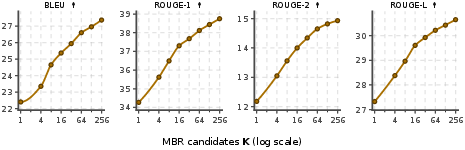
- Unclear benefits of minimum Bayes risk decoding: The reported improvements from generating multiple candidates and applying MBR conflate NCM’s generation quality with additional candidate selection and compute. The contribution of candidate count, scoring model, and selection criterion requires separate analysis.
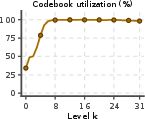
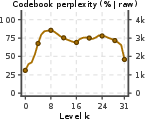
- Codebook utilization does not establish codebook quality: Utilization rates between roughly 62% and 90% are reported, but the effects of inactive or redundant codes on capacity, quality, training stability, and downstream generation are not analyzed.
- Training stability and reproducibility are insufficiently characterized: The paper does not report the sensitivity of results to random seeds, initialization, codebook collapse, optimizer settings, or tokenizer-training instability across repeated runs.
- Error correction across levels is limited: Once a coarse code is sampled, later levels mainly add residual detail. Mechanisms that revise incorrect coarse decisions during later computation are not developed or evaluated.
- The hierarchy may encode surface regularities rather than transferable abstractions: It remains unresolved whether coarse representations preserve task-relevant information across domains or merely exploit dataset-specific token and positional statistics.
- No theoretical analysis of likelihood or expressivity: The factorized hierarchical model is not formally compared with autoregressive or diffusion objectives in terms of representational capacity, likelihood consistency, approximation error, or conditions under which coarse-to-fine factorization is advantageous.
- Deployment constraints are not studied: The paper does not evaluate memory footprint, model parallelism, quantization, CPU inference, mobile or edge deployment, fault tolerance, or streaming generation.
- Streaming and interactive generation remain open: Because the hierarchy represents an entire sequence and decodes after completion, the suitability of NCM for token-by-token streaming, editing, continuation, and low-latency interactive use is unclear.
- Safety and controllability are unexamined: The paper provides no analysis of toxic, biased, private, or otherwise harmful generations, nor of whether errors in coarse levels make safety filtering or controllable decoding more difficult.
Practical Applications
Immediate Applications
The paper’s results support near-term use of NCM as an efficiency-oriented alternative to autoregressive and diffusion language generation, particularly where output quality can be preserved with substantially fewer model evaluations.
- Lower-latency summarization services — media, enterprise search, and customer support
- Deploy NCM for document, news, meeting, and ticket summarization. On XSum, it achieved competitive or better ROUGE scores while using approximately 16× fewer function evaluations than a strong diffusion baseline.
- A practical workflow could generate several summaries within the latency budget of one conventional model and select among them using minimum Bayes risk (MBR) decoding.
- Dependencies: The tokenizer and generator must be trained or fine-tuned for the target domain; ROUGE improvements may not translate directly to factuality or user preference. Human or automated factuality checks remain necessary.
- Real-time and high-throughput machine translation — translation APIs and edge software
- NCM can support German–English and similar translation workloads where latency, throughput, or inference cost is important. The model generates multiple latent-code levels in parallel rather than producing one token at a time.
- Potential products include lower-cost translation APIs, live caption translation, browser translation, and translation embedded in productivity software.
- Dependencies: The reported results are strongest for the evaluated language pair and benchmark. Each additional language pair may require a separate tokenizer and generator, and exact translation quality must be validated for terminology, morphology, and low-resource languages.
- Cost reduction for batch text generation — cloud inference and content pipelines
- The reported 10–31× wall-clock speedups and lower numbers of function evaluations could reduce GPU-hours for batch generation, synthetic-data creation, content variants, and evaluation workloads.
- NCM’s shorter coarse levels also reduce the amount of computation performed in early generation steps, making it suitable for batching large numbers of requests.
- Dependencies: Real savings depend on optimized GPU kernels, batching efficiency, tokenizer overhead, memory movement, and the cost of decoding the final latent representation. The paper evaluates models near 100M parameters, so scaling behavior must be measured before projecting savings to larger systems.
- Candidate generation and reranking — search, recommendation, and writing assistants
- Because NCM is faster, systems can generate multiple candidate responses and select among them using MBR, a reward model, a safety classifier, or task-specific scoring.
- This enables workflows such as:
- 1. Generate several summaries, translations, or answers.
- 2. Score candidates for relevance, factuality, style, or policy compliance.
- 3. Return the best candidate.
- The paper reports roughly 7% higher ROUGE-L for summarization when saved computation is reinvested in candidate generation and MBR decoding.
- Dependencies: Candidate selection can introduce systematic bias, amplify errors, and increase total memory use. The reranker must be independent enough to provide useful discrimination.
- Resource-efficient private or on-device language tools — mobile, embedded, and local software
- NCM’s reduced sampling cost could support local summarization, rewriting, translation, or drafting on laptops, phones, and embedded devices with limited battery or connectivity.
- Potential tools include offline meeting-note summarizers, local email assistants, accessibility software, and privacy-preserving document processors.
- Dependencies: The paper does not establish mobile deployment. Quantization, model compression, tokenizer memory, thermal limits, and acceptable quality under smaller models require engineering validation.
- Constraint-oriented reasoning prototypes — education and puzzle software
- The Sudoku results suggest that coarse-to-fine latent generation can be useful for tasks requiring globally consistent outputs. A prototype could use NCM to propose Sudoku solutions, generate practice problems, or provide candidate completions for educational software.
- The tokenizer achieved 100% reconstruction accuracy on the evaluated Sudoku data, and NCM outperformed the reported autoregressive and diffusion baselines across difficulty levels.
- Dependencies: Generated solutions must be checked with a formal Sudoku validator. Benchmark accuracy does not establish reliability on arbitrary board sizes, variants, or adversarially constructed puzzles.
- Research tooling for fast non-autoregressive generation — academia and model development
- Researchers can use the released implementation and two-stage pipeline as a baseline for studying hierarchical text representations, discrete latent variables, parallel generation, and test-time scaling.
- Useful experiments include replacing the VQ-VAE, changing the number of levels, adding adaptive stopping, testing other languages, or comparing NCM with speculative decoding and block-autoregressive models.
- Dependencies: Reproducibility depends on access to the code, exact training configurations, datasets, and comparable hardware. The paper reports several benchmark-specific tokenizers, so results may not transfer automatically across domains.
- Energy-aware inference scheduling — cloud operations and sustainability
- Reducing function evaluations can lower energy consumption per generated sequence, especially in high-volume summarization, translation, and content-generation services.
- Operators could route short or latency-sensitive requests to NCM while reserving larger autoregressive models for tasks requiring maximum controllability.
- Dependencies: Energy savings must be measured end-to-end, including tokenizer encoding, decoding, candidate selection, data transfer, and idle capacity. Faster inference may also increase total request volume, offsetting some savings.
Long-Term Applications
The following opportunities are plausible extensions of the method but require further research, larger-scale validation, or additional safety and reliability mechanisms.
- Large-scale production LLMs with hierarchical latent decoding — general-purpose AI platforms
- NCM could become an alternative architecture for general-purpose assistants, combining coarse semantic planning with fine-grained linguistic realization.
- A future system might generate a high-level response structure first, then progressively refine wording, entities, formatting, and code. This could make intermediate representations available for inspection or intervention.
- Dependencies: The paper’s scaling evidence is preliminary. Larger models must demonstrate that the learned levels remain semantically meaningful, that quality scales comparably to autoregressive models, and that fine-level errors do not damage factuality or instruction following.
- Controllable generation through level-specific editing — enterprise writing and safety systems
- If coarse levels reliably encode global structure and fine levels encode detail, applications could modify only selected levels:
- revise tone or style while preserving content,
- change formatting without regenerating the full response,
- enforce terminology or safety constraints at later levels,
- produce multiple surface realizations from one coarse plan.
- This could lead to hierarchical editing tools and more efficient revision workflows.
- Dependencies: The paper provides qualitative evidence for coarse-to-fine semantics but does not prove that levels are cleanly disentangled. Editing one level may unintentionally change meaning, entities, or logical constraints.
- Adaptive computation and early stopping — latency-aware assistants
- Systems could stop after a coarse level when an approximate output is sufficient, or continue to finer levels only for important requests. Examples include preview summaries, autocomplete, search snippets, and progressively rendered responses.
- A confidence estimator could decide whether additional levels are needed or whether a candidate should be regenerated.
- Dependencies: Early-level outputs in the paper may contain repetitions, omissions, or malformed wording. Reliable stopping requires calibrated uncertainty measures and task-specific quality thresholds.
- Fast deliberation and test-time search — reasoning, planning, and agent systems
- NCM could generate many candidate plans, programs, proofs, schedules, or puzzle solutions within a fixed compute budget. A verifier or reward model could then select or refine the best candidate.
- The Sudoku results provide an initial indication that parallel coarse-to-fine generation may benefit globally constrained reasoning tasks.
- Dependencies: Sudoku is substantially simpler than real-world planning or code generation. Applications require formal verification, execution-based checking, robustness to invalid intermediate codes, and experiments on mathematics, programming, planning, and tool-use benchmarks.
- Hierarchical code generation — software engineering tools
- A coarse-to-fine model could first generate program structure—modules, functions, interfaces, or control flow—and then refine implementation details such as variable names, expressions, and comments.
- Potential tools include rapid code completion, multi-file scaffolding, test generation, and candidate patch synthesis.
- Dependencies: A single token or latent reconstruction error can invalidate executable code, a limitation explicitly relevant to the paper’s discussion of text reconstruction. Any deployment would need compilation, testing, static analysis, sandboxing, and security scanning.
- Structured report and document generation — healthcare, finance, and government
- NCM could generate structured drafts for clinical summaries, financial reports, regulatory filings, case notes, or administrative forms by refining from document-level organization to exact terminology and formatting.
- The architecture may be useful where global structure must remain stable while details are progressively filled in.
- Dependencies: These domains require high factual accuracy, auditability, privacy protection, and domain-specific validation. The paper does not evaluate medical, financial, or legal data, and benchmark summarization results are insufficient evidence for unsupervised deployment.
- Multimodal and non-text hierarchical generation — robotics, audio, and vision-language systems
- The residual multiscale-code approach could be adapted to speech, audio, images, action sequences, or multimodal outputs. A robot, for example, might generate a coarse task plan before refining it into temporally detailed actions.
- Similar architectures could support fast speech synthesis, video captioning, embodied planning, or compressed multimodal communication.
- Dependencies: These extensions require modality-specific tokenizers and reconstruction operators. Temporal continuity, physical safety, perceptual quality, and error propagation may differ substantially from text generation.
- Policy and public-sector inference infrastructure — sustainable AI procurement
- Governments and institutions could use the method as evidence for evaluating language-model architectures not only by accuracy, but also by quality per function evaluation, training-token efficiency, latency, and energy use.
- Procurement standards could require reporting these measures alongside conventional benchmark scores and diversity metrics.
- Dependencies: The reported efficiency comparisons use particular model sizes, hardware, batch sizes, and evaluation protocols. Policy standards should require standardized end-to-end measurements rather than relying on the paper’s headline speedups.
- Training-efficient domain adaptation — organizations with limited data or compute
- The reported 4–5× reduction in training tokens relative to strong diffusion baselines suggests a possible route for universities, startups, and public institutions to build specialized generators with smaller computational budgets.
- A domain-specific VQ tokenizer followed by a generator could support internal document search, technical summarization, or controlled text production.
- Dependencies: Lower token consumption does not guarantee lower total development cost: tokenizer training, hyperparameter tuning, data cleaning, and domain evaluation remain necessary. The approach may also suffer from codebook underutilization or reconstruction errors in highly specialized vocabularies.
Glossary
- Autoregressive (AR) model: A model that generates each token sequentially, conditioning on previously generated tokens. “autoregressive models that generate one token at a time”
- Block-autoregressive diffusion: A diffusion-generation approach that processes groups of tokens sequentially while generating tokens within each group in parallel. “Block-autoregressive diffusion enables KV caching at the cost of parallelism”
- BLEU: An automatic machine-translation evaluation metric based on n-gram overlap with reference translations. “using BLEU and ROUGE-1/2/L scores, respectively”
- Classifier-free guidance: A conditional-generation technique that combines conditional and unconditional model predictions without requiring a separately trained classifier. “We count each classifier-free guidance step as two function evaluations”
- Codebook: A finite collection of vectors used to represent continuous latent vectors through quantization. “Given latent vectors and a codebook”
- Codebook utilization: The proportion of entries in a codebook that are actually selected by the tokenizer. “We also report tokenizer codebook utilization”
- Coarse-to-fine generation: A generation strategy that first produces a low-resolution representation and progressively adds finer details. “NCM generates text through a learned coarse-to-fine hierarchy of discrete codes.”
- Conditional generation: Generation in which the model produces output based on an input prompt or other provided context. “On conditional generation (XSum summarization and WMT14 translation)”
- Continuous diffusion model: A diffusion model that evolves continuous representations, such as vectors in an embedding space, rather than discrete tokens. “continuous methods evolve representations of tokens in an embedding space”
- Cross-entropy loss: A loss function that measures the discrepancy between a target probability distribution and a model’s predicted distribution. “During training, all levels are predicted in one forward pass using a cross-entropy loss.”
- Cumulative reconstruction: The progressively accumulated reconstruction formed by combining the code contributions from multiple hierarchy levels. “each partial sum , the cumulative reconstruction, is a partial reconstruction using the first levels.”
- Diffusion LLM (DLM): A LLM that generates text by iteratively denoising a corrupted or noisy representation. “Diffusion LLMs (DLMs) offer parallel sampling for faster generation”
- Discrete latent variable: A latent representation restricted to a finite set of symbolic or indexed values. “Discrete latent variables and next scale prediction.”
- Discrete quantization: The process of mapping continuous vectors to entries in a finite codebook. “A single quantization step generally leaves an approximation error.”
- Distillation: Training a smaller or faster student model to reproduce the behavior of a larger or slower teacher model. “by distilling a many-step teacher into a few-step student”
- Flow-based model: A generative model that learns a transformation between probability distributions, often enabling continuous-time or few-step generation. “Diffusion and Flow-Based Models for Text Generation.”
- Function evaluation (NFE): One execution of a model or numerical generation function during sampling. “We compare the number of function evaluations (NFE)”
- Generative perplexity: A perplexity measure assigned to generated samples by a separate reference LLM. “we evaluate NCM's unconditional generation quality using generative perplexity”
- Hidden width: The dimensionality of the internal representation passed through a neural network’s hidden layers. “Project the resized vectors to the hidden width”
- Latent vector: A continuous internal representation of input data used by a model instead of the original discrete or high-dimensional form. “Given latent vectors ”
- Masked diffusion: A discrete diffusion method that progressively replaces masked positions with predicted tokens. “masked diffusion (discrete diffusion) refines all positions”
- Mean per-sample unigram entropy: An entropy-based measure of lexical diversity computed from unigram distributions within generated samples. “mean per-sample unigram entropy () alongside Gen.\ PPL”
- Minimum Bayes risk (MBR) decoding: A decoding method that selects the candidate with the lowest expected loss under a chosen evaluation criterion. “minimum Bayes risk (MBR) decoding”
- Multiscale residual quantization: Quantization that represents data using progressively longer code sequences, with each level encoding residual error from earlier levels. “Multiscale residual quantization uses progressively longer code sequences”
- Nested dropout: A training method that retains only an initial prefix of hierarchical representations, encouraging earlier components to contain useful information. “We use nested dropout”
- Next-concept modeling (NCM): The paper’s coarse-to-fine language-generation framework that predicts discrete representation levels sequentially and codes within each level in parallel. “We introduce Next-Concept Modeling (NCM), a two-stage language modeling framework.”
- Next-scale prediction: A generation strategy that predicts representations at progressively finer scales. “following next-scale prediction for images”
- Non-autoregressive generation: Generation in which multiple output positions are predicted simultaneously rather than one after another. “the leading non-autoregressive language modeling paradigm”
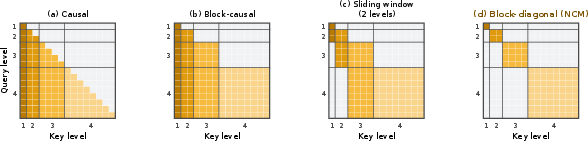
- Prefix-LM attention: An attention pattern in which prompt positions interact bidirectionally while target positions attend to the prompt and their allowed target context. “NCM supports prompt-conditioned generation through a prefix-LM attention pattern.”
- Quantized latent: A latent representation in which continuous vectors have been replaced by selected codebook entries. “The selected codebook vectors form the quantized latent”
- Reconstruction operator: A function that maps codebook vectors at one resolution to a contribution defined over the full sequence length. “The reconstruction operator maps the selected codebook vectors to a length- contribution”
- Reconstruction loss: A training objective that penalizes differences between an input and its reconstructed version. “Reconstruction loss”
- Residual quantization: A quantization method that repeatedly quantizes the remaining approximation error using additional codebooks. “Residual quantization corrects for errors made at previous steps”
- ROUGE: A family of overlap-based metrics for evaluating automatically generated summaries against reference summaries. “using BLEU and ROUGE-1/2/L scores, respectively”
- Sampling step: One iteration in the process of generating or refining a model output. “Reducing these passes can substantially degrade generation quality”
- Straight-through estimator: A gradient-estimation technique that approximates differentiation through a discrete operation by passing gradients through it as though it were continuous. “We use a straight-through estimator to pass reconstruction gradients through the discrete quantization step”
- Stop-gradient: An operation that prevents gradients from propagating through a specified tensor during backpropagation. “Here denotes stop-gradient”
- Test-time scaling: Increasing computation during inference, such as by generating and evaluating additional candidates, to improve output quality. “effective test-time scaling”
- Unconditional generation: Generation performed without an input prompt or conditioning signal. “Across unconditional generation, conditional generation (translation and summarization), and reasoning tasks”
- Vector quantization (VQ): The replacement of each continuous vector with its nearest entry in a learned codebook. “vector quantization replaces each vector with its nearest codebook entry”
- VQ-VAE: A variational autoencoder whose latent representations are discretized using vector quantization. “A multiscale residual VQ-VAE encodes text into a hierarchy of discrete codes”

