AgentGarten: Code Worlds for Evolving Agents
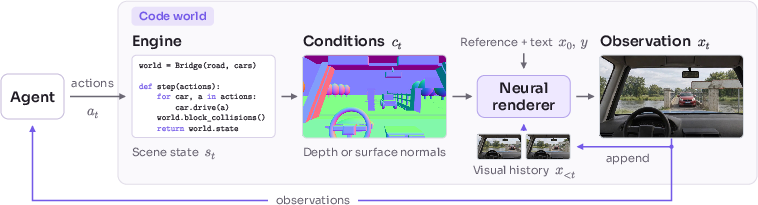
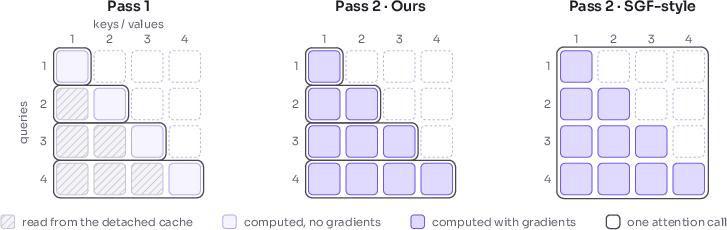
Abstract: Interactive virtual worlds allow agents to learn through exploration and interaction. What agents can learn is bounded by the environments they practice in, which must be faithful, with consistent state, rules, and dynamics, and realistic, with observations that follow the real-world visual distributions. Achieving both across diverse worlds remains a bottleneck. We introduce AgentGarten, a framework that couples simulators and game engines with a shared neural renderer to build real-time interactive environments. Its simulation backends maintain persistent world state and execute program-defined interaction rules, while the renderer generates visual observations from structured conditions exported through a common interface. To build the neural renderer, we adapt a pretrained video model to geometry conditions, distill it with our proposed Adversarial Forcing, and optimize inference for real-time interaction. Adversarial Forcing makes history prefilling differentiable through exact replay, so that losses on later predictions update how the renderer encodes prior observations, and adds real-data adversarial supervision to improve its visual quality. In AgentGarten, agents perceive the world through visual observations, interact with it in real time, and improve by distilling each round of experience into playbooks that subsequent agents inherit and refine. Our empirical study demonstrates a substantial gain in learning efficiency, with agents learning from just 4 rounds compared with millions for a conventional reinforcement learning counterpart. As new worlds can be written as code and rendered through the same interface, environments can scale in both number and difficulty alongside their agents, a step toward agents that keep evolving through interactive experience.


Paper Prompts
Sign up for free to create and run prompts on this paper.
Top Community Prompts
Explain it Like I'm 14
1. What is the paper about?
The paper introduces AgentGarten, a system for creating interactive virtual worlds where AI agents can practice skills.
These worlds are built from computer code, so their rules are clear and editable. For example, code can describe:
- Where objects are located
- How objects move
- What happens when an agent pushes or picks something up
- How different agents interact
AgentGarten combines these coded rules with an AI system that generates realistic-looking images and video. This means an agent can act in a world that is both:
- Reliable, because its rules and physical state are controlled by code.
- Visually varied, because an AI renderer creates the agent’s observations.
The main goal is to help AI agents learn more quickly by giving them many different worlds in which to practice.
2. What questions does the research ask?
The researchers are mainly asking:
- Can we build virtual worlds that have reliable rules while still looking realistic?
- Can one visual system display many different coded environments?
- Can the system generate images quickly enough for real-time interaction?
- Can AI agents learn useful skills from only what they see?
- Can agents improve over multiple rounds by writing down lessons from their earlier attempts?
A simple example is a hide-and-seek game. Instead of giving an agent the exact location of every object, the agent must look at pictures of the world, decide what to do, and learn from what happens.
3. How did the researchers do it?
Building worlds with code
Each AgentGarten world contains a program that describes the environment. This program keeps track of the world’s hidden state, such as:
- The position of objects
- The movement of objects
- The location of the camera
- The current task
- The results of previous actions
When an agent performs an action, such as moving a box, the program updates the world.
This is similar to a video game engine. The game engine knows that a box has moved even if the box is temporarily hidden from the camera.
Showing the world to the agent
The agent does not directly receive the world’s internal information. It only receives images or short video clips.
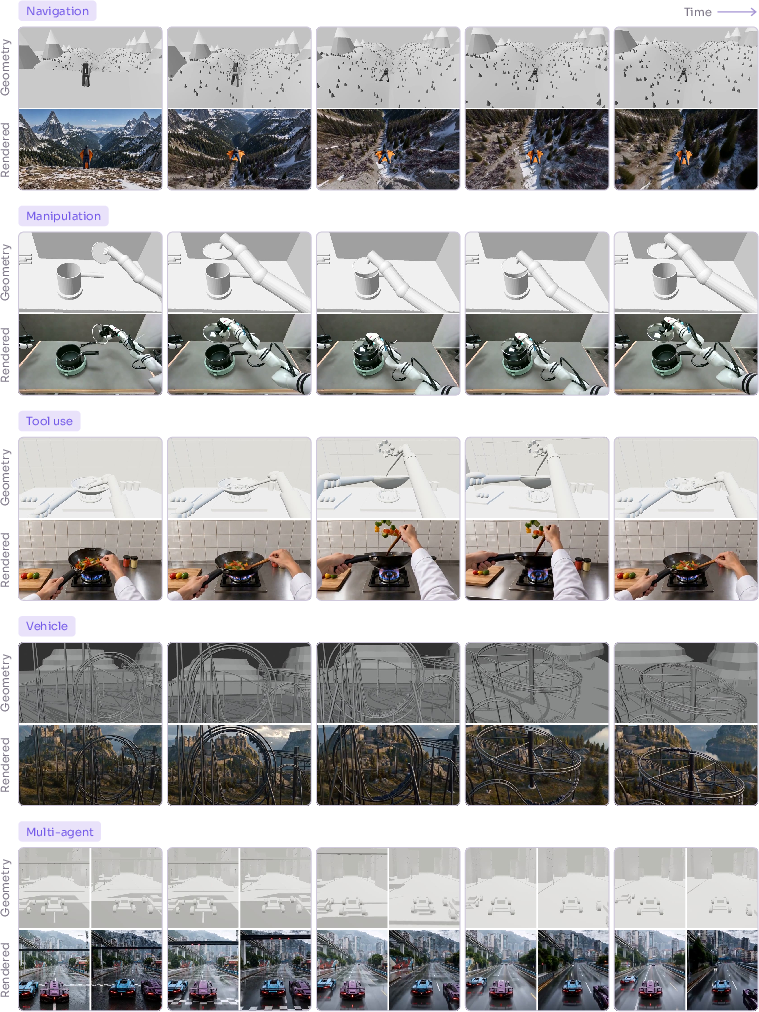
AgentGarten uses a neural renderer to create these observations. A neural renderer is an AI system that turns information about a scene—such as its shape, depth, and camera position—into realistic-looking pictures.
An analogy would be:
- The coded simulator is like a stage manager who knows where every actor and prop is.
- The neural renderer is like a camera artist who creates the view that the audience sees.
- The AI agent is like an actor who can see the stage but cannot read the stage manager’s notes.
The renderer uses information such as:
- Depth, meaning how far objects are from the camera
- Surface directions, meaning which way parts of objects face
- A starting image or visual style
- Text descriptions
- Earlier video frames
Training the visual system
The researchers began with a video-generation model that had already learned from many videos. They adapted it so that it could follow the geometry and rules of coded worlds.
The system generates video in short blocks, rather than trying to create a very long video all at once. This helps the agent receive feedback quickly after each action.
The researchers also introduced a training method called Adversarial Forcing. In simple terms, this method uses two types of feedback:
- It checks whether the generated video follows the teacher model’s behavior.
- It checks whether the video looks like a real video.
This is somewhat like training an artist with both a drawing teacher and a strict art judge. The teacher explains what should be drawn, while the judge points out when the result looks unnatural.
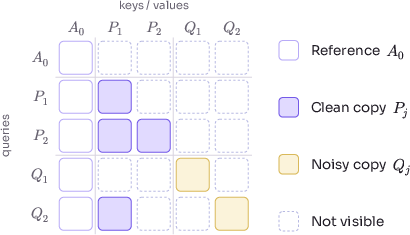
The researchers also created exact replay. This allows the system to repeat its earlier calculations exactly during training. It is like replaying a video game using the same button presses and getting exactly the same result. This helps the AI learn from mistakes made earlier in a long sequence.
Testing the agents
The researchers tested AgentGarten in several environments, including:
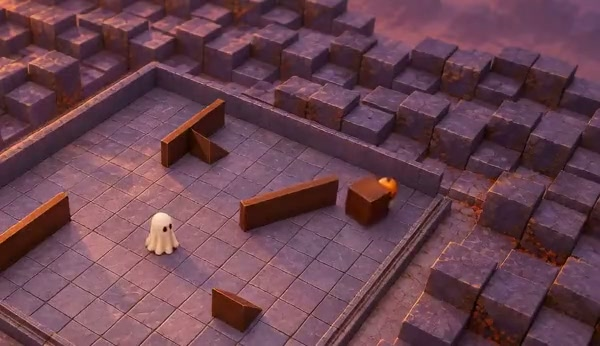
- Hide-and-seek
- Playing with a dog
- Two cars passing on a narrow bridge
- Herding sheep
- Driving a loader to move rocks
The agents saw only rendered first-person views. They did not receive the exact coordinates of objects or the hidden state of the simulation.
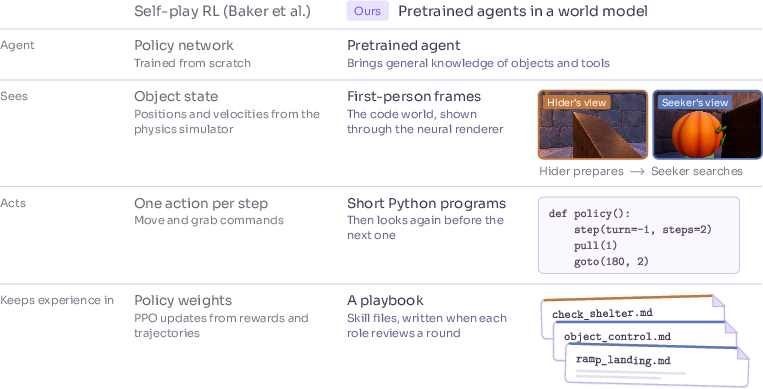
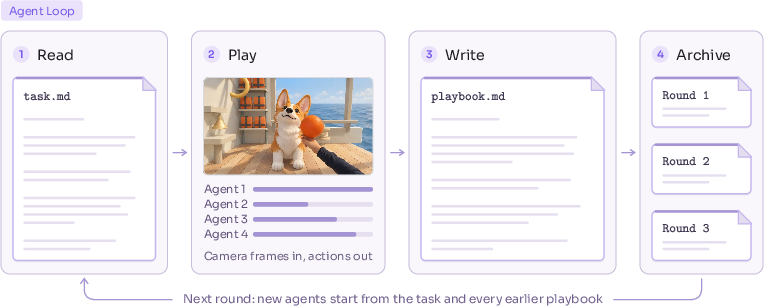
After each round, the agents wrote playbooks: notes describing what worked, what failed, and what they should try next. Agents in later rounds received these notes and used them to improve their behavior.
4. What did the researchers find?
The renderer created better long videos
The researchers compared their method with an earlier training method called Self Forcing.
With Self Forcing, the video gradually became less realistic during long sequences. It developed repeated patterns and lost details.
With Adversarial Forcing, the renderer kept more natural textures and details during 30-second video rollouts.
This matters because an agent needs a stable view of the world. If objects suddenly change shape or the scene becomes blurry, the agent may make decisions based on incorrect information.
Exact replay was more accurate
The new replay method reproduced the original calculations exactly, with no numerical difference. Another method had about a 3.99% difference.
The new method was also slightly faster and used almost the same amount of memory. This suggests that the researchers improved training accuracy without making the system much more expensive.
The renderer worked in real time
On one powerful NVIDIA H100 graphics card, AgentGarten generated more than 35 video frames per second.
This is close to the speed needed for interactive applications such as games or simulations. It means an agent can act, quickly receive a new visual observation, and act again without waiting a long time.
Agents learned useful strategies quickly
In the hide-and-seek experiment, agents developed behaviors such as:
- Moving a panel to build a hiding place
- Carrying a ramp to cross a wall
- Moving the ramp closer after an unsuccessful attempt
These strategies appeared after only a small number of rounds. Earlier research using traditional reinforcement learning needed millions of game episodes to discover similar behaviors.
However, the paper explains that this is not a perfectly fair one-to-one comparison. The older agents learned almost everything from scratch. The agents in AgentGarten were already large pretrained AI systems with general knowledge about objects and tools. Their main challenge was learning how to use that knowledge in a specific virtual world.
Agents improved in other worlds too
The agents generally performed better over four rounds:
| World | Improvement |
|---|---|
| Companion dog | The engagement score increased from 13 to 19 |
| One-lane bridge | The time decreased from 71 seconds to 41 seconds |
| Herding | The agents improved from penning 3 sheep to penning all 4 |
| Quarry loader | The agent eventually moved a rock into a bunker and parked successfully |
These results suggest that written playbooks helped agents remember and improve their strategies.
5. Why is this research important?
AgentGarten offers a new way to train AI agents. Instead of building one special simulator for every task, researchers could write new environments as code and use the same visual renderer for all of them.
This could make it easier to create training worlds for:
- Robots
- Self-driving vehicles
- Computer games
- Household assistants
- Cooperation between multiple AI agents
- Problem-solving and tool use
The system also separates the world’s rules from its appearance. The same sequence of events could be shown from a different camera or in a different visual style without changing what actually happened.
In the future, this could help create AI agents that continually improve through practice. They could try a task, study their mistakes, write down useful lessons, and pass those lessons to later versions of themselves.
However, the research also has limits. The visual renderer can still make mistakes, and the experiments were performed in simulated worlds rather than the real world. Real environments are often messier and less predictable. The agents may also benefit greatly from knowledge learned before the experiments.
Overall, the paper’s main idea is that AI agents can learn more effectively when they have many editable, realistic, interactive worlds to explore. AgentGarten is a step toward AI systems that learn not only from fixed training data, but also from repeated experience and reflection.
Knowledge Gaps
Knowledge gaps, limitations, and open questions
The paper leaves the following issues unresolved:
- Limited empirical scale: The agent study uses only a small number of worlds, rounds, seeds, and episodes, making it unclear whether the reported improvements generalize beyond the selected demonstrations.
- No statistical uncertainty analysis: The reported scores and milestone rounds lack confidence intervals, variance estimates, significance tests, or results across independently repeated runs.
- Weak baseline coverage: The study does not systematically compare AgentGarten with strong alternatives such as ground-truth-rendered simulators, conventional RGB renderers, vision-language agents without playbooks, reinforcement-learning agents with equivalent pretrained knowledge, or existing interactive world models.
- Confounded sample-efficiency comparison: The comparison between pretrained agents and tabula-rasa reinforcement learning conflates pretrained semantic knowledge, different observation modalities, different action interfaces, different training objectives, and different episode budgets; a controlled comparison is still needed.
- Unclear contribution of playbooks: The experiments do not isolate the effects of written playbooks from conversational memory, repeated prompting, agent initialization, task familiarity, or simply receiving additional interaction opportunities.
- No ablation of agent components: The relative contributions of visual rendering quality, reflective failure analysis, tool use, task-file design, playbook retrieval, and foundation-model reasoning remain unmeasured.
- No comparison with privileged observations: Although agents are restricted to rendered frames, the paper does not quantify how much performance is lost relative to access to simulator state, object coordinates, depth, segmentation, or raw geometry.
- Small and potentially cherry-picked task suite: The environments appear manually selected and may favor behaviors that pretrained agents already understand; performance on adversarial, procedurally generated, or unfamiliar tasks is not established.
- Incomplete task diversity: The experiments provide limited evidence for long-horizon manipulation, deformable objects, dexterous contact, articulated mechanisms, complex navigation, dense multi-agent interaction, or tasks requiring precise metric estimation.
- Unresolved multi-agent scalability: The framework is demonstrated with a few agents, but the effects of increasing agent count, conflicting goals, communication, occlusion, and simultaneous actions are not evaluated.
- No systematic evaluation of physical fidelity: The paper does not measure whether rendered visual consequences accurately reflect the simulator’s collisions, contacts, object masses, friction, articulation limits, or other physical properties.
- Renderer errors may still affect learning: Although rendering errors do not alter simulator state directly, they can cause incorrect actions and therefore alter the experienced trajectory; the paper does not quantify this indirect control-loop failure mode.
- Lack of state-consistency metrics: Long-rollout evaluation is primarily qualitative. The paper does not report object identity persistence, pose drift, texture consistency, geometric alignment, temporal coherence, or consistency after camera changes.
- Limited long-horizon validation: The renderer is evaluated on rollouts of approximately 30 seconds or 769 frames, leaving its behavior over substantially longer interactions, repeated resets, and hours of continuous use unknown.
- Unclear behavior beyond the training horizon: The proposed sink-prefix, sliding-window cache, and rotary-position remapping may introduce discontinuities or forgotten context, but their effect on long-term spatial and object identity consistency is not systematically tested.
- Restricted conditioning modalities: The renderer primarily relies on depth and surface normals. Its robustness to segmentation, optical flow, semantic maps, object states, sparse observations, imperfect camera calibration, or mixed condition types remains unexplored.
- Dependence on estimated geometry: The paper does not quantify performance degradation when depth and normal maps contain realistic monocular-estimation errors, missing regions, temporal instability, or severe occlusions.
- Appearance controllability is unresolved: It remains unclear how reliably the renderer preserves object identity, material properties, colors, and task-relevant visual cues when the appearance reference, text description, camera, or lighting changes.
- Potential hallucination of task-relevant details: The neural renderer may invent visual features, openings, obstacles, or object states that are absent from the engine; the paper does not measure hallucination rates or their impact on action selection.
- No perceptual versus functional evaluation: Improvements in visual realism are not linked to agent performance through controlled tests, so it is unknown whether the adversarial objective improves useful observability or merely human-perceived image quality.
- Adversarial training analysis is incomplete: The paper compares Self Forcing and Adversarial Forcing mainly through qualitative examples and does not provide quantitative image, video, temporal-consistency, or downstream-control metrics for the two methods.
- Missing component ablations: The individual effects of DMD, exact replay, adversarial supervision, R1/R2 regularization, geometry dropout, spatial warping, noise injection, and teacher-forcing adaptation are not separately established.
- Teacher dependence is unexamined: The method relies on a pretrained bidirectional video teacher, but the sensitivity of the final renderer to teacher quality, domain mismatch, teacher bias, and teacher-generated artifacts is unknown.
- Distribution-matching failure modes are unclear: The paper does not characterize when DMD or the fake-score model becomes unstable, collapses, over-smooths dynamics, or amplifies errors during autoregressive rollout.
- Replay correctness is hardware- and kernel-dependent: Bitwise identity is shown for one H100 configuration and a specific implementation. Portability across GPUs, precisions, CUDA versions, kernels, distributed execution, and compiler settings remains unverified.
- Replay benefits are not directly measured: The paper establishes numerical agreement and reports cost, but does not show how exact replay changes training stability, final visual quality, rollout length, or downstream agent performance relative to detached-cache training.
- Inference claims lack broader benchmarking: The reported 35–36 frames per second is measured on one H100 with fixed resolution, block size, cache size, and batch conditions; latency and throughput on consumer GPUs, multiple concurrent worlds, higher resolutions, and varied sequence lengths are unknown.
- End-to-end interaction latency is incompletely characterized: The measurements do not fully establish action-to-observation latency under realistic engine load, network conditions, browser streaming, multiple agents, or variable action durations.
- Cost and resource requirements are underreported: Training time, dataset size, energy use, total GPU hours, storage requirements, and engineering effort for adding a new world are not provided.
- Environment-authoring scalability is unvalidated: The claim that new worlds can be created efficiently through code is not supported by measurements of authoring time, correction cycles, failure rates, or the expertise required from coding agents or human developers.
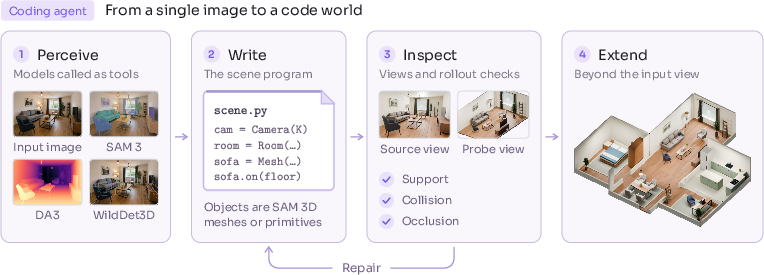
- Single-image reconstruction limitations remain open: The image-to-3D pipeline must infer unseen geometry, physical properties, and interaction rules, but its reconstruction accuracy and downstream task reliability are not evaluated across diverse scenes.
- Program correctness is not formally guaranteed: Verification queries for collision clearance, contact, and occlusion may miss semantic, dynamical, or edge-case bugs in generated scene programs; systematic validation coverage is absent.
- Generalization across engines is untested: The shared renderer is described as compatible with simulators and game engines, but results are not reported across multiple backends with different coordinate systems, physics engines, cameras, or condition exporters.
- No robustness evaluation under distribution shift: The paper does not test novel visual styles, layouts, object categories, dynamics, lighting, camera poses, textures, weather, sensor noise, or task rules outside the training distribution.
- Failure recovery is insufficiently studied: The agents’ ability to detect and recover from renderer artifacts, incorrect beliefs, failed tool use, irreversible actions, or permanently damaged playbooks is not quantified.
- Reward and score reliability is unclear: Several environments use bespoke scores, but the paper does not establish that these measures align with task success, efficiency, safety, or human judgments.
- Learning may reflect prompt or playbook leakage: The paper does not clarify whether task descriptions, environment-specific action semantics, or prior playbook content inadvertently reveal solutions or create world-specific shortcuts.
- No evaluation of knowledge retention and interference: It remains unknown whether accumulating playbooks improves performance across many tasks or instead produces retrieval errors, contradictory strategies, context-window saturation, and negative transfer.
- No safety or containment analysis: Code-generating agents can modify environment programs and action scripts, yet the paper does not address sandboxing, malicious code, unsafe actions, unauthorized state access, or verification of generated programs.
- Reproducibility is incomplete: The provided text does not establish whether model checkpoints, training data, exact prompts, environment seeds, playbooks, evaluation scripts, and full implementation details are available sufficiently to reproduce the results.
- Theoretical guarantees are absent: The framework offers no formal guarantees for temporal consistency, controllability, convergence of Adversarial Forcing, preservation of simulator semantics, or agent performance under renderer imperfections.
Practical Applications
Immediate Applications
- Embodied-AI training and benchmarking — robotics and autonomous systems
- Deploy AgentGarten as a visual-interaction benchmark for robots and embodied agents performing navigation, manipulation, tool use, herding, driving, and multi-agent coordination.
- Use programmable scene dynamics for ground-truth evaluation while exposing agents only to rendered camera observations. This enables controlled tests of visual grounding, memory, planning, recovery from failure, and tool use.
- Potential products and workflows include a benchmark server, standardized task files, replayable evaluation suites, and regression testing for robot foundation models.
- Dependencies: The neural renderer must preserve object identity, geometry, occlusion, and temporal consistency sufficiently for the evaluated behavior. Results should not be treated as evidence of real-world competence without transfer testing.
- Rapid generation of synthetic training environments — software, robotics, and game development
- Generate interactive environments from text prompts or a single image, then refine them through code and verification queries for collision, contact, clearance, and occlusion.
- Organizations could create large libraries of task-specific worlds without producing detailed meshes and materials for every scene. Examples include warehouse layouts, household interiors, construction sites, roads, and industrial workspaces.
- A practical workflow is: prompt or image input → scene-program generation → automated physics and visibility checks → neural rendering → agent rollout → iterative code repair.
- Dependencies: Generated geometry must be physically valid, task-relevant assets must be represented, and the appearance reference must be compatible with the desired visual domain.
- Agent practice before real-world deployment — industrial automation and logistics
- Train or evaluate agents for tasks such as moving objects, crossing constrained routes, operating simple machinery, or coordinating through narrow passages.
- The explicit state transition function allows developers to inspect whether a failure came from the agent’s policy, the scene rules, or the renderer. This is useful for safety testing and debugging.
- Potential tools include a “digital rehearsal” platform in which an agent practices under varied layouts, camera views, appearances, and interaction rules before being connected to physical equipment.
- Dependencies: Sim-to-real transfer remains unresolved. Real sensors, latency, friction, dynamics, and safety constraints may differ substantially from the code world.
- Visual-agent regression testing and continuous evaluation — AI and software engineering
- Use fixed scene programs and recorded state trajectories to test whether changes to an agent model affect performance on perception, planning, or recovery tasks.
- Because the same trajectory can be rendered with different camera viewpoints or visual styles, developers can separate behavioral robustness from sensitivity to appearance.
- A practical product could provide CI-style tests for multimodal agents: every model revision is evaluated on a fixed set of interactive worlds and scored on task completion, time, collisions, and recovery behavior.
- Dependencies: Tasks need reproducible seeds, stable renderer versions, and metrics that distinguish genuine strategy improvement from exploitation of rendering artifacts.
- Interactive game and browser-based training environments — gaming and education
- Use code-defined worlds to build lightweight browser games involving navigation, puzzles, bowling, driving, or tool use while varying the visual presentation through the shared renderer.
- The explicit game logic can remain deterministic and inspectable, while the rendered appearance can be personalized or regenerated.
- Potential applications include adaptive games in which an AI opponent or tutor creates increasingly difficult scenarios based on the player’s behavior.
- Dependencies: Current performance is demonstrated on high-end GPU hardware; consumer deployment would require model compression, cloud serving, or substantially cheaper inference.
- Replayable visualization and alternative camera production — media, simulation, and analytics
- Re-render recorded state trajectories from new viewpoints, appearances, or visual styles without changing the underlying events.
- This could support debugging videos, simulation explainers, synthetic training data, game replays, and multiple-camera visualization of the same interaction.
- For example, an engineering team could inspect an autonomous-agent failure from the agent’s first-person view, an overhead camera, and a visually enhanced presentation while retaining identical state transitions.
- Dependencies: The renderer only receives the structured conditions exposed by the engine. Unrepresented attributes, materials, and hidden geometry may be hallucinated or inconsistent.
- Playbook-based agent improvement — enterprise automation and research workflows
- Adopt the paper’s round-based procedure: agents perform tasks, review observations and failures, write compact playbooks, and inherit those playbooks in later rounds.
- This can be used immediately for simulated customer-service workflows, software-agent tasks, browser automation, or tool-use benchmarks where experiences can be recorded and inspected.
- A practical implementation would store playbooks as versioned Markdown or structured skill files linked to demonstrations, failure cases, and recommended tests.
- Dependencies: Written lessons may contain incorrect generalizations or brittle heuristics. Playbooks require validation, provenance tracking, and possibly automatic contradiction detection.
- Research into efficient video-model serving — machine learning systems
- The implementation techniques—block-causal generation, bounded key–value caches, exact replay, CUDA graphs, fused kernels, and small decoders—can inform real-time video-generation and interactive multimodal systems.
- The reported throughput of more than 35 frames per second on one H100 suggests immediate feasibility for controlled, high-end server applications such as interactive demos, agent simulators, and remote browser experiences.
- Dependencies: The reported throughput depends on a specific resolution, hardware, cache size, sampler, and model configuration. It does not establish comparable performance on commodity devices or at higher resolutions.
- Policy and safety evaluation for autonomous agents
- Policymakers, standards bodies, and safety teams can use inspectable code worlds to evaluate whether agents obey action constraints, remain within time or resource budgets, and recover safely from unexpected conditions.
- Scenarios can be authored for restricted access, collision avoidance, emergency stops, multi-agent conflicts, and human–agent coordination.
- Because the environment state is explicit, evaluators can audit hidden variables and replay the exact sequence that led to a violation.
- Dependencies: Simulated compliance does not guarantee behavior in physical or socially complex environments. Regulatory use would require validated scenarios, independent audits, and evidence of correlation with real-world incidents.
Long-Term Applications
- Sim-to-real training for physical robots — robotics and manufacturing
- A mature version of AgentGarten could generate large numbers of visually varied but dynamically controlled environments for warehouse robots, mobile manipulators, agricultural machines, or construction equipment.
- Agents could progress from simple tasks to increasingly difficult layouts, disturbances, and multi-agent interactions, using rendered first-person observations during training.
- The shared renderer could reduce the cost of adding visual diversity while the code engine preserves exact task rules and state transitions.
- Dependencies: Major research is needed on calibrated physics, sensor noise, action latency, photometric realism, contact dynamics, domain randomization, and reliable transfer from rendered observations to camera and depth sensors.
- Digital twins for industrial operations — manufacturing, energy, logistics, and construction
- Code worlds could evolve into digital twins in which operational layouts, machine states, and task rules are represented explicitly while neural rendering supplies realistic visual views.
- Potential workflows include operator training, maintenance rehearsal, warehouse route planning, emergency response, and testing of autonomous equipment under rare conditions.
- A twin could replay the same operational event under alternative camera placements or visualizations for incident investigation.
- Dependencies: Industrial deployment requires integration with live sensors and enterprise systems, strict state synchronization, validated physical models, cybersecurity, access control, and guarantees that generated visuals do not obscure safety-critical information.
- Adaptive curriculum generation for embodied agents — academia and AI research
- Since new worlds can be written as code and scaled in difficulty, researchers could build automatic curricula that vary geometry, distractors, time limits, available tools, and opponent strategies.
- An agent might begin with direct navigation, progress to obstacle negotiation, and eventually handle cooperative or adversarial multi-step tasks.
- The playbook mechanism could provide an interpretable memory layer that records transferable skills rather than only opaque policy weights.
- Dependencies: Curriculum generators must avoid producing tasks that are visually attractive but physically invalid, reward-hackable, or disconnected from target capabilities. Skill transfer across worlds needs systematic measurement.
- General-purpose embodied foundation models — AI and robotics
- AgentGarten’s separation between explicit world state and rendered observations could support pretraining agents across many compatible engines and task types.
- A future model could learn general visual-action abstractions while retaining a clean interface for task rules, cameras, tools, and multi-agent settings.
- Such systems might serve as reusable “world interaction” models for domestic robots, industrial assistants, or autonomous vehicles.
- Dependencies: The paper’s experiments involve pretrained agents and short task runs, not proof of general embodied intelligence. Scaling will require broad datasets, robust long-horizon memory, action grounding, and evaluation against physical environments.
- Human training and professional simulation — healthcare, aviation, emergency response, and education
- Code-defined worlds could provide visually diverse practice scenarios for procedures, patient interaction, evacuation, driving, equipment handling, or collaborative decision-making.
- A training system could preserve deterministic scenario logic while generating different visual contexts and difficulty levels, then provide replay-based feedback.
- In healthcare, for example, the approach might eventually support simulated room navigation or equipment-use training, but not replace validated clinical simulation.
- Dependencies: High-stakes domains require expert-authored rules, validated outcomes, accurate human and equipment models, privacy protections, and certification. Neural rendering artifacts could teach unsafe habits if not detected.
- Multi-agent coordination and autonomous traffic research — transportation and robotics
- The bridge, racing, herding, and hide-and-seek examples suggest a platform for studying cooperation, competition, negotiation, right-of-way, and recovery under partial observability.
- Future systems could test fleets of vehicles, drones, or warehouse robots under shared constraints and evaluate emergent coordination strategies.
- Policy researchers could use these environments to examine how communication limits, incentives, or rule changes affect collective safety.
- Dependencies: Emergent strategies may be specific to the simulated rules and renderer. Valid conclusions require adversarial testing, formal constraints, diverse seeds, and comparisons with real traffic or robot behavior.
- Synthetic visual data for perception and multimodal model training — computer vision
- Recorded state trajectories could be re-rendered with multiple appearances, cameras, and descriptions to create paired data for depth estimation, navigation, action recognition, and visual question answering.
- The structured-condition interface may help generate datasets where geometry and semantics are known while visual style varies.
- This could reduce dependence on expensive annotation for rare events such as collisions, occlusions, unusual tool configurations, or emergency maneuvers.
- Dependencies: Synthetic data can contain systematic visual biases, implausible textures, and renderer-specific artifacts. It must be mixed with real data and evaluated for distribution shift.
- Reliable long-horizon neural rendering — generative-model infrastructure
- Adversarial Forcing, exact replay, and frozen-backbone regularization could be adapted to other interactive generative models that must maintain consistency over long sequences.
- Potential targets include interactive 3D scenes, avatar environments, video editing systems, and multimodal simulators.
- Exact replay may be particularly useful where gradients through recursive history are needed but full differentiable rollouts exceed memory limits.
- Dependencies: The approach relies on deterministic or reproducible execution. Different hardware, kernels, precision modes, distributed systems, or nondeterministic operators may prevent bitwise replay and require new approximate methods.
- Everyday personal and educational assistants with interactive world understanding
- In the distant term, users could describe a room, object arrangement, or practical task and receive an interactive simulation for planning furniture placement, practicing repairs, learning spatial concepts, or rehearsing travel routes.
- An assistant might generate alternative layouts, expose likely obstacles, and let users test actions before performing them in the real world.
- Dependencies: Image-to-3D reconstruction remains ambiguous, hidden geometry must be inferred safely, and the system must clearly distinguish verified physical consequences from plausible visual generation. For safety-critical household tasks, human confirmation would remain necessary.
Glossary
- Adversarial Forcing: A distillation method that combines self-rollout training, exact replay, and adversarial supervision to train a real-time neural renderer. “We adapt a pretrained bidirectional video model to structured conditions, convert it to block-causal generation, and distill it into a real-time renderer on a single GPU with Adversarial Forcing”
- Autoregressive generation: A generation process in which each output depends on previously generated outputs. “Stage 2 adapts the geometry-conditioned model to blockwise autoregressive generation.”
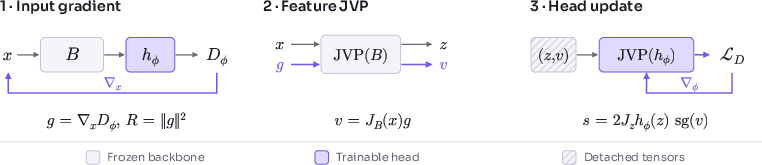
- Backbone: The primary neural-network architecture whose features or components are reused by other models. “A trainable head aggregates intermediate features from the frozen teacher backbone into a discriminator logit.”
- Bidirectional video model: A video model that can attend to information from both earlier and later positions during processing. “Starting from a pretrained bidirectional backbone, training proceeds through geometry conditioning, teacher-forcing adaptation, and Adversarial Forcing.”
- Block-causal generation: Sequential generation in fixed-size blocks where each block can access prior blocks but not future ones. “We adapt a pretrained bidirectional video model to structured conditions, convert it to block-causal generation, and distill it into a real-time renderer on a single GPU with Adversarial Forcing”
- Camera intrinsics: Internal parameters of a camera model, such as focal length and principal-point location, that determine image projection. “Perception and generation models lift the visible content into instance masks, monocular depth and camera intrinsics”
- Closed-loop execution: An interactive control process in which an agent repeatedly acts, observes the result, and uses that observation to choose subsequent actions. “Their primary challenge is not discovering concepts from nothing, but grounding abstract knowledge into closed-loop sensorimotor action”
- Cross-attention: An attention mechanism in which one sequence attends to representations from another sequence. “with encoding and text keys and values integrated via cross-attention.”
- Distribution matching distillation (DMD): A distillation technique that trains a student model to reproduce the output distribution of a teacher model. “We match autoregressive student rollouts to the bidirectional teacher through distribution matching distillation (DMD) in the manner of Self Forcing”
- Double backward: A second-order automatic-differentiation operation that differentiates through a previously computed backward pass. “The fused attention kernels in our backbone, such as FlashAttention, do not support this double backward.”
- Exact replay: A recomputation procedure that reproduces a rollout with identical numerical execution so that gradients can flow through history encoding. “We preserve the rollout's execution structure: attention runs block by block with scaled dot-product attention (SDPA), using the same key--value order and call shapes.”
- Fused attention kernel: An optimized implementation that combines multiple attention operations into a single GPU kernel to reduce memory movement and execution overhead. “The fused attention kernels in our backbone, such as FlashAttention, do not support this double backward.”
- Geometry conditioning: Conditioning a generative model on geometric information such as depth maps or surface normals. “We train a geometry-conditioned autoregressive video model to implement the renderer in Section~\ref{sec:formulation}.”
- History-gradient replay: A replay-based method that allows later losses to update the computation that encoded earlier generated history. “Adversarial Forcing makes history prefilling differentiable through exact replay”
- Inductive bias: A modeling assumption that encourages a learning system to favor particular structures or patterns. “to avoid imposing a pixel-aligned inductive bias.”
- Jacobian–vector product (JVP): The product of a function’s Jacobian matrix and a vector, computed without explicitly materializing the full Jacobian. “and by one Jacobian--vector product that carries forward through the frozen backbone without a gradient graph.”
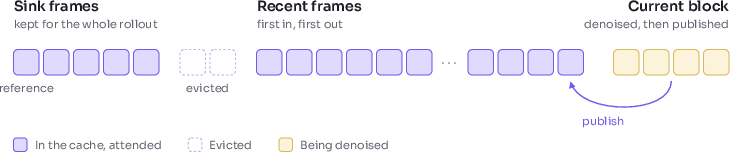
- Key–value cache: A stored collection of attention keys and values reused during autoregressive inference to avoid recomputing prior context. “A bounded key--value cache and streaming decoding support continuous inference within the interaction loop”
- Latent: A compact learned representation of data, typically used internally by a generative model. “A frozen Wan video autoencoder maps RGB and geometry videos to latents.”
- Monocular depth: Depth estimated from a single image or camera viewpoint. “Perception and generation models lift the visible content into instance masks, monocular depth and camera intrinsics”
- Neural renderer: A learned model that generates visual observations from structured scene information and contextual inputs. “A shared neural renderer synthesizes the agent's visual observations from structured conditions exported by the engine through a unified interface.”
- Occlusion: The blocking of one object or surface by another in a visual scene. “it only needs coarse geometry that faithfully conveys layout, silhouettes, occlusion, and motion dynamics.”
- Positional remapping: The adjustment of positional encodings when a model processes sequences beyond its original training horizon. “For rollouts exceeding the training horizon, we apply top-aligned rotary position remapping”
- Procedural generation: Automatic creation of environments or content through algorithms, rules, or programs rather than manual construction. “ProcTHOR generates interactive houses procedurally at scale”
- Relativistic objective: An adversarial-learning objective that compares the discriminator’s scores for real and generated samples directly. “We use the relativistic pairing of R3GAN”
- R1/R2 regularization: Gradient-penalty regularizers that constrain discriminator sensitivity on real and generated samples, respectively. “It combines distribution matching on self-rollouts with exact bitwise replay for history gradients, alongside a real-data adversarial objective whose exact R1/R2 regularization avoids double-backward through fused attention.”
- Rotary coordinates: Position information encoded through rotations applied to query and key representations in attention mechanisms. “Geometry and RGB share temporal rotary coordinates”
- Score distillation: A generative-model distillation approach that uses score or denoising estimates from a teacher to train a student model. “to prevent the visual degradation that score distillation alone exhibits over long rollouts”
- Sensorimotor action: Action guided by the interaction between sensory perception and motor control. “grounding abstract knowledge into closed-loop sensorimotor action”
- Streaming decoding: Generating and delivering outputs incrementally as they become available rather than waiting for the complete sequence. “A bounded key--value cache and streaming decoding support continuous inference within the interaction loop”
- Surface normals: Vectors perpendicular to surfaces that describe their local orientation in 3D space. “We use colorized depth or surface normals as structured conditions.”
- Teacher forcing: Training an autoregressive model using the correct previous outputs as context rather than its own generated outputs. “Training proceeds through geometry conditioning, teacher-forcing adaptation, and Adversarial Forcing.”
- Tabula rasa: A learning setup in which an agent begins without preexisting knowledge or learned parameters. “Self-play RL trains tabula rasa policies over privileged object state across millions of episodes.”
- Transformer: A neural-network architecture based primarily on attention mechanisms for modeling sequences. “We concatenate geometry and RGB tokens along the sequence dimension and process them with the same Transformer layers.”
- Vector–Jacobian product (VJP): The product of a vector and a Jacobian, commonly used to propagate gradients backward through a function. “where is obtained by one vector--Jacobian product”
- Visual history: Previously generated visual observations used as context for producing subsequent observations. “the neural renderer generates subsequent observations from visual history ”
- World model: A model that represents or predicts the states, observations, and dynamics of an environment. “Conversely, video world models synthesize rich, interactive visual observations from data”

