RRSI: Regularized Recursive Self-Improvement of Agent Harnesses
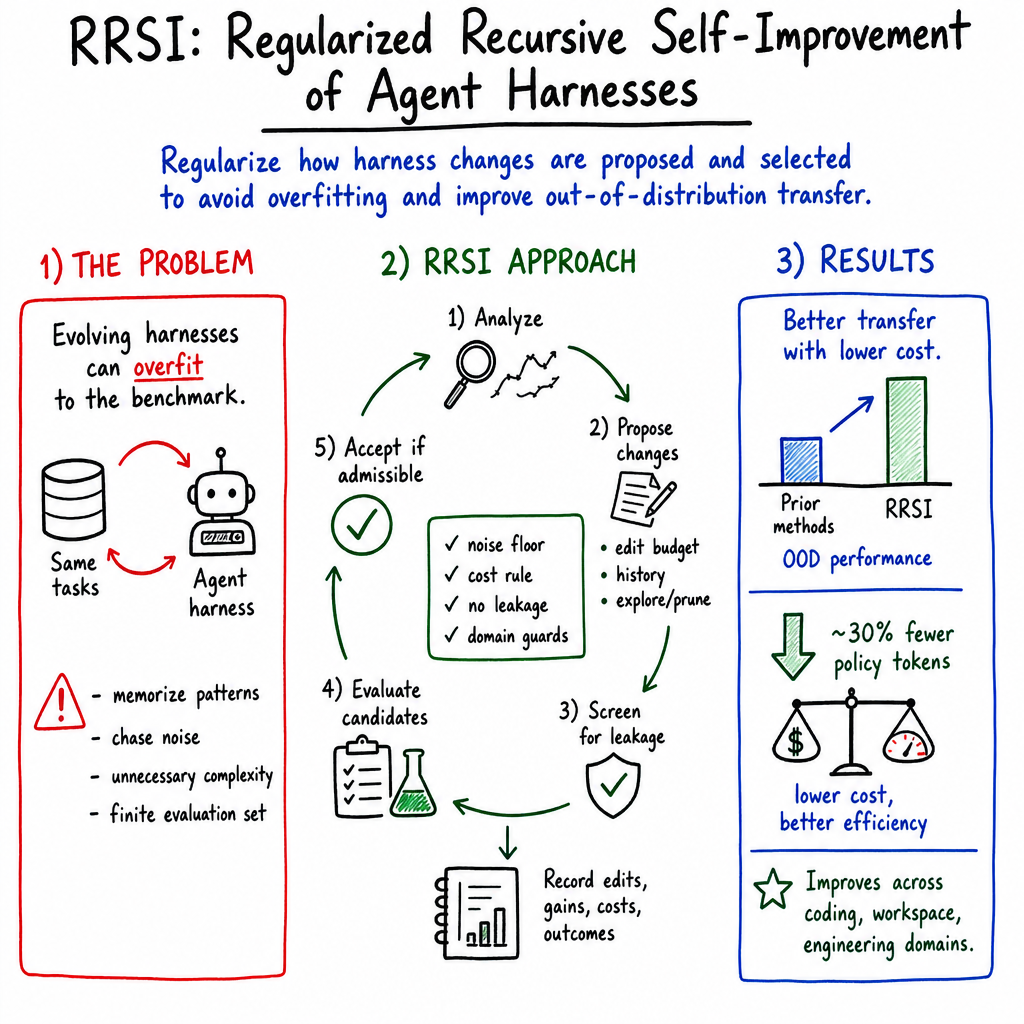
Abstract: An LLM agent's capability is largely magnified by its harness, namely the prompts, control flow, tooling, memory, and context management surrounding the frozen backbone model. Recent methods increasingly automate this process by iteratively proposing and selecting component-wise edits of an agent harness, practically establishing a form of recursive self-improvement (RSI) at the agent-system level. However, such recursive evolution may overfit by memorizing the training tasks, showing large in-distribution gains that shrink or even vanish on out-of-distribution benchmarks. We introduce Regularized Recursive Self-Improvement of Agent Harnesses (RRSI), which incorporates the principles of regularizations into harness self-improvement by constraining the evolution candidate proposal and selection. The proposer operates with a temporally annealed budget, limiting how many edits a candidate can bundle, and it encourages unexplored trajectories based on evolution history. The selector is equipped with a critic and a pruner: the critic screens benchmark-specific proposals, while the pruner, removes changes that are too small, too expensive, or no longer useful. Together these constraints favor reusable agent mechanisms over benchmark-specific ones or even noises. Across eight benchmarks spanning coding, agentic workspace and engineering design tasks, RRSI gains up to 14.1 points on the split it evolves against and up to 4.7 points on the five out-of-distribution benchmarks, while producing a harness that runs on 30% fewer policy tokens than the unregularized evolution. Code is available at https://github.com/google-research/rrsi and project page is https://regularized-rsi.com/.
Paper Prompts
Sign up for free to create and run prompts on this paper.
Top Community Prompts
Explain it Like I'm 14
1. What is this paper about?
This paper introduces a method called RRSI, short for Regularized Recursive Self-Improvement of Agent Harnesses.
The main idea is that an AI agent is not just the LLM itself. It also has a surrounding system, called a harness, that tells it:
- what instructions to follow,
- which tools to use,
- how to plan and act,
- what information to remember,
- how to handle mistakes, and
- what information to keep in its working memory.
For example, the same LLM might perform much better if it is given a better system for reading files, using a computer terminal, checking its work, and recovering from errors.
Researchers have begun using AI to automatically improve these harnesses. However, this can create a problem: the AI may learn tricks that work only on the particular test questions it has seen. This is called overfitting.
RRSI is designed to help the agent learn useful improvements that also work on new and different tasks.
2. What questions does the research ask?
The paper focuses on several important questions:
- Can an AI improve the instructions and tools surrounding another AI?
- Do automatically improved harnesses work on new tasks, or only on the tasks used during improvement?
- Can the improvement process avoid memorizing specific answers or test cases?
- Can the improved agent become more capable without using much more computing power?
- Which parts of RRSI are most important?
The researchers are especially interested in the difference between:
- evolve-set performance: how well the agent performs on tasks used to improve it, and
- held-out performance: how well it performs on new tasks that it never saw during improvement.
This is similar to studying for a test. A student who memorizes the exact practice questions may score highly on those questions but perform poorly on a new test. A student who learns the underlying ideas should do well on both.
3. How did the researchers conduct the study?
The basic improvement process
The researchers begin with a LLM whose internal settings, or weights, remain unchanged. They modify only its harness.
The process works roughly like this:
- The current harness tries to solve a group of tasks.
- Researchers record what went well and what went wrong.
- Another LLM suggests changes to the harness.
- The suggested versions are tested.
- A promising version becomes the new harness.
- The process repeats.
This is called recursive self-improvement because feedback from the current agent is used to create a better version of the system surrounding it.
Why ordinary improvement can fail
If the same tasks are used again and again, the system may begin to memorize details about them. It might also keep changes that appear helpful only because of random luck.
For instance, imagine changing a robot’s instructions after watching it play the same ten games repeatedly. The robot might learn a trick that works in those ten games but fails in every new game.
What RRSI changes
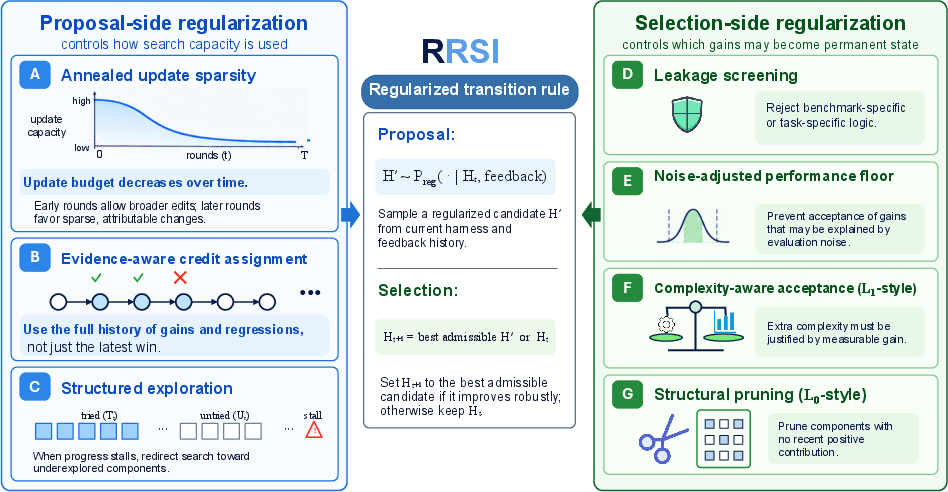
RRSI adds safeguards, or regularization, to make the improvement process more careful. The main safeguards are:
Smaller and more controlled updates
Early in the process, the system may try several related changes at once. Later, it is allowed to make fewer changes at a time.
This makes it easier to identify which change helped. It is like changing one part of a bicycle at a time so you know which repair fixed the problem.
Remembering past experiments
RRSI keeps a record of:
- which part of the harness was changed,
- what idea the change was testing,
- whether it helped,
- whether it increased the amount of computer work, and
- whether the change was accepted or rejected.
This prevents the system from repeatedly trying ideas that already failed.
Exploring neglected possibilities
If the system keeps changing only prompts, RRSI may encourage it to examine other parts of the harness, such as memory, tools, or the order of actions.
This is similar to making sure a student studies several topics instead of practicing only one favorite chapter.
Rejecting test-specific tricks
A separate checking system, called a critic, looks for changes that directly include:
- task names,
- exact answers,
- special values from the test set, or
- other information that would work only on the training tasks.
Such changes are rejected before they can influence the results.
Ignoring improvements caused by random noise
AI systems can behave differently each time they attempt the same task. Because of this, a candidate harness might appear better simply by chance.
RRSI measures this natural variation and requires a new version to improve by more than the expected random fluctuation.
Controlling computing cost
A new harness is not accepted just because it gets a slightly higher score. If it uses many more tokens, or requires much longer reasoning, the extra cost must be justified by a meaningful improvement.
A token is a small piece of text processed by the LLM. More tokens usually mean more time and money.
Removing unhelpful parts
RRSI tracks which components of the harness are useful. Components that repeatedly fail to help can be removed.
The goal is not simply to make the harness more powerful, but also to keep it reasonably simple and efficient.
The benchmarks
The researchers tested RRSI in three broad areas:
- Coding, including terminal tasks and fixing software bugs.
- Workspace tasks, such as legal and professional work.
- Engineering design, where proposed designs are checked by simulations or testing programs.
They used eight benchmarks in total. In each area, the harness was improved using one set of tasks and then tested on different tasks it had not seen.
The researchers compared RRSI with:
- the original, unimproved harness, and
- four other automatic harness-improvement methods.
4. What did the researchers find?
RRSI improved performance on new tasks
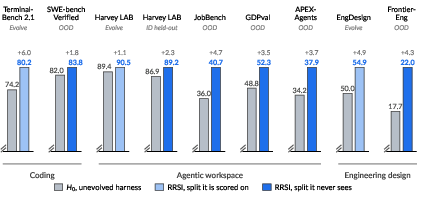
The most important finding is that RRSI improved performance not only on the tasks used for improvement, but also on unseen tasks.
Across the experiments:
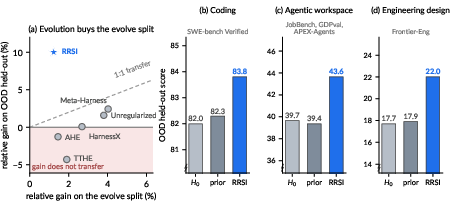
- RRSI improved the evolution benchmark by as much as 14.1 percentage points.
- It improved out-of-distribution benchmarks by as much as 4.7 percentage points.
- It improved every held-out test set in the main experiments.
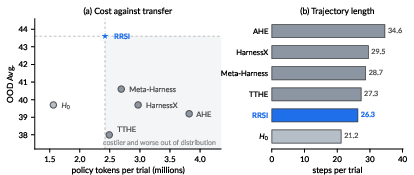
- It used about 30% fewer policy tokens than unregularized evolution.
“Out-of-distribution” means tasks that are meaningfully different from the tasks used during improvement, such as a different type of work or a different tool system.
Ordinary methods often overfit
The other improvement methods often achieved high scores on the tasks they evolved against. However, their gains were much smaller on new benchmarks.
In some cases, they performed no better than the original harness. One method even performed worse than the starting harness on the average of the new tasks.
This supports the paper’s central claim: simply choosing the highest-scoring version on the improvement tasks is not enough.
Regularization improved generalization
The experiments removed different parts of RRSI to see what happened.
When the researchers removed the proposal safeguards or the selection safeguards:
- performance on the improvement tasks often increased,
- performance on new tasks decreased, and
- computing costs increased.
This is important because it shows that a higher score on the original tasks can actually be misleading. The safeguards may produce a slightly smaller improvement on familiar tasks, but they produce a more useful and reliable system overall.
The improvements worked with different models
The researchers evolved harnesses using different LLMs, including Claude and Gemini. The improvements transferred to other models as well.
For example, a harness improved using one Gemini model also helped a smaller Gemini model that had not been involved in the improvement process.
This suggests that RRSI may discover general strategies, such as better planning or error recovery, rather than tricks tied to one specific model.
The system became more efficient
RRSI produced an improved harness that used fewer tokens than the other evolved harnesses.
This matters because an agent that solves tasks correctly but uses an enormous amount of computation may be too expensive to use in practice.
5. Why are these results important?
The paper shows that improving an AI agent is not only about making it score higher on the tasks it has already seen. The real goal is to create improvements that continue to work in new situations.
RRSI treats automatic agent improvement more like careful scientific experimentation:
- change a limited number of things,
- record what happened,
- avoid repeating failed ideas,
- reject cheating or test-specific tricks,
- account for random variation, and
- remove changes that are not worth their cost.
The research suggests that AI systems can improve their own surrounding instructions and tools, but this process needs controls. Without them, the system may become better at “studying the test” rather than becoming genuinely better at solving problems.
Conclusion and potential impact
RRSI could help developers build stronger AI agents without retraining the underlying LLM. Instead of changing the model’s internal knowledge, developers can improve the system around it: its prompts, tools, memory, planning process, and error recovery.
If the results hold up in future studies, this approach could lead to AI agents that:
- solve a wider range of tasks,
- transfer their skills to unfamiliar situations,
- use less computing power,
- avoid memorizing benchmark-specific tricks, and
- improve more safely and reliably over time.
However, the paper also has limitations. The LLM itself was kept fixed, and the method still depends on the quality of the tasks and feedback used during improvement. More research is needed to see whether RRSI works with other models, tools, agent designs, and longer-running improvement processes.
Knowledge Gaps
Knowledge Gaps, Limitations, and Open Questions
- Statistical reliability is not established: The paper reports point estimates but does not provide confidence intervals, significance tests, variance across independent evolution seeds, or task-level uncertainty, making it unclear whether the reported transfer gains are robust.
- The number of evolution runs is unclear: It is not specified whether results represent single runs or averages over multiple independent proposer, evaluator, and trajectory-sampling runs.
- The regularization hyperparameters may be overfit: Parameters such as the noise band , pruning window, exploration window, edit budgets, and cost coefficients are selected using the evolve set, but the paper does not quantify their sensitivity or assess whether this creates another layer of adaptive overfitting.
- The relative contribution of individual regularizers remains unresolved: The ablations remove proposal-side or acceptance-side groups as a whole, without separately isolating annealed sparsity, credit assignment, structured exploration, leakage screening, stability-aware acceptance, cost-aware acceptance, and pruning.
- The effectiveness of the leakage critic is not independently validated: The paper does not report false-positive and false-negative rates, inter-rater agreement with human reviewers, or experiments showing how performance changes when the critic is imperfect or adversarially bypassed.
- Leakage detection is limited to explicit task-specific content: The method may not detect indirect memorization, benchmark-specific strategies encoded through generic-looking prompts, latent correlations, or edits that exploit verifier artifacts without naming task-specific entities.
- The method lacks a formal generalization guarantee: The paper motivates RRSI using adaptive data analysis, but it does not derive bounds relating evolve-set reuse, candidate count, search rounds, evaluation noise, and out-of-distribution performance.
- The definition of “generalization” is narrow: Transfer is evaluated across selected benchmarks and task formats, but the study does not test substantially different domains, languages, modalities, interaction protocols, tool APIs, or open-ended real-world task streams.
- Benchmark diversity may still be insufficient: Several agentic workspace benchmarks share similar task structures and judge-mediated evaluation, so the observed transfer may partly reflect common task or verifier conventions rather than reusable harness mechanisms.
- The claimed cross-policy robustness is sparsely tested: Cross-policy experiments use only a small number of models and primarily focus on coding tasks; robustness across substantially different model families, capability levels, context windows, instruction-following behaviors, and proprietary/open-weight models remains unknown.
- Weight-updating recursive self-improvement is not studied: The conclusions may not extend to settings where the backbone is fine-tuned, distilled, reinforced, or otherwise updated alongside the harness.
- Long-horizon recursive evolution is unexplored: Experiments use a fixed and apparently short evolution schedule, leaving open whether regularization prevents complexity accumulation, collapse, or drift over hundreds or thousands of rounds.
- Performance under nonstationary task streams is unknown: The method is evaluated with a fixed evolve set and fixed benchmark distributions, not with changing tasks, tools, policies, or environments that require continual adaptation.
- The cost analysis is incomplete: The paper measures policy tokens consumed by the final harness but does not report the total computational and monetary cost of proposing, critiquing, evaluating, and evolving candidates.
- The cost–performance trade-off is not fully characterized: It remains unclear how performance changes as candidate count, number of trials per task, evolution rounds, and evaluation budget vary, or whether comparable transfer can be obtained more cheaply through additional evaluation rather than regularization.
- The noise estimate may be unreliable for heterogeneous tasks: The procedure for estimating from repeated base-harness evaluations may not capture task-dependent variance, heavy-tailed outcomes, correlations across candidates, or changes in variance caused by later harness edits.
- Selection remains based primarily on a single empirical score: The method does not examine more statistically principled alternatives such as confidence-bound selection, cross-validation over evolve tasks, held-out validation during evolution, or multi-objective optimization over score, cost, and robustness.
- The effect of task-level resampling is not investigated: It is unclear whether using fresh evolution tasks, rotating validation subsets, or task-level cross-validation would reduce overfitting more effectively than the proposed history-based constraints.
- The quality of credit assignment is uncertain: Candidate edits can modify multiple interacting harness components, so recording a source diff and score change may not identify causal contributions or distinguish synergistic mechanisms from incidental correlations.
- Pruning may remove delayed-benefit components: The paper does not evaluate whether the fixed pruning window incorrectly deletes mechanisms whose value appears only on rare, difficult, or long-horizon tasks.
- The open edit space creates unresolved safety and reliability risks: The study does not assess whether evolution can introduce insecure tool permissions, destructive control flow, privacy violations, prompt-injection vulnerabilities, or behavior that is beneficial on benchmarks but unsafe in deployment.
- Verifier gaming is not comprehensively examined: Deterministic simulators and unit tests reduce judge variance but may still contain exploitable shortcuts; the paper does not test whether evolved harnesses exploit weaknesses in any verifier.
- Human usefulness and output quality are not directly evaluated: Improvements in benchmark scores are not supplemented with human judgments of correctness, usefulness, readability, safety, or maintainability of the resulting deliverables and harness code.
- Harness maintainability is unmeasured: The paper claims that RRSI favors reusable mechanisms, but it does not assess code complexity, interpretability, debuggability, portability, or the engineering effort required to understand and maintain evolved harnesses.
- Baseline comparisons may not establish complete fairness: Although the methods share an initial harness, policy, evolve set, and candidate budget, the paper does not fully compare total inference budgets, proposer prompts, number of evaluations, implementation maturity, or hyperparameter-selection procedures across methods.
- The relationship between evolve-set gains and transfer is not modeled: The experiments show an empirical trade-off but do not determine whether lower evolve-set improvement is intrinsically beneficial, merely correlated with simpler edits, or dependent on the particular benchmark and score scale.
- Ceiling and floor effects are insufficiently addressed: Some benchmarks have high base performance while others have very low performance for weaker models, making absolute and relative gains difficult to compare and potentially masking failures or regressions.
- Reproducibility details remain incomplete: Important implementation choices—such as exact proposer and analyst prompts, candidate-generation constraints, edit parsing, trial allocation, stopping rules, and the full hyperparameter-selection process—are not presented in the paper text sufficiently to independently reproduce the results.
- The paper does not test adversarial or distribution-shifted evaluation: Future work is needed to determine whether RRSI remains effective when held-out tasks are deliberately designed to expose benchmark-specific assumptions or to stress tool, context, and recovery behavior.
- The persistence of learned mechanisms is unknown: It remains unresolved whether evolved harness improvements continue to transfer after tool versions, backbone models, task instructions, context limits, or verifier implementations change.
- The optimal regularization schedule is unexplored: The cosine annealing rule is selected a priori, but alternative schedules, adaptive budgets, and schedules conditioned on uncertainty or observed progress are not compared.
- Interactions between harness components are not systematically analyzed: Because prompts, memory, tools, control flow, and context management can be highly coupled, it is unclear which classes of edits account for transfer and whether some combinations are necessary or harmful across domains.
Practical Applications
Immediate Applications
- Production agent-harness optimization for software engineering
- Sector: Software development, DevOps, cloud platforms.
- Organizations can apply RRSI to improve coding-agent harnesses without retraining the underlying LLM. The system can iteratively revise prompts, repository-navigation logic, terminal-tool descriptions, error-recovery routines, context compaction, and planning/verification workflows.
- Potential tools and workflows: An internal “harness optimizer” that evaluates candidate configurations on historical bug-fixing tasks, rejects benchmark-specific edits, and deploys only changes that improve performance without excessive token use.
- Evidence from the paper: RRSI improved Terminal-Bench performance by up to 14.1 points in one policy setting and transferred gains to SWE-bench Verified, including when evaluated with a different model.
- Assumptions and dependencies: Reliable automated tests or verifiers must be available; repository data must be properly isolated from evolution tasks; production deployment requires sandboxing, code-review gates, rollback, and protection against prompt or tool-interface changes that could introduce security vulnerabilities.
- Cost-aware optimization of enterprise LLM agents
- Sector: Customer support, operations, consulting, knowledge management, and cloud AI.
- RRSI can be used to reduce unnecessary planning loops, redundant tool calls, oversized prompts, and excessive memory retrieval while preserving task quality. Its complexity-aware acceptance rule provides a practical mechanism for rejecting changes whose token cost is not justified by performance gains.
- Potential product: A monitoring dashboard showing task success, token consumption, trajectory length, rejected edits, and transfer performance across customer or operational workloads.
- Evidence from the paper: The final RRSI harness used approximately 30% fewer policy tokens than unregularized evolution and was cheaper than the other evolved harnesses tested.
- Assumptions and dependencies: Token count is only a proxy for total cost; latency, tool charges, human-review time, and infrastructure usage should also be measured. Cost reductions must not remove safety checks or important verification steps.
- Robust agent configuration for legal and professional-workspace tasks
- Sector: Legal technology, finance, consulting, human resources, and document-intensive enterprise work.
- Firms can evolve workflows for document retrieval, source citation, multi-step analysis, drafting, self-review, and context management using representative but held-out work items. The leakage critic is particularly useful for preventing the system from embedding client names, answers, or task-specific patterns into the harness.
- Potential workflow: Use anonymized historical matters for evolution, reserve unseen matters for evaluation, and require human approval before changes are released to production.
- Evidence from the paper: RRSI improved held-out and out-of-distribution agentic-workspace benchmarks, including legal and economically valuable task settings.
- Assumptions and dependencies: Evaluation must reflect substantive correctness rather than merely stylistic preferences of an LLM judge. Confidentiality, privilege, data residency, and auditability requirements may restrict the feedback data available to the optimizer.
- Engineering-design and simulation-agent workflows
- Sector: Engineering, robotics, manufacturing, architecture, and industrial R&D.
- RRSI can improve agents that iteratively generate designs, run simulations, inspect failures, modify parameters or code, and submit a final design. The approach is especially suitable where deterministic simulators or testbenches provide objective feedback.
- Potential tools: An engineering-agent harness that automatically improves task decomposition, simulation orchestration, constraint checking, failure recovery, and result reporting.
- Evidence from the paper: Improvements transferred from EngDesign to Frontier-Eng, where deterministic simulation or testbench grading reduced the risk that gains were caused only by judge-model preferences.
- Assumptions and dependencies: Simulators must adequately represent real-world constraints. Deployment in physical systems still requires safety certification, domain-expert review, hardware testing, and tolerance for simulation-to-reality gaps.
- Evaluation and quality-assurance infrastructure for agent developers
- Sector: AI research, model evaluation, platform engineering, and MLOps.
- RRSI provides a practical template for evaluating whether an agent improvement is genuinely reusable rather than overfit to a development benchmark. Teams can incorporate:
- separate evolution, in-distribution holdout, and out-of-distribution evaluation sets;
- baseline noise estimation;
- candidate-diff leakage screening;
- edit-history and attribution logs;
- token and trajectory-cost reporting; and
- conservative acceptance thresholds.
- Potential product: A continuous-integration system for agent harnesses that treats prompts, tools, memory policies, and control-flow code as versioned artifacts.
- Assumptions and dependencies: Held-out tasks must remain inaccessible during evolution, and evaluation sets must be sufficiently diverse. LLM-based critics and judges can themselves be noisy or biased, so deterministic tests and human audits remain important.
- Academic research on modular agent design
- Sector: Academia and open-source agent research.
- Researchers can use RRSI to study which harness mechanisms transfer across tasks, models, and tool ecosystems. The logged history of proposed, rejected, accepted, and pruned edits can support causal or ablation-style analysis of prompts, memory, tools, planning, and context management.
- Potential research workflow: Publish a base harness, evolution set, untouched transfer suites, complete edit histories, evaluation seeds, and cost measurements rather than reporting only the best score on the evolution benchmark.
- Assumptions and dependencies: Reproducibility depends on access to the same backbone models, tool environments, benchmark versions, and evaluator configurations. Results should not be generalized beyond the tested domains without additional validation.
- Policy and governance standards for self-improving agents
- Sector: AI governance, standards bodies, regulators, and enterprise risk management.
- RRSI supports concrete governance requirements for systems that modify their own prompts, tools, memory, or control flow:
- maintain immutable evaluation sets;
- require change logs and provenance;
- screen for benchmark or user-data leakage;
- impose resource budgets;
- validate changes on independent tasks;
- preserve rollback versions; and
- prohibit autonomous deployment of unreviewed harness changes in high-risk domains.
- Potential policy artifact: A “harness change-management” standard analogous to software supply-chain or model-risk-management controls.
- Assumptions and dependencies: Organizations must be able to inspect harness source and evaluation traces. These controls are less effective when agents can modify opaque external services or when the verifier is easily manipulated.
- Personal productivity and daily-life assistants
- Sector: Consumer software and personal knowledge management.
- A local or hosted assistant could improve how it organizes files, summarizes information, schedules tasks, uses productivity tools, and recovers from failed actions. RRSI’s pruning and cost controls could prevent the assistant from accumulating unnecessary memory, lengthy prompts, or redundant action loops.
- Potential workflow: Optimize on synthetic or user-approved tasks, evaluate on separate tasks, and ask for explicit consent before changing access permissions or automation behavior.
- Assumptions and dependencies: Personal data must not be used as unrestricted training or evolution feedback. Strong permission boundaries, transparency about changes, and easy rollback are essential.
Long-Term Applications
- Continual self-improvement of deployed agents
- Sector: Autonomous software, enterprise automation, robotics, and long-running digital services.
- RRSI could become part of an online adaptation loop in which agents learn from operational failures while retaining only changes that transfer across time periods, users, and environments. The evolution history could distinguish broadly useful mechanisms from temporary workload-specific adaptations.
- Potential system: A versioned agent controller with shadow evaluation, canary deployment, rollback, and automatic retirement of unproductive components.
- Dependencies and risks: The paper evaluates finite, offline evolution sets rather than unrestricted online learning. Continual deployment requires protection against feedback loops, distribution shift, adversarial users, privacy leakage, and irreversible behavioral drift.
- Cross-model and cross-provider harness portability
- Sector: AI infrastructure and model marketplaces.
- Because the paper reports transfer to policies that were not used during evolution, future systems could maintain model-agnostic harness layers for planning, tool use, memory, and verification. This could allow organizations to switch between providers or model sizes without rebuilding the entire agent architecture.
- Potential product: A compatibility and benchmarking layer that tests one harness across multiple models and automatically removes model-specific assumptions.
- Dependencies: Transfer is not guaranteed across radically different context limits, tool APIs, instruction-following behavior, or multimodal capabilities. Harnesses may need model-specific adapters, and portability must be measured rather than assumed.
- Autonomous robotics and embodied systems
- Sector: Robotics, logistics, industrial automation, and autonomous vehicles.
- RRSI could optimize high-level robot behaviors such as task decomposition, sensor-query policies, recovery from failed actions, memory of workspace state, and coordination with external tools or simulators.
- Potential workflow: Evolve in simulation, test on unseen simulated environments, then conduct restricted physical trials with safety monitors and human override.
- Dependencies and risks: The current evidence concerns software agents and engineering simulations, not physical robots. Real-world deployment requires handling sensor noise, hardware wear, real-time constraints, safety-critical failures, and sim-to-real transfer.
- Healthcare decision-support and clinical workflow agents
- Sector: Healthcare and biomedical research.
- A carefully constrained version could optimize administrative and decision-support workflows: retrieving patient information, checking documentation completeness, preparing summaries, coordinating referrals, or proposing questions for clinician review. RRSI could help reduce redundant context and enforce verification steps.
- Potential tool: A clinician-supervised harness optimizer evaluated on de-identified, institution-specific cases and independent external cases.
- Dependencies and risks: The paper does not establish clinical safety or diagnostic validity. Use would require privacy protection, prospective validation, calibrated uncertainty, clinician oversight, regulatory approval where applicable, and strict exclusion of autonomous high-stakes decisions.
- Education and adaptive tutoring systems
- Sector: Education and learning technology.
- RRSI could optimize tutoring-agent strategies for explanation, questioning, misconception diagnosis, pacing, tool use, and feedback. Independent evaluation sets could test whether improvements generalize across subjects, age groups, curricula, and student backgrounds.
- Potential product: A tutor harness that adapts instructional workflows while preserving pedagogical constraints and limiting unnecessary interaction length.
- Dependencies and risks: Benchmark scores may not capture genuine learning. Longitudinal studies, teacher review, fairness analysis, child-safety controls, and measures of durable learning—not merely answer accuracy—would be required.
- Safety-oriented agent architecture search
- Sector: AI safety, cybersecurity, and high-assurance software.
- The proposal and selection mechanisms could be extended so that candidate harnesses are judged not only on task success and token cost but also on robustness, policy compliance, resistance to prompt injection, least-privilege tool use, and recoverability.
- Potential research direction: Multi-objective RRSI with hard safety gates, adversarial evaluation, formal checks for selected control-flow properties, and independent red-team suites.
- Dependencies: The current method screens explicit leakage and manages complexity but does not provide comprehensive security guarantees. Safety objectives must be measurable, independently evaluated, and protected from optimization-induced gaming.
- Federated or organization-specific harness evolution
- Sector: Finance, government, healthcare, and privacy-sensitive enterprise systems.
- Multiple organizations could evolve compatible harnesses using local task feedback while sharing abstract edit metadata, reusable mechanisms, or anonymized performance statistics rather than raw data.
- Potential workflow: Federated evaluation of candidate harness components, followed by local acceptance based on privacy, cost, and domain-specific performance.
- Dependencies: Privacy-preserving aggregation, comparable verifiers, protection against poisoned feedback, and governance over shared harness components would be necessary. Local improvements may not transfer when workflows, laws, or tool ecosystems differ substantially.
- Automated creation of agent platforms and tool ecosystems
- Sector: Software platforms, cloud services, and enterprise automation.
- Over time, RRSI could evolve not only prompts and control flow but also tool descriptions, memory schemas, subagent roles, context policies, and orchestration graphs. This may produce domain-specific agent platforms for coding, research, design, or operations.
- Potential product: A “harness compiler” that converts task requirements and evaluation interfaces into a tested, versioned agent workflow.
- Dependencies and risks: The larger the editable system, the harder it becomes to attribute improvements and detect emergent failure modes. Longer evolution runs, richer causal attribution, stronger sandboxing, and human approval would be needed before allowing autonomous architectural changes.
- Regulated benchmarking and certification of self-improving agents
- Sector: Public policy, procurement, finance, healthcare, and safety-critical industries.
- The distinction between evolution-set performance and transfer performance could support certification regimes requiring an agent to demonstrate improvement on unseen, adversarial, cross-domain, and cost-constrained evaluations before deployment.
- Potential standard: Certification reports could include the initial and final harnesses, all accepted edits, evaluator independence, resource changes, leakage checks, and performance confidence intervals.
- Dependencies: Agreement is needed on benchmark governance, evaluator independence, update-trigger thresholds, and how frequently a deployed agent must be recertified. Certification cannot rely solely on the same benchmark used to optimize the system.
Glossary
- Adaptive empirical optimization: Optimization in which future search decisions depend on measurements previously collected from the same data or tasks. “Harness evolution can therefore be viewed as adaptive empirical optimization over an unusually expressive search space.”
- Adaptive overfitting: Overfitting caused by repeatedly adapting a system to feedback from a reused evaluation set. “...creating an adaptive overfitting risk: evolve-set performance may improve without corresponding gains on unseen tasks.”
- Agent harness: The collection of prompts, control logic, tools, memory, and context-management mechanisms surrounding a model. “A frozen backbone model is wrapped in a harness of prompts, control flow, tool interfaces, memory and context management.”
- Agentic workspace: An environment in which an agent performs open-ended, tool-mediated work rather than a narrowly defined prediction task. “Across eight benchmarks spanning coding, agentic workspace and engineering design tasks...”
- Annealed update sparsity: A schedule that gradually reduces the number of modifications permitted in each update. “-Style Annealed Update Sparsity.”
- Backbone policy: The underlying model whose behavior is shaped by the surrounding harness. “We consider an agent built from a backbone policy and a harness .”
- Cardinality constraint: A restriction on the number of active elements, such as the number of edits in an update. “The edit budget is the closest to an -style cardinality constraint...”
- Candidate harness: A proposed modified version of the current agent harness. “The candidates are evaluated on the same evolve set; and the best candidate is selected as the next incumbent.”
- Context management: The process of controlling which information is presented to the model at each step. “...the memory and context management that decides what the policy sees at each step.”
- Credit assignment: Determining which change or mechanism caused an observed outcome. “As later rounds allow fewer edits per candidate, it becomes easier to identify which change is responsible for an observed improvement.”
- Critic: A component that inspects proposed changes for undesirable or benchmark-specific content. “The selector is equipped with a critic and a pruner...”
- Cross-round failure feedback: Feedback summarizing failures across multiple optimization rounds. “The proposer, the analyst that writes the cross-round failure feedback and the leakage critic are all Claude Opus 4.8.”
- Empirical noise band: An estimated range representing score variation attributable to stochastic evaluation noise. “We treat the search as stalled when its progress over the previous rounds remains within the empirical noise band .”
- Empirical score: A performance estimate calculated from a finite set of observed trials. “ is the empirical score obtained from a finite number of stochastic agent runs.”
- Evidence-aware credit assignment: Credit assignment that incorporates the complete history of prior evaluations and outcomes. “RRSI therefore records, for every evaluated candidate, the component it modifies, the hypothesis it tests, the source diff, the resulting score and cost changes, and whether the candidate was accepted.”
- Evolution set: The task set used to propose and evaluate harness modifications. “At round , the current harness is executed on an evolve set to obtain trajectories...”
- Fitness signal: An empirical measurement used to guide the optimization of a system. “This inherits both the mechanisms and the risks of self-improving agents that search over their own code under an empirical fitness signal...”
- Frozen backbone model: A model whose parameters remain unchanged during harness optimization. “Our study focuses on harness-level recursive self-improvement with frozen backbone models...”
- Held-out benchmark: A benchmark withheld from the optimization process and used to measure generalization. “...the resulting harness is evaluated unchanged on both the evolve benchmark and SWE-bench Verified.”
- Hypothesis space: The set of possible solutions or system configurations considered by an optimization procedure. “Instead of restricting this hypothesis space directly, we regularize the search trajectory through it.”
- In-distribution: Drawn from the same general task distribution as the data used for optimization. “The in-distribution held-out split of Harvey LAB gains 2.3...”
- Inference cost: The computational expenditure incurred while a model generates outputs. “Thus additional inference cost must be justified by measurable performance improvement.”
- Lasso/ regularization: A regularization method that encourages sparsity by penalizing the absolute magnitude of parameters or components. “This process imitates the Lasso/-style sparsification...”
- Leakage screening: Detection and removal of proposed changes that encode information specific to the evaluation tasks. “Before full evaluation, a critic reads each candidate diff and rejects edits that explicitly encode task names, entity names, task-specific values, answers, or other logic specific to the evolve benchmark...”
- Noise-adjusted floor: A minimum acceptable score threshold that accounts for estimated evaluation noise. “A candidate must satisfy the noise-adjusted floor...”
- Out-of-distribution (OOD): Evaluation on tasks or data differing substantially from those used during optimization. “RRSI improves every split outside the evolve set, in all three domains.”
- Policy-token cost: The number of tokens generated by the underlying model during an agent trajectory. “We use policy-token cost as a common measurable proxy for this footprint.”
- Pruner: A component that removes changes judged ineffective, excessively costly, or unnecessary. “The selector is equipped with a critic and a pruner: the critic screens benchmark-specific proposals, while the pruner, removes changes that are too small, too expensive, or no longer useful.”
- Recursive self-improvement (RSI): Iterative improvement in which a system’s feedback is used to modify the system or its operating mechanism. “Such iterative harness evolution provides a practical form of recursive self-improvement (RSI) at the agent-system level...”
- Regularization: The use of constraints or penalties to reduce overfitting and discourage unnecessarily complex solutions. “We introduce Regularized Recursive Self-Improvement of Agent Harnesses (RRSI), which incorporates the principles of regularizations into harness self-improvement...”
- Reinforcement-style trajectory: A sequence of actions, observations, and intermediate states produced while an agent performs a task. “Given a task with its environment, the agent produces a trajectory and a deliverable...”
- Ridge/ regularization: A regularization method that discourages large parameter magnitudes or overall solution complexity. “This process is analogous to Ridge/-style shrinkage...”
- Search trajectory: The sequence of candidate configurations visited during an optimization process. “RRSI regularizes the search trajectory through it.”
- Selection-side constraint: A restriction governing which proposed modifications may be retained. “On the selection side, we constrain which empirical improvements are strong enough, efficient enough, and sufficiently free of leakage to survive.”
- Sparse update: An update that changes only a limited number of components. “Sparse updates limit how many mechanisms can change in response to one round of feedback...”
- Structural pruning: Removing entire system components that have not demonstrated useful contributions. “Structural pruning is analogous to Lasso/-style sparsification because persistently unproductive components are removed from the retained harness...”
- Stochastic evaluation: Evaluation whose results vary because model execution or other parts of the process are probabilistic. “Repeatedly selecting among noisy evaluations can convert stochastic winners into permanent search state.”
- Test-time computation: Computation performed while solving or evaluating tasks, rather than during model training. “...apparent improvements can arise from task-specific fitting or increased test-time computation rather than reusable mechanisms...”
- Trajectory: The complete sequence of states, actions, and outputs generated during one agent run. “With trials per task, we use... ...”
- Transfer evaluation: Evaluation of a system on tasks or benchmarks different from those used for optimization. “We keep the same open edit space and instead regularize the search dynamics...”
- Verifier: A mechanism that assesses whether an agent’s output satisfies task requirements. “The verifier can be a unit-test suite in coding environments or a LLM-as-a-judge program in agentic workspace environments.”