DeepSeek Elastic Compute (DSec): A Sandbox Infrastructure for Effective Agentic Training at Scale
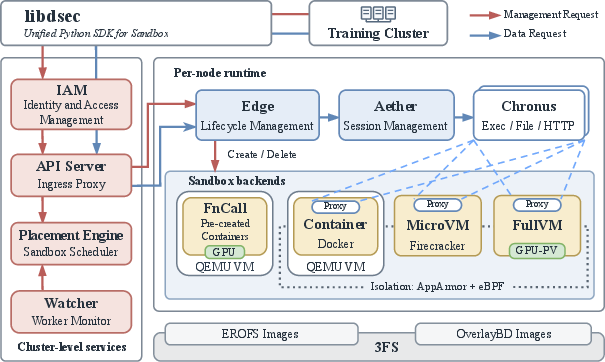
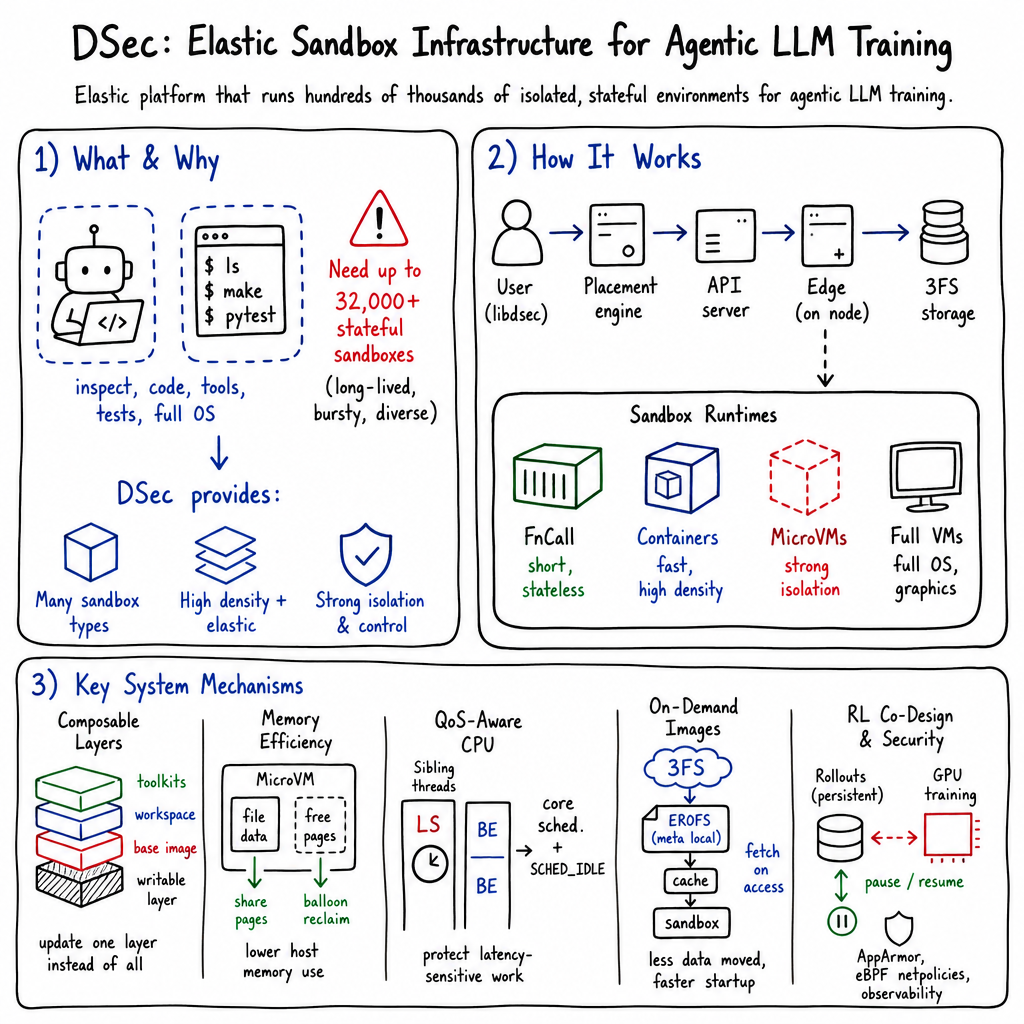
Abstract: Large-scale agentic training and evaluation with LLMs rely on isolated, stateful execution environments in which models inspect repositories, invoke tools, execute commands, and interact with task-specific services. These workloads create sandboxes in large bursts, span heterogeneous functionality and isolation requirements, retain state across long interactions, and draw from large image corpora with limited reuse. Supporting them therefore requires an elastic execution platform rather than a single sandbox runtime. This report presents DeepSeek Elastic Compute (DSec), a production sandbox platform that exposes FnCall, container, microVM, and full-VM sandbox backends through a unified SDK. DSec coordinates placement and lifecycle management across the cluster, composes environments from independently versioned layers, combines memory sharing, reclamation, and CPU scheduling for high-density execution, and loads image data on demand from Fire-Flyer File System (3FS), a cluster-wide distributed filesystem. DSec is co-designed with the reinforcement learning (RL) framework, decouples stateful rollout execution from preemptible GPU training, coordinates sandbox lifecycle with training to preserve rollout state while reclaiming idle resources, and mitigates agent misbehavior such as reward hacking. A single production-scale unit of DSec spans around 160 nodes, serving about 3 million sandboxes per day; in production, it supports over 380,000 concurrent sandboxes and sustains over 5,000 sandbox creations per second. Our evaluation and deployment experience show that these mechanisms reduce environment setup and image-distribution overhead, improve memory efficiency, and preserve latency-sensitive performance under high-density overcommit.
Paper Prompts
Sign up for free to create and run prompts on this paper.
Top Community Prompts
Explain it Like I'm 14
1. What is this paper about?
This paper introduces DeepSeek Elastic Compute (DSec), a large computer system designed to help artificial-intelligence agents do complicated tasks safely and quickly.
An AI agent is more than a chatbot that only writes text. It may also:
- read and edit computer files,
- run programs,
- use tools,
- browse websites,
- test its own code,
- interact with virtual computers.
To do these jobs, the agent needs a private computer-like environment called a sandbox. A sandbox is like a temporary, locked room on a computer. The AI can work inside it without damaging other users’ files or programs.
The main purpose of the paper is to explain how DSec creates and manages huge numbers of these sandboxes for training and testing AI agents.
2. What questions does the research try to answer?
The researchers are mainly asking:
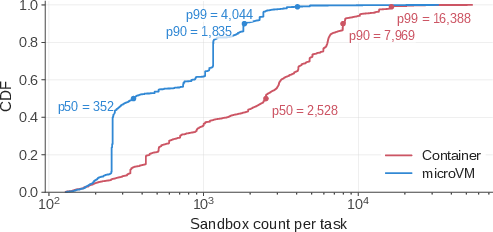
- How can thousands of sandboxes be created at the same time? An AI training job may need up to 32,000 environments in a short period.
- How can the system run many sandboxes on the same computers? Most sandboxes spend much of their time waiting for the AI’s next action, so they do not use much CPU power continuously.
- How can each sandbox receive the right software and files quickly? Different tasks may need different operating systems, libraries, code projects, tools, and test programs.
- How can the system keep a sandbox’s memory and files safe when training is interrupted? AI training may pause or restart while an agent is still working.
- How can the system prevent badly behaved AI programs from causing trouble? An agent might accidentally delete files, use too many resources, or try to access something it should not.
3. How was the system designed and studied?
A unified control system
DSec provides a Python software library called libdsec. Researchers can use it to:
- create a sandbox,
- choose its computer resources,
- set network rules,
- run commands,
- read the results,
- stop the sandbox when finished.
This gives different types of sandboxes a similar interface, even though they work differently underneath.
Several kinds of sandboxes
DSec supports four main types:
| Sandbox type | Simple explanation | Best suited for |
|---|---|---|
| FnCall | A quick, reusable computer task | Short programs and small jobs |
| Container | A lightweight isolated environment sharing part of the host system | Coding and software-engineering tasks |
| MicroVM | A small virtual machine with stronger separation | Security-sensitive tasks |
| Full VM | A complete virtual computer with its own operating system | Android, graphics, browsers, and GUI tasks |
The researchers compare these to different vehicles. A bicycle is fast and cheap for a short trip, while a bus or truck is heavier but can carry more and handle different jobs. Similarly, a container is efficient, while a full virtual machine provides more features and protection.
Layered environments
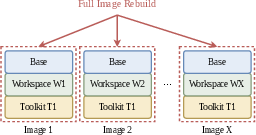
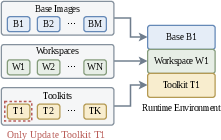
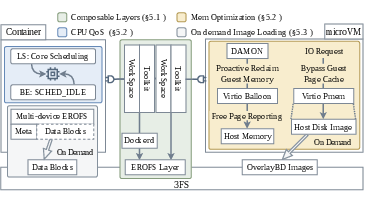
Instead of building every sandbox as one giant software package, DSec separates it into layers:
- a base operating system,
- the task’s code and files,
- tools used by the AI.
This is similar to building a sandwich from separate slices. If the tool layer changes, the system only replaces that slice instead of rebuilding the entire sandwich.
DSec uses a technology called OverlayFS to combine these layers so that they look like one normal computer directory.
On-demand image loading
A sandbox’s software is stored in a large distributed file system called 3FS. DSec does not copy every file into every sandbox immediately. Instead, it loads files only when they are needed.
This is like streaming a movie: you do not download every movie in the world before watching one. You receive the parts you need when you need them.
High-density resource management
Because many agents are waiting for their next instruction, DSec allows many sandboxes to share a computer’s resources. This is called overcommitment.
For example, a computer might promise resources to many sandboxes, assuming they will not all need their maximum amount at the same time. The system also uses memory sharing and reclamation to recover resources from inactive sandboxes.
However, DSec must be careful not to slow down tasks that need quick responses. It therefore gives special treatment to latency-sensitive tasks, while running less urgent tasks with lower priority.
Testing at production scale
The researchers studied real production workloads and measured:
- how many sandboxes were created,
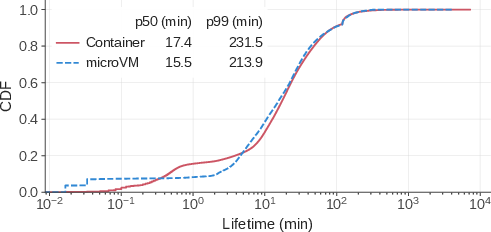
- how long they lived,
- how much CPU and memory they used,
- how often images were reused,
- how much data was accessed,
- how quickly sandboxes could be started.
They also compared different image-loading strategies and examined how DSec behaved in a very large deployment.
4. What were the main findings?
DSec can operate at very large scale
One production unit of DSec uses about:
- 160 computer nodes,
- about 30,000 CPU cores,
- around 250 terabytes of memory.
It can serve approximately:
- 3 million sandboxes per day,
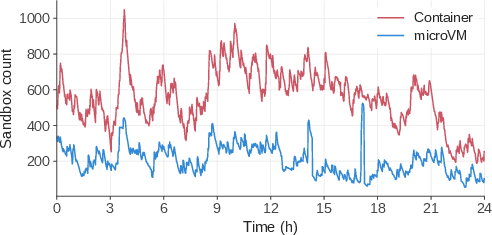
- more than 380,000 sandboxes at the same time,
- over 5,000 sandbox creations per second.
These numbers show that DSec is not just a small program for launching containers. It is a complete platform for managing a huge number of AI environments.
Most sandboxes use little CPU most of the time
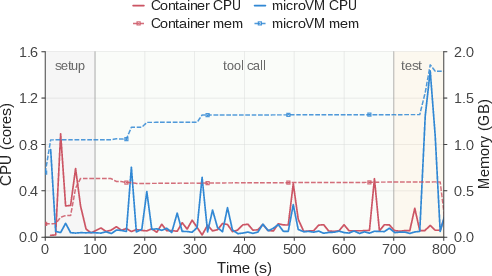
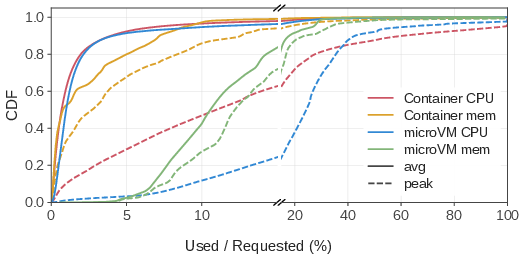
About 90% of container and microVM sandboxes use 5% or less of their requested CPU capacity on average.
This supports the idea of placing many sandboxes on the same physical computer. They often work in short bursts and then wait while the AI decides what to do next.
However, their memory remains in use for much longer. A sandbox may keep files, installed programs, and running services even while its CPU is mostly idle. This means memory management is especially important.
Layering reduces repeated setup work
The researchers found that many different base images, workspaces, and toolkits are used. During one week, the system served:
- 11,266 different container base images,
- 102,171 workspaces,
- 103 toolkits,
- more than 130 terabytes of environment data in total.
Using separate layers means that changing one toolkit does not require rebuilding every complete environment that uses it. This saves time, storage, and computer work.
On-demand image loading reduces waste
The system found that programs usually use only a small part of their full software images. For example, programs accessed only about 4% to 13% of the data in several types of images.
Therefore, copying an entire image before starting a sandbox wastes resources. DSec’s on-demand approach avoids much of this unnecessary copying.
The paper reports that:
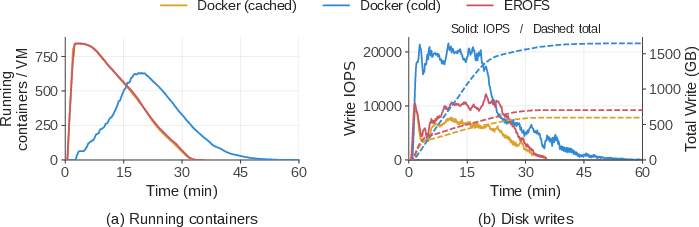
- eager image pulling made completion take about 1.7 times longer,
- on-demand loading reduced total disk writes by 57%.
Multiple sandbox types are useful
No single sandbox design works well for every task.
- Containers are efficient for ordinary coding tasks.
- MicroVMs provide stronger protection.
- Full virtual machines are needed for complete operating systems, graphics, and Android.
- FnCall is useful for very short tasks.
Supporting all of these allows the system to choose the right balance between speed, cost, and safety.
The system can handle temporary demand increases
DSec normally uses its own computers but can send some work to cloud virtual machines when demand becomes too high. This is called cloud bursting.
In the reported setup, cloud machines handled about 30% of peak extra demand, helping the system avoid buying enough permanent hardware for rare busy periods.
5. Why are these findings important?
Training an AI agent to use tools is much more difficult than simply training it to produce text. The agent needs a realistic computer environment where its actions can be tested.
If sandboxes start too slowly, use too much memory, or interfere with one another:
- AI training becomes slower,
- experiments become more expensive,
- test results may become unreliable,
- one badly behaved agent could affect many others.
DSec addresses these problems by combining:
- many types of isolated environments,
- reusable software layers,
- on-demand file loading,
- careful memory and CPU management,
- security controls,
- support for interrupted and resumed training.
6. Possible impact
The ideas in this paper could make large-scale AI training more practical and affordable. Better sandbox infrastructure may help researchers train agents that can:
- write and test software,
- use websites and computer programs,
- solve security challenges,
- operate virtual phones or computers,
- complete long tasks through many steps.
The system could also make AI experiments more reliable because each agent receives a controlled and repeatable environment.
However, the system is complex and depends on large amounts of hardware and storage. It also must continue improving its security, since AI-generated programs can behave unexpectedly. Overall, the paper shows that powerful AI agents need not only better models, but also strong computer infrastructure that can safely support millions of realistic interactions.
Knowledge Gaps
Knowledge gaps, limitations, and open questions
- The paper does not provide a complete end-to-end comparison of DSec against established sandbox platforms or simpler baselines under identical production workloads.
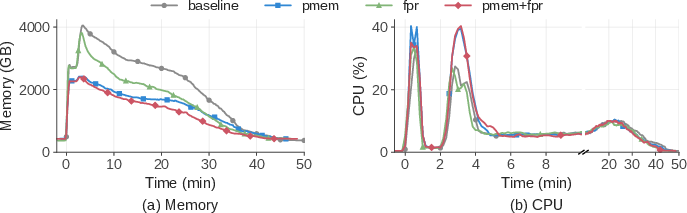
- The evaluation is incomplete in the provided text: quantitative results for several claimed mechanisms—such as memory sharing, reclamation, CPU scheduling, state preservation, and agent-misbehavior mitigation—are not reported in sufficient detail to assess their independent contributions.
- The effects of composable environment layers on sandbox startup latency, CPU consumption, metadata overhead, layer-conflict frequency, and runtime performance are not systematically quantified.
- The paper does not evaluate how overlay-layer ordering handles conflicting files, incompatible dependencies, package-manager state, symbolic links, filesystem metadata, or services that expect a mutable installation tree.
- The long-term maintenance cost of independently versioned layers remains unclear, including garbage collection, provenance tracking, rollback, reproducibility, and compatibility testing across large numbers of layer combinations.
- The reported image-distribution results do not include a detailed breakdown of tail latency, cache-miss behavior, 3FS contention, network bandwidth consumption, or failure recovery during simultaneous startup bursts.
- On-demand image loading is evaluated primarily through aggregate disk-write reduction and completion-time changes; its impact on the latency of the first command, page-fault stalls, repeated file access, and interactive agent performance is unresolved.
- The paper does not establish whether the observed low image-access ratios remain valid for full VM, GUI, Android, browser, security, and long-running software-engineering workloads.
- The production measurements focus mainly on containers and microVMs, leaving the scalability, performance, and failure characteristics of FnCall and full-VM backends insufficiently evaluated.
- The relationship between sandbox density and quality-of-service degradation is not characterized with controlled experiments across different densities, workload mixes, CPU topologies, memory pressures, and overcommit ratios.
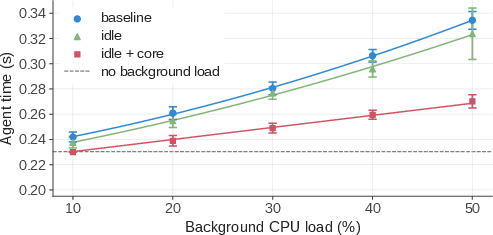
- The proposed CPU scheduling approach does not quantify interference experienced by latency-sensitive tasks, particularly under simultaneous multithreading, noisy neighbors, bursty compilation, or adversarial CPU consumption.
- The paper does not specify the admission-control thresholds, reclaim policies, or formal safety guarantees used when memory demand exceeds available capacity.
- The effectiveness and overhead of memory sharing across containers and microVMs are not separated from other sources of memory savings, such as page reclamation, deduplication, guest ballooning, or image caching.
- The consequences of memory reclamation for sandbox correctness are not examined, including performance after reclaim, guest instability, service timeouts, loss of filesystem cache, and recovery from out-of-memory conditions.
- The paper reports demonstrated node densities but does not identify the maximum sustainable density, the dominant bottleneck at saturation, or how density changes with sandbox lifetime and workload type.
- The placement engine relies on periodically refreshed cluster state, but the paper does not quantify stale-state effects, placement oscillations, hotspot formation, or burst-time rejection rates.
- The resilience of the control plane is not evaluated under simultaneous failures of the API server, watcher, placement engine, edge process, 3FS, or network paths.
- The paper does not describe the consistency guarantees for sandbox state, snapshots, workspace writes, and lifecycle operations when commands, preemption, reclamation, or failure occur concurrently.
- Efficient migration or restoration of a live sandbox to another node is not addressed, despite the requirement to preserve state across GPU-training preemption and infrastructure failures.
- The paper does not measure the time, storage overhead, and correctness of restoring interrupted rollouts, nor does it specify how in-flight commands, external connections, processes, and partial writes are handled.
- The treatment of network isolation is underspecified: the paper does not report whether eBPF policies prevent DNS tunneling, IPv6 bypasses, covert channels, lateral movement, malicious traffic, or access to cloud and host metadata services.
- The security boundary of running containers and FnCall workloads inside QEMU/libvirt VMs is not formally analyzed or compared with microVM and full-VM isolation.
- The paper does not provide a threat model or security evaluation for kernel escapes, hypervisor vulnerabilities, malicious images, compromised toolkits, supply-chain attacks, or cross-sandbox data leakage.
- The hierarchical project and quota model is described functionally, but its behavior under recursive delegation, quota exhaustion, denial-of-service attempts, revocation, and concurrent policy changes is not evaluated.
- Agent misbehavior is discussed mainly in terms of resource exhaustion and reward hacking, but the paper does not define a taxonomy, detection accuracy, false-positive rate, response latency, or measurable reduction in harmful behavior.
- It remains unclear whether access-control mitigations for agent misbehavior affect task solvability, reward quality, exploration, or the validity of RL trajectories.
- The paper does not test whether agents can intentionally exploit sandbox lifecycle mechanisms, snapshots, cached layers, network rules, or cleanup failures to obtain unintended capabilities or rewards.
- The claimed cloud-bursting strategy is evaluated only for a particular 30 TB image subset and one deployment configuration; its cost, latency, availability, and performance under changing image popularity are not established.
- The 70% image-coverage and 30% peak-overflow figures do not show how cloud eligibility changes across seasons, new task distributions, toolkit updates, or worst-case bursts.
- The paper does not compare cloud bursting with alternatives such as dynamic image replication, local cache expansion, workload deferral, or dedicated overprovisioning.
- The operational and financial trade-offs of using 3FS and cloud-hosted distributed storage for image serving are not reported, including bandwidth cost, cross-site synchronization time, durability, and recovery objectives.
- The reported production scale lacks workload-normalized resource-efficiency metrics, such as cost per sandbox-minute, CPU-hours per successful task, memory-hours, energy consumption, and storage amplification.
- The paper does not provide confidence intervals, repeated-trial variance, or statistical significance for its measurements, making it difficult to distinguish robust effects from workload-specific observations.
- The workload traces are drawn from early 2026 production samples, but the paper does not establish whether they generalize to other organizations, model families, task distributions, geographic deployments, or non-DeepSeek harnesses.
- The evaluation does not examine heterogeneous accelerator configurations, despite supporting GPU-enabled FnCall and workloads whose performance may depend on GPU type, partitioning, or virtualization mode.
- The interaction between DSec scheduling and asynchronous RL is not quantified, including rollout throughput, policy staleness, straggler reduction, sample efficiency, and training convergence.
- It is unresolved whether infrastructure optimizations change the distribution of trajectories or rewards in ways that affect RL results, making comparisons between DSec-enabled and conventional training potentially confounded.
- The paper does not evaluate task-level success rate, agent capability, or training quality as the ultimate outcomes of the platform; most evidence concerns infrastructure metrics rather than end-to-end research productivity.
- The lifecycle and cleanup behavior of FnCall is described as best-effort, but residual files, processes, memory, GPU state, and security-sensitive artifacts after failed cleanup are not quantified.
- Full VM support for graphics, Android, and commercial operating systems is presented descriptively, without measurements of boot latency, graphics performance, device compatibility, snapshot overhead, or isolation under realistic computer-use workloads.
- The paper does not address reproducibility of environments over time when external package repositories, network services, mutable 3FS contents, or toolkit versions change.
- The effects of restricted network access on package installation, builds, browser tasks, and evaluation validity are not systematically studied.
- The API and proxy path introduces multiple forwarding layers, but the paper does not quantify per-command latency, streaming throughput, connection scalability, or the overhead under tens of thousands of concurrent interactive sessions.
- The system’s behavior under extremely long-lived sandboxes, abandoned sessions, continuously growing writable state, and snapshot accumulation remains unexplored.
- No formal model or guarantee is provided for fairness among users, projects, workload classes, or latency-sensitive versus best-effort jobs during resource contention.
- The paper does not investigate energy-aware scheduling or the environmental cost of maintaining hundreds of thousands of mostly idle but stateful sandboxes.
- The generality of DSec’s unified SDK is limited because callers must select the backend themselves; the paper does not study automatic backend selection or provide policies for choosing the lowest-cost backend that preserves task correctness and isolation.
Practical Applications
Immediate Applications
- Scalable infrastructure for LLM agent training and evaluation — AI infrastructure / cloud computing. Organizations can deploy a DSec-like platform as a unified execution layer for reinforcement learning, benchmark evaluation, and agentic workflows. The SDK can provision function-call environments, containers, microVMs, or full VMs according to workload requirements, allowing agents to inspect repositories, execute code, invoke tools, and interact with browsers or operating systems in isolated sessions. Potential product or workflow: an internal “agent execution service” integrated with RL trainers, evaluation harnesses, coding benchmarks, and model-monitoring systems. Dependencies: reliable container and VM orchestration, sufficient cluster capacity, strong identity and access management, and compatibility between the SDK and existing training frameworks.
- Automated software-engineering evaluation and coding-agent testing — software development / education. Container sandboxes can execute repository-level tasks, install dependencies, run tests, and preserve changes across multiple model interactions. This supports automated assessment of coding agents on tasks such as bug fixing, code generation, repository maintenance, and continuous-integration repair. Potential workflow: create a sandbox from a base language image, attach a repository workspace and toolkit layer, allow the agent to modify files, and compute rewards from exit codes, test results, or task-specific verifiers. Dependencies: deterministic repositories and dependency versions, secure handling of untrusted code, reproducible test environments, and carefully designed reward functions.
- High-throughput execution of short programming and GPU tasks — serverless computing / developer tools. The FnCall backend can support short, stateless workloads such as code compilation, online-judge problems, utility scripts, serverless functions, and lightweight GPU kernels. Reusing pre-created environments avoids the provisioning cost of creating a new container for every invocation. Potential product: a secure “function execution” API for coding platforms, automated graders, batch data processing, or model-generated utility programs. Dependencies: tasks must be sufficiently short and stateless; persistent state, complex OS requirements, or strong isolation may require containers or microVMs instead.
- Secure execution of untrusted code — cybersecurity / software supply-chain security. MicroVMs and VM-backed containers can isolate generated code, security-testing tools, package-installation processes, and potentially malicious workloads more strongly than ordinary containers. Fine-grained network rules can restrict access to package repositories or external services. Potential workflow: run malware-analysis experiments, vulnerability reproductions, dependency tests, or agent-generated shell commands in a microVM with a restricted network policy and an automatic time-to-live. Dependencies: the isolation boundary must be independently audited; network policy, kernel configuration, image provenance, and escape prevention are critical. The paper’s mechanisms reduce risk but do not eliminate the need for security review.
- Interactive computer-use and browser-agent evaluation — automation / human-computer interaction. Full VMs with GUI and graphics support can host browsers, desktop applications, games, Android environments, and other systems that cannot run correctly in a lightweight container. This enables reproducible evaluation of agents that operate graphical interfaces rather than only APIs or shells. Potential product: a browser-agent testing service that records screenshots, interaction traces, filesystem state, and task success. Dependencies: GPU virtualization or compatible graphics translation layers, deterministic GUI state, sufficient VM resources, and safeguards against external network side effects.
- Composable environment management for research and production — DevOps / MLOps. Separating base operating-system images, workspaces, and toolkits allows each component to be versioned and updated independently. Research groups can update an agent harness without rebuilding every repository image, while platform operators can reuse common base layers across many tasks. Potential tool: a layered environment registry with versioned base images, task workspaces, toolkits, and reproducible composition manifests. Dependencies: conflict-resolution rules, immutable layer management, provenance metadata, compatibility testing, and support for writable runtime state.
- Reduced startup and storage overhead through on-demand image loading — cloud storage / container platforms. EROFS, OverlayBD, and shared distributed storage can load image data only when it is accessed rather than pulling and materializing complete images at startup. This is particularly useful when images are large, have low reuse, and expose only a small fraction of their data during execution. The paper reports that on-demand loading reduced cumulative disk writes by 57%, while eager image pulling increased completion time by approximately 1.7 times in the reported ablation. Dependencies: low-latency distributed storage, adequate metadata locality, predictable network performance, and mechanisms to prevent a burst of page faults from degrading active workloads.
- Higher-density hosting of idle or intermittently active sandboxes — data-center operations. Since approximately 90% of sampled sandboxes used no more than 5% of their requested CPU capacity on average, operators can safely overcommit CPU for workloads that alternate between short execution bursts and periods of model-generation delay. CPU scheduling can prioritize latency-sensitive tasks over best-effort rollouts. Potential product: a workload-aware sandbox scheduler that classifies sessions as latency-sensitive or best-effort and dynamically adjusts CPU allocation. Dependencies: accurate usage monitoring, admission control, memory reclamation, protection against noisy neighbors, and workload-specific service-level objectives.
- Elastic capacity for bursty research workloads — academic and industrial research computing. RL rollouts and evaluations may request tens of thousands of sandboxes in a short period. A DSec-style placement engine, node-local admission control, and stateless watcher services can absorb bursts without requiring every component to maintain centralized durable state. Potential workflow: automatically provision thousands of environments for a benchmark run, retain their state during asynchronous training, and reclaim them after time-to-live expiration or task completion. Dependencies: horizontally scalable control-plane services, accurate health information, quota enforcement, and sufficient distributed storage bandwidth.
- Cloud bursting for intermittent demand peaks — hybrid cloud operations. Organizations can keep steady-state workloads on on-premise infrastructure while offloading eligible sandbox requests to cloud VMs when utilization exceeds a threshold. Synchronizing a deduplicated set of frequently accessed image data to cloud storage can reduce image-transfer costs and improve overflow responsiveness. Dependencies: cloud/on-premise network connectivity, compatible runtime and image formats, data-governance approval, cloud cost controls, and a sufficiently large share of workloads whose image dependencies are available in the cloud cache.
- Controlled agent permissions and delegated project management — enterprise governance / policy. Hierarchical projects, quotas, and bounded delegation can allow teams or agents to create subprojects and manage their own sandbox resources without exceeding organizational limits. The same authorization model can govern humans, training harnesses, and autonomous agents. Potential workflow: assign each experiment, customer, or agent a project with limits on CPU, memory, concurrency, network access, and sandbox lifetime. Dependencies: correct identity binding, auditable policy enforcement, prevention of privilege escalation, and organizational policies for data access and external communication.
- Reproducible academic experimentation — research methodology. Researchers can use immutable environment layers, persistent sandbox state, recorded command traces, and task-specific verifiers to make agent experiments more reproducible. This is applicable to reinforcement learning, coding benchmarks, computer-use evaluation, security research, and systems research. Dependencies: versioned datasets and repositories, deterministic dependency resolution, preservation of random seeds and model versions, and publication of sufficient environment metadata.
Long-Term Applications
- General-purpose operating infrastructure for autonomous software agents — enterprise automation. A mature DSec-like service could become the execution substrate for agents that independently plan, install software, modify files, call APIs, run tests, and coordinate with other agents. Agents could receive temporary projects with bounded quotas, create sub-environments, and preserve state across long-running workflows. Potential products: autonomous software-maintenance services, repository migration agents, automated data-engineering pipelines, and multi-agent development environments. Dependencies: robust long-horizon state management, stronger agent authentication, reliable recovery after partial failure, policy-compliant tool use, and defenses against reward hacking or goal misgeneralization.
- Large-scale multi-agent simulation — robotics, economics, and social science. The ability to host hundreds of thousands of isolated, stateful environments could support simulations in which agents interact with software systems, virtual worlds, markets, or institutional rules. Full VMs could provide heterogeneous operating environments, while containers and microVMs could host large populations of lightweight agents. Dependencies: scalable simulation semantics, controlled interaction between sandboxes, economically feasible compute and storage, validated behavioral models, and methods for interpreting simulation results.
- Robotics and embodied-agent training in virtual environments — robotics / autonomous systems. Full-system sandboxes with graphics, Android support, or virtualized sensors could provide repeatable environments for training agents that operate robots, mobile devices, games, or simulated physical systems. The same lifecycle and state-preservation mechanisms could connect policy training with interactive simulation. Potential workflow: run many parallel simulations, collect trajectories and verifier signals, update the policy asynchronously, and resume environments after training preemption. Dependencies: high-fidelity simulators, GPU scheduling, realistic sensor and actuator models, sim-to-real transfer, and sufficiently low-latency interaction.
- Autonomous cybersecurity testing and red-team experimentation — cybersecurity. Strongly isolated, network-controlled microVMs could host agents that discover vulnerabilities, reproduce exploits, test patches, and analyze malware across large collections of operating-system images. Layered environments would allow rapid combination of vulnerable applications, security tools, and target repositories. Dependencies: strict containment, legally authorized target environments, safe handling of exploit artifacts, detailed audit logging, and safeguards against accidental external attacks.
- Adaptive resource allocation for agentic workloads — systems research / cloud scheduling. Future schedulers could use model behavior, rollout phase, memory pressure, predicted tool calls, and task latency requirements to allocate CPU, memory, storage bandwidth, and GPUs dynamically. This could extend the paper’s static overcommit and reclamation mechanisms into predictive, feedback-controlled scheduling. Potential product: a reinforcement-learning-aware scheduler that pauses, migrates, checkpoints, or expands sandboxes based on expected future interaction. Dependencies: accurate prediction models, migration or checkpoint support, bounded control-loop latency, fairness guarantees, and protection against agents manipulating resource signals.
- Checkpointable and migratable long-lived agent sessions — distributed systems / productivity software. If sandbox memory, filesystem state, and network-visible session state can be checkpointed consistently, an agent could continue operating after node failure, training preemption, or migration between on-premise and cloud resources. This would support multi-hour or multi-day agents rather than short-lived evaluation tasks. Dependencies: consistent snapshots of processes and services, external-session reconciliation, durable storage, handling of open network connections, and secure restoration of credentials.
- Federated or privacy-preserving agent execution — healthcare, finance, and government. Organizations could run agents against sensitive local repositories or datasets while exposing only controlled tool interfaces and verifier outputs. Fine-grained network policies and isolated execution could support local processing of medical, financial, legal, or public-sector data. Dependencies: regulatory compliance, encryption, data-residency guarantees, formal access-control verification, privacy-preserving logging, and domain-specific validation of agent outputs. Sandboxing alone is insufficient for privacy protection.
- Energy-aware scheduling of large-scale agent training — energy and sustainability. High-density execution, on-demand image loading, and elastic cloud bursting could eventually be combined with carbon-aware or electricity-price-aware scheduling. Rollouts and evaluations could be shifted across time or locations when latency requirements permit. Dependencies: reliable energy and carbon-intensity signals, acceptable training delays, geographically distributed storage and compute, and accounting that includes data-transfer and image-replication costs.
- Standardized benchmark infrastructure for agent capabilities and safety — academia / policy. A common sandbox API and backend taxonomy could support reproducible benchmarks across coding, security, browser use, operating-system interaction, and tool use. Standardized resource limits, network policies, environment manifests, and verifier interfaces would make results more comparable across laboratories. Dependencies: community-agreed benchmark specifications, transparent reporting of infrastructure effects, prevention of benchmark contamination, and independent audits of task validity and safety.
- Policy and auditing frameworks for autonomous compute delegation — regulation / governance. The project’s hierarchical quotas, identity model, lifecycle controls, and misbehavior analysis could inform policies for autonomous systems that are permitted to create and manage computational resources. Future governance tools might require approval workflows for network access, resource escalation, or creation of sub-agents. Dependencies: formal definitions of agent authority, interoperable audit standards, explainable event logs, incident-response procedures, and legal clarity regarding responsibility for agent actions.
Glossary
- Ablation: An experiment that removes or changes one component to measure its effect on system performance. “In our ablation, eager image pulling stretches completion time by 1.7, while on-demand loading reduces cumulative disk writes by 57\%.”
- Agentic workflow: A task process in which an AI model autonomously interacts with tools and an execution environment. “Recent advances in frontier LLMs have made agentic workflows practical and widely adopted”
- API server: A service that receives, routes, and manages requests through an application programming interface. “The {apiserver} serves as the ingress proxy for the sandbox cluster.”
- Bare metal: A physical host machine running workloads without an additional virtualization layer directly beneath them. “The VM provides an isolated kernel and network stack and serves as an additional security boundary between untrusted containers and the bare metal.”
- Bind mount: A filesystem mechanism that makes an existing directory available at another path, replacing the target path’s contents. “A bind mount replaces the target path entirely, whereas these components require append semantics”
- COTS operating system: A commercially available operating system distributed as an off-the-shelf product. “Full VM backends cover workloads that require a complete commercial off-the-shelf operating system environment”
- Composable environment layer: An independently managed filesystem or software component that can be combined with other layers to form an execution environment. “Our insight is that the base OS environment, each workspace, and each toolkit are logically {independent layers} with their own lifecycles”
- Concurrent sandbox: A sandbox that is active at the same time as other sandbox instances. “In production, it supports over 380,000 concurrent sandboxes”
- Container runtime: Software responsible for creating, starting, and managing operating-system-level containers. “We modify the container runtime (i.e., dockerd) to dynamically compose the overlayfs stack”
- CPU overcommit: Allocating more virtual or requested CPU capacity than is physically available, relying on workloads not using all capacity simultaneously. “The platform must improve CPU utilization through overcommit without interfering with latency-sensitive tasks.”
- Cross-platform proxy: A mediation component designed to operate across multiple operating systems or execution backends. “Container and VM sandboxes run {aether}, a cross-platform proxy that establishes a communication channel with the {edge}.”
- Distributed filesystem: A filesystem that stores and serves data across multiple networked machines. “3FS~\citep{hf3fs_repo} distributed file system deployment for base images and workspace storage.”
- Durable state: State that survives process or service restarts and can be recovered afterward. “Please note that neither the {placement engine} nor the {watcher} requires durable state.”
- eBPF: A kernel technology that runs verified, programmable code at specified operating-system hook points, commonly for networking and observability. “During creation, the {edge} provisions storage, applies the eBPF-based network policy, and launches the runtime.”
- Elastic scaling: The ability of a system to increase or decrease resources in response to changing demand. “DSec provides elastic service scaling, high-density resource management, memory sharing and reclamation”
- EROFS: A read-only filesystem format optimized for efficient storage and access, especially for container images. “Container images are converted offline from OCI into EROFS”
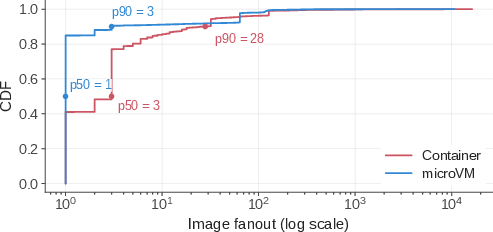
- Fanout: The number of consumers, instances, or tasks that use a particular artifact or image. “As~\autoref{fig:fanout_cdf} shows, container images have a median fanout of three and a p90 fanout of 28”
- Firecracker microVM: A lightweight virtual machine designed to provide stronger isolation with lower overhead than a conventional VM. “Firecracker microVMs~\citep{firecracker} provide a stronger isolation boundary while retaining Linux compatibility.”
- FnCall: DSec’s backend for executing short, stateless functions in reusable containers. “FnCall targets short, stateless tasks such as OJ workloads, code compilation, serverless programs, GPU kernels, and utility code.”
- Guest page cache: Memory inside a virtual machine used to cache filesystem pages accessed by the guest operating system. “memory footprint, guest page cache, host page cache, and writable state may remain pinned long after the CPU becomes idle.”
- Horizontal scalability: The ability to handle increased demand by adding more service instances or machines. “Such bursts make horizontal scalability a system-wide requirement”
- Image corpus: A collection of software or virtual-machine images used to construct execution environments. “These workloads create sandboxes in large bursts, span heterogeneous functionality and isolation requirements, retain state across long interactions, and draw from large image corpora with limited reuse.”
- Image distribution: The process of storing, transferring, and making execution images available to compute nodes. “shared services, such as scheduling and image distribution, to avoid centralized bottlenecks.”
- Ingress proxy: A front-facing service that receives external requests and forwards them to internal components. “The {apiserver} serves as the ingress proxy for the sandbox cluster.”
- Isolation boundary: A technical separation that prevents one workload from directly interfering with another. “They are useful for security-sensitive tasks, stronger tenant isolation, and workloads that need a VM boundary with Linux compatibility.”
- Latency-sensitive task: A workload whose correctness or performance depends on meeting strict response-time limits. “For CPU, some tasks impose strict per-step latency budgets, such as game-playing agents with a fixed time limit per move.”
- Lifecycle management: The coordinated creation, operation, suspension, recovery, and termination of a resource or service. “DSec coordinates placement and lifecycle management across the cluster”
- MicroVM: A minimal virtual machine that provides hardware-level isolation with relatively low resource overhead. “In production, this allows a single node to host up to 800 microVMs”
- On-demand image loading: Loading image data only when it is needed during execution rather than transferring the complete image at startup. “Together, these image formats support on-demand loading and incremental snapshots over a shared base”
- OverlayBD: A storage format or system that supports layered virtual block-device images and incremental access. “MicroVM disk images use an OverlayBD~\citep{dadi} format over the same storage.”
- OverlayFS: A union filesystem that presents multiple directory layers as one combined directory tree. “Overlayfs natively provides the merge semantics we need”
- Overcommit: The practice of allocating more resources than are physically available based on expected underutilization. “During agent interaction, a sandbox often waits for the LLM to generate the next action, so CPU usage is sparse and naturally suitable for overcommit.”
- Para-virtualized GPU: A virtual GPU interface designed to let a guest operating system use host GPU-related functionality with reduced virtualization overhead. “we leverage para-virtualized GPU interfaces of the host hypervisor (e.g., virtio-gpu).”
- Placement engine: A scheduler component that chooses an appropriate host machine for a new workload. “The {placement engine} selects a host node for each new sandbox.”
- Preemption: The interruption of a running workload so that its resources can be reassigned to another workload. “GPU training jobs may be preempted while long-running rollouts are still in progress.”
- Reclamation: The recovery of resources from idle, expired, or terminated workloads. “memory sharing and reclamation become important platform requirements.”
- Reinforcement learning rollout: An execution phase in which a model interacts with an environment to produce a trajectory used for learning. “First, during rollout, the current model interacts with the sandboxed environment”
- Reward hacking: Exploiting weaknesses in a reward mechanism to obtain high scores without accomplishing the intended task. “and mitigates agent misbehavior such as reward hacking.”
- Scheduler preemption: The scheduler-initiated interruption of a workload to make resources available for another workload. “it may interrupt and resume their associated rollouts across policy updates or scheduler preemptions”
- Stateful execution environment: An isolated environment whose files, processes, and other changes persist across interactions. “Large-scale agentic training and evaluation with LLMs rely on isolated, stateful execution environments”
- Straggler: A task or instance that completes substantially later than other tasks in the same batch. “while stragglers in any stage delay useful model interaction.”
- Tenant isolation: Preventing one user, workload, or organizational tenant from accessing or affecting another’s resources. “They are useful for security-sensitive tasks, stronger tenant isolation”
- Time-to-live (TTL): A duration after which a resource or session expires automatically. “Finally, the sandbox is stopped explicitly or reclaimed once its time-to-live elapses”
- Trajectory: The ordered sequence of observations, actions, and outcomes generated during an agent’s interaction with an environment. “it reads files, issues tool calls, executes commands, observes outputs, and produces a trajectory for each task.”
- Virtual block device: A software-provided block-storage interface that appears to a guest system as a disk device. “image data read through a virtual block device can be cached once by the host and again by each guest”
- Virtual machine snapshot: A saved representation of a virtual machine’s state that can be used to restore or instantiate it later. “For full VM workloads, it is a prepared VM image or snapshot.”
- vsock: A socket communication mechanism designed for communication between a virtual machine and its host. “such as a Unix domain socket for Linux containers or vsock for VM backends.”
- Writable upper directory: The top writable layer in a layered filesystem where runtime modifications are stored. “A writable upper directory sits atop the stack, transparently absorbing any runtime writes without modifying the read-only layers underneath.”
- Workload heterogeneity: Variation among workloads in their resource demands, dependencies, functionality, or isolation requirements. “Agent workloads are highly heterogeneous.”

