Scaling Discovery through Test-Time Communication
Abstract: Science advances not in isolation but through collaboration, yet existing agentic systems capture little of this. Whether communicating agents help remains an open question with mixed prior results. We show that test-time communication can substantially outperform independent parallel attempts on challenging tasks, where sharing a breakthrough can push the whole group forward. We first study the effect of scaling multi-agent test-time communication, where agents have no predefined roles and communicate via a shared directory, on ARC-AGI-3, a benchmark requiring novel problem solving. We find that a team of communicating agents, team@, matches the success rate of $4k$ independent agents, and this advantage grows with , suggesting gains compound with scale. The effect is not merely efficiency: a task that no single agent can solve, a team of agents can solve reliably. Furthermore, these gains transfer to research-oriented tasks, given sufficient compute. On polyomino packing, communicating agents outperform best@ and exceed the prior best-known score. On MNIST classifier compression, communication surpasses the best-known human solution. A team of four agents produced a 1,957-byte classifier submission achieving 99.4% test accuracy, smaller than both the best-known human solution and the best single-agent result. These gains are not unconditional. Independent agents may outperform communication when compute is limited or when a clear measure of progress is absent. However, under sufficient compute and clear feedback, multi-agent communication consistently yields stronger results.
Paper Prompts
Sign up for free to create and run prompts on this paper.
Top Community Prompts
Explain it Like I'm 14
论文主要讲什么?
这篇论文研究的是:如果几个人工智能“智能体”互相交流、分享发现,它们能不能比各自单独工作时做得更好?
这里的“智能体”可以理解为几个独立工作的 AI 助手。它们能够:
- 使用电脑和工具;
- 写代码、运行实验;
- 记录自己的想法和结果;
- 看到其他 AI 分享的成功经验和失败教训;
- 在别人的发现基础上继续改进。
论文的核心观点是:在困难、开放式的问题上,交流的 AI 团队可以像科学家团队一样,通过不断接力和改进,解决单个 AI 很难解决的问题。
研究想回答什么问题?
作者主要想知道以下几件事:
- 交流的 AI 团队是否比同样数量、但互不交流的 AI 更强?
- 一个 AI 找到的好方法,能否帮助其他 AI 更快地找到更好的方法?
- 团队交流的优势是否只是因为“尝试次数更多”,还是因为交流本身真的有帮助?
- 在什么情况下交流最有效?
- 如果时间或计算资源很少,交流是否仍然值得?
论文把两种方法进行了比较:
- 独立 AI:几个 AI 分别解决同一个问题,互相看不到工作结果。最后选择其中最好的答案。
- 交流团队:几个 AI 同时工作,并通过一个共享文件夹和记录本分享想法、实验结果和失败原因。
作者把第二种方法称为 team@k,表示有 k 个互相交流的 AI;把第一种方法称为 best@k,表示从 k 个独立尝试中选出最好的一个。
研究是怎样进行的?
研究人员使用了几种不同类型的任务,测试 AI 团队的能力。
1. ARC-AGI-3 游戏任务
这是一个需要解决陌生网格游戏的测试。
AI 一开始不知道游戏规则,必须通过不断尝试来推测:
- 哪些操作有用;
- 游戏的目标是什么;
- 不同动作会带来什么结果;
- 怎样通过一个关卡进入下一个关卡。
这有点像让几个学生一起玩一个完全陌生的游戏,并让他们互相告诉对方自己的发现。
研究人员使用了 Claude Sonnet 4.6,并测试了 25 个游戏。他们比较了:
- 3 个互相交流的 AI;
- 5 个互相交流的 AI;
- 3 个或 5 个互不交流的 AI。
每个 AI 都有自己的工作记录,但交流团队可以访问一个共同的“留言板”,上面写着:
- 新发现;
- 失败的尝试;
- 哪些方法得分更高;
- 如何重复某个实验。
2. 多骨牌拼图任务
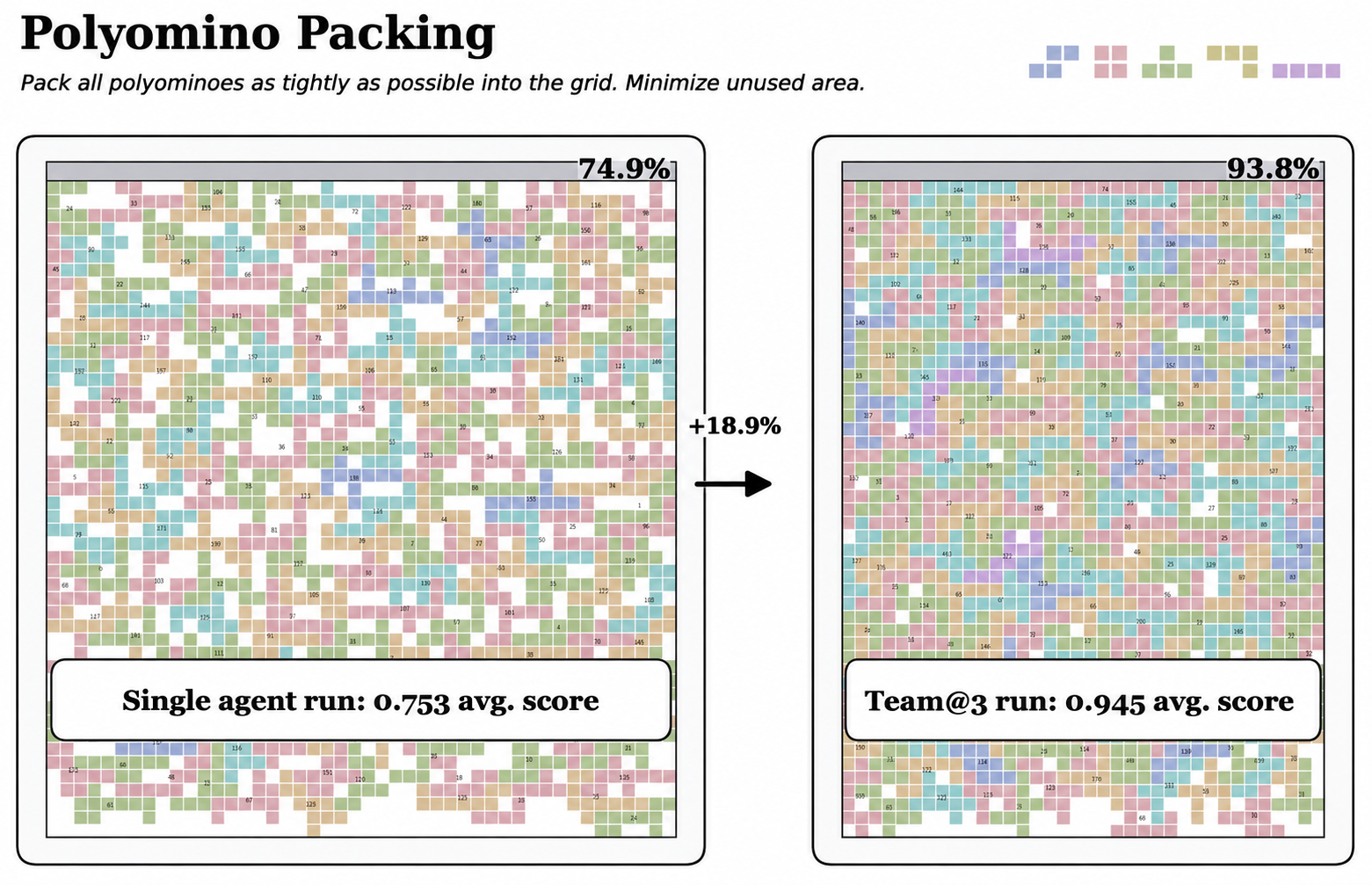
第二项任务是把许多不同形状的拼图块装进尽可能小的矩形中。
这类似于把很多形状不规则的积木塞进一个盒子,同时尽量减少空隙。
这是一个很难的计算问题。AI 需要自己设计更好的摆放策略,例如:
- 把拼图靠近底部放置;
- 让拼图之间接触更多;
- 尝试不同的方向;
- 尽量填满角落和空隙。
研究人员比较了单个 AI 和交流团队在 3 小时到 72 小时内的表现。
3. MNIST 手写数字分类器压缩
MNIST 是一个包含手写数字图片的数据集。AI 要设计一个程序,让电脑能够识别数字 0 到 9。
但任务还有一个限制:程序必须保持至少 99.4% 的准确率,同时文件要尽可能小。
这就像要求学生制作一个非常小的“数字识别器”,它既要答题准确,又不能占用太多空间。
研究人员让 4 个 AI 交流工作 96 小时,并把结果与独立工作的 AI 以及之前人类做出的最好结果比较。
研究中的一个重要概念:可验证的进步
论文反复强调,交流是否有用,取决于 AI 能不能判断某个新想法确实更好。
例如:
- 游戏是否成功;
- 拼图得分是否提高;
- 分类器是否仍达到 99.4% 的准确率。
这种可以用分数或测试结果检查的进步,被作者称为“可验证的进步分享”。
可以把它想象成一个学习小组:如果大家能马上知道哪种解题方法得分更高,就容易共同进步;如果没人知道哪个答案更好,大家可能反而会互相误导。
主要研究结果
交流团队解决了更多困难游戏
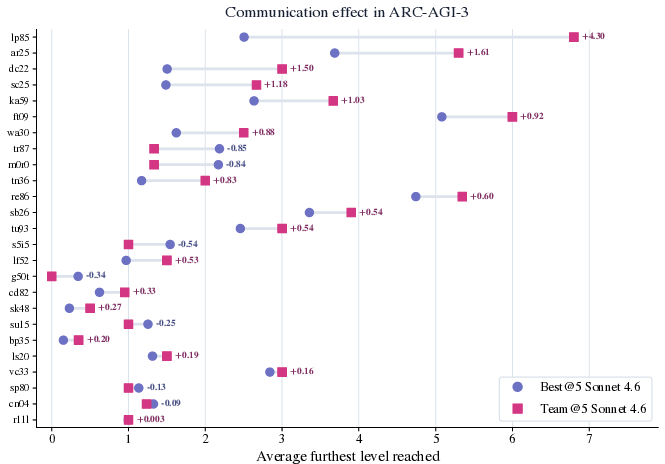
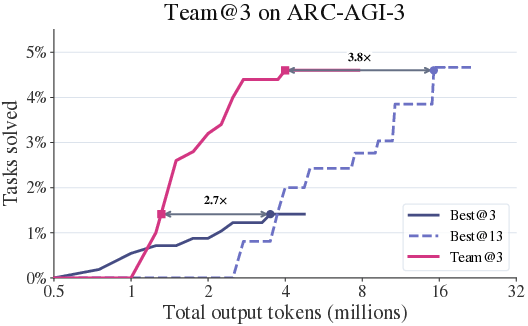
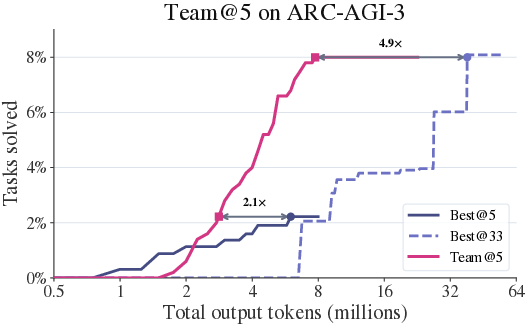
在 ARC-AGI-3 测试中,交流团队明显优于同样数量的独立 AI。
例如:
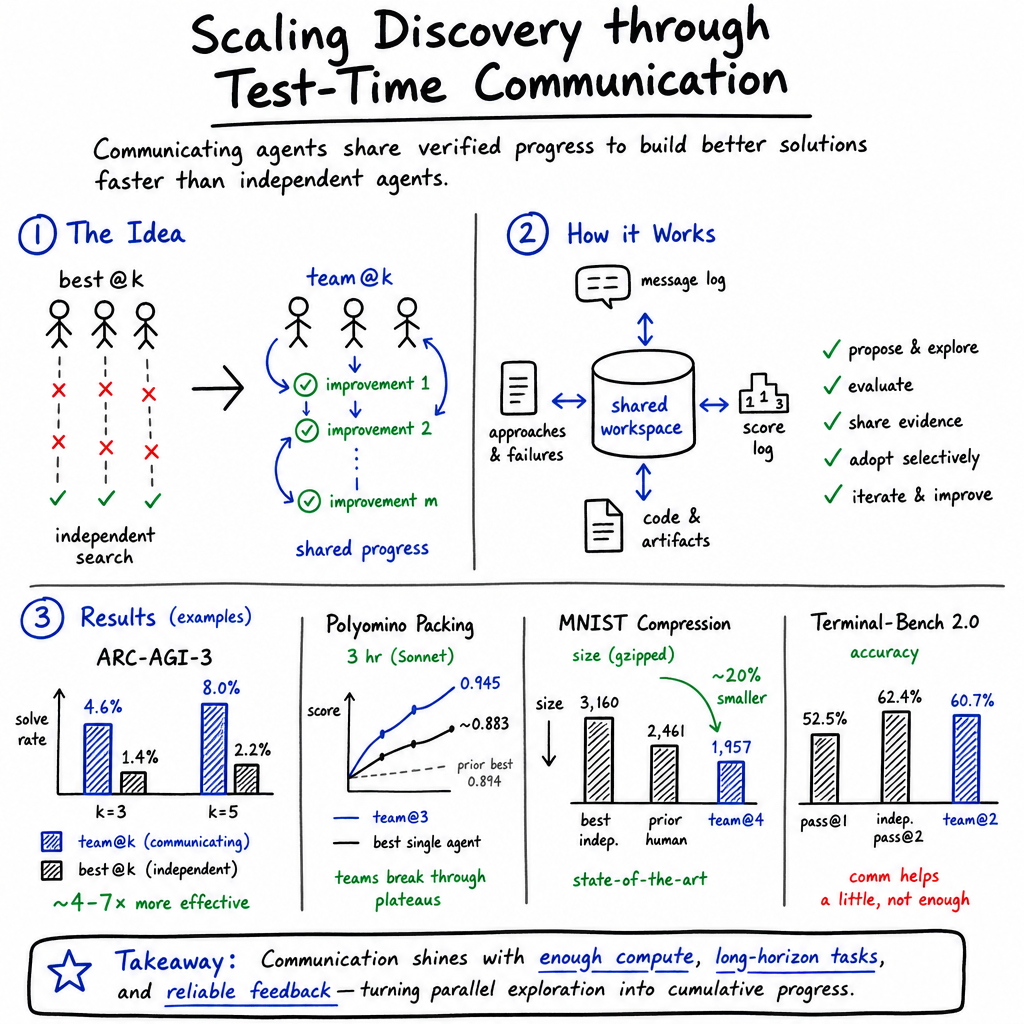
- 3 个交流 AI 的效果大约相当于 13 个独立 AI;
- 5 个交流 AI 的效果大约相当于 33 个独立 AI。
这说明交流不仅仅是“多试几次”,而是能让每个 AI 利用其他成员的发现。
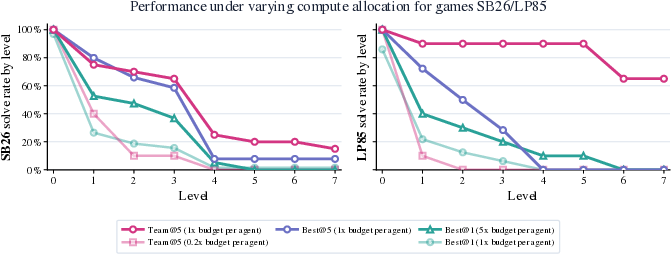
一个特别明显的例子是游戏 LP85:
- 64 次单独尝试都没有成功;
- 5 个交流 AI 组成的团队成功率达到了 65%。
另一个游戏 FT09 中:
- 独立 AI 的成功率约为 26%;
- 3 个交流 AI 的成功率提高到 90%。
团队成员可能分别发现不同线索,然后把这些线索组合起来,最终解决单个 AI 无法解决的问题。
交流让 AI 突破了多骨牌拼图的“瓶颈”
在多骨牌拼图任务中,独立工作的 AI 往往很快找到一个还不错的方法,但之后很难继续进步。
交流团队则可以像接力赛一样工作:
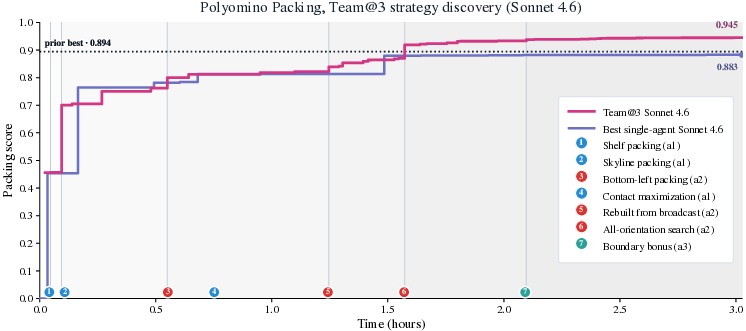
- 一个 AI 提出“让拼图尽量互相接触”的想法;
- 另一个 AI 把这个想法重新实现得更快;
- 它又尝试所有可能的拼图方向;
- 第三个 AI 加入“贴近盒子边缘和角落”的规则;
- 团队继续改进,得到更紧密的排列。
在 3 小时测试中:
- 最好的独立 AI 得分约为 0.883;
- 交流团队得分达到 0.945;
- 之前人类已知的最好得分是 0.894。
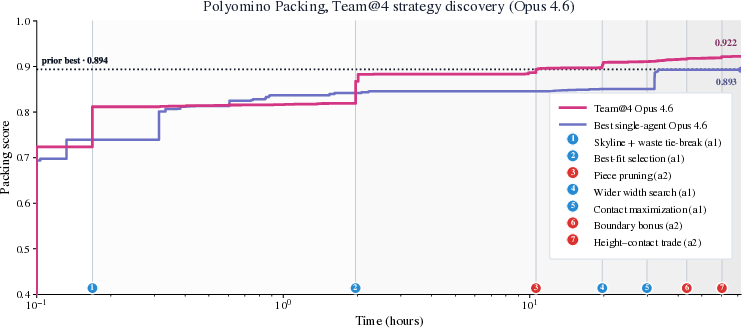
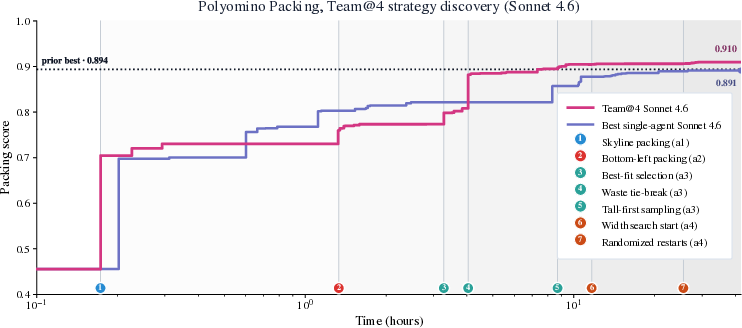
在更长的测试中,交流团队也超过了独立 AI:
- Opus 交流团队:0.922,独立 AI:0.893;
- Sonnet 交流团队:0.910,独立 AI:0.891。
得分越高,说明拼图排列得越紧密、留下的空白越少。
交流团队压缩出了更小的手写数字分类器
在 MNIST 任务中:
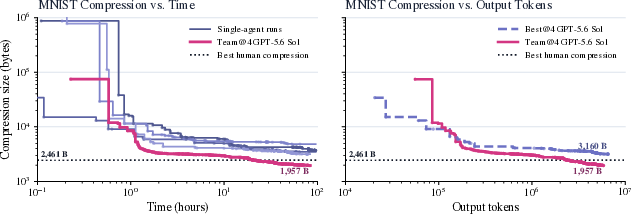
- 之前人类最好的结果大小是 2,461 字节;
- 最好的独立 AI 结果大小是 3,160 字节;
- 交流团队做出了只有 1,957 字节的分类器;
- 它仍然达到了 99.4% 的测试准确率。
也就是说,团队做出的程序比之前人类的最好结果还小大约 20%,同时准确率仍然符合要求。
团队能够做到这一点,是因为不同 AI 分别尝试了不同想法,然后把成功的部分组合起来。例如:
- 一个 AI 找到了可以重复使用的神经网络结构;
- 另一个 AI 改进了分类器的最后一层;
- 其他 AI 研究怎样用更少的参数保留重要信息;
- 最后团队将这些改进结合起来。
交流并不总是有效
论文并没有说“交流永远更好”。交流也有缺点。
交流需要一开始的协调时间
团队成员一开始要花时间:
- 介绍自己的思路;
- 阅读别人的记录;
- 判断哪些方法值得采用;
- 避免几个人重复做完全相同的事情。
所以在计算资源很少时,独立 AI 可能暂时表现更好。
这就像几个人一起做作业:刚开始需要讨论分工,可能比一个人直接开始做更慢。但如果时间足够长,团队通常能通过合作做出更好的结果。
每个 AI 必须有足够的工作时间
如果把很少的计算资源分给太多 AI,每个 AI 都没有足够时间认真探索,团队反而会变差。
研究发现:
- 资源充足时,交流团队明显更强;
- 资源紧张时,独立 AI 有时更好;
- 团队规模不能无限扩大,太多成员可能会增加混乱和协调成本。
没有可靠反馈时,交流可能帮助不大
在 Terminal-Bench 2.0 测试中,AI 很难可靠地判断一个中间结果是否比另一个更好。
在这种情况下,交流团队虽然比单个 AI 好一些,但没有超过互不交流的独立 AI。
这说明,如果 AI 不能判断哪些建议正确,交流可能让错误想法传播开来,甚至让大家放弃原本更好的方案。
为什么这些结果重要?
这篇论文的重要发现是:AI 团队的价值不仅仅是把任务分成几部分并行完成。
更重要的是,团队可以进行一种连续的“发现—分享—改进”过程:
- 一个 AI 找到线索;
- 另一个 AI 检查这个线索;
- 第三个 AI 改进它;
- 团队继续在新方法上探索;
- 最终得到单个 AI 很难独自发现的结果。
这和科学研究团队的工作方式很像。科学家通常不会只做完全独立的实验,而是会:
- 分享实验结果;
- 学习别人的失败;
- 改进别人的想法;
- 把多个小发现组合成重大成果。
论文表明,人工智能团队也可能通过类似方式产生“累积式进步”。
研究可能带来的影响
如果这些结果在更多任务中成立,未来的 AI 系统可能不再只是一个 AI 独自完成工作,而是由多个 AI 组成研究团队。
这种系统可能用于:
- 设计更好的算法;
- 编写和改进软件;
- 进行科学实验;
- 发现新的工程方案;
- 优化机器学习模型;
- 解决需要长时间探索的复杂问题。
不过,实际使用时需要注意三个条件:
- 每个 AI 要有足够的时间和计算资源;
- 系统要能准确判断哪些结果更好;
- 交流方式要避免所有 AI 太早相信同一个错误想法。
总的来说,这篇论文说明:当问题很困难、答案可以被测试、而且 AI 有足够时间时,让 AI 互相交流,可能比让它们各自独立尝试更有效。一个 AI 的突破可以成为另一个 AI 的起点,许多小进步最终能够连成一个单个 AI 无法完成的大进步。
Knowledge Gaps
Knowledge gaps, limitations, and open questions
- Limited benchmark diversity: The empirical evidence is concentrated on ARC-AGI-3, one polyomino-packing task, MNIST compression, and a brief Terminal-Bench comparison; it remains unclear whether the findings generalize to broader scientific, software-engineering, mathematical, or real-world research tasks.
- Strong dependence on selected models: Most experiments use a small number of specific model–task pairings—particularly Claude Sonnet 4.6, Claude Opus 4.6, and GPT-5.6 Sol—so the robustness of communication gains across model families, capability levels, training procedures, and open-weight models is unresolved.
- No systematic model-capability analysis: The paper does not establish whether communication benefits are largest for weak, intermediate, or highly capable agents, nor whether they disappear once a base model can solve the task independently.
- Small team-size range: The principal ARC-AGI experiments compare only team sizes of three and five, while the other tasks use three or four agents. The claimed compounding scaling trend has not been tested over a sufficiently broad range of team sizes.
- Uncertain asymptotic scaling: It is unknown whether communication continues to outperform independent sampling at larger team sizes or eventually suffers from congestion, redundant exploration, synchronization costs, or majority-driven errors.
- Limited statistical power for long-horizon tasks: The polyomino experiments use only two team runs in some 72-hour conditions, and the MNIST result relies on a single four-agent team run. The stability and reproducibility of these headline results therefore remain uncertain.
- Insufficient uncertainty reporting: The reported comparisons generally lack confidence intervals, hypothesis tests, or run-level variance estimates, making it difficult to determine whether some observed performance differences are statistically reliable.
- Potential selection bias in trajectory reporting: Several plots show the highest-scoring trajectory among many runs rather than aggregate distributions. This may overstate typical team performance and does not reveal how frequently communication fails.
- Incompletely isolated communication mechanisms: The protocol changes several factors simultaneously—shared artifacts, explicit progress logs, slot ownership, forced approach diversity, evidence requirements, and adoption rules—so the contribution of each component is not identified.
- No full protocol ablation: The paper does not separately evaluate unrestricted communication, restricted communication, synchronous versus asynchronous communication, centralized versus decentralized coordination, or different message formats.
- Unclear effect of forced diversity: Agents are required to claim distinct approaches and preserve meaningful variations, but the paper does not determine whether this improves results relative to allowing agents to converge naturally.
- Unclear role of the shared filesystem: Agents share both communication artifacts and graded task files. The relative importance of textual communication, code sharing, artifact reuse, and direct modification of shared solutions is not measured.
- Verifier quality is not systematically varied: The paper identifies verifiable progress as important but does not experimentally vary verifier accuracy, delay, granularity, noisiness, or availability to establish causal thresholds for successful communication.
- Open question about deceptive or misleading feedback: The experiments do not test whether teams remain robust when progress scores are noisy, adversarial, delayed, or correlated with the wrong objective.
- No rigorous causal test of “verified progress sharing”: The proposed mechanism is supported mainly through qualitative traces and correlations. It remains unresolved whether verified progress sharing, rather than increased exploration or favorable task structure, causes the observed gains.
- Communication overhead is incompletely measured: Token counts are reported, but the analysis does not fully account for wall-clock latency, filesystem operations, verifier calls, computational energy, infrastructure costs, context-window usage, and human or engineering effort required to construct the harness.
- Ambiguous resource-equivalence comparisons: Team and independent-agent conditions may differ in effective compute because communication, shared state, and ongoing access to accumulated artifacts alter the amount and usefulness of information available per agent. More rigorous accounting is needed for equivalent total FLOPs, inference cost, and elapsed time.
- Prompt and harness sensitivity is unknown: The results may depend heavily on the specific communication prompt, Copilot CLI, synchronization primitives, and implementation details. The paper does not test whether comparable gains arise under alternative prompts or agent frameworks.
- Potential platform confounds: Because all agents are mediated through GitHub Copilot CLI and a particular Harbor-based environment, it is unclear whether the results reflect communication as a general capability or optimization for this specific software stack.
- Limited comparison with stronger coordination baselines: The study primarily compares team@ with best@. It does not systematically compare against debate, voting, sequential refinement, centralized planning, manager–worker architectures, specialist role assignment, iterative self-refinement, or retrieval-based collaboration.
- No comparison with pooled-context agents: A single agent with access to all peer trajectories, or a single model operating with an expanded context and shared memory, could clarify whether multiple independent reasoning processes are necessary.
- Unresolved distinction between communication and shared search state: The experiments do not isolate whether the benefit comes from agents influencing one another during reasoning or simply from maintaining a shared evolving solution that any agent can improve.
- Generalization beyond identical agents is unexplored: The protocol uses agents with the same model, task, and instructions. The value of heterogeneous teams with different models, temperatures, tools, expertise, or reasoning styles remains unknown.
- Role specialization is not evaluated: The paper intentionally removes predefined roles, but it does not establish whether explicit specialization would improve scalability, reduce duplication, or help on tasks without clear progress signals.
- Failure modes are undercharacterized: The analysis provides limited systematic information about harmful coordination, premature convergence, propagation of incorrect discoveries, conflicting edits, communication overload, and agents spending excessive effort reading or debating peers.
- Terminal-Bench evidence is too narrow: The claim that communication is less useful without reliable intermediate verification is based on team@2 and pass@2 on one benchmark setting. Larger teams, alternative protocols, stronger evaluators, or task-specific feedback could produce different outcomes.
- Task structure may favor the proposed protocol: ARC-AGI’s leveled progression and the optimization tasks’ continuous scores provide unusually clear feedback and shared artifacts. The effectiveness of communication on tasks with delayed, qualitative, or irreversible outcomes remains unresolved.
- Human baseline comparisons are incomplete: The paper compares selected results with prior human solutions but does not provide controlled human–agent comparisons under matched compute, time, tooling, or information conditions.
- Prior-best comparisons may not be fully standardized: The human and agent submissions may differ in artifact formats, evaluation environments, implementation constraints, or optimization budgets, which could affect claims of state-of-the-art performance.
- MNIST is a narrow test of ML research: Success on a small, well-understood dataset does not establish that communication improves machine-learning research involving larger datasets, distribution shift, noisy objectives, expensive training, or scientific interpretation.
- Potential overfitting to the MNIST evaluation setup: The compression task uses a fixed dataset, threshold, and deterministic gzip metric. It remains unknown whether teams discover genuinely general compression principles or optimize narrowly for this specific scoring function.
- Test-set and evaluation robustness are unclear for MNIST: Although agents cannot inspect individual test examples, the paper does not establish how sensitive the 99.4% threshold and final ranking are to alternative test splits, random seeds, accuracy thresholds, or hidden distribution shifts.
- Polyomino results may depend on a single objective and evaluator: It is unknown whether the discovered communication benefits persist under different instance distributions, scoring functions, execution-time limits, or packing constraints.
- Long-horizon coordination dynamics are not formally modeled: The paper describes relay-like progress but does not quantify how discoveries propagate, how often agents adopt or reject peer ideas, or how communication affects the probability and timing of breakthroughs.
- No predictive criterion for when communication will help: The paper identifies sufficient compute and verifiable progress as qualitative conditions, but it does not provide a quantitative decision rule for choosing between independent sampling and communication before running a task.
- Coordination-tax thresholds are not characterized: The minimum useful per-agent budget, optimal communication frequency, and relationship between coordination overhead and task horizon remain unspecified.
- Reliability of “unsolved” claims is limited: Games are labeled unsolved after finite numbers of trials, but zero observed successes does not establish impossibility or meaningful inability; larger samples and calibrated probability estimates are needed.
- Aggregate game weighting may obscure task heterogeneity: ARC-AGI results average games equally despite substantial differences in difficulty and variance. Alternative weighting schemes and task-level analyses could change the overall conclusions.
- Action-efficiency conclusions may depend on the chosen RHAE metric: The RHAE formulation includes human baselines, weighting, caps, and a particular nonlinear penalty. The robustness of the agent-efficiency conclusions to alternative efficiency metrics is not established.
- Reproducibility of qualitative case studies is uncertain: The detailed polyomino and MNIST traces illustrate successful collaborations but do not show whether similar discovery sequences recur across runs or are representative of typical teams.
- The paper does not test robustness to communication corruption or strategic behavior: Agents are assumed to report honestly and use shared logs cooperatively. How teams perform when agents hallucinate evidence, misreport scores, overwrite artifacts, or pursue incompatible objectives remains open.
- Privacy and information-boundary issues are unexplored: Shared workspaces may expose intermediate code, data-derived information, or proprietary artifacts that would be unavailable in realistic multi-researcher settings.
- Human oversight is absent: The study does not examine whether intermittent human feedback, expert intervention, or human verification improves communication, mitigates failure modes, or changes the optimal team structure.
- Energy and environmental implications remain unaddressed: Even if teams achieve better token efficiency than independent agents at matched success rates, their absolute compute, energy consumption, and carbon costs may still be substantially higher than those of simpler methods.
Practical Applications
Immediate Applications
- Software engineering: shared-workspace coding agents
- Deploy multiple LLM agents in a common repository or task container to explore alternative implementations, test hypotheses, and record reproducible results in an append-only log.
- Suitable for bug fixing, performance optimization, refactoring, dependency migration, and competitive-programming-style algorithm development.
- A practical workflow would include:
- atomic ownership of tasks or experiment slots;
- separate scratch spaces for each agent;
- a shared leaderboard of measured outcomes;
- automatic tests, benchmarks, and regression checks;
- adoption of another agent’s approach only when it produces a demonstrably better result.
- Sector: software engineering, DevOps, cybersecurity, developer tools.
- Potential products: multi-agent coding assistants, autonomous repository optimizers, benchmark-driven pull-request generation, and experiment dashboards.
- Dependencies: reliable automated tests or performance metrics, isolation of concurrent code changes, sufficient inference budget, and safeguards against agents overwriting or adopting faulty work.
- Algorithm and heuristic optimization
- Apply communicating agents to optimization problems where candidate solutions can be scored continuously, such as scheduling, routing, packing, resource allocation, compiler optimization, and combinatorial search.
- The polyomino results suggest a useful pattern: one agent proposes an objective or heuristic, another makes it computationally efficient, and a third refines the objective or search budget.
- Organizations could run a persistent optimization workspace in which agents submit candidate algorithms and a scoring service automatically evaluates them.
- Sector: logistics, manufacturing, operations research, transportation, cloud computing.
- Potential tools: solver-optimization pipelines, automated heuristic discovery systems, warehouse-layout optimizers, and fleet-routing services.
- Dependencies: a fast, trustworthy scorer; reproducible execution; bounded runtime; and objective functions that meaningfully correlate with real-world performance.
- Machine-learning model compression and deployment
- Use communicating agents to jointly search over architectures, quantization methods, feature selection, inference code, and serialization formats under a fixed accuracy constraint.
- The MNIST experiment supports workflows that optimize the complete deployment artifact—not only model weights—including code size and compression format.
- This could be used to create smaller models for embedded devices, browser inference, edge sensors, and low-bandwidth deployments.
- Sector: machine learning, edge computing, IoT, mobile software, robotics.
- Potential products: automated model-compression assistants, edge-AI compilation services, and multi-agent neural architecture search tools.
- Dependencies: a reliable validation oracle, representative held-out data, protection against overfitting to the evaluator, and sufficiently long optimization runs. MNIST-level results should not be assumed to transfer directly to safety-critical or large-scale models.
- Automated research engineering
- Organize agents around a shared experimental filesystem and evidence log to run ablations, reproduce results, tune algorithms, and combine partial improvements.
- Agents can maintain experiment lineage, preserve failed approaches as negative evidence, and build new trials from measured improvements rather than from unverified suggestions.
- Sector: academic research, industrial R&D, computational science.
- Potential tools: autonomous experiment managers, research-notebook agents, benchmark orchestration systems, and reproducibility assistants.
- Dependencies: clearly defined metrics, versioned datasets and code, experiment provenance, human review of conclusions, and controls for duplicated or irreproducible experiments.
- Interactive problem-solving assistants
- For tasks that unfold through sequential feedback—such as debugging, simulation, game planning, or tool-based diagnosis—multiple agents can share discoveries while each continues independent exploration.
- This is especially relevant when progress at later stages depends on knowledge discovered earlier, as in the paper’s multi-level game tasks.
- Sector: technical support, education, simulation, robotics, interactive AI.
- Potential workflows: agents jointly diagnose a software failure, explore alternative repair plans, or share observations from a simulator before selecting a final action.
- Dependencies: sufficiently informative feedback, safe action spaces, and mechanisms for preserving diverse hypotheses rather than converging prematurely on a majority opinion.
- Benchmarking and evaluation of agent systems
- Replace simple
best@kor majority-vote evaluations with comparisons between independent agents and communication-enabled teams. - Benchmarks can measure solve rate, time to verified progress, token cost, quality of intermediate artifacts, and the coordination overhead introduced by communication.
- Sector: AI research, model evaluation, enterprise procurement.
- Potential outputs: standardized communication harnesses, team-scaling curves, and cost-adjusted evaluations for agentic systems.
- Dependencies: matched model capabilities and per-agent budgets, consistent evaluation environments, enough trials to account for high variance, and task-specific verifiers.
- Replace simple
- Policy and institutional design for AI-assisted research
- Research organizations can establish shared, auditable workspaces where AI agents publish claims with timestamps, evidence, reproduction instructions, and counterevidence.
- This provides a practical governance pattern for monitoring autonomous experimentation and distinguishing verified progress from unsupported recommendations.
- Sector: public-sector R&D, universities, regulated industries.
- Dependencies: access controls, audit logs, privacy protection, human accountability, and policies for handling proprietary or sensitive research artifacts.
- Daily-life planning and troubleshooting
- A consumer assistant could use several agents to explore meal planning, travel itineraries, household repairs, budgeting options, or technology troubleshooting, provided proposed solutions can be checked against explicit constraints.
- For example, agents could generate alternative travel plans, verify prices and schedules, and retain only options that satisfy budget and timing requirements.
- Dependencies: current and trustworthy external data, explicit user preferences, verification of factual claims, and safeguards against costly or unsafe actions. Communication is unlikely to help when agents lack a reliable way to rank alternatives.
Long-Term Applications
- Autonomous scientific discovery platforms
- Build persistent multi-agent research laboratories in which agents propose hypotheses, design experiments, analyze results, update shared theories, and iteratively redirect one another’s search.
- The paper’s “verified progress sharing” mechanism could support cumulative discovery in chemistry, materials science, biology, physics, and climate modeling.
- A mature system might maintain a graph of hypotheses, methods, evidence, failed attempts, and successive improvements.
- Sector: scientific research, pharmaceuticals, materials, energy.
- Dependencies: expensive or slow physical experiments, reliable domain-specific measurement, causal interpretation of results, robust uncertainty estimation, and human oversight. Many real scientific advances lack the clean scalar verifier available in the benchmark tasks.
- Drug discovery and experimental medicine
- Communicating agents could jointly explore molecular structures, synthesis routes, protein-design strategies, or treatment combinations, sharing promising candidates and rejecting those that fail predictive or laboratory tests.
- One agent might identify a candidate, another optimize its synthesis, and another evaluate toxicity, stability, or manufacturability.
- Potential products: closed-loop computational drug-design systems and laboratory robotics platforms.
- Dependencies: high-quality experimental assays, validated biological models, regulatory compliance, reproducibility, and physical-lab integration. A model score alone is insufficient evidence of therapeutic safety or efficacy.
- Autonomous robotics and multi-robot coordination
- Robots could share observations, failed maneuvers, maps, and successful policies while independently exploring a physical environment.
- Applications include warehouse picking, inspection, search and rescue, agricultural robotics, and planetary exploration.
- The shared-workspace pattern could be adapted into a distributed memory or event log, while a simulator or task-performance metric verifies progress.
- Sector: robotics, logistics, defense, space, agriculture.
- Dependencies: low-latency communication, robust synchronization, safe exploration, sensor reliability, handling of conflicting observations, and real-time constraints. The coordination tax observed in the paper may be unacceptable when action budgets or response times are tight.
- Energy-system optimization
- Multi-agent systems could search for improved grid dispatch policies, battery charging schedules, building-control strategies, or renewable-energy integration plans.
- Agents could independently test policies in a digital twin and share strategies that improve cost, reliability, emissions, or resilience scores.
- Sector: energy, utilities, climate technology.
- Dependencies: high-fidelity simulators, safety and stability constraints, real-time data, regulatory requirements, and verification that simulator gains transfer to physical infrastructure.
- Financial portfolio and risk optimization
- Communicating agents could explore portfolio allocations, execution strategies, stress scenarios, and risk controls, with a backtesting and scenario-analysis service acting as the verifier.
- A shared evidence log could preserve the rationale, data window, and failure modes of each strategy.
- Sector: finance, insurance, risk management.
- Dependencies: non-stationary markets, transaction costs, leakage-resistant evaluation, adversarial behavior, compliance, and strict limits on autonomous trading. Historical backtest scores are not sufficient proof of future performance.
- Cybersecurity vulnerability discovery and remediation
- Several agents could inspect code, generate exploit hypotheses, test them in sandboxed environments, and share reproducible vulnerabilities and patches.
- Communication may allow one agent’s partial exploit or code insight to guide another toward a deeper vulnerability, while automated exploitability tests verify progress.
- Sector: cybersecurity, software assurance, critical infrastructure.
- Potential tools: autonomous red-team platforms, patch-generation systems, and vulnerability triage pipelines.
- Dependencies: safe sandboxing, legal authorization, precise vulnerability verification, protection of sensitive findings, and controls preventing agents from propagating exploitable code.
- Education and collaborative tutoring
- A tutoring system could use agents with different exploratory trajectories to diagnose misconceptions, propose explanations, generate exercises, and test which intervention improves learning.
- Communication would be most useful when student progress is measurable through formative assessments rather than inferred from unverified dialogue quality.
- Sector: education, training, accessibility.
- Dependencies: valid learning metrics, age-appropriate content, privacy protection, teacher oversight, and evidence that agent communication improves learning outcomes rather than merely producing longer explanations.
- Large-scale engineering design
- Communicating agents could optimize aircraft components, semiconductor layouts, mechanical structures, or communication networks by sharing candidate designs and progressively refining them against simulation-based objectives.
- The relay pattern demonstrated in polyomino packing—discovering a criterion, making its search computationally practical, and then extending it—could generalize to engineering design loops.
- Sector: aerospace, automotive, electronics, industrial design.
- Dependencies: accurate multiphysics simulation, manufacturability constraints, explainable design decisions, certification, and substantial compute. Designs must be validated physically before deployment.
- General-purpose autonomous organizations
- At larger scale, the approach could support teams of specialized or identical agents that maintain shared project state, allocate exploration slots, preserve alternative approaches, and promote only empirically superior work.
- This could yield AI systems for long-running product development, policy analysis, infrastructure planning, or enterprise operations.
- Dependencies: scalable communication protocols, conflict resolution, cost controls, security, persistent memory, human governance, and methods for handling tasks without a clear or reliable progress metric. The paper’s results specifically caution that communication may fail or underperform independent attempts when compute is limited or progress cannot be objectively verified.
Glossary
- Asynchronous broadcast channel: A communication mechanism in which messages are distributed to participants without requiring them to act at the same time. “which acts as an asynchronous broadcast channel”
- Atomic filesystem operation: A file-system action that completes indivisibly, preventing concurrent processes from observing an intermediate state. “using an atomic filesystem operation”
- Best@: The best outcome obtained from independent trials or agents. “Our central comparison pits a team of communicating agents, team@, against the best result from independent agents, best@”
- Bottom-left packing: A packing heuristic that places each object as low and as far left as possible within the available space. “Agent \textcolor[HTML]{DC322F}{a2}'s bottom-left packing searches for the lowest legal placement, breaking ties toward the left.”
- Classifier compression: The process of reducing a machine-learning model’s storage requirements while preserving a required level of accuracy. “On MNIST classifier compression, communication surpasses the best-known human solution.”
- Coordination tax: The initial computational or performance cost caused by coordinating multiple agents. “At low budgets, team@ incurs a coordination tax that outweighs its benefits.”
- Covariance: A statistical measure of how two variables vary together. “With five original features selected using their covariance on the training data”
- Disconfirming evidence: Observations or results that contradict or weaken a proposed explanation or method. “Additional shared records contain adopted approaches, disconfirming evidence, and a score log of the approaches so far.”
- Empirical ML research: Machine-learning research based on experiments and measured observations rather than solely on formal proofs. “MNIST Classifier Compression tests empirical ML research.”
- Frontier-CS: A benchmark for evaluating agents on challenging computer-science research and optimization tasks. “We now turn to Frontier-CS~\citep{mang2026frontiercs} to test whether test-time communication yields stronger performance on challenging algorithmic tasks.”
- Gzip-9 compression: A high-compression configuration of the gzip compression algorithm used to reduce file size. “We measure size using a deterministic gzip-9 compression of the submission”
- Heuristic: A practical rule or strategy for finding good solutions when exhaustive optimization is impractical. “The task is NP-hard, so agents must discover good heuristics and design a packing algorithm rather than search exhaustively.”
- Inference code: The executable code required to apply a trained model to new inputs. “which includes inference code and model weights”
- Leveled structure: An organization of a task into sequential stages whose completion indicates incremental progress. “This leveled structure makes breakthroughs cleanly measurable.”
- Long-horizon task: A task requiring an extended sequence of actions, experiments, or decisions before completion. “These benefits transfer to longer-horizon research problems.”
- Majority answer: An answer selected because it is produced by the largest number of independent attempts. “e.g., by taking the majority answer or the best@ when a verifier is available”
- Minimum-area rectangle: The smallest rectangular region capable of containing a given collection of shapes. “where agents pack polyominoes into a minimum-area rectangle”
- Model context: The sequence of instructions, observations, and prior outputs available to a model during an interaction. “Each agent has a separate model context and designated scratch directory”
- NP-hard: A computational complexity classification for problems at least as difficult as the hardest problems in NP; efficient exact algorithms are not generally known. “tests algorithmic optimization on an NP-hard problem.”
- Oracle: An external evaluation mechanism that provides authoritative results without exposing its internal data or computation. “MNIST submissions are evaluated by a host-owned oracle in a fresh network-disabled container.”
- Parallelism: The execution of multiple computational processes or attempts at the same time. “Can communication offer more than just parallelism?”
- Pass@$2$: The probability that at least one of two attempts succeeds. “team@2 improves over a single attempt but does not outperform independent pass@2.”
- Placement lookahead: A search procedure that evaluates the consequences of possible placements before selecting one. “Agent \textcolor[HTML]{DC322F}{a2} then evaluates every piece orientation within the placement lookahead”
- Polyomino: A plane figure formed by joining a finite number of equal-sized squares edge to edge. “On polyomino packing, communicating agents outperform best@”
- Randomized restart: A strategy that repeatedly begins a search from a new random state to explore different parts of a solution space. “\textcolor[HTML]{CB4B16}{a4} reallocates that time to randomized restarts.”
- Recurrent CNN: A convolutional neural network that repeatedly applies the same convolutional component across multiple steps or layers. “A recurrent CNN reuses one convolutional cell nine times”
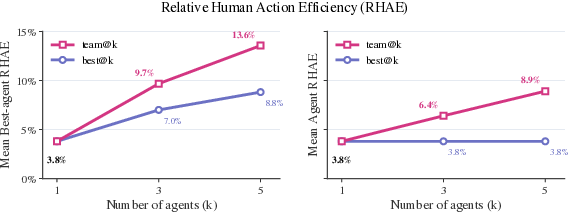
- Relative human action efficiency (RHAE): A benchmark metric comparing an agent’s action efficiency with human performance on the same task. “The official metric, by contrast, scores a run not only by what it clears but by how economically it plays, using a metric called relative human action efficiency (RHAE)”
- Search space: The set of possible states, actions, or candidate solutions that an algorithm can explore. “while its search is still unfolding.”
- Self-contained classifier: A classifier whose submission includes all components necessary for inference without external model dependencies. “Agents must train and compress a self-contained MNIST classifier”
- Shared workspace: A common computational area through which multiple agents exchange files, messages, or results. “communicate through a shared workspace”
- Skyline packing: A packing heuristic that places objects along the upper contour of the already occupied region. “then skyline packing, placing them along the upper contour of the occupied region.”
- State-of-the-art: The best reported performance currently achieved for a task or benchmark. “yielding new state-of-the-art results.”
- Synchronization primitive: A low-level coordination mechanism that controls concurrent access to shared resources. “the only protocol-level allocation, enforced by a synchronization primitive, is slot ownership.”
- Test-time compute: Computational resources used while generating an answer or solving a task, rather than during model training. “For test-time compute, it is standard to sample independent outputs in parallel”
- Test-time communication: Information exchange among agents while they are actively solving a task. “We show that \emph{test-time communication can substantially outperform independent parallel attempts on challenging tasks”
- Token efficiency: The amount of task performance obtained per generated language-model token. “Figure~\ref{fig:arc-token-efficiency} paints a more nuanced picture.”
- Trajectory: The ordered sequence of actions, observations, and intermediate states produced during an agent’s task execution. “Their trajectories contain intermediate results, failed experiments, and reusable artifacts”
- Verifier: A mechanism that evaluates whether a candidate solution is correct or measures its quality. “An agent is to adopt a peer's approach only after observing a clearly better result”
- Verified progress sharing: A communication strategy in which agents share and adopt discoveries supported by objective evidence of improvement. “We call this mechanism verified progress sharing.”
- Wall-clock time: The actual elapsed time experienced from the beginning to the end of a computation. “We measure both metrics against wall-clock time and against total output tokens to account for compute.”