PointZero: 3D Point Track Completion for Learning Transferable 3D Dynamics
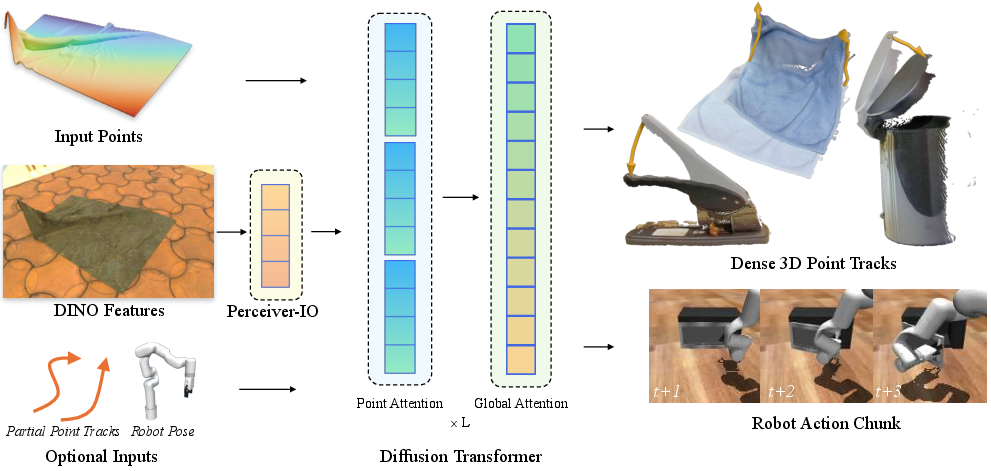
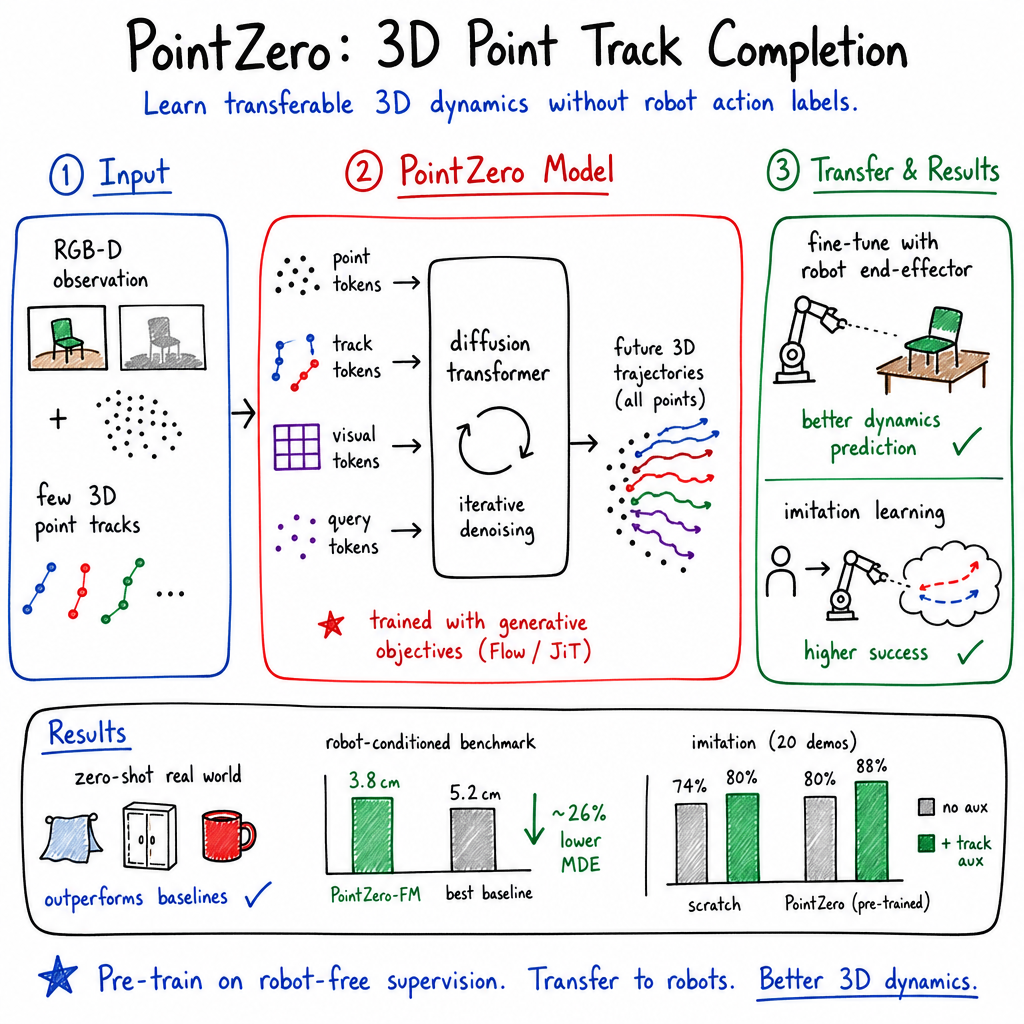
Abstract: World models endow perceptual systems with the ability to predict how scenes evolve under interaction. They are most beneficial when trained on diverse volumes of data, to instill a rich prior into downstream applications. Existing methods typically require robot action labels to learn action-conditioned 3D dynamics, which excludes web video data from the training pool. We study 3D point track completion as a pre-training objective for learning transferable 3D dynamics without robot data. Given a single RGB-D observation and sparse partial 3D trajectories (tracks), we predict future 3D tracks of all observed points. We show this objective produces a rich 3D dynamics prior, without requiring robot action labels. We contribute a diverse dataset of 2.9 million synthetic frames spanning deformable, articulated, and rigid objects, and use it to train PointZero. We show that a flexible and expressive transformer, PointZero, outperforms prior methods on the same data. We demonstrate the utility of our pre-training objective by post-training PointZero for two downstream applications: (1) action-conditioned 3D dynamics prediction and (2) imitation learning. When fine-tuned to condition on end-effector pose, PointZero outperforms the baselines on the recent PGND 3D dynamics benchmark. When fine-tuned to predict robot actions and 3D tracks, PointZero outperforms or matches the baselines on 6/7 simulated and real-world robot manipulation tasks. We furthermore evaluate training PointZero from scratch to isolate the benefits of our proposed architecture from those of our proposed pre-training objective and dataset. We release the dataset, checkpoints, and full training recipe.
Paper Prompts
Sign up for free to create and run prompts on this paper.
Top Community Prompts
Explain it Like I'm 14
1. What is this paper about?
This paper introduces PointZero, an artificial-intelligence system that learns how objects move in 3D.
The main idea is simple: give the system:
- one picture that includes color and depth information,
- the movements of only a few points on an object,
and ask it to predict how all the other points on the object will move in the future.
For example, if the system sees a hand pulling one part of a cloth, it tries to predict how the entire cloth will bend and move.
The researchers hope this will help robots understand physical movement without needing huge amounts of robot-specific training data.
2. What questions are the researchers asking?
The paper focuses on several important questions:
- Can a computer learn 3D object movement without being told what actions a robot took?
- Can a model trained on many different objects learn general rules about motion?
- Can this knowledge transfer to new tasks, such as predicting robot movements or controlling a robot?
- Can the model work on real objects even if it was mostly trained in simulation?
This is important because collecting data from real robots is expensive and slow. By contrast, videos and computer simulations can provide much more information.
3. How did the researchers do it?
Representing objects as 3D points
The researchers represent an object using many tiny points in 3D space. Each point has a position such as:
- left or right,
- up or down,
- closer to or farther from the camera.
Together, these points form a point cloud, which is like a 3D version of a picture made from dots.
The system also receives a few point tracks. A point track is the path followed by one point over time. It is similar to drawing a line showing where a spot on a moving object goes.
For example, the model might be told how three points on a moving shirt travel. It then predicts the paths of thousands of other points on the shirt.
Using images with depth
The model starts with an RGB-D image:
- RGB means a normal color image.
- D means depth, or how far each part of the scene is from the camera.
This allows the system to build a rough 3D description of the object.
The transformer model
PointZero uses a type of neural network called a transformer. A transformer is a machine-learning system that looks at many pieces of information and learns how they relate to one another.
An analogy is solving a puzzle. Instead of looking at each puzzle piece alone, the transformer studies how all the pieces fit together.
PointZero combines:
- 3D point locations,
- the few known point tracks,
- information from the image.
It then predicts future positions for all the points.
Training with simulated data
The researchers created a large computer-generated dataset containing:
- 2.9 million image frames,
- rigid objects, such as boxes,
- articulated objects, such as objects with hinges or moving parts,
- deformable objects, such as cloth and rope.
The model was trained to predict the correct future movement in these simulations.
This first stage is called pre-training. It is like teaching a student many general ideas before asking the student to solve a particular problem.
Testing and later training
The researchers tested PointZero in several ways:
- on new simulated scenes,
- on real-world objects,
- on robot dynamics prediction,
- on robot imitation tasks.
They also compared it with other machine-learning systems.
Some experiments trained PointZero further for a specific task. This is called fine-tuning or post-training. It is similar to taking a general science student and giving them extra lessons in robotics.
4. What did the researchers find?
PointZero predicted motion more accurately
On the synthetic test data, PointZero performed better than all the comparison methods for:
- deformable objects,
- articulated objects,
- rigid objects.
This means it was better at predicting the future 3D locations of object points.
The advantage was especially useful for complicated objects. For example, cloth can bend and change shape in many ways, while a box usually moves as one solid piece.
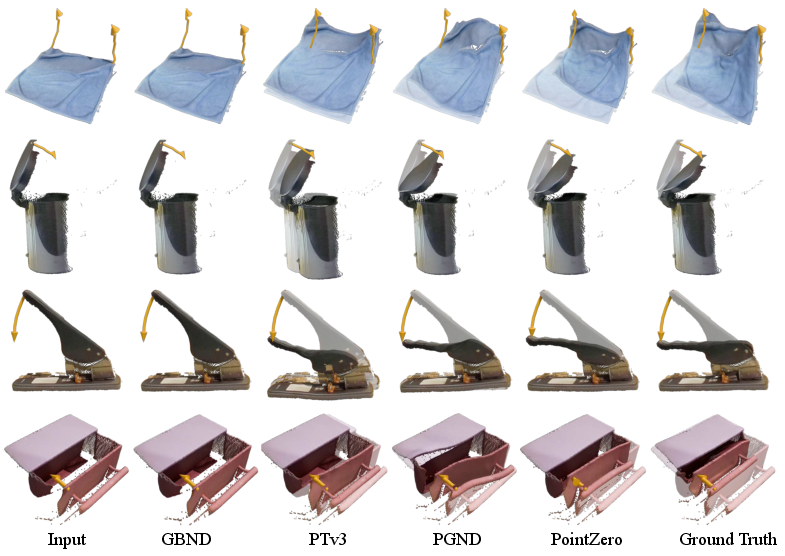
It worked on real objects without extra training
The researchers tested the model on 14 real-world objects and 124 human-object interactions.
PointZero had been trained only on simulated data for this test. Even so, it generally performed better than the other methods.
It was better at:
- following the given point movements,
- keeping cloth-like objects from shrinking or stretching unrealistically,
- preserving the shape of rigid objects,
- predicting movements of objects with hinges or joints.
This shows some zero-shot generalization. In simple terms, the model could handle examples it had not been directly trained on.
It helped predict robot-controlled motion
The researchers adapted PointZero to use a robot’s hand or tool position as the input instead of a few point tracks.
After this extra training, PointZero performed better than comparison systems on four out of six robot dynamics scenes. It also performed competitively in the other scenes.
The most important comparison was between:
- PointZero trained from the beginning for the task,
- PointZero first taught general 3D motion and then fine-tuned.
The pre-trained version worked better. This suggests that the general motion knowledge learned by PointZero was genuinely useful.
It improved robot manipulation
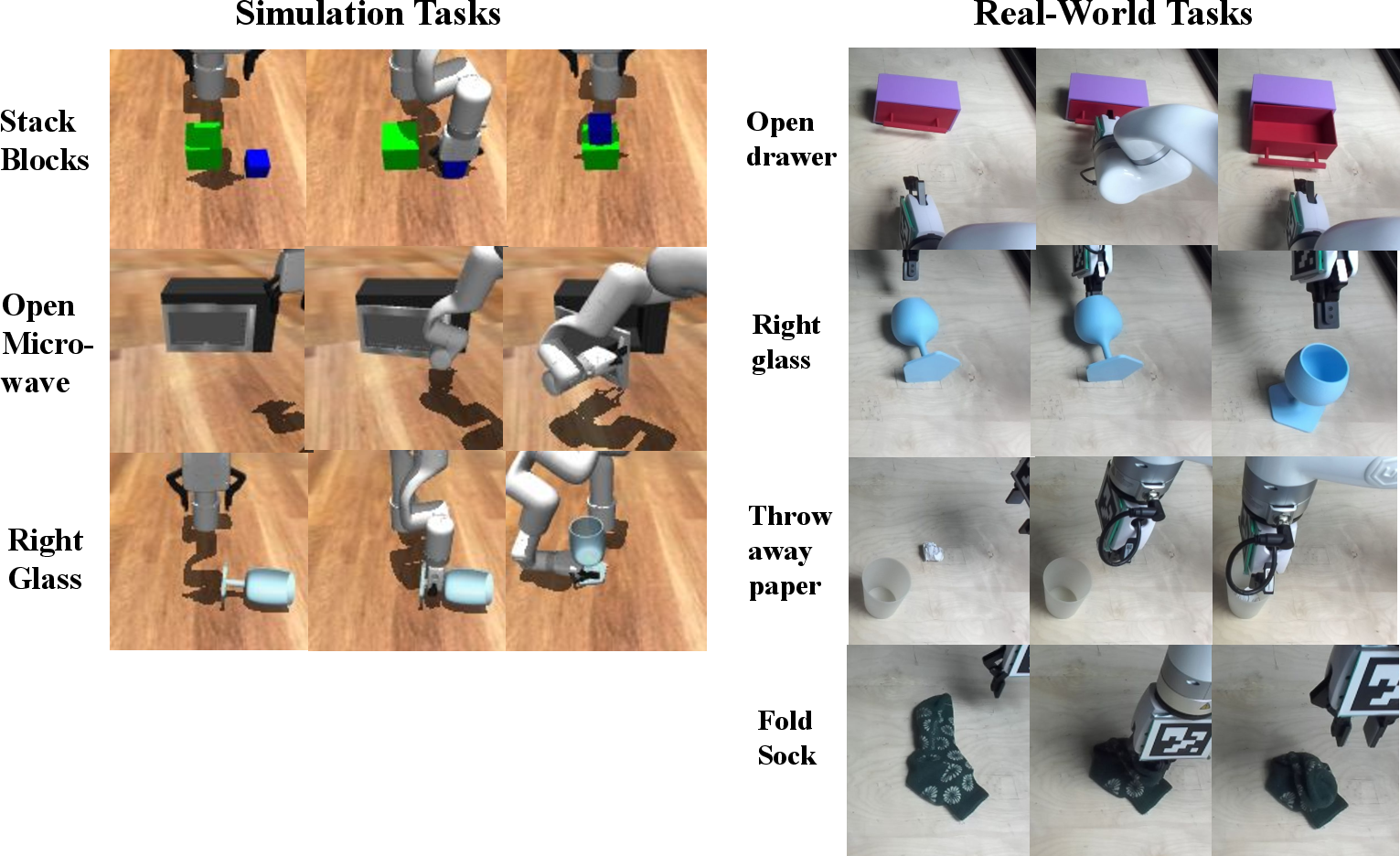
The researchers also used PointZero for imitation learning. In imitation learning, a robot watches examples of a person or another robot completing a task and learns to copy the behavior.
The tasks included things such as:
- stacking blocks,
- opening a microwave,
- moving a cup,
- opening a drawer,
- handling paper or a sock.
PointZero achieved the highest or tied for the highest success rate on six of seven tasks.
In simulation, using the pre-trained model increased average success from 80.5% to 88.2% when extra point-track information was used. Even without that extra information, success increased from 74.1% to 80.0%.
These results suggest that learning to predict 3D movement helps robots decide what actions to take.
5. Why is this important?
Most older systems need detailed robot information, such as:
- exactly what the robot arm did,
- where the robot touched an object,
- what action happened at each moment.
This makes training data difficult and expensive to collect.
PointZero uses a different idea: it learns from the movement of points. Point movements can potentially be found in ordinary videos, even when no robot action labels are available.
This could allow researchers to use:
- simulation,
- online videos,
- human demonstrations,
- ordinary object interactions,
to teach robots about the physical world.
In the future, this may help robots learn to:
- fold clothes,
- open doors and drawers,
- move fragile objects,
- handle flexible materials,
- adapt to unfamiliar objects.
6. Limitations and future work
The system is promising, but it is not perfect.
The researchers point out that their simulations do not fully capture:
- all real-world materials,
- messy and crowded environments,
- detailed hand-object contact,
- forces such as pushing and friction,
- very long sequences of movement.
The model also mainly uses simple information, such as point paths and robot hand positions. It does not yet fully understand details such as exactly where contact happens or how strongly an object is being pushed.
Future versions could combine simulation with information extracted from real videos. They could also learn about forces, contact points, and more complicated interactions.
Conclusion
PointZero teaches an AI system to predict how 3D objects will move by watching the paths of only a few points. It does not need robot action labels during its main training stage.
The experiments show that PointZero:
- predicts object movement accurately,
- transfers knowledge from simulation to real objects,
- improves robot motion prediction,
- helps robots learn tasks from demonstrations.
The broader message is that teaching AI about how the physical world changes over time may be a powerful way to build more capable and flexible robots.
Knowledge Gaps
Knowledge gaps, limitations, and open questions
- The synthetic pre-training data does not adequately represent the diversity of real-world materials, textures, object geometries, contact mechanics, clutter, occlusions, lighting, sensing noise, and human-object interactions.
- The extent to which simulation-to-real transfer depends on the particular simulator, object assets, physics parameters, and rendering pipeline remains unquantified.
- The real-world evaluation is small, covering only 14 objects and 124 interactions, and does not establish generalization across larger object populations, environments, operators, camera configurations, or interaction styles.
- The real-world point-track and action labels are generated using FoundationStereo, CoTracker3, and manually initialized hand-contact points; the effect of tracking, depth, calibration, and annotation errors on reported performance is not measured.
- The method assumes a single RGB-D observation with a foreground mask and sufficiently complete observed geometry, leaving performance under missing depth, transparent or reflective surfaces, severe occlusion, clutter, and imperfect segmentation unresolved.
- The model predicts future tracks only for points visible in the initial observation, so it does not address newly revealed surfaces, occluded objects, scene entry, object removal, or topology changes.
- The fixed horizon of ten physical frames leaves long-horizon stability, error accumulation, repeated contacts, irreversible changes, and cyclic or delayed dynamics unexplored.
- The practical benefit of predicting complete trajectories in one generative step versus sequential prediction is not isolated through dedicated ablations on horizon length, rollout stability, and computational cost.
- The conditioning regime is restricted to one to three point tracks, and the sensitivity to the number, spatial distribution, visibility, tracking quality, and semantic relevance of conditioning points is not systematically evaluated.
- The study does not determine whether conditioning points must lie on the manipulated object, whether points on the robot or surrounding scene are useful, or how the model handles contradictory or physically implausible input tracks.
- The point-track objective does not explicitly model contact locations, forces, friction, mass, compliance, constraints, or other latent physical variables, making its ability to represent contact-rich dynamics uncertain.
- The paper does not test whether adding explicit contact, force, tactile, proprioceptive, or action information improves prediction beyond sparse point-track conditioning.
- The model’s predictions are evaluated mainly with final-timestep point-cloud metrics, which do not fully capture temporal smoothness, identity preservation, physical plausibility, contact correctness, collision violations, or uncertainty calibration.
- The best-of-10 oracle evaluation can favor models that generate at least one accurate sample without measuring the probability of producing that sample, average-case quality, diversity, or reliability in deployment.
- The multimodality claim is not directly validated: the paper does not report calibration, likelihood-related measures, diversity-quality trade-offs, or whether distinct generated trajectories correspond to genuinely plausible physical outcomes.
- The reported advantage of the JiT and flow-matching objectives is not disentangled from differences in sampling schedules, number of solver steps, noise distributions, time sampling, or optimization settings.
- The choice of four Euler sampling steps is not justified through a systematic accuracy–latency study, leaving real-time suitability and sensitivity to the numerical solver unresolved.
- The contribution of the DINOv2 visual features, Perceiver compression, transformer size, point-cloud tokens, and cross-attention design is not fully isolated with comprehensive component ablations.
- The paper does not compare against large-scale video or 3D representation pre-training methods under matched data, compute, model capacity, and downstream fine-tuning conditions.
- The synthetic dataset’s 2.9 million frames may contain correlated frames and interactions, but the effective number of independent training examples and the risk of train–test leakage through shared assets or dynamics parameters are not reported.
- The relationship between dataset scale, object-category diversity, interaction diversity, and performance is only partially explored; the minimum data requirements for useful transfer remain unknown.
- The model’s ability to generalize to object categories, material properties, articulation structures, and interaction types absent from the synthetic training distribution is not systematically tested.
- The zero-shot real-world evaluation does not establish whether the model learns physical dynamics or primarily exploits geometric, visual, and motion priors specific to the training distribution.
- Post-training for robot-conditioned dynamics is evaluated on only six PGND scenes, and the claimed transfer advantage is not tested across substantially more scenes, robots, embodiments, action spaces, or sensor configurations.
- The comparison between pre-training and training from scratch is confounded by fine-tuning choices such as LoRA, parameter freezing, initialization, and trainable parameter counts; matched optimization and capacity controls are needed.
- The imitation-learning experiments use only 20 labeled demonstrations per task and a small set of seven tasks, leaving scaling behavior with demonstration count, task complexity, and task diversity unresolved.
- The contribution of the additional 100 actionless videos is not comprehensively separated from the contribution of synthetic pre-training, auxiliary point-track supervision, architecture, and task-specific data augmentation.
- The policy experiments do not assess robustness to distribution shifts such as novel object instances, clutter, perturbations, execution noise, lighting changes, or recovery from failed actions.
- The paper does not evaluate whether improved point-track prediction causally produces better robot policies, as opposed to the gains arising from shared architecture, visual features, auxiliary supervision, or optimization effects.
- The method’s computational and memory costs for dense point clouds, long trajectories, diffusion sampling, and multi-scene deployment are not reported or compared with downstream baselines.
- The model’s behavior under uncertainty and partial observability is not characterized; it is unclear whether it can represent uncertainty caused by unknown physical parameters, hidden contacts, or ambiguous future outcomes.
- The normalization by the initial-frame centroid and percentile radius may remove absolute scale and pose information, but the consequences for tasks requiring metric force, gravity, workspace, or object-size reasoning are not investigated.
- The approach is not evaluated on multi-object interactions, object–object collisions, tool use, deformable–rigid contact, or scenes where relational dynamics among several objects are essential.
- The method’s ability to support closed-loop planning and control is not demonstrated; open-loop trajectory prediction errors may not reflect performance when predictions are repeatedly updated from new observations.
- Long-term safety and failure modes are not studied, including physically impossible predictions, penetration, self-intersection in deformable objects, unstable articulated joints, and catastrophic extrapolation outside the training distribution.
- The proposed use of pseudo-annotations from real videos remains unvalidated, particularly regarding the accuracy of monocular or multiview 3D reconstruction, track persistence through occlusion, and the noise introduced into pre-training labels.
- The paper does not establish whether the learned dynamics prior transfers beyond robot manipulation to applications such as physical reasoning, simulation initialization, AR/VR interaction, autonomous navigation, or human–robot collaboration.
- The release claims a full training recipe, but reproducibility risks remain because the paper does not fully clarify dataset-generation distributions, simulator settings, filtering criteria, train–validation–test splits, and all post-training hyperparameters in the main text.
Practical Applications
Immediate Applications
The paper’s released dataset, checkpoints, and training recipe make several applications feasible now, provided that the deployment environment supplies calibrated RGB-D observations and sufficiently accurate point tracking or robot-pose data.
- Few-shot robot manipulation for rigid, articulated, and deformable objects (Robotics; deployable now)
Fine-tune the pretrained model with a small number of robot demonstrations to predict end-effector action trajectories and future 3D point tracks. Candidate workflows include opening drawers, stacking blocks, handling cups, manipulating paper, folding cloth, and moving socks. The reported results show high success rates using approximately 20 action-labeled demonstrations, with the model achieving the best or joint-best performance on six of seven evaluated tasks.
Potential product/tool: a robot-learning software module that initializes manipulation policies from
PointZerocheckpoints rather than training from scratch. Dependencies: RGB-D sensing, camera–robot calibration, reliable foreground segmentation, safe action execution, and task-specific fine-tuning. Performance may decline for contact-rich interactions, clutter, objects outside the synthetic training distribution, or long-horizon tasks. - Scene-specific 3D dynamics prediction for robot planning (Robotics and industrial automation; deployable now) Replace sparse point-track conditioning with robot end-effector pose and fine-tune the model on a limited set of interactions in a target scene. The resulting predictor can estimate how an object or material will move under candidate robot actions, supporting trajectory selection, model-predictive control, collision avoidance, and grasp planning. The paper reports that fine-tuned models outperform or match application-specific baselines on most PGND benchmark scenes. Potential workflow: observe a new object, collect a small interaction dataset, fine-tune using LoRA, simulate candidate end-effector trajectories, and execute the safest or most task-relevant trajectory. Dependencies: scene-specific interaction data, accurate end-effector pose histories, sufficiently representative action coverage, and uncertainty-aware planning. Predictions should not be treated as physically guaranteed, especially near contacts and occlusions.
- Dense 3D motion forecasting from sparse tracked points (Computer vision, robotics, AR/VR; deployable now) Given one RGB-D frame and one to three sparse 3D trajectories, the model can complete future trajectories for all observed points. This can support object-motion visualization, tracking assistance, motion segmentation, and prediction of how partially observed objects will deform or articulate. Potential product/tool: an interactive motion-completion system for labeling tools, cloth, articulated mechanisms, or manipulated objects in 3D video. Dependencies: accurate depth, camera intrinsics, point tracking, and sufficiently visible object surfaces. The system predicts plausible futures rather than identifying a unique physically correct future when the conditioning is ambiguous.
- Video-based generation of robot-free 3D dynamics training data (Robotics and computer vision; deployable now for research and prototyping) The method allows actionless videos to contribute to dynamics pretraining because supervision can be derived from 3D point tracks rather than robot action labels. Existing point-tracking and depth-reconstruction tools can produce approximate training pairs from human demonstrations, manipulation videos, or web video. Potential workflow: estimate depth, track points across frames, construct sparse-to-dense trajectory examples, and use them to pretrain or adapt a dynamics model. Dependencies: reliable monocular or stereo depth, camera-motion compensation, temporal point correspondence, and filtering of tracking failures. Web videos often lack metric scale, contain occlusions, and may not expose contact forces or the true cause of motion.
- Low-data imitation learning for manipulation (Robotics; deployable now in controlled settings) The pretrained spatial-dynamics representation can be combined with a lightweight action head and a small number of expert demonstrations. This is particularly useful when collecting robot demonstrations is expensive but additional unlabeled or actionless videos are available. The paper reports improvements over training from scratch even without downstream point-track annotations. Potential tool: a demonstration-efficient policy-learning pipeline that uses labeled robot trajectories together with unlabeled human or robot videos. Dependencies: task similarity between pretraining and deployment, compatible camera viewpoints, a stable robot control interface, and adequate coverage of successful behavior. The evidence is still limited to a small set of tasks.
- Academic research benchmark and baseline for 3D world models (Academia; deployable now) Researchers can use the released 2.9-million-frame synthetic dataset, real-world evaluation data, checkpoints, and code to benchmark 3D dynamics models across deformable, articulated, and rigid objects. The point-track completion objective provides a common pretraining task that does not require embodiment-specific action labels. Potential outputs: reproducible comparisons of transformers, graph networks, diffusion models, flow matching, regression objectives, and sim-to-real transfer methods. Dependencies: careful evaluation beyond best-of-many oracle metrics, consistent train/test splits, and additional real-world datasets to avoid overestimating performance from synthetic data.
- Robotics simulation and digital-twin prototyping (Industrial automation and simulation; deployable now as a learned surrogate) The model can provide a fast learned approximation of object motion for early-stage planning or simulation, especially for objects whose dynamics are difficult to model analytically, such as cloth, paper, ropes, and soft packaging. It can complement rather than replace physics engines during policy development. Dependencies: calibration to the target materials and environment, validation against measured trajectories, and safeguards against compounding rollout errors. The paper evaluates relatively short horizons, so long sequences require additional validation.
- Interactive AR/VR/XR visualization of anticipated object motion (AR/VR and human–computer interaction; prototype-ready) Sparse tracked points from a user’s hand or an object can condition dense 3D future motion, allowing an interface to preview likely cloth deformation, drawer movement, or object articulation. This could support training, teleoperation, design review, or instructional overlays. Dependencies: low-latency RGB-D or stereo tracking, stable camera pose estimation, and confidence estimates to prevent visually misleading predictions. Real-time performance and perceptual quality were not fully established in the paper.
Long-Term Applications
These applications follow naturally from the paper’s findings but require broader data, stronger uncertainty modeling, physical validation, or integration with larger-scale systems.
- General-purpose robot foundation models for multi-task manipulation (Robotics; long-term) Point-track completion could serve as a robot-free pretraining stage for a foundation model spanning many robots, environments, and object categories. A future system could combine web video, human demonstrations, synthetic simulation, and robot data, then transfer to unseen tasks with minimal task-specific supervision. Required development: multi-scene and multi-task training, embodiment-independent representations, richer action conditioning, and evaluation across diverse robots and materials. The current study uses relatively small downstream task sets and mostly short-horizon predictions.
- Closed-loop model-predictive control with uncertainty-aware 3D forecasts (Robotics and autonomous systems; long-term) The generative flow-matching formulation models multiple plausible trajectories. A controller could sample possible futures, score them against task objectives, and repeatedly replan from new observations. This could improve manipulation under uncertainty, particularly for deformable objects. Required development: calibrated predictive uncertainty, fast sampling, differentiable or efficiently searchable planning objectives, contact-aware conditioning, and formal safety constraints. Best-of-10 oracle evaluation in the paper does not by itself demonstrate reliable online uncertainty estimation.
- Contact- and force-aware dynamics models (Robotics, biomechanics, and manufacturing; long-term) Extending the input beyond sparse trajectories and end-effector pose to include contact locations, forces, torques, gripper state, tactile data, and material properties could improve predictions for pushing, grasping, folding, and tool use. Dependencies: synchronized tactile and force sensing, standardized contact annotations, and models capable of representing discontinuous contact events. The paper explicitly identifies the absence of rich contact representations as a limitation.
- Large-scale 3D world models trained from internet video (Computer vision and generative AI; long-term) Point tracking and monocular or multi-view reconstruction could convert large video collections into approximate metric 3D trajectories. A scaled model might learn general priors for object motion, human–object interaction, and scene evolution without robot-specific labels. Required development: robust automatic annotation, scale and camera-motion normalization, handling of occlusion and viewpoint changes, and methods for separating object motion from camera motion. The quality of pseudo-labels from real videos will strongly determine feasibility.
- Autonomous warehouse and household robots with zero- or one-shot object adaptation (Robotics and logistics; long-term) A sufficiently general model could predict the behavior of previously unseen boxes, bags, clothing, food items, and household objects after observing only a few points or a short exploratory interaction. This would reduce the need to build a separate dynamics model for every object and task. Dependencies: broad real-world coverage, robust perception under clutter, active exploration policies, safety guarantees, and reliable adaptation to object mass, friction, stiffness, and articulation. The current zero-shot results are promising but do not establish robust deployment at this scale.
- Digital twins for deformable manufacturing and logistics processes (Manufacturing, supply chain, and industrial engineering; long-term) Learned 3D dynamics could model packaging materials, cables, fabrics, flexible parts, and irregular goods in sorting, assembly, and packing systems. A digital twin could be used to test robot trajectories and optimize throughput before deployment. Dependencies: high-fidelity calibration to material parameters, domain-specific datasets, integration with industrial simulators, and validation under production variability. Synthetic training currently does not fully capture real materials, clutter, or contact-rich processes.
- Assistive and rehabilitation robotics (Healthcare; long-term) Predicting the motion of clothing, limbs, support devices, or household objects could help assistive robots plan dressing, feeding, transfer, and rehabilitation actions. A dynamics prior may reduce the number of personalized demonstrations needed for each patient or environment. Dependencies: medically validated sensing, strict safety and fail-safe operation, personalization to body geometry and mobility constraints, and datasets representing vulnerable users. The paper does not evaluate human-body interaction or clinical settings.
- Physics-informed educational and scientific simulators (Education and academia; long-term) The model could power interactive environments in which students manipulate virtual cloth, rigid bodies, ropes, or articulated objects and observe predicted 3D outcomes. It could also serve as a learned prior for scientific studies of partially observed dynamics. Dependencies: physically meaningful calibration, interpretable uncertainty, accurate long-horizon behavior, and clear distinction between plausible visual prediction and validated physical simulation. Without these safeguards, the system may teach visually convincing but incorrect mechanics.
- Everyday motion-forecasting assistants (Consumer technology and daily life; long-term) In smart-home or wearable-camera systems, predicted 3D motion could support safer interaction with moving objects, anticipatory interfaces, fall or collision avoidance, and context-aware assistance for handling laundry, dishes, or tools. Dependencies: privacy-preserving processing, reliable sensing in ordinary homes, robust behavior under occlusion and lighting changes, and extensive safety testing. The paper’s results do not yet address privacy, human motion, or unconstrained household environments.
- Standardized policy and regulatory evaluation for learned physical prediction (Policy and standards; long-term) The released benchmark could motivate standards for evaluating 3D dynamics models across rigid, articulated, and deformable objects, including sim-to-real transfer, uncertainty calibration, energy use, and failure severity. Such standards would help distinguish visually plausible forecasts from safe, physically reliable predictions. Dependencies: broader real-world datasets, agreed safety metrics, reproducible hardware protocols, and reporting requirements that include failures rather than only best-of-many success or oracle scores.
Glossary
- Action-conditioned dynamics: A dynamics model whose predictions depend on the actions applied to the system. “action-conditioned 3D dynamics”
- Articulated object: An object composed of rigid parts connected by joints that permit relative motion. “deformable, articulated, and rigid objects”
- Autoregressive: Generated sequentially, with each prediction depending on previous outputs. “task-conditioned futures”
- Chamfer Distance (CD): A distance measure between point sets based on nearest-neighbor distances in both directions. “the bi-directional Chamfer Distance (CD)”
- Cross-attention: An attention mechanism in which queries attend to keys and values from another sequence. “cross-attention from to $F_{\text{DINO}$”
- Diffusion model: A generative model trained to reverse a gradual noise-injection process. “Flow matching and diffusion models for image generation”
- Diffusion transformer (DiT): A transformer architecture that predicts denoising or diffusion-related quantities. “We use a diffusion transformer with alternating layers of self-attention and cross-attention.”
- Ego-centric: Represented from the viewpoint of an embodied agent or observer. “Diverse Egocentric Human Data”
- Earth Mover’s Distance (EMD): A distance between distributions or point sets based on the minimum transport cost for transforming one into the other. “the Earth Mover's Distance (EMD)”
- Embodiment: The physical form and action capabilities of an agent, especially a robot. “No robot- or embodiment-specific annotations are needed.”
- End-effector pose: The position and orientation of the operative tool or terminal part of a robot. “conditioning on robot end-effector (EEF) pose”
- Finite Element Method (FEM): A numerical method that approximates physical systems by subdividing them into finite elements. “the Finite Element Method (FEM)”
- Flow matching: A generative-model training method that learns a vector field transporting samples from a source distribution to a target distribution. “For flow matching~\cite{lipman2023flowmatchinggenerativemodeling}”
- Foreground mask: A binary image indicating which pixels belong to the objects or region of interest. “foreground mask ”
- Graph-Based Neural Dynamics (GBND): A neural dynamics model that represents particles and their relationships as a graph. “Graph-Based Neural Dynamics (GBND)”
- Inductive bias: A structural assumption built into a model that favors particular solutions or representations. “networks with inductive biases such as spatial grids”
- Imitation learning: Learning a policy by reproducing behavior demonstrated by an expert. “Imitation learning for Robot Manipulation”
- Isotropic Gaussian: A Gaussian distribution with equal variance in every direction. “we sample an isotropic Gaussian source point”
- Latent space: An internal, typically lower-dimensional representation in which a model performs computation or generation. “applied in learned autoencoder latent spaces”
- LoRA: Low-Rank Adaptation, a parameter-efficient fine-tuning method that trains low-rank update matrices instead of all model parameters. “We post-train with the JiT objective and LoRA.”
- Masked autoencoding: Self-supervised learning in which portions of an input are masked and reconstructed. “self-supervised learning methods such as masked autoencoding”
- Material Point Method (MPM): A particle-based numerical method for simulating continuum materials and their deformation. “the Material Point Method (MPM)”
- Mean Distance Error (MDE): The average distance between corresponding predicted and ground-truth points. “the mean squared error (MSE), mean distance error (MDE)”
- Metric 3D representation: A representation that preserves physical distances and spatial scale in three dimensions. “which cannot explicitly represent metric 3D scene motion”
- Multimodal distribution: A probability distribution containing multiple distinct modes or plausible outcomes. “they capture a multimodal distribution over plausible point trajectories.”
- Partial observability: A setting in which the complete state of a system cannot be directly observed. “under partial observability and noise”
- Perceiver-IO: A transformer architecture that uses a fixed set of latent queries to process inputs of varying size. “We compress them into visual tokens using a Perceiver-IO module”
- Point cloud: A collection of points representing the geometry of a three-dimensional object or scene. “an observed 3D point cloud”
- Point track: The temporal sequence of 3D positions associated with a particular scene point. “we predict future 3D tracks of all observed points.”
- Post-training: Additional training applied to a pretrained model for a specific downstream task. “We study the utility of our pre-training objective by post-training pre-trained models”
- Pre-training objective: A task used to train a model before adapting it to downstream applications. “3D point track completion as a pre-training objective”
- Robot-free supervision: Training supervision that does not require robot actions or robot-specific annotations. “Robot-free supervision”
- Self-attention: An attention mechanism in which elements of a sequence attend to other elements within the same sequence. “we apply layers of self-attention over ”
- Sim-to-real transfer: The transfer of a model trained in simulation to physical-world settings. “real-world evaluation of zero-shot sim-to-real transfer”
- Sparse trajectory: A trajectory specified by only a small number of tracked points or observations. “a small number of sparse point trajectories”
- System identification: Estimating a system’s physical parameters or dynamics from observations. “when state estimation and system identification are successful”
- Task-agnostic supervision: Training supervision that is not tied to a particular task or successful task outcome. “Task-agnostic supervision”
- Temporally weighted squared error: A squared-error loss that assigns different importance to predictions at different times. “the coordinate-averaged, temporally weighted squared error”
- Transformer: A neural-network architecture based primarily on attention mechanisms for processing sequences or sets. “a flexible and expressive transformer”
- Unproject: To convert image pixels and depth values into corresponding 3D coordinates using camera calibration. “to unproject the masked depth into an observed 3D point cloud”
- Vector field: A function assigning a vector, such as a velocity, to every point in a space. “the target velocity is ”
- World model: A model that represents and predicts how an environment changes over time and under interaction. “World models endow perceptual systems with the ability to predict how scenes evolve under interaction.”
- Zero-shot generalization: Performance on new data or tasks without additional task-specific training. “We further evaluate whether #1 learns a generalizable dynamics prior by testing the model's zero-shot capabilities.”