Learning to Solve Hard Problems in RL for LLMs by Never Giving Up
Abstract: We demonstrate that training LLMs with RL does not improve performance equally across a dataset. RL shows large improvements on easy problems that an LLM is already good at solving, but small improvements on hard problems. We call this the Matthew Effect in RL for LLMs, after the phenomenon of cumulative advantage from economics and network science summarized as "the rich get richer". The naive explanation is that hard problems require more compute to find a solution. We argue that modern RL methods are exacerbating the issue by wasting too much compute on easy problems and instead should dynamically reallocate how they use compute. We introduce Never Give Up (NGU), a simple adaptive sampling method that keeps generating samples for a problem until one is correct. By leveraging asynchronous RL, this naturally uses fewer samples to filter out easy problems and allocates more compute to solving harder problems. We investigate the design choices that affect NGU, such as off-policy robustness, and develop a set of best practices. On the math benchmark Deepscaler, NGU improves performance per compute, especially on harder problems. On a recent coding task, Manufactoria, standard GRPO with a per-test reward fails to fully solve problems that have a range of easy and difficult tests. NGU iteratively improves, solving harder and harder tests, until it learns to fully solve coding problems.
Paper Prompts
Sign up for free to create and run prompts on this paper.
Top Community Prompts
Explain it Like I'm 14
1. What is the paper about?
This paper studies how reinforcement learning (RL) improves LLMs, or LLMs—the kind of AI that can write text, solve math problems, and produce computer code.
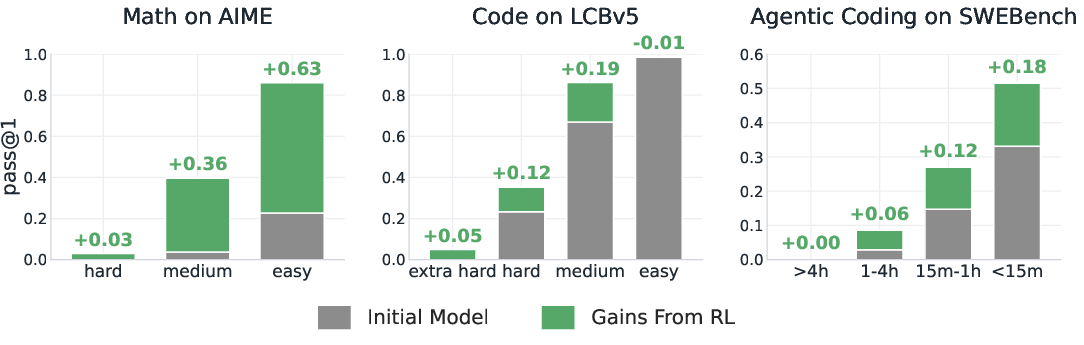
The researchers found an unfair pattern: RL usually helps an AI improve much more on problems it was already good at solving. It helps less on problems that were already difficult.
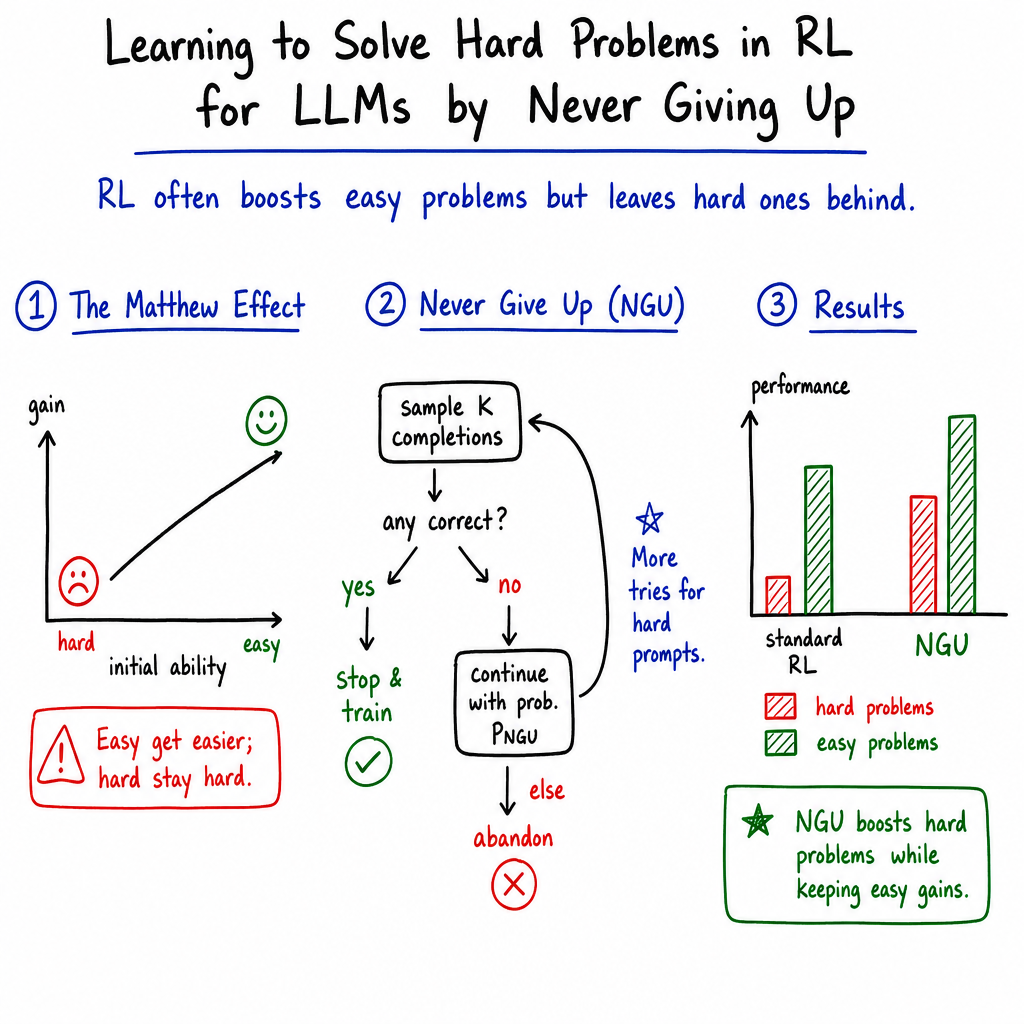
They call this the Matthew Effect, based on the idea that “the rich get richer.” In this case, easy problems become even easier, while hard problems may remain unsolved.
The paper introduces a method called Never Give Up (NGU). Its goal is to give the AI more chances to work on difficult problems instead of spending too much time practicing problems it already understands.
2. What questions did the researchers ask?
The paper focuses on several main questions:
- Does RL improve easy problems more than difficult problems?
- Why does this happen?
- Is the problem that the AI does not generate enough possible answers for difficult questions?
- Does RL waste computing power by repeatedly practicing easy questions?
- Can the researchers create a training method that automatically gives more attention to difficult problems?
- Does this method work for both mathematics and computer programming?
The researchers especially wanted to improve performance per unit of computing power. In simple terms, they wanted the AI to learn as much as possible without wasting time and energy.
3. How did the researchers investigate this?
Comparing easy and hard problems
First, the researchers examined several existing RL-trained LLMs working on:
- Mathematics
- Code completion
- Software engineering tasks
They grouped problems by difficulty. For example, a problem was considered easier if the original model could solve it often, and harder if the model almost never solved it.
They then compared the model’s performance before and after RL training.
Testing different numbers of attempts
When training an AI, researchers often ask it to produce several answers to the same problem. This paper calls the number of attempts .
For example:
- If , the AI tries four answers.
- If , it tries thirty-two answers.
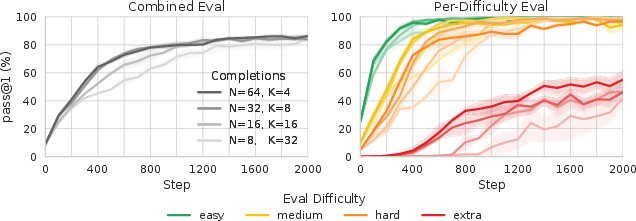
The researchers tested different values of to see whether simply giving the AI more attempts would solve difficult problems.
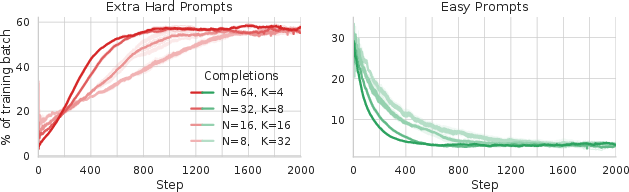
However, there is a problem. If the AI spends many attempts on an easy problem, most of those attempts may be unnecessary. It could have used that computing time on something harder.
Understanding GRPO
The paper studies a method called GRPO, a type of reinforcement learning used to train LLMs.
A simple way to understand GRPO is to imagine a teacher asking an AI for several answers and comparing them with one another. Correct answers receive a higher score, while incorrect answers receive a lower score. The model is then adjusted so that it is more likely to produce answers like the successful ones.
If every answer is wrong, however, the training system has little useful information about what to learn. It is like a student taking a test, getting every question wrong, and receiving no hints about how to improve.
The Never Give Up method
NGU changes how the AI uses its attempts:
- The AI tries a small number of answers to a problem.
- If it solves an easy problem, training moves on quickly.
- If all answers are wrong, the problem is not immediately abandoned.
- The AI gets more chances to try that problem.
- It may eventually stop trying if the problem seems impossibly difficult.
This is similar to a teacher giving a student extra practice on a difficult question while not making a student repeat a question they already understand.
NGU uses asynchronous RL, meaning that different training tasks do not all have to finish at the same time. As soon as one problem is solved or filtered out, another problem can take its place. This allows the system to spend more time on difficult problems without making the whole training process wait.
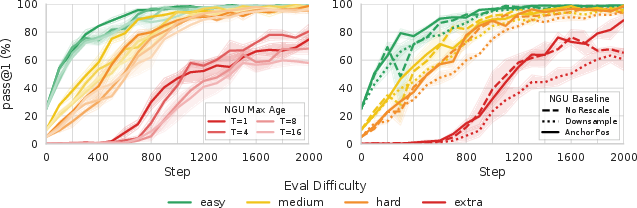
The researchers also tested how to handle old answers. Old answers can become less useful after the model changes, so NGU removes answers that are too outdated. The experiments suggested that keeping some recent old answers was helpful, but keeping too many old answers hurt performance.
4. What did the researchers find?
RL creates a Matthew Effect
Across mathematics, coding, and software engineering, RL generally improved problems in proportion to the model’s starting ability.
In other words:
- Problems the model already solved fairly often improved a lot.
- Problems the model almost never solved improved much less.
This means that ordinary RL does not automatically teach an AI to solve its hardest problems.
Simply increasing the number of attempts is not enough
The researchers expected that asking for more answers might help with difficult problems. Sometimes it did, because more attempts increase the chance of discovering a correct answer.
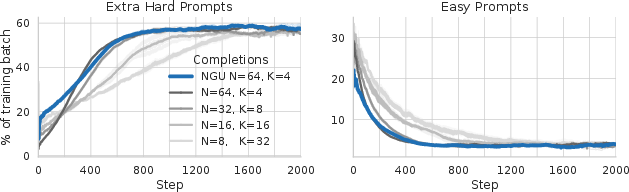
But using a large, fixed number of attempts for every problem also wasted computing power on easy problems. It could even make training less effective overall.
The important issue was not only how many attempts the AI made. It was where those attempts were spent.
NGU improved difficult math problems
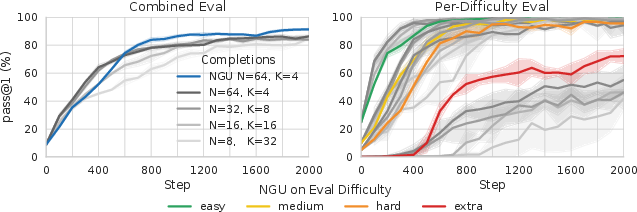
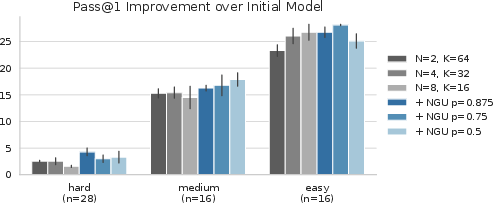
On a small mathematics experiment, NGU improved performance especially on the hardest questions.
The researchers then tested it on a larger and more difficult math dataset. NGU performed better than several standard approaches on difficult problems, while preserving more of the performance on easier problems.
This was important because some methods that focus strongly on hard problems can accidentally make the model worse at easy ones. NGU created a better balance.
NGU helped solve difficult coding tests
The researchers also tested NGU on a coding task called Manufactoria. Each coding problem had many tests, ranging from easy to very difficult.
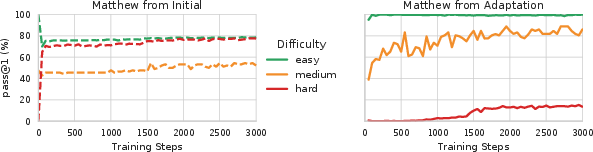
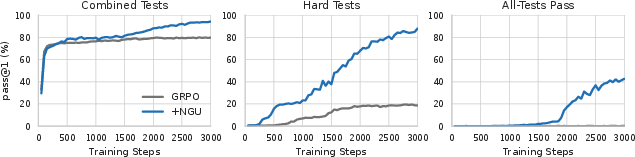
Standard RL learned to pass many individual tests, but it often failed to pass all the tests for a single problem. It kept improving on easier tests but became stuck on the hardest ones.
NGU continued spending effort on the hardest unsolved tests. Eventually, it learned to solve complete problems, including all their tests.
Difficulty can change during training
The researchers found that a problem’s difficulty is not fixed forever. A problem that seems hard at the beginning may become easy after the model learns how to understand the task.
This is one reason a fixed training plan can be less effective. NGU observes the model’s current success and adjusts its effort as training continues.
5. Why are these findings important?
Training large AI models requires enormous amounts of computing power. If the AI repeatedly practices problems it already knows, much of that power is wasted.
The paper suggests a better strategy:
- Spend little effort on problems the model solves easily.
- Spend more effort on problems that are difficult but still possibly solvable.
- Continue giving difficult problems new chances instead of abandoning them too quickly.
- Avoid keeping outdated training examples for too long.
NGU is useful because it does not require a perfect list of which problems are easy or hard. Instead, it learns this naturally from the model’s recent attempts.
6. Possible impact and limitations
If the method works reliably at larger scales, it could help AI systems become better at challenging tasks such as:
- Advanced mathematics
- Writing reliable software
- Solving complex scientific problems
- Performing long, multi-step reasoning
It could also reduce the amount of computing power needed to reach a particular level of performance.
However, the paper mainly studies mathematical reasoning and coding tasks. The authors note that future research should test NGU in more complicated situations, such as AI systems that interact with the world through many steps.
There is also a risk that the model could spend too much time on problems that are nearly impossible. NGU deals with this by sometimes giving up, but choosing the right probability for continuing is still important.
Simple conclusion
The paper’s main message is that AI training often makes easy skills stronger while leaving the hardest skills behind. This happens partly because standard RL gives every problem roughly the same amount of attention.
The proposed solution, Never Give Up, lets the AI move quickly past easy problems and keep trying difficult ones. The experiments show that this can improve performance on hard math and coding tasks without wasting as much computing power.
In short, the paper argues that teaching an AI well is not just about giving it more practice. It is also about making sure that the practice is spent on the problems where it can learn the most.
Knowledge Gaps
Knowledge gaps, limitations, and open questions
- The Matthew Effect is demonstrated primarily through observational comparisons of initial and post-RL performance; the paper does not establish a causal decomposition of how much is attributable to signal loss, compute allocation, optimization dynamics, data composition, or model plasticity.
- The proposed definition of the Matthew Effect depends on initial pass rates and difficulty buckets, but the robustness of the effect to alternative difficulty measures, evaluation budgets, calibration procedures, and continuous rather than categorical difficulty estimates remains unresolved.
- The analyses use only a small number of model–task combinations and focus mainly on mathematical reasoning and code generation; it is unclear whether the effect generalizes to instruction following, factuality, multimodal reasoning, planning, tool use, or long-horizon agentic environments.
- The experiments do not systematically evaluate model scale, architecture, tokenizer, pretraining mixture, or instruction-tuning history, leaving open which model properties make the Matthew Effect stronger or weaker.
- The claim that inefficient compute allocation is a primary cause is not isolated from other explanations, such as reward sparsity, gradient variance, mode collapse, exploration failure, or distribution shift during training.
- The comparison of different completion counts keeps total batch size fixed but does not fully disentangle prompt coverage, optimizer noise, number of updates, generation latency, and the effective number of unique training examples.
- The conclusion that signal loss is not the primary driver is based on a narrow GSM8K experiment with one small model and a limited range of values; larger models, other reward structures, and different batch-size or training-budget regimes may yield different results.
- The paper does not provide a formal convergence or sample-complexity analysis explaining when reallocating samples from easy to hard prompts should improve expected performance.
- The geometric continuation probability is manually selected and globally fixed; the optimal value may vary across prompts, training stages, model capabilities, reward sparsity, and compute prices.
- NGU can allocate unboundedly large sampling effort to a prompt in principle, but the paper does not characterize worst-case compute usage, tail latency, queue starvation, or safeguards needed for prompts that are unsolvable or incorrectly judged as unsolved.
- The expected sampling cost does not capture the variance and heavy-tail behavior of NGU’s compute distribution; the practical impact of this variance on throughput, hardware utilization, and training stability is not quantified.
- The study does not compare NGU against a broad set of adaptive allocation methods, including learned difficulty predictors, bandit-based prompt selection, prioritized replay, gradient-norm allocation, uncertainty sampling, adaptive curricula, or optimal-budget allocation.
- The curriculum baseline appears relatively simple and relies on initial model performance; stronger online curricula that estimate current prompt difficulty could narrow or eliminate NGU’s reported advantage.
- The paper does not determine whether NGU’s gains come primarily from repeated sampling of hard prompts, from maintaining larger completion groups, from positive anchoring, or from asynchronous scheduling.
- The ablations do not independently vary NGU resampling, completion retention, advantage anchoring, and asynchronous execution under matched compute and data conditions, limiting attribution of the method’s individual components.
- The effects of stale, off-policy completions are tested only through a small set of age thresholds ; the relationship between policy divergence, rollout age, reward distribution, and update bias remains unexplored.
- The proposed “anchoring the positives” advantage rescaling is heuristic, and its bias, variance, stability, and compatibility with other policy-gradient objectives have not been theoretically characterized.
- The paper does not test whether NGU remains effective when rewards are continuous, noisy, preference-based, verifier-based, or partially incorrect rather than binary correctness rewards.
- The experiments assume reliable correctness evaluators; the consequences of verifier errors, adversarial solutions, test leakage, or reward hacking for NGU’s repeated-sampling behavior are not examined.
- The method may repeatedly exploit prompts with unusually high reward variance rather than genuinely difficult prompts, but the paper does not analyze whether NGU improves transferable capabilities or merely optimizes prompt-specific success rates.
- The study evaluates performance mainly with pass@1 and aggregate test-pass metrics; it does not establish whether NGU improves pass@k, calibration, reasoning quality, solution diversity, robustness, or out-of-distribution generalization.
- The relationship between training-time NGU allocation and test-time inference compute is unclear; models trained with NGU may require more or less sampling at inference, but this trade-off is not measured.
- The paper does not report comprehensive wall-clock, energy, monetary, and memory costs, particularly the overhead of storing completions, tracking prompt histories, filtering stale samples, and coordinating asynchronous workers.
- Compute matching by approximate H100 hours does not fully control for hardware utilization, communication overhead, generation length, number of optimizer updates, or differences in convergence time.
- The asynchronous setup introduces policy lag and system-level effects that may contribute to the gains; NGU has not been compared with a synchronous implementation using an equally effective dynamic allocation mechanism.
- The method’s sensitivity to worker count, rollout-to-training ratios, queue policies, network latency, sequence length, and heterogeneous hardware is not evaluated.
- The paper does not investigate catastrophic forgetting or regression on easy prompts comprehensively, despite noting that aggressive filtering can cause regressions; performance retention across the entire training distribution requires more systematic measurement.
- The claim that NGU preserves easy-task performance is supported by selected difficulty plots but not by detailed per-prompt regression analyses, worst-case performance, or continual-evaluation results.
- Difficulty is treated as a scalar prompt-level property in math, whereas Manufactoria contains heterogeneous test-level difficulty; how NGU should allocate compute across nested structures such as subtasks, tests, trajectories, or reasoning steps remains unresolved.
- In Manufactoria, the harness-aware difficulty is re-estimated after approximately 100 steps, but the choice of adaptation point is ad hoc and no general procedure is provided for detecting when prompt or harness adaptation has ended.
- The coding experiments do not establish whether NGU’s advantage arises from better exploration of hard tests, better optimization of full-program behavior, or an interaction with the per-test reward decomposition.
- The Manufactoria results are based on a single specialized benchmark and a particular reward harness; replication across diverse repositories, software-engineering tasks, unit-test structures, and agentic coding environments is needed.
- The paper does not test NGU in genuine multi-step Markov decision processes, despite suggesting that it may extend beyond contextual-bandit settings; its behavior with delayed rewards, state visitation, credit assignment, and environment resets is unknown.
- The relationship between NGU and explicit dense evaluation signals is not resolved: it remains unclear whether adaptive sampling can compensate for sparse or poorly structured rewards, or whether dense reward design yields larger gains at lower cost.
- The paper does not examine interactions with supervised fine-tuning, rejection sampling, iterative preference optimization, verifier training, test-time search, or multi-stage RL curricula.
- The reported experiments use three seeds in several settings, but statistical power, confidence intervals, effect-size uncertainty, and robustness to dataset subsampling are limited, especially for hard subsets with few examples.
- The hardest evaluation buckets can contain very few or initially unsolved problems, making improvements sensitive to sampling variance; the stability of these conclusions on larger and independently curated hard-task sets is not established.
- The paper does not investigate whether NGU increases training-set memorization or overfitting by repeatedly revisiting difficult prompts, nor whether its gains transfer to unseen problems from the same underlying distribution.
- No principled stopping rule is provided for deciding when continued sampling of a prompt is no longer cost-effective or when a task is fundamentally beyond the model’s current capability.
- The paper leaves open whether prompt-level adaptive allocation can be combined with per-token or per-trajectory allocation to target the specific reasoning steps responsible for failure.
- The broader applicability of the Matthew Effect as a theoretical construct remains uncertain because the paper does not distinguish it from established phenomena such as curriculum bias, rich-get-richer sampling, optimization imbalance, and primacy effects.
Practical Applications
Immediate Applications
The paper’s findings can be translated into practical workflows wherever an LLM is trained with correctness-based rewards, such as verified answers, unit-test outcomes, or task-completion signals. The strongest near-term applications are in training infrastructure and software engineering.
- More compute-efficient post-training of reasoning models — Industry / AI infrastructure
- Integrate
Never Give Up (NGU)into asynchronous GRPO or related RL pipelines. - Sample a small number of completions for each prompt, stop spending compute on prompts that are already reliably solved, and continue sampling unresolved prompts with probability .
- This can improve performance on difficult mathematical and coding tasks without proportionally increasing the total training budget.
- Dependencies: an asynchronous rollout-and-training system, a reliable binary or scalar correctness signal, prompt-level bookkeeping, and controls for stale or off-policy samples. The reported results used values such as , , and a limited completion age, but these settings are task- and model-dependent.
- Integrate
- Improved code-generation and code-repair models — Software engineering
- Apply NGU to coding tasks evaluated by unit tests, integration tests, static analyzers, or formal verification.
- Rather than repeatedly optimizing tests that are already frequently passed, the training system can concentrate rollouts on unresolved or high-difficulty tests until the generated program passes the full test suite.
- Potential products include coding assistants that are better at edge cases, repository-level bug fixing, and full-task completion rather than partial code correctness.
- Dependencies: executable and trustworthy test harnesses, sufficiently isolated code execution, meaningful test coverage, and safeguards against reward hacking or overfitting to visible tests.
- Adaptive mathematical-reasoning model training — Education, tutoring, and scientific software
- Use prompt-level adaptive sampling when fine-tuning models for algebra, geometry, contest mathematics, symbolic manipulation, or quantitative science.
- Easy problems can be filtered quickly, while hard problems receive additional attempts and stronger learning signals. This may improve performance per GPU-hour compared with increasing the same completion budget for every problem.
- Potential tools include domain-specific theorem-solving models, automated solution verifiers, and tutoring systems trained to handle difficult student questions.
- Dependencies: exact or high-quality verification, sufficient diversity of training problems, and monitoring for regression on easy problems. The paper shows that simply removing easy prompts can cause previously solved behavior to regress.
- Training dashboards based on difficulty-stratified evaluation — Industry / Academia
- Replace a single aggregate pass rate with performance curves divided by initial or dynamically estimated difficulty.
- Track metrics such as pass@1 or pass@64 for easy, medium, hard, and previously unsolved prompts, as well as the fraction of training compute allocated to each group.
- This can reveal whether an RL run is genuinely expanding capability or merely making already-easy tasks more reliable.
- Dependencies: a representative evaluation set, repeated sampling to estimate difficulty, and protection against benchmark contamination or adaptive overfitting.
- Difficulty-aware reward and test-harness diagnostics — Software and ML operations
- For tasks with multiple tests or subgoals, measure reward progress separately for easy and hard components.
- The Manufactoria results suggest that aggregate per-test reward can conceal stagnation: a model may achieve high overall test accuracy while failing the hardest cases and never completing an entire task.
- Teams can therefore add “full-task success,” hardest-test success, and completion-of-all-requirements metrics to model monitoring.
- Dependencies: decomposable task evaluation and a reward design that distinguishes partial progress from complete success.
- Compute budgeting for model-training services — Cloud AI and data centers
- Use NGU-like allocation to reduce redundant inference on prompts with near-certain outcomes and redirect accelerator time to informative cases.
- This may improve training throughput or reduce cost for organizations operating large-scale RL post-training clusters.
- The method is especially relevant when rollout generation is a major cost and tasks have highly uneven difficulty.
- Dependencies: efficient asynchronous scheduling, low-overhead queue management, sufficient parallelism, and safeguards against a small number of apparently impossible prompts consuming unlimited resources.
- Research replication and RL-system benchmarking — Academia
- Reproduce the paper’s comparisons between fixed- GRPO, curriculum-based sampling, and NGU across mathematics, code generation, planning, and other verifiable tasks.
- Report accuracy as a function of compute, not only accuracy at a fixed number of optimization steps.
- This would provide a more meaningful basis for comparing RL algorithms and could identify whether the Matthew Effect generalizes beyond contextual-bandit-style LLM training.
- Dependencies: matched compute accounting, multiple random seeds, transparent rollout logging, and evaluation on genuinely held-out tasks.
- Human-facing AI assistance with adaptive inference budgets — Daily life / Productivity
- A deployed assistant could initially make a small number of attempts for a request and invoke additional internal search, tool calls, or verification only when the task appears difficult or uncertain.
- Examples include checking a complicated spreadsheet formula, debugging a script, verifying a travel-planning constraint, or solving a multi-step household budgeting problem.
- This is an inference-time analogue of the paper’s compute-allocation principle, although it is not directly evaluated in the paper.
- Dependencies: reliable uncertainty or correctness estimates, bounded latency, user-visible explanations when extra computation is used, and safeguards for high-stakes decisions.
Long-Term Applications
The following applications require broader validation, more capable asynchronous systems, or extensions beyond the paper’s current setting of mostly verifiable reasoning and coding tasks.
- Adaptive RL for multi-step autonomous agents — Robotics, operations, and enterprise automation
- Extend NGU from one-shot contextual-bandit tasks to long-horizon agents that operate browsers, software repositories, robots, or business workflows.
- An agent could continue exploring a partially successful task until a difficult subgoal is achieved, while terminating or deprioritizing tasks that are already solved.
- Potential products include repository-maintenance agents, robotic task learners, automated data-analysis agents, and workflow automation systems.
- Dependencies: credit assignment across many actions, reliable intermediate-state evaluation, safe exploration, recovery from irreversible actions, and methods for controlling off-policy data staleness. The paper explicitly identifies multi-step agentic environments as future work.
- Adaptive exploration for robotics and embodied learning — Robotics
- Allocate additional trials to manipulation, navigation, or control scenarios where the robot repeatedly fails, while reducing trials for mastered behaviors.
- A robotics version could maintain recent successful and failed trajectories and use only sufficiently current data for policy updates, analogous to the paper’s completion-age filtering.
- Dependencies: high-quality success detectors, simulation-to-real transfer, safety constraints, expensive physical experimentation, and algorithms that handle continuous states and long-horizon dynamics. The current evidence comes from language-model rollouts, not physical robots.
- High-reliability scientific and engineering problem solving — Science, engineering, and energy
- Train models to solve difficult symbolic, numerical, design, or simulation-backed tasks by allocating more rollouts to cases where valid solutions are rare.
- Applications could include circuit design, energy-system optimization, material discovery, theorem proving, and engineering-code generation.
- NGU could be combined with simulators, formal solvers, or laboratory validation as correctness signals.
- Dependencies: accurate and affordable simulators or validators, broad coverage of rare failure modes, and independent expert review. Improvements on benchmark problems may not automatically transfer to open-ended scientific discovery.
- Adaptive training for medical and legal reasoning systems — Healthcare and public policy
- Use difficulty-stratified RL to focus training on rare diagnostic patterns, complex contraindications, difficult legal precedents, or multi-constraint policy questions.
- A system could receive additional training examples when it fails difficult validated cases instead of optimizing primarily for common, easy cases.
- Dependencies: expert-validated rewards, privacy-preserving data, strong distribution-shift evaluation, regulatory oversight, and strict human-in-the-loop deployment. The paper does not establish clinical or legal safety, so this is a research direction rather than an immediate deployment recommendation.
- Personalized education systems that target unresolved concepts — Education
- Track which exercises a tutoring model or student can already solve reliably and allocate additional explanation, practice, or model-training effort to persistent errors.
- At the model level, NGU could improve difficult-skill reasoning; at the learner level, the same principle suggests repeatedly revisiting unresolved concepts while avoiding redundant practice.
- Potential tools include adaptive homework generators, automated feedback systems, and teacher dashboards showing hard-but-solvable misconceptions.
- Dependencies: accurate diagnosis of conceptual difficulty, avoidance of discouraging repetition, pedagogical validation, fairness across learners, and distinction between a genuinely hard concept and a poorly worded question.
- Financial and economic decision-support models — Finance
- Train models on difficult, verifiable tasks such as financial-code testing, portfolio-constraint checking, compliance-rule reasoning, or fraud-investigation workflows.
- Adaptive sampling could concentrate training on rare combinations of constraints and difficult edge cases rather than common transactions.
- Dependencies: changing regulations and market conditions, strict auditability, adversarial robustness, calibrated uncertainty, and prohibition of autonomous high-stakes decisions without human review. The paper provides no evidence that NGU improves financial forecasting or trading.
- Policy and public-sector evaluation of AI systems — Government and standards bodies
- Adopt difficulty-stratified and compute-normalized reporting requirements for reasoning models.
- Evaluations could require separate results for easy, hard, and previously unsolved cases, together with the compute used to obtain them and evidence that performance gains are not limited to already-strong regions of the task distribution.
- This would help policymakers distinguish broad capability improvement from benchmark-specific optimization.
- Dependencies: standardized difficulty definitions, reproducible evaluation protocols, disclosure of training contamination, and agreement on how to measure task difficulty when it changes as the model adapts to a prompt or harness.
- Online difficulty estimation and automatic curriculum construction — ML platforms
- Combine NGU with learned prompt-difficulty predictors, bandit-based sampling, or gradient-variance estimates to select training examples using both observed success rates and expected learning value.
- A future platform could dynamically estimate whether a problem is easy, learnable-but-hard, or effectively unsolvable, then allocate rollouts accordingly.
- Dependencies: robust online estimates, protection against feedback loops, calibrated stopping rules, and careful handling of prompts whose difficulty changes during training. The paper shows that static initial difficulty estimates can become outdated.
- Adaptive verification and test-time search — General-purpose LLM products
- Extend the method from training-time rollouts to inference-time search: generate a few candidate answers, stop when a verified answer is found, and spend additional search budget only on unresolved cases.
- This could support proof generation, code repair, structured planning, and complex question answering while keeping average latency lower than applying the maximum search budget to every request.
- Dependencies: verifiers that are difficult to exploit, latency and cost limits, robust stopping criteria, and evaluation of worst-case rather than only average-case performance.
- Fault-tolerant industrial control and maintenance planning — Energy, manufacturing, and infrastructure
- Use adaptive sampling to focus planning and diagnostic models on rare combinations of faults, operating conditions, and maintenance constraints.
- Models could generate multiple repair or control plans until one satisfies all safety and operational checks.
- Dependencies: high-fidelity digital twins, formal safety constraints, certified fallback controllers, and extensive stress testing. Any deployment in physical infrastructure would require guarantees beyond the empirical results reported in this paper.
Overall, the most defensible near-term use of the work is as a compute-allocation and evaluation strategy for verifiable LLM training, particularly in mathematics and software engineering. Broader applications depend on extending NGU beyond short, binary-reward tasks and demonstrating that its gains persist under distribution shift, noisy verification, long-horizon interaction, and high-stakes safety requirements.
Glossary
- Advantage: A reinforcement-learning signal measuring how much better an action’s reward is than a baseline expectation. “the advantage is computed as each completion's reward minus the group mean”
- Agentic coding: Code-generation tasks in which an AI system performs multi-step actions or operates as an agent. “DeepSWE-Preview on agentic coding”
- Asynchronous reinforcement learning: Reinforcement learning in which data generation and model updates proceed independently rather than in synchronized batches. “We leverage modern asynchronous RL for LLMs”
- Contextual bandit: A decision-making problem in which an agent selects actions using contextual information but does not model long-term state transitions. “our current RL for LLM setups are simple contextual bandits, not MDPs”
- Cumulative advantage: A process in which an existing advantage leads to further advantages over time. “This is a form of cumulative advantage”
- Curriculum learning: A training strategy that presents examples according to a planned progression of difficulty. “We compare against a simple curriculum learning baseline”
- Dense evaluation signal: Feedback that provides detailed information across multiple aspects or stages of a task rather than a single aggregate score. “we should move towards dense evaluation signals”
- Dynamic compute allocation: The adaptive assignment of computational resources according to problem difficulty or expected benefit. “We argue for dynamic compute allocation.”
- Empirical group baseline: A reinforcement-learning baseline calculated from the observed rewards of multiple sampled completions for the same prompt. “These methods use an empirical group baseline”
- Exploration: The process of trying uncertain actions or states to discover potentially better outcomes. “RL work prior to LLMs tackled highly difficult scenarios through the lens of exploration in sparse reward tasks”
- Finite-state automata: Computational models with a finite number of states and transitions used to recognize or process patterns. “The underlying logic resembles constructing finite-state automata or tag systems”
- Geometric distribution: A probability distribution describing the number of repeated trials before a specified event occurs. “This creates a geometric distribution of the total number of samples”
- Gradient: A vector indicating how a model’s objective changes with respect to its parameters and therefore how those parameters should be updated. “the prompt contributes no gradient”
- GRPO: Group Relative Policy Optimization, a reinforcement-learning method that computes relative advantages among multiple completions sampled for a prompt. “We train our model with GRPO”
- Harness: The surrounding prompt, evaluation procedure, and execution framework used to make and assess model outputs. “after accounting for adaptation to a prompt or harness”
- Harness-aware Matthew Effect: The observed tendency for reinforcement learning to improve tasks in proportion to performance measured after adaptation to a task-specific prompt or evaluation framework. “The Harness-Aware Matthew Effect in RL for LLMs”
- Latent variable: A variable that influences observed data but is not directly observed or measured. “models each prompt's success rate as a latent variable”
- LLM: A neural LLM trained on large text corpora to generate and analyze natural language. “Reinforcement learning (RL) is a standard method for post-training LLMs~(LLMs)”
- Markov decision process (MDP): A formal model of sequential decision-making defined by states, actions, transition probabilities, and rewards. “our current RL for LLM setups are simple contextual bandits, not MDPs”
- Matthew Effect: A cumulative-advantage phenomenon in which entities that are already successful tend to receive disproportionately greater gains. “We call this the Matthew Effect in RL for LLMs”
- Off-policy: Describing learning from data generated by a policy different from the policy currently being optimized. “We investigate the design choices that affect NGU, such as off-policy robustness”
- Online method: A method that updates its behavior continuously as new data or outcomes become available. “we therefore aim to achieve signal efficiency using an adaptive, online method”
- Pareto-optimal: Describing a solution for which improving one objective would necessarily worsen another. “achieving close to the pareto-optimal amount of hard prompts in the training batch”
- Pass@1: The probability that the first generated completion for a problem is correct. “pass@1 on AIME (math), pass@1 on LCBv5 (code)”
- Pass@64: The probability that at least one correct completion is obtained from a set of 64 sampled completions. “based on our initial model's pass@64”
- Policy gradient: An optimization method that updates a policy by estimating the gradient of expected reward with respect to the policy’s parameters. “The resulting objectives admit a simple, unbiased policy-gradient estimator”
- Plasticity loss: The reduced ability of a neural network to learn new behaviors after extensive training. “the primacy bias in RL found that RL models trained from scratch will fail to recover from initial bad trajectories, due to plasticity loss”
- Post-training: Model training performed after pre-training, typically to align or specialize a LLM for particular tasks. “post-training LLMs”
- Primacy bias: A tendency for a model’s initial experiences or conditions to exert a disproportionate influence on later learning. “we can see it as a sort of primacy bias in RL”
- Prompt harness: An evaluation or execution framework that structures a prompt and enforces requirements on the model’s output. “The model is not well adapted to its prompt at initialization.”
- Reinforcement learning (RL): A learning paradigm in which an agent improves its behavior using reward feedback from interactions with an environment or task. “Reinforcement learning (RL) is a standard method”
- Rollout: A generated trajectory or completion produced by a policy during reinforcement-learning data collection. “we filter stale rollouts from the loss”
- Signal efficiency: The extent to which useful learning information is obtained per unit of computational cost. “We propose an alternative interpretation: the signal efficiency hypothesis for RL on LLMs.”
- Signal loss: The absence of a usable learning gradient when sampled outputs provide no reward variation. “This signal loss hypothesis”
- Sparse reward: A reward structure in which meaningful feedback is provided only rarely or at the end of a task. “highly difficult scenarios through the lens of exploration in sparse reward tasks”
- Staleness: The age or outdatedness of training data relative to the current model or policy. “we keep track of the age of previous NGU completions”
- Stochastic gradient: An estimate of a training objective’s gradient computed from a sample or minibatch rather than the full dataset. “inefficient stochastic gradient estimation”
- Test-time search: The generation and evaluation of multiple candidate outputs during inference to improve the final result. “improving test-time search”
- Trajectory: A sequence of states, actions, and rewards produced during an interaction or generated solution attempt. “NGU adaptively concentrates sampling on trajectories that improve over previous solutions”
- Zero gradient: A condition in which the computed learning gradient is absent, preventing an example from directly updating the model. “We filter out any prompt that receives no GRPO gradient”

