SAS: Simple Attention Sparsification via End-to-End Optimization of Context Ranking
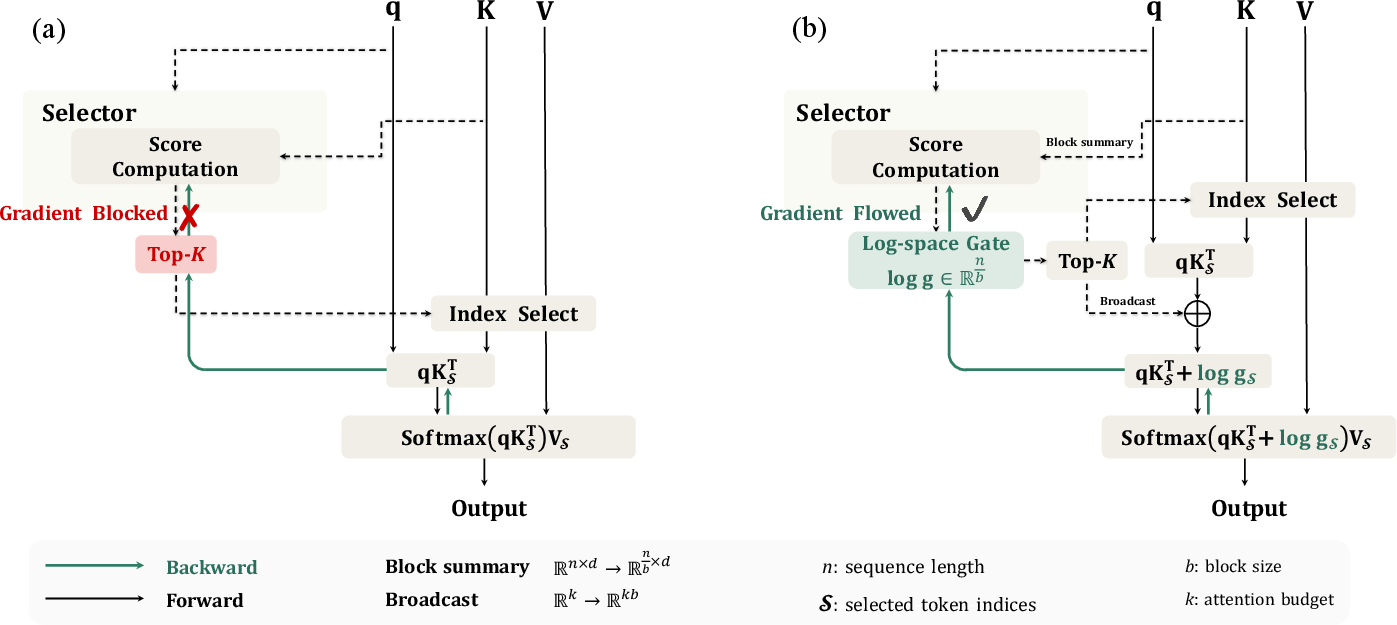
Abstract: Post-training attention sparsification reduces the quadratic cumulative attention cost of pretrained Transformers by selecting a small set of context units (tokens or blocks) for each query. Existing trainable methods usually use a lightweight selector to score context units, followed by hard Top-K selection that blocks gradients from the language modeling loss. Consequently, these methods commonly distill layer-wise dense attention distributions. Although this encourages the selector to rank context units by dense attention weights in the original model, the ranking is not directly aligned with their impact on predictions under a fixed attention budget (i.e., the number of attended context units per query), potentially wasting the limited budget on less useful units. To address this misalignment, we propose Simple Attention Sparsification (SAS), a gated sparse attention mechanism that optimizes context ranking end-to-end with the language modeling loss. The key idea is to inject the selector's continuous scores into attention logits during training, allowing the loss to update the selector through standard backpropagation. We identify several choices crucial for this simple design to work well in practice: placing the gate inside the attention softmax in log form, using normalized softmax gates to calibrate historical context against the always-retained current block, and preserving continuous selector scores so the model learns relative priorities rather than only hard selections. To support long-sequence training, we implement a memory-efficient Triton kernel that integrates SAS into FlashAttention-style computation. Across reasoning, long-context understanding, and agentic tasks, SAS consistently outperforms trainable sparse attention baselines across attention budgets, with especially large gains under tight budgets, demonstrating more effective context ranking for downstream tasks.
Paper Prompts
Sign up for free to create and run prompts on this paper.
Top Community Prompts
Explain it Like I'm 14
1. What is this paper about?
This paper presents a method called SAS, short for Simple Attention Sparsification.
The method helps LLMs, such as ChatGPT-like systems, work with very long texts more quickly and cheaply. Instead of making the model look at every earlier word each time it generates a new word, SAS teaches the model to focus only on the most useful parts of the text.
A simple analogy is studying for a test: rather than rereading an entire textbook for every question, you quickly find the few pages most likely to contain the answer.
2. What questions are the researchers asking?
The researchers mainly want to know:
- Can a LLM learn which parts of a long text are most useful?
- Can it choose those parts based directly on whether they help the model make better predictions?
- Can this selection process be trained without changing the entire LLM?
- Can the model remain accurate while looking at far fewer words?
- What is the best way to train the system to rank useful pieces of context?
The paper focuses especially on a problem with existing methods. Earlier systems often learned to copy the model’s original attention patterns. However, the places the model looks at most are not always the places that are most helpful for its final answer.
3. How does the method work?
Ordinary attention
LLMs use a system called attention. For every new word, the model looks back at previous words and decides how important each one is.
For example, in the sentence:
“Maya dropped the glass because it was slippery.”
To understand what “it” means, the model may need to look back at “glass.” Attention helps the model decide which earlier words matter.
With a very long document, ordinary attention checks all previous words. This becomes slow because the amount of work grows very quickly as the document gets longer.
Sparse attention
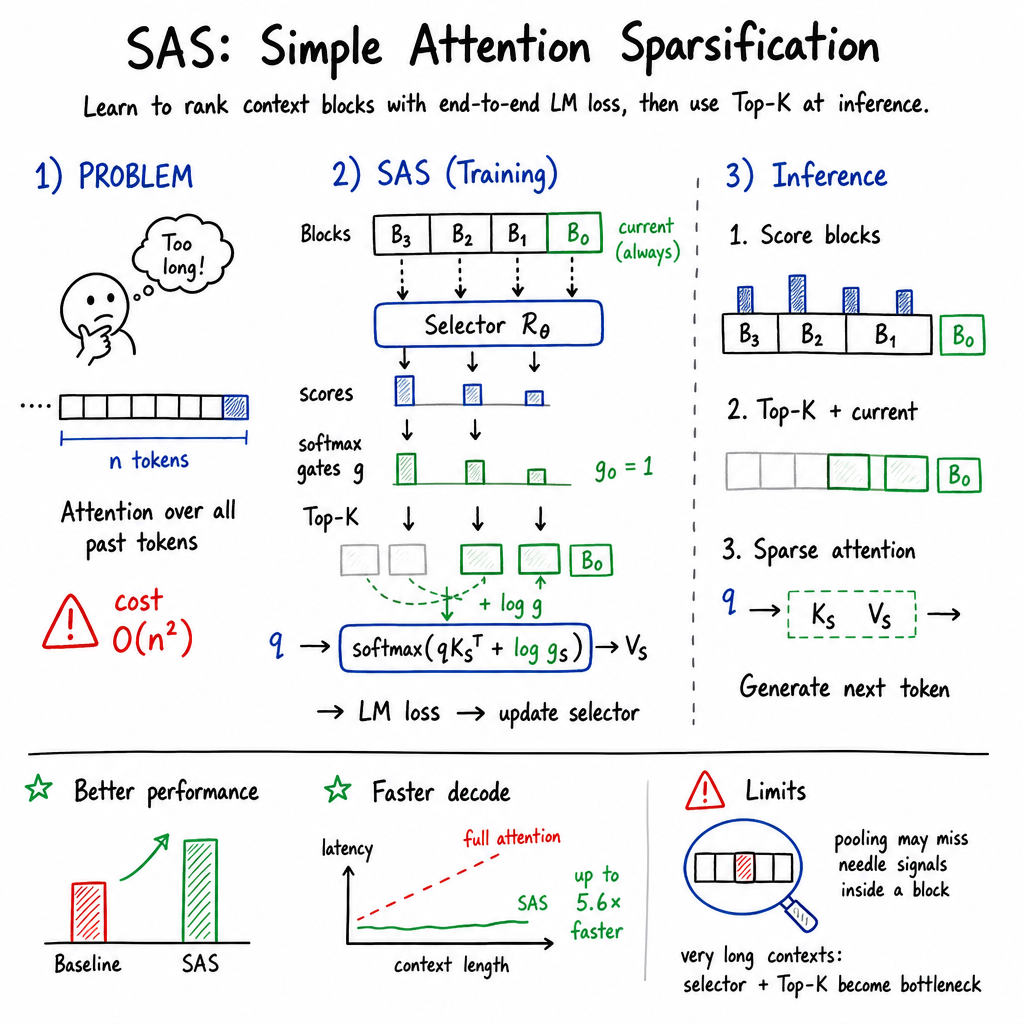
SAS divides the earlier text into small groups called blocks. A block might contain 64 tokens, where a token is a small piece of a word.
Instead of looking at every block, the model chooses the top few blocks that seem most relevant. This is called sparse attention.
If there are 1,000 blocks but the model only examines 32 of them, it can save a large amount of computing time.
The problem with hard selection
The model uses a small extra component called a selector. The selector gives each block a score, like a ranking:
| Text block | Selector score |
|---|---|
| Block A | 0.91 |
| Block B | 0.62 |
| Block C | 0.15 |
The model then chooses the highest-scoring blocks.
However, choosing only the top blocks creates a problem. This decision is like a light switch: a block is either selected or not selected. Because of this, the model’s training signal cannot easily tell the selector how to improve its scores.
This is similar to trying to teach someone to choose the best players for a team, but only telling them whether the final team won or lost—not explaining how each player affected the result.
SAS’s solution: soft gates
SAS still chooses a limited number of blocks during actual use, but during training it gives selected blocks soft scores, or “gates.”
These gates act like adjustable volume controls. A more useful block gets more influence, while a less useful block gets less influence.
The scores are added inside the attention calculation. This allows the model’s normal prediction error—called the language modeling loss—to send feedback directly to the selector.
The selector can then learn:
“This block helped the answer, so I should rank similar blocks higher next time.”
The researchers found that several details are important:
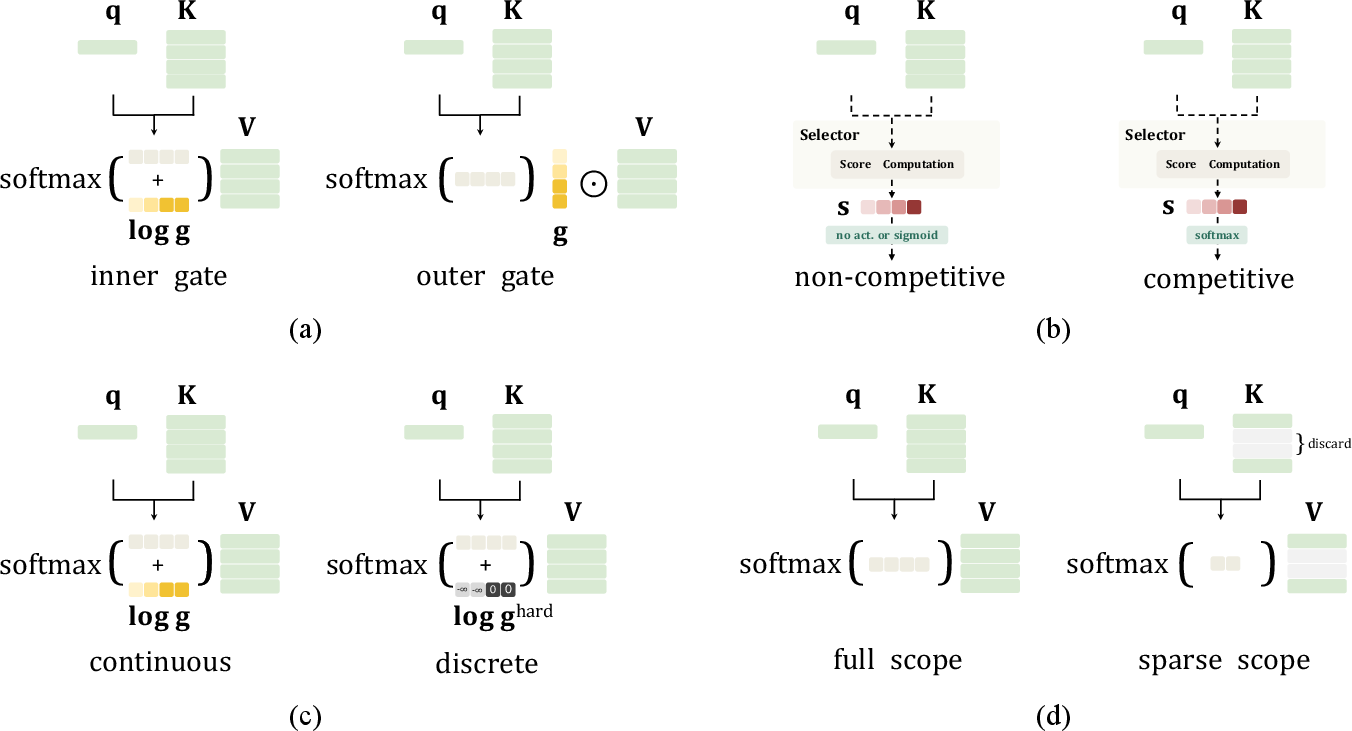
- The gates should affect attention before the attention probabilities are normalized.
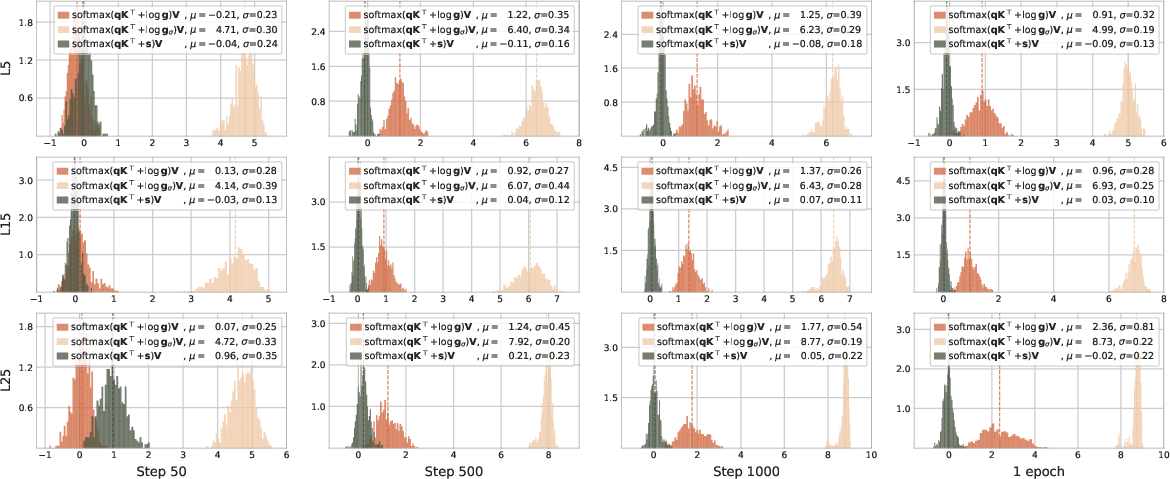
- The block scores should be normalized so they can be compared fairly.
- The system should keep the differences between scores instead of turning everything into a simple yes-or-no choice.
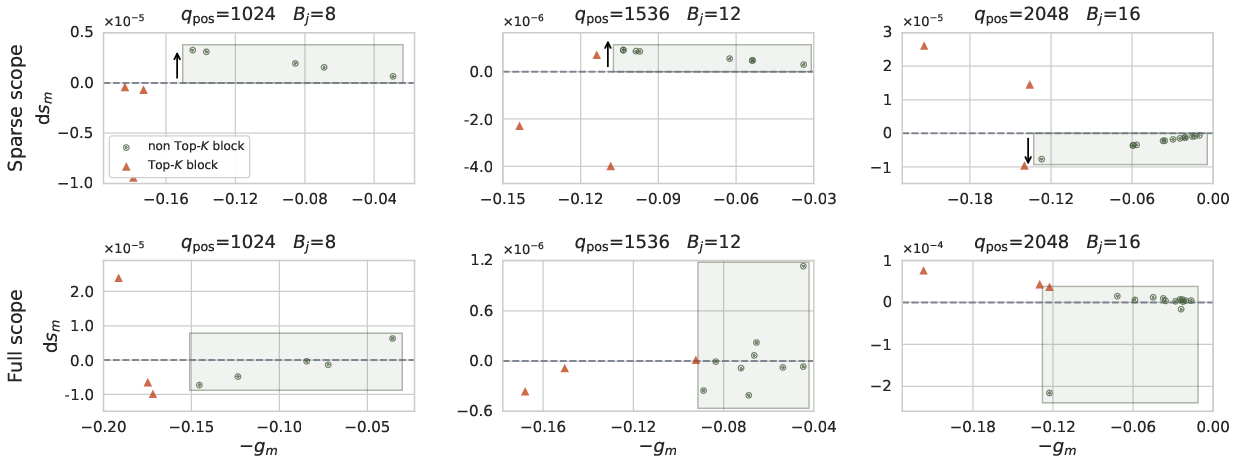
- Training should focus mostly on the blocks that are actually selected, which saves computing power.
The researchers also created a special computer program, using a technology called a Triton kernel, to make this process memory-efficient. This is similar to designing a faster assembly line so the machine does not need to store every intermediate result.
4. What did the researchers find?
SAS usually performed better
The researchers compared SAS with:
- Full attention, which examines all the context
- Earlier sparse-attention systems
- Methods based on fixed rules or guesses about which blocks matter
They tested the systems on several types of tasks:
- Reasoning, including difficult mathematics and science questions
- Long-context understanding, where the answer may be hidden far back in a long document
- Agent tasks, where the model must use tools or carry out several steps
SAS generally performed better than the main trainable comparison system, especially when the model was allowed to examine only a small amount of context.
For example, with a budget of 1,024 tokens, SAS improved over the comparison method by about:
- 6 to 8 percentage points on MATH500
- 11 to 16 percentage points on GPQA-Diamond
These are substantial improvements, especially because the model was using only a small part of the available context.
It worked especially well with tight budgets
When the model could examine more context, the difference between methods became smaller. But when the model had to be very selective, SAS was much better at choosing the most useful information.
This suggests that SAS is learning a better ranking of context blocks rather than simply copying where the original full-attention model looked.
The design experiments supported the method
The researchers also tested different versions of SAS. They found that:
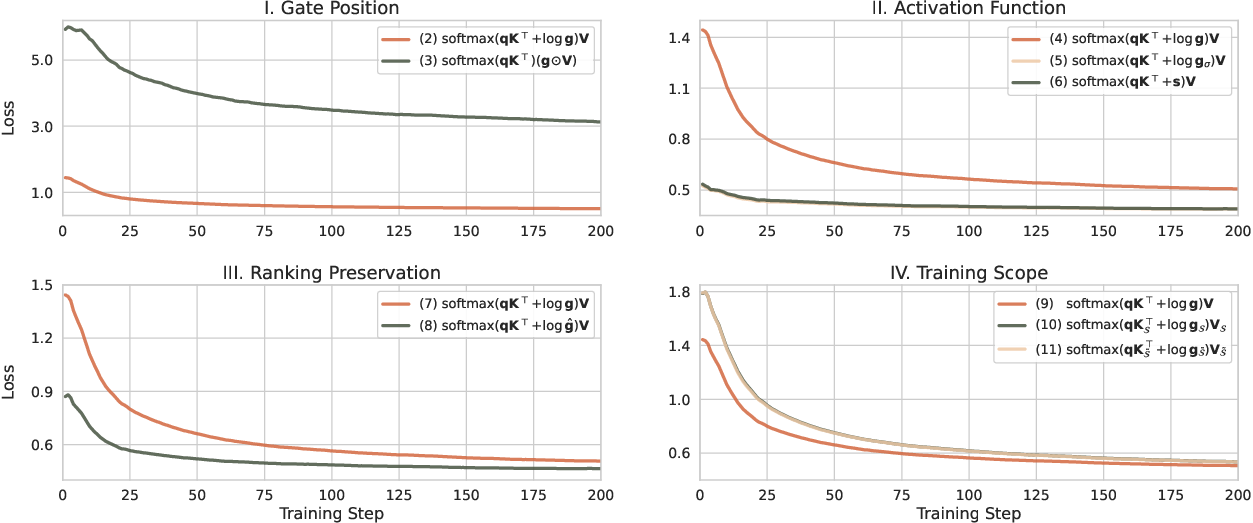
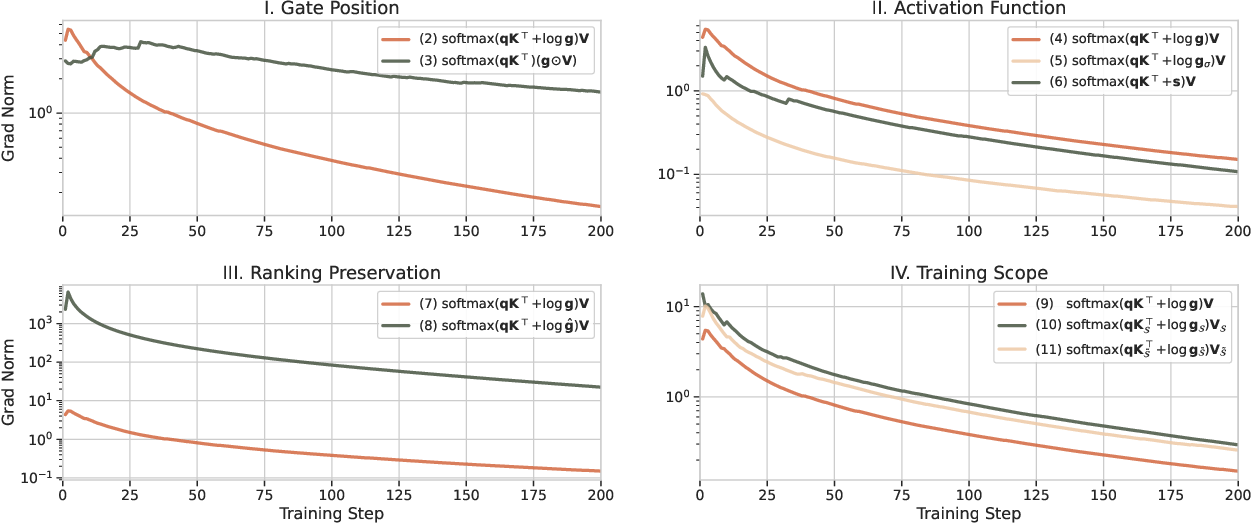
- Putting the gates inside the attention calculation worked better than applying them afterward.
- Normalized scores worked better than independent scores.
- Keeping continuous scores worked better than converting them immediately into hard choices.
- Training only on selected blocks was cheaper and eventually reached similar performance to training on all blocks.
5. Why is this important?
Long-context LLMs can be expensive because they repeatedly examine large amounts of text. SAS could make them:
- Faster when reading long documents
- Cheaper to run
- More practical for long conversations
- Better at handling large files, books, codebases, and records
- More useful for agents that need to remember information over many steps
The most important idea is that SAS trains the model to choose context based on whether that context helps its final prediction—not merely based on where a dense model happened to pay attention.
Conclusion
SAS is a method for helping LLMs focus on the most useful parts of a long text. It divides the text into blocks, ranks those blocks, and lets the model learn from its own mistakes which blocks deserve higher rankings.
The experiments show that SAS can reduce the amount of attention needed while preserving—and sometimes improving—accuracy. Its benefits are especially clear when the model has a very small attention budget.
The research could lead to faster and less expensive LLMs that still understand long documents well. However, the paper mainly tests specific models and tasks, so further research would be needed to determine how well SAS works across other models, languages, and real-world applications.
Knowledge Gaps
Knowledge gaps, limitations, and open questions
- Limited backbone diversity: The evaluation focuses primarily on Qwen3 models at 4B, 8B, and 14B parameters, leaving the method’s effectiveness on other model families, architectures, tokenizer designs, attention variants, and substantially larger models unresolved.
- Narrow training-data diversity: The selector is trained on OpenR1-MATH-220K, while the same checkpoint is evaluated on reasoning, long-context, and agentic tasks. It remains unclear whether the learned ranking generalizes when the training corpus is more diverse or better matched to non-mathematical domains.
- Unclear domain-transfer behavior: The paper does not establish whether selectors trained on one model or domain can be transferred to another model, task distribution, language, or mixture of domains without retraining.
- Incomplete comparison with alternative trainable methods: The main controlled comparison is against SeerAttention-R. Comparisons with other recent learned routing, differentiable Top-, retrieval-based, token-level, and KV-cache selection methods are limited or absent, making the relative advantage over the broader state of the art uncertain.
- Dependence on the AttnGate selector: SAS is instantiated using the SeerAttention-R selector architecture. It is not established whether the gains arise from the SAS objective itself or from interactions specific to AttnGate, nor whether the method works equally well with simpler, larger, token-level, or architecture-aware selectors.
- Block-size sensitivity is underexplored: Most experiments use 64-token blocks. The effects of block size on ranking quality, latency, memory use, fine-grained retrieval, and task accuracy remain unclear, especially for heterogeneous or highly localized information.
- Limited budget coverage: The experiments examine a relatively small set of fixed attention budgets. The method’s behavior under extremely tight budgets, budgets approaching dense attention, and dynamically varying budgets has not been systematically characterized.
- No adaptive-budget mechanism: SAS ranks blocks for a predefined Top- budget, but the paper does not investigate whether the selector can estimate confidence or allocate different numbers of blocks to different queries while preserving quality guarantees.
- Inference-time gate mismatch: Training uses continuous log-space gates, whereas inference removes the gates and applies hard Top- selection followed by ordinary sparse attention. The extent to which this train–test mismatch affects performance, and whether retaining inference-time gate weights would help, is not fully analyzed.
- Unresolved ranking optimality: The paper demonstrates improved task performance but does not show that SAS rankings approximate an optimal subset under the fixed budget. There is no direct comparison with oracle subsets, exhaustive selection on short contexts, or upper bounds based on marginal prediction utility.
- Limited causal analysis of selected context: The experiments do not determine whether selected blocks contain semantically necessary evidence, merely correlate with useful predictions, or exploit systematic positional and formatting artifacts.
- Cross-layer coordination remains insufficiently studied: The paper motivates end-to-end training partly by arguing that layer-wise distillation misses cross-layer complementarity, but it does not quantify how selections coordinate across layers or test explicitly whether joint cross-layer routing provides the claimed benefit.
- Head- and query-group interactions are not fully analyzed: The implementation supports GQA and per-group selection, but the paper does not report how rankings differ across attention heads or query groups, nor whether sharing selectors across heads sacrifices quality.
- Long-context extrapolation is uncertain: Evaluation reaches long contexts such as 65,536 tokens, but it does not establish performance at substantially longer lengths or under context distributions different from training. The stability of ranking quality as the number of candidate blocks grows remains open.
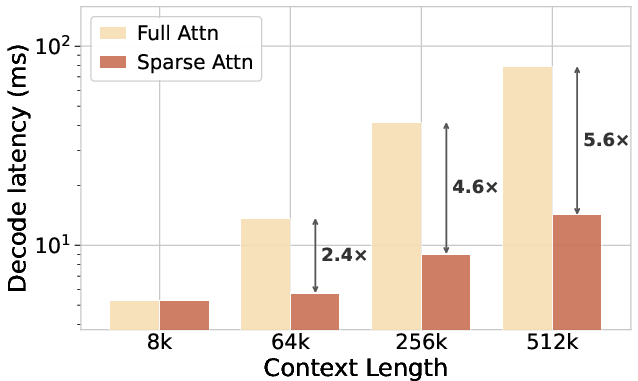
- Prefill cost is not reduced: The inference implementation uses dense attention during prefill and sparse attention only during decoding. For applications dominated by prompt ingestion, the end-to-end latency and energy benefits may therefore be substantially smaller than the reported decode-time gains.
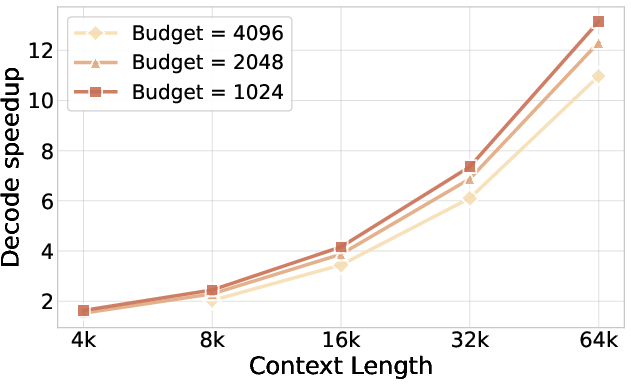
- End-to-end serving benefits are incompletely measured: The paper reports task accuracy and describes a serving implementation, but does not provide comprehensive measurements of wall-clock latency, throughput, peak memory, energy consumption, kernel-launch overhead, and selector-scoring cost across batch sizes and hardware.
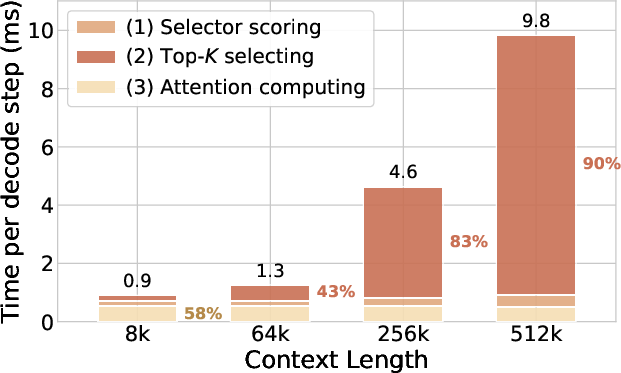
- Selector overhead may reduce theoretical savings: Every decoding step still scores all cached blocks before selecting Top-. The practical break-even point between selector computation, KV gathering, and sparse attention is not established for different context lengths and budgets.
- Hardware and implementation generality are unclear: Results rely on custom Triton, FlashInfer, and SGLang integrations. Portability and performance on other GPUs, accelerators, inference engines, and distributed-serving configurations are not demonstrated.
- Training efficiency is only partially evaluated: Sparse-scope training is reported to reach comparable final performance, but the paper does not fully quantify total training FLOPs, wall-clock time, memory consumption, convergence across random seeds, or the cost of full-scope versus sparse-scope optimization.
- Training stability and reproducibility need broader validation: Ablations are centered on one Qwen3-4B setup and one benchmark. The robustness of the observed gate-activation and ranking-preservation effects across seeds, model scales, datasets, and optimization schedules remains uncertain.
- Sensitivity to initialization and hyperparameters is unexplored: The method may be sensitive to selector initialization, learning rate, temperature or normalization choices, block budget, sequence length, and the ratio of current to historical context, but systematic sensitivity analyses are not reported.
- The role of the always-retained current block is not isolated: SAS fixes the current block’s gate to one, yet the paper does not examine alternative local-context policies, multiple always-retained blocks, or learned treatment of recent context.
- Potential positional bias is not addressed: Contiguous block selection and the always-retained recent block may favor recency or structural positions. The paper does not separate genuine relevance learning from positional heuristics.
- Robustness to adversarial or noisy contexts is unknown: It is unclear whether the selector can reliably retrieve relevant evidence when distractors are inserted, important information is repeated, evidence appears late, or documents contain adversarially positioned content.
- Failure modes on multi-hop reasoning remain unclear: Aggregate benchmark scores do not reveal whether sparse routing consistently preserves all evidence needed for multi-step reasoning, tool use, code execution, or long dependency chains.
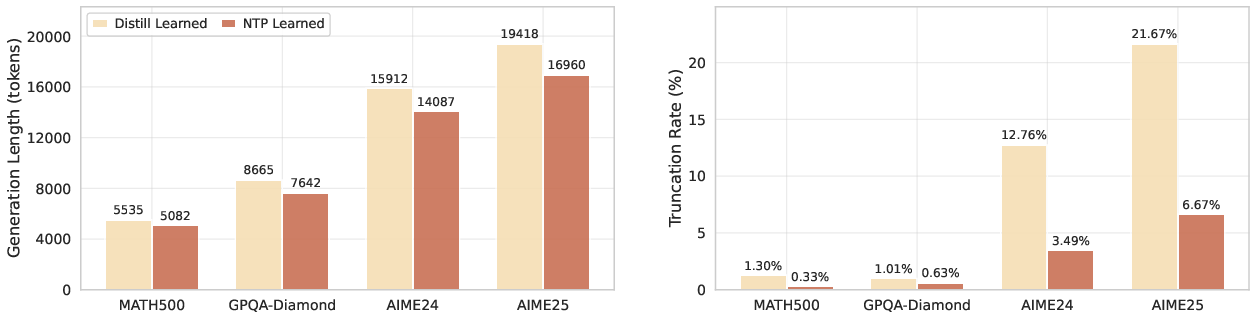
- Generation-quality trade-offs are incompletely characterized: The paper reports accuracy and average generation length in some experiments, but does not comprehensively evaluate calibration, hallucination, factuality, refusal behavior, verbosity, or degradation in free-form generation.
- Safety and alignment effects are unexamined: Because sparsification can remove safety-relevant or instruction-relevant context, its effects on policy adherence, prompt injection resistance, privacy-sensitive retrieval, and harmful-output rates remain unresolved.
- Continued-pretraining results are preliminary: The paper provides only initial evidence for jointly training the backbone and selector. The relative benefits, required compute, catastrophic forgetting risks, and interaction between backbone adaptation and selector learning require systematic study.
- No principled explanation of the optimal gate activation is provided: Softmax normalization performs well empirically, but the paper does not derive conditions under which it is optimal or compare it with temperature-scaled softmax, sparsemax, entmax, or other competitive gating functions.
- Gradient analyses do not directly establish downstream causality: The derivations explain why certain gates produce different gradients, but it remains unproven which gradient properties are necessary for superior final ranking and whether alternative gradient-estimation methods could perform better.
- The impact of selector errors is not quantified: The paper does not report recall of oracle-important blocks, ranking correlation with prediction-impact measures, or how individual selection mistakes propagate through multiple layers and decoding steps.
- Evaluation uncertainty is unevenly reported: Some baselines are extracted from figures or reproduced, and standard deviations are omitted in certain ablations. More complete multi-seed confidence intervals and statistically controlled comparisons would be needed to establish the reliability of smaller gains.
- The method’s applicability beyond block sparsity is unresolved: SAS is demonstrated for block-level routing, but it is not shown whether the same end-to-end gated formulation transfers effectively to token-level sparsification, hybrid local-global patterns, structured retrieval, or layer-specific budgets.
Practical Applications
Immediate Applications
- Cost- and latency-efficient long-context LLM serving — software/cloud infrastructure.
Integrate SAS-style learned block selection into existing Transformer serving stacks, such as
SGLang,FlashInfer, or paged-KV-cache systems. During decoding, a lightweight selector can rank cached context blocks and retain only the Top- blocks plus the current block, reducing per-query attention from to approximately . This can lower GPU memory bandwidth, inference latency, and serving cost for long prompts and long generated responses. Dependencies: the model must support block-partitioned KV caches; selector overhead must remain smaller than the attention savings; quality must be validated at the chosen budget; specialized GPU kernels are needed for efficient block gathering. - Drop-in acceleration for already deployed dense LLMs — enterprise AI and model serving. Because SAS freezes the pretrained backbone and trains only a lightweight selector, organizations can adapt existing dense models without full architectural retraining. A practical workflow is: train a selector on representative language-modeling data, export its checkpoint, and load it as an alternative sparse-attention backend while retaining the original dense model as a fallback. Dependencies: the selector may need to be trained separately for substantially different model families, domains, context lengths, or positional-encoding configurations. The paper’s strongest evidence concerns Qwen3 models and specific task distributions.
- Long-document question answering and summarization — legal, finance, healthcare, and research. Deploy SAS for documents containing contracts, filings, medical records, technical manuals, or papers. The selector can preserve relevant historical blocks while avoiding dense attention over the entire document, making long-context retrieval and generation more affordable. It is especially suitable when the relevant evidence is distributed across a long context rather than confined to a fixed local window. Dependencies: block granularity can cause relevant information to be omitted when useful tokens are scattered across blocks. Safety-critical domains require answer-quality, citation, and omission testing against dense attention.
- Long-horizon reasoning and code generation — education, programming tools, and scientific computing. The reported gains on MATH500, GPQA-Diamond, AIME, and long-context benchmarks suggest use in systems that maintain long chains of reasoning, large codebases, notebooks, or multi-file software projects. A coding assistant could selectively attend to files, functions, prior tool outputs, and earlier reasoning traces while keeping the active context within a fixed budget. Dependencies: reasoning traces may contain information whose relevance is difficult to predict early. Production systems should monitor for silent failures and support dynamic budget increases when confidence is low.
- Agentic systems with extended interaction histories — software agents and customer-service automation. SAS can be integrated into agents that accumulate tool calls, observations, plans, and dialogue turns. The learned ranking can select historically useful interaction blocks while retaining the most recent block, reducing decode cost in multi-turn tasks. The paper’s BFCL and VitaBench results provide direct motivation for this use case. Dependencies: tool outputs can have delayed importance; irreversible omission of a block may corrupt the agent’s state. Systems should retain immutable external memory or allow retrieval and budget escalation.
- Efficient batch inference and concurrent serving — cloud platforms and edge deployment. The reported support for grouped-query attention, CUDA graph capture, paged KV caches, and batched decoding makes SAS applicable to multi-user serving. Providers can expose configurable attention budgets, trading response quality for throughput or latency according to workload priorities. Dependencies: selector execution, block indexing, and irregular memory access may limit realized speedups, especially for small batches or short contexts. End-to-end benchmarks must measure wall-clock performance rather than infer it solely from asymptotic complexity.
- A reproducible research baseline for learned context ranking — academia. Researchers can use the open-source implementation and Triton kernel to study post-training sparse attention without relying on dense-attention distillation. The method provides a controlled baseline for comparing selector architectures, block sizes, training scopes, attention budgets, and domain-specific adaptation strategies. Dependencies: fair comparisons require matched backbones, selectors, data, inference kernels, and evaluation protocols. Results may vary with selector capacity, training length, and context distribution.
- Adaptive inference-quality controls — AI platform operations and daily productivity tools. Applications can expose several pre-trained selector budgets, for example 1,024, 2,048, and 4,096 tokens. A latency-sensitive request can use a low budget, while difficult queries, low-confidence answers, or high-value workflows can automatically fall back to a larger budget or dense attention. Dependencies: an effective confidence or uncertainty signal is not provided by SAS itself. Budget switching must be calibrated to avoid excessive quality degradation or unpredictable latency.
- Energy-efficient local LLM use — laptops, mobile devices, and private infrastructure. By reducing KV-cache reads and attention computation, SAS can make long-context generation more feasible on constrained hardware. Potential products include offline document assistants, private coding assistants, and long-running personal agents that avoid sending context to a cloud service. Dependencies: actual energy savings depend on kernel support, memory traffic, selector overhead, and hardware architecture. The paper does not establish battery or energy measurements.
Long-Term Applications
- Domain-specialized sparse LLMs for regulated sectors — healthcare, law, and finance. Organizations could train selectors on domain-specific language-modeling data so that block ranking reflects specialized prediction behavior—for example, prioritizing medication history in clinical notes, governing clauses in contracts, or risk disclosures in financial filings. This could produce domain-adapted sparse models with lower operating costs. Dependencies: domain adaptation must preserve privacy and comply with sector-specific regulation. Selective attention can amplify omissions, so audit trails, dense-attention comparison, human review, and formal safety evaluations are required.
- Joint optimization of the backbone and selector — next-generation model training. The paper provides initial evidence that SAS extends to continued pretraining. A longer-term direction is to train the Transformer and selector jointly from the beginning or during mid-training, allowing the model to develop representations compatible with sparse routing rather than adapting a dense model after pretraining. Dependencies: joint training may introduce routing collapse, instability, or reduced compatibility with dense checkpoints. Large-scale experiments are needed to determine whether training-time savings offset the added optimization complexity.
- Dynamic or token-level budgets — adaptive-compute reasoning systems. Instead of assigning every query the same Top- budget, future systems could use selector confidence, query difficulty, or predicted uncertainty to allocate more blocks to difficult reasoning steps and fewer blocks to routine tokens. This could combine SAS with early-exit or test-time-compute strategies. Dependencies: the current method uses a fixed budget and block-level selection. Reliable confidence estimation, differentiable budget control, and safeguards against under-allocation are needed.
- Hierarchical memory for autonomous agents — robotics and embodied AI. SAS could become one layer of a hierarchical memory system: recent observations remain active, medium-term experiences are ranked by the selector, and older information is retrieved from external memory when needed. This is relevant to robots operating over long missions, where sensor histories, maps, plans, and tool interactions exceed the active context window. Dependencies: the paper evaluates language-model tasks rather than embodied control. Real-world deployment requires temporal consistency, multimodal selectors, robust recovery from omitted state, and latency guarantees.
- Multimodal sparse attention — vision-language and audio-language systems. The same gated-ranking principle could select image patches, video segments, audio windows, or multimodal memory blocks. End-to-end optimization against the task loss may rank units by their effect on final predictions rather than by dense attention weights alone. Dependencies: modalities have different spatial and temporal structures; contiguous text blocks may not be an appropriate unit. Multimodal kernel support and task-specific selectors would require substantial development.
- Learned retrieval and KV-cache management — information retrieval and model-memory systems. SAS selectors could supply a model-native ranking signal for cache retention, context compression, or retrieval prefetching. A serving system might use selector scores to decide which KV blocks to keep resident on GPU, which to move to CPU memory, and which to reload on demand. Dependencies: attention relevance is query-dependent and may differ from long-term memory value. Cache eviction must account for future queries, not only the current prediction, and must avoid costly data movement.
- Robust sparse attention with safety-aware routing — high-assurance AI. Future products could combine SAS with redundancy mechanisms: retain safety policies, system instructions, provenance blocks, or legally required disclosures regardless of selector scores, while using learned ranking for the remaining context. This would make sparse attention more suitable for regulated assistants and autonomous systems. Dependencies: identifying mandatory content requires external rules or classifiers. The paper’s current always-retained current block does not guarantee preservation of all globally important instructions.
- Compiler and hardware co-design for learned block sparsity — GPU, accelerator, and systems research. The Triton kernel demonstrates that gates can be fused into FlashAttention-style tiled computation. Longer term, hardware and compilers could support native Top- block routing, sparse KV-cache gathering, selector execution, and dynamic memory layouts, improving the gap between theoretical and practical speedups. Dependencies: irregular per-query routing can reduce hardware utilization and complicate scheduling. Benefits will depend on block size, workload regularity, accelerator memory hierarchy, and efficient support for batched heterogeneous budgets.
- Standardized evaluation and governance for context omission — policy and academia. The method motivates benchmarks that measure not only average accuracy but also omission risk: whether sparse routing drops critical facts, safety instructions, citations, or personally relevant information. Such evaluations could inform deployment policies specifying when sparse attention is acceptable and when dense fallback is mandatory. Dependencies: benchmark coverage must include adversarially placed evidence, long-range dependencies, distribution shifts, and safety-critical scenarios. The paper’s reported improvements do not by themselves establish reliability across these conditions.
- Personal productivity systems with privacy-preserving long-term memory — daily life. A personal assistant could maintain years of notes, messages, schedules, and documents while using SAS to select relevant historical blocks during each interaction. This may reduce local compute and permit larger private memories on consumer hardware. Dependencies: personal data requires strong access control, deletion guarantees, and transparent provenance. Selective routing must not cause the assistant to overlook commitments, health information, or user-specified preferences.
Glossary
- Agentic tasks: Tasks involving autonomous or tool-using agents that must perform multi-step actions. “Across reasoning, long-context understanding, and agentic tasks, SAS consistently outperforms trainable sparse attention baselines across attention budgets”
- Autoregressive decoding: Sequential generation in which each new token is produced using previously generated tokens. “During autoregressive decoding, each new query attends to all previous keys and values.”
- Backbone LLM: The main pretrained LLM whose parameters support an additional module or adaptation. “The LLM backbone is frozen during training.”
- Block sparse attention: An attention mechanism that restricts each query to selected groups of tokens rather than the full context. “This section reviews the attention computation underlying autoregressive LLMs and block sparse attention”
- Broadcast gates: Replicating a single gating value across all elements in a designated group. “For each historical block , the gate is broadcast to all tokens in that block”
- Cumulative attention cost: The total computational cost of attention accumulated over all decoding steps. “This makes the cumulative attention cost grow quadratically with context length.”
- CUDA graph capture: A GPU execution technique that records and replays a sequence of CUDA operations to reduce launch overhead. “The backend supports grouped query attention (GQA) with per-group block selection, CUDA graph capture for the decode path, and batched concurrent decoding.”
- Dense attention: Attention in which every query attends to all available keys and values. “Since many high-performing LLMs are already deployed with dense attention, practice favors inference-efficient methods that avoid architectural changes or retraining.”
- Dense-attention distillation: Training a sparse model or selector to reproduce attention distributions from a dense model. “However, hard Top- selection prevents language-modeling gradients from directly updating the selector, so existing methods often rely on dense-attention distillation”
- Differentiable activation: A function whose derivatives allow gradients to pass through it during optimization. “where is a differentiable activation function and leaves the current block unbiased.”
- Differentiable ranking: Learning an ordering of items using operations that permit gradient-based optimization. “To make block ranking learnable, the selector scores must affect the attention computation during training.”
- Discrete selection: Choosing items from a set using non-continuous decisions, such as binary inclusion or exclusion. “Sparse attention with discrete Top- selection prevents gradients propagation from language modeling loss to selector.”
- End-to-end optimization: Jointly optimizing a component using the final task objective rather than an intermediate proxy objective. “In this work, we explore end-to-end optimization of context selection with the language modeling loss.”
- FlashAttention: A memory-efficient attention algorithm that computes attention in tiles without materializing the full attention matrix. “our kernel fuses the gate addition into the tile-level computation in FlashAttention”
- FSDP: Fully Sharded Data Parallel, a distributed-training method that shards model parameters, gradients, and optimizer states across devices. “Our implementation builds on VeOmni~\cite{ma2025veomni} with FSDP distributed training.”
- Gated attention: Attention modified by learned multiplicative or additive factors that control the contribution of tokens or blocks. “SAS, a gated sparse attention mechanism that optimizes context ranking end-to-end with the language modeling loss.”
- Grouped query attention (GQA): An attention architecture in which multiple query heads share key and value heads. “The backend supports grouped query attention (GQA) with per-group block selection”
- Hard Top- selection: Selecting exactly the highest-scoring items using a discrete operation. “The selector chooses the most important blocks from all context blocks”
- Historical context: Previously processed context excluding the currently active token block. “The activation function determines how the selector calibrates historical context against the always-retained current block.”
- Inference-time sparsification: Reducing computation during model inference by selectively processing only part of the input context. “Inference time attention sparsification / KV-cache selection.”
- Language modeling loss: The objective measuring how well a LLM predicts target tokens. “The key idea is to inject the selector's continuous scores into the attention logits during training, allowing the language modeling loss to update the selector through standard backpropagation.”
- Log-space gate: A gate represented as an additive logarithmic bias to attention logits, producing multiplicative weighting after softmax. “during training, blockwise scores from selector are interpreted as log-space gates”
- Long-context inference: Generating model outputs while processing unusually long input sequences. “Long-context inference has become a critical efficiency bottleneck for LLMs”
- Memory-efficient kernel: A specialized GPU computation routine designed to reduce intermediate memory usage. “To support long-sequence training, we implement a memory-efficient Triton kernel”
- Online softmax: A streaming softmax computation that updates normalization statistics incrementally rather than storing all logits. “and performs the standard online update.”
- Paged KV cache: A memory-management scheme that stores key–value cache data in separately addressable blocks or pages. “built on top of its paged KV cache and FlashInfer~\cite{ye2025flashinfer} attention kernels.”
- Post-training attention sparsification: Converting a pretrained dense-attention model into a sparse-attention model after pretraining. “This motivates post-training attention sparsification”
- Prefill/decode pipeline: The division of language-model inference into processing the initial prompt and generating subsequent tokens. “Following the standard prefill/decode pipeline of LLM serving”
- Quadratic attention cost: Attention complexity that grows proportionally to the square of sequence length. “This makes the cumulative attention cost grow quadratically with context length.”
- Ranking misalignment: A mismatch between the ordering learned by an optimization target and the ordering that best serves the final task objective. “However, this surrogate supervision can induce a ranking misalignment”
- Sparse scope training: Training in which computation and gradient updates are restricted to selected context blocks. “Training scope mainly affects efficiency: sparse scope training converges more slowly at first but gradually approaches full scope”
- Straight-through estimator (STE): An optimization technique that uses a discrete operation in the forward pass while substituting a differentiable approximation during backpropagation. “a hard Top- gate using STE”
- Selector: A lightweight model component that assigns relevance scores to context tokens or blocks. “A selector is a lightweight module that scores context units for each query”
- Soft gate: A continuous weighting factor that preserves relative differences among selected items. “SAS keeps discrete Top- selection but attaches a continuous soft gate to each selected block”
- Softmax normalization: Exponentiating scores and normalizing them so that they form a probability distribution. “The scores are converted into normalized gates ”
- Streaming scan: Processing data sequentially in tiles or chunks while maintaining intermediate computation statistics. “During the streaming scan over key--value tiles, the kernel adds the normalized log gate”
- Surrogate supervision: An auxiliary training signal used in place of the final task objective. “However, this surrogate supervision can induce a ranking misalignment”
- Tile-level computation: Performing a matrix operation on small submatrices rather than materializing the full matrix. “our kernel fuses the block gate into the tile-level $\mathbf{q}\mathbf{K}_{\mathcal{S}^\top$ computation.”
- Triton kernel: A GPU kernel implemented using Triton, a programming framework for writing optimized tensor operations. “We implement a FlashAttention-style Triton kernel”
- Unnormalized logits: Raw scores used directly as attention biases without normalization. “and unnormalized logit injection, which adds directly to attention logits.”
- Vanishing or blocked gradients: Gradients that become zero or fail to pass through a computation, preventing parameter updates. “Because hard Top- selection is non-differentiable, these methods commonly train selectors through layer-wise distillation”
- Value contribution: The portion of an attention output supplied by the value vectors associated with selected keys. “the gate only rescales the value contribution of each block.”

