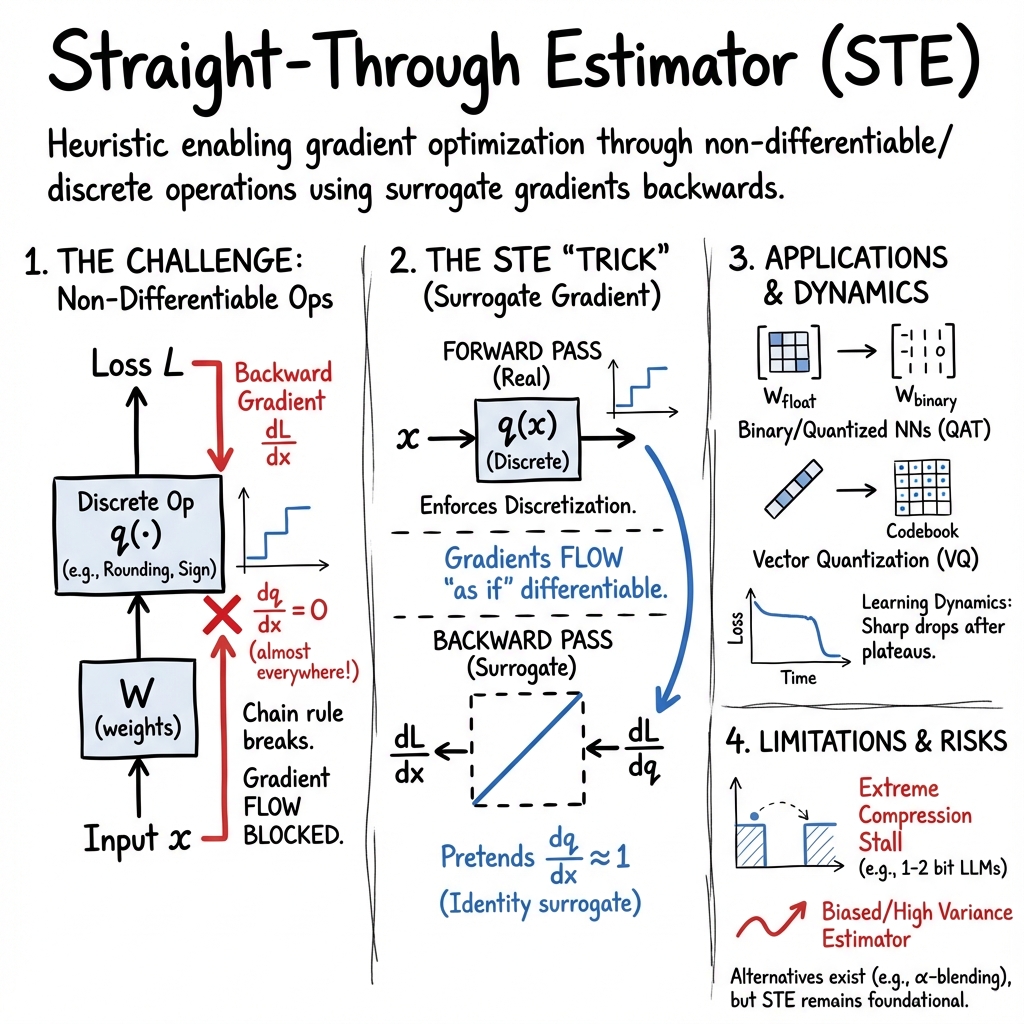
Straight-Through Estimator (STE)
- STE is a heuristic that uses surrogate gradients during backpropagation to enable end-to-end training despite non-differentiable quantization or discrete operations.
- It plays a critical role in training binary neural networks, quantization-aware models, and discrete latent variable systems by facilitating gradient flow.
- Its performance relies on careful surrogate selection and hyperparameter tuning, with ongoing research addressing challenges like bias-variance tradeoffs and convergence issues.
The straight-through estimator (STE) is an algorithmic heuristic that enables gradient-based optimization of models containing non-differentiable or discrete operations by substituting in surrogate gradients during the backward pass. STE originated as a workaround for training binary neural networks, but has since become foundational in a range of domains requiring end-to-end training through quantization, discretization, or other non-smooth modules. Despite its widespread adoption, the theoretical understanding and practical consequences of STE, especially in finite-sample regimes and high-compression settings, have been the subject of ongoing research, yielding a nuanced picture of both its capabilities and its limitations.
1. Mathematical Formalism and Variants
Let denote a non-differentiable quantization or discretization operator (e.g., a rounding or sign function), and the loss function with respect to model parameters . The core challenge is that is zero almost everywhere, precluding gradient-based updates in standard backpropagation. The STE circumvents this by approximating the backward derivative as if were the identity, i.e.,
During the forward pass, enforces discretization; in the backward pass, gradients flow unimpeded through , “pretending” that is differentiable. This mechanism enables standard optimization algorithms (SGD, Adam) to train networks containing binary, integer, or one-hot-valued components.
Numerous variants of STE have been proposed. These include replacing the backward identity with surrogates such as the derivative of the hard sigmoid, clipped ReLU, finite-difference approximations, or using stochastic smoothing via convolution with a noise distribution (as in additive noise annealing or stochastic regularization). In context-specific applications, one also finds Gumbel-Softmax-based straight-through estimators (ST-GS) for categorical variables, and generalized STEs (G-STE) which transmit gradients not only through the immediate quantized value but also through auxiliary threshold or partitioning parameters as in non-uniform quantization (Liu et al., 2021).
2. Theoretical Foundations and High-Dimensional Dynamics
The theoretical basis for STE effectiveness, especially in non-convex or high-dimensional settings, has evolved significantly. Early heuristic justification was supplemented by rigorous analysis of its “coarse” gradient: when the surrogate is properly chosen (e.g., the derivative of a clipped ReLU for binary activations), the expected coarse gradient is positively correlated with the population gradient, and following its negative direction yields descent in the loss function (Yin et al., 2019). In contrast, poor choices of the surrogate can yield instability and loss of convergence.
In the high-dimensional limit (as model width ), the detailed stochastic learning dynamics of quantized models under STE become tractable at the level of macroscopic order parameters such as alignment with the teacher vector (overlap) and weight norm. These macroscopic states follow deterministic ODEs, and the evolution of generalization error can be described as plateauing (a slow phase) followed by a sharp drop, where the plateau length depends on quantization hyperparameters, especially the quantization range (Ichikawa et al., 12 Oct 2025). The bit-width and quantization range modulate the moments (e.g., first and second moments under the quantizer), directly affecting both transient learning dynamics and final error floor.
Recent finite-sample analyses have established sample complexity requirements for successful STE-based optimization. When training a quantized two-layer network (with binary weights/activations), the number of required samples 0 must scale as 1 (with 2 the ambient dimension) to guarantee ergodic convergence near the global minimum, with slower convergence (and recurrence phenomena) for last-iterate guarantees in the presence of noise (Jeong et al., 23 May 2025). These studies rely on tools from compressed sensing (e.g., restricted isometry properties) and dynamical systems theory to show that, with sufficient data, the drift of the surrogate gradient overcomes stochastic fluctuations introduced by finite sampling and label noise.
3. Methodologies and Applications
The universalization of STE has led to diverse application scenarios:
- Quantization-aware training (QAT): STE enables propagation of gradients through quantization operators (binarization, ternarization, uniform/non-uniform quantization). Variants such as additive noise annealing view STE as deterministic smoothing under an appropriate noise model, and synchronization across layerwise noise schedules is essential for compositional convergence of multilayer QNNs (Spallanzani et al., 2022).
- Binary neural networks (BNNs): STE is used to enable end-to-end optimization of networks with 1-bit weights and/or activations. Adaptations such as AdaSTE use data-dependent, coordinate-wise adaptive step sizes to address vanishing gradients and enhance convergence (Le et al., 2021). Recent formulations view the optimal estimator as balancing the gradient estimating error and stability (variance), motivating spectrum families such as the Rectified STE (ReSTE), which permit interpolating between stable (large error) and accurate (unstable) regimes via a tunable power parameter (Wu et al., 2023).
- Vector-quantized models and codebooks: In vector quantized networks (VQNs), discrete codebook assignments introduce non-differentiability. STE is effective but suffers from code utilization collapse and gradient mismatch; solutions include affine reparameterization of the codebook and synchronized optimization to better align moments and reduce the gradient gap (Huh et al., 2023).
- Discrete latent variable models: For problems involving discrete choices (e.g., referential games, discrete VAEs), the ST-GS estimator permits backpropagation through categorical variables. Enhancements such as decoupling the forward and backward temperature parameters (decoupled ST-GS) allow independent control over sampling discreteness and gradient smoothness, resulting in optimized bias-variance trade-offs for estimated gradients (Shah et al., 2024).
- Optimization under hardware and system constraints: In analog compute-in-memory (CIM) hardware, differentiation through highly complex, non-differentiable hardware noise models is handled using an extended STE scheme: forward pass includes full hardware noise simulation, while the backward pass remains tractable (identity gradient), yielding substantial accuracy, speed, and memory improvements compared to brute-force noise awareness (Feng et al., 16 Aug 2025).
- Sparse recovery and learning with constraints: Beyond neural network quantization, STE has been adapted to sparse support recovery (sea algorithm) (Mohamed et al., 2023) and to training networks under explicit logical (CNF) constraints (“CL-STE”), where it enables learning from constraints via surrogate gradients (Yang et al., 2023).
4. Limitations, Alternatives, and Improvements
Despite empirical success, several limitations of standard STE are well documented:
- Sub-optimality in extreme compression: In highly coarse quantization (1–2 bits per parameter), the standard STE may “stall” if the surrogate gradient update is too small to induce a change between quantized levels. This is particularly problematic for LLMs or other large models where the quantization grid is coarse and the gradient noise accumulates, leading to oscillations or sub-optimal convergence (Malinovskii et al., 2024).
- Bias-variance tradeoff and estimator instability: STE gradients are typically biased estimators of the true gradient and can suffer from high variance, especially near quantization boundaries. Controlled additive noise approaches, or noise-proxy variants (as in NIPQ), are devised to regularize and stabilize the optimization (Shin et al., 2022, Wang et al., 2022).
- Theoretical equivalence with custom estimators: Studies now show that, under suitable scaling of learning rates and weight initialization, a broad class of custom gradient estimators are essentially equivalent to STE in the small learning rate regime, especially under adaptive optimizers such as Adam (Schoenbauer et al., 2024). This challenges the notion that improved gradient surrogate shapes alone can deliver consistent empirical improvements.
- Alternatives to STE: Methods such as alpha-blending (Liu et al., 2019) avoid STE altogether by constructing affine combinations of the quantized and continuous weights, providing fully differentiable graphs for backpropagation and improving both theoretical interpretability and empirical performance.
5. Impact of Hyperparameters and Discrete Learning Dynamics
Quantization-specific hyperparameters such as bit width (3) and quantization range (4) profoundly influence both the generalization error dynamics and asymptotic performance under STE. Analytical results in the high-dimensional limit show that these hyperparameters set the effective drift and noise in the ODE describing coarse-grained learning, with range selection mediating both error floor and convergence rate (Ichikawa et al., 12 Oct 2025). The interplay between quantization parameters and learning-rate schedules must therefore be tuned in concert for successful optimization, especially in joint quantization of both weights and activations.
In addition, for multi-layer and compositional networks, synchronizing annealing schedules or surrogate choices across layers is critical: pointwise convergence to the target stair or quantized function may fail if one layer’s smoothing is delayed relative to others (Spallanzani et al., 2022).
6. Theoretical Extensions and Future Research Directions
Recent work recasts the STE as a simulation of projected Wasserstein gradient flow (pWGF) (Cheng et al., 2019), providing a formal geometric underpinning for its success, and suggests that more generalized projection distances (such as MMD) can further improve performance on distributions with infinite support. Finite-sample convergence guarantees, recurrence properties under label noise, and formal linkages to ergodic theorems expand the toolkit for analyzing discrete learning dynamics (Jeong et al., 23 May 2025).
Ongoing research explores more expressive or hardware-aligned surrogate gradients, adaptive and subspace-specific step size tuning, and explicit trade-offs between estimator bias, variance, and optimization stability. Structured quantization, discrete compressed fine-tuning (for LLMs), and analog domain deployment remain active frontiers where extensions and rigorous understanding of STE will continue to play a central role.