HarnessDev: Can LLMs Create and Evolve Their Own Agent Harness?
Abstract: As agents move from research prototypes to deployed tools, their capability increasingly depends on model-external execution infrastructure, commonly termed the agent harness. Changing this harness while holding model weights fixed can substantially alter task performance. Current agent evaluations typically report downstream performance under a chosen harness, leaving a model's ability to develop the harness itself comparatively underexplored. We introduce HarnessDev, a benchmark that shifts the unit of evaluation from task outputs to runnable infrastructure. HarnessDev covers two stages. In Creation, the agent starts from a minimal seed and a small number of cases, then builds a complete execution system. In Evolution, it starts from its own created harness and iteratively revises it using downstream execution feedback, with the goal of improving benchmark performance. We then evaluate each constructed harness on capability (task success on held-out benchmarks) and efficiency (execution-token cost). The reported Creation results cover six creator LLMs, four domains, and five downstream benchmarks totaling 2,207 unique downstream instances, with hidden evaluation tasks withheld from development. We find that generated harnesses remain substantially behind mature human-engineered references on code and on search and research, while matching or exceeding the selected references on writing and machine-learning experimentation, with large variation in execution cost. Evolution produces some performance gains, but they are unstable and transfer only partially to held-out tasks. Experiments with a fixed runtime model further show that the gains depend strongly on the model executing the harness, indicating limited transfer across models.
First 10 authors:
Paper Prompts
Sign up for free to create and run prompts on this paper.
Top Community Prompts
Explain it Like I'm 14
1. What is this paper about?
This paper asks a new question:
Can LLMs build and improve the software systems that help them solve tasks?
An LLM is the LLM behind tools such as coding assistants and research assistants. However, the model alone is not enough. It needs a surrounding software system called a harness.
A harness is like the control center around the model. It decides:
- how the model uses tools,
- how it remembers information,
- how it plans steps,
- how it checks its own work,
- what it does when something goes wrong,
- and when it should stop.
The paper introduces a benchmark called HarnessDev to test whether LLMs can create these systems and make them better over time.
2. What questions are the researchers asking?
The paper focuses on two main research questions.
Creation
Can an LLM build a useful harness starting from a very simple, partly empty system?
This is similar to giving a student a basic toolbox and asking them to design a complete machine that can solve different kinds of problems.
Evolution
Can an LLM improve a harness that it created earlier?
The researchers want to know whether the LLM can look at results, find mistakes, change the harness, and make it work better without damaging parts that already worked.
They also study several related questions:
- Do harnesses work well on new tasks, or only on the examples used during development?
- Do harnesses remain useful when a different LLM runs them?
- How much do they cost to operate?
- Are larger and more complicated harnesses always better?
- Can the LLM recognize and fix important weaknesses?
3. How did the researchers study this?
Building the harnesses
The researchers tested six different LLMs as creator models. These models were asked to build harnesses for several areas:
- computer programming,
- machine-learning experiments,
- writing,
- and online research.
Each model began with the same weak starting system. This starting system could accept instructions and use basic tools, but it had no real planning, memory, checking, retrying, or recovery abilities.
The creator model had to add these features.
For example, a model might need to build a coding harness that can:
- inspect a software project,
- decide what files to change,
- edit the files,
- run tests,
- notice failures,
- try again,
- and check whether the final answer is correct.
Testing the harnesses
After a harness was created, it was frozen, meaning that no more changes were allowed. The researchers then used it to solve many tasks.
They measured two main things:
- Capability: How many tasks did the harness solve correctly?
- Efficiency: How many tokens did the running model use?
Tokens are small pieces of text processed by an LLM. More tokens usually mean more computation, time, and money.
The researchers also used held-out tasks. These are tasks hidden from the creator model during development. They are like a final exam: they show whether the harness learned a general skill instead of memorizing practice questions.
Testing evolution
For the evolution experiments, a model started with a harness it had already created. It received results from a set of coding tasks and was allowed to revise the harness several times.
The researchers then checked whether the changes helped on:
- the tasks the model had seen feedback from,
- new hidden tasks,
- and tasks run by a different LLM.
This helped the researchers detect overfitting. Overfitting happens when a system becomes better at the practice questions but not at new questions.
4. What did the researchers find?
LLMs can build working harnesses
The models were able to turn the weak starting system into functioning harnesses. This is important because it shows that LLMs can do more than answer questions or write small pieces of code. They can also design the larger software system that controls their own actions.
However, success depended heavily on the type of task.
Performance depended on the subject area
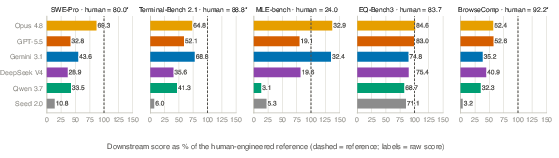
The generated harnesses performed differently in different fields:
- They came close to human-designed systems for writing.
- They sometimes matched or beat the selected human-designed systems for machine-learning experiments.
- They were weaker at coding.
- They were weakest at search and research, where the system must gather information over many steps and decide which information is trustworthy.
This suggests that long, complicated tasks are still especially difficult for automatically designed harnesses.
Human-designed systems were often better
For coding and research, mature systems built by human engineers generally performed better than the LLM-created harnesses.
Human engineers are still better at designing reliable features such as:
- saving progress,
- recovering from errors,
- checking final answers,
- managing long conversations,
- and stopping at the right time.
For example, many generated coding harnesses included ideas about memory or saved progress, but those features were often never actually used during real tasks.
Bigger harnesses were not necessarily better
Some models added thousands of lines of code, but the size of the harness did not reliably predict its quality.
A smaller, carefully designed change could work better than a large rewrite. This is similar to repairing a bicycle: adding many new parts does not necessarily make it faster or safer. Sometimes one well-chosen repair is more useful.
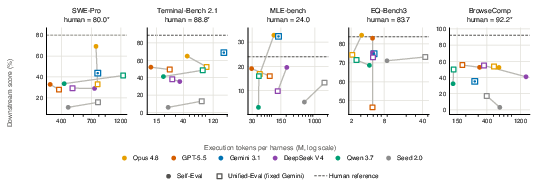
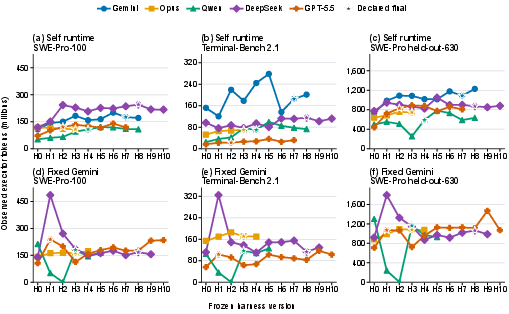
The researchers also found that spending more tokens did not always produce better results. Some systems used much more computation but solved fewer tasks.
Harnesses were often tied to the model that created them
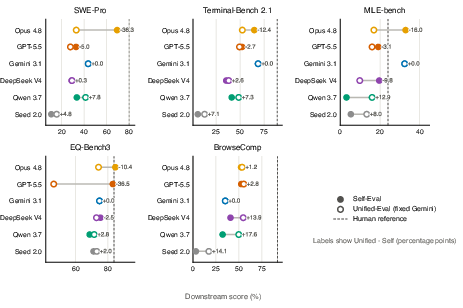
A major finding was that a harness could work well with the model that created it but perform badly with another model.
This happened because the harness might assume that the running model:
- follows instructions in a certain way,
- responds within a particular number of steps,
- formats tool calls in a specific style,
- or stops at a particular time.
When the executor model changed, those assumptions sometimes broke.
This is like designing a remote control that works perfectly with one television but has the buttons in the wrong places for another television.
Evolution produced some improvements, but not reliably
The models could use feedback to improve their harnesses. For example, one model discovered that the harness often claimed a task was complete even when the result was incorrect. It added a stronger completion check, which improved performance.
However, evolution was unstable:
- some revisions improved results,
- some made results worse,
- some helped only one type of task,
- and some gains disappeared on hidden tasks.
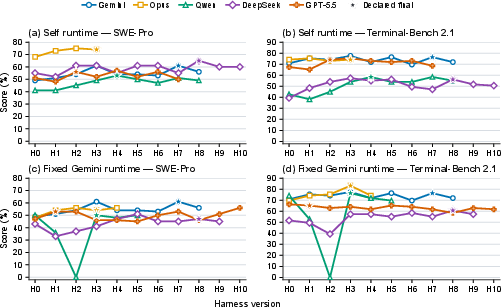
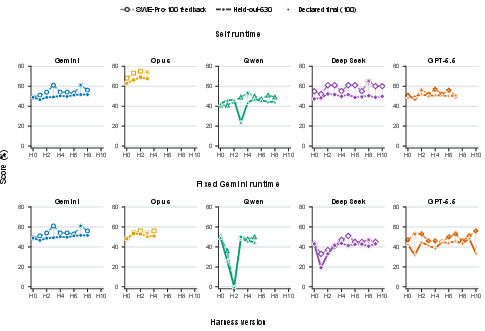
On the visible feedback tasks, models often appeared to improve substantially. But the improvement was usually smaller on hidden tasks.
This means that the models sometimes learned to handle the particular test cases they had seen rather than learning a general solution.
Choosing the best version was difficult
The models were usually able to find changes that helped locally, but they often selected a final version that was not the best on hidden tasks.
Only a small number of the chosen final versions were actually the best versions when tested on the hidden evaluation set.
The researchers also found that results could naturally vary from one run to another. A small score increase might simply be luck rather than a real improvement.
5. Why are these findings important?
This paper changes how researchers think about evaluating AI agents.
Usually, researchers test whether an AI can complete a task using a harness designed by someone else. This paper instead tests whether the AI can help build the harness itself.
That is important because real-world AI systems need more than a powerful model. They also need reliable software around the model.
The findings suggest that:
- LLMs can already create useful agent systems.
- Human engineers are still important for making these systems dependable.
- Automatically improving a harness is possible but not yet reliable.
- Systems need to be tested on new tasks, not only familiar feedback tasks.
- Harnesses should be designed to work with different models.
- Both success rate and operating cost matter.
- Features such as memory, error recovery, and verification need more careful design.
Simple conclusion
The paper shows that LLMs can begin to build and repair the “machines” that help them work. They can create planning loops, tool systems, checking methods, and recovery strategies.
But they are not yet dependable software engineers for their own harnesses. Their improvements can be unstable, too specialized to certain tasks, expensive to run, or dependent on one particular model.
In the future, tools like HarnessDev could help researchers measure whether AI systems are becoming better at building complete, reusable, and trustworthy agents—not just at producing one good answer.
Knowledge Gaps
Knowledge gaps, limitations, and open questions
- Limited domain coverage in Evolution: Evolution is evaluated only on code harnesses, so it remains unknown whether models can iteratively improve writing, research, data-analysis, or other domain-specific harnesses.
- Narrow benchmark diversity within domains: Several conclusions rely on a small number of downstream benchmarks, including only 46 Writing tasks and 75 MLE-bench tasks, leaving uncertainty about whether the findings generalize across task formats, difficulty levels, and domains.
- Dependence on public benchmark splits: Evolution uses subsets of the SWE-bench Pro public split for both feedback and held-out evaluation. Although the subsets are disjoint, they may share benchmark- or distribution-specific properties, so transfer to independently constructed or temporally shifted tasks is unresolved.
- Unclear robustness to distribution shift: The study does not test whether evolved harnesses remain effective when repositories, tool interfaces, task requirements, data formats, or user workflows differ substantially from those seen during development.
- Insufficiently independent held-out evaluation: The main held-out Evolution evaluation is drawn from the same public benchmark family as the feedback set. More independent test suites are needed to distinguish genuine harness improvement from benchmark-family adaptation.
- Small number of creator runs: Creation uses three independent harnesses per creator–benchmark pair, and Evolution uses only nine trajectories. This limits the precision of variance estimates and makes it difficult to determine whether observed differences are systematic or due to stochastic development outcomes.
- Incomplete statistical significance analysis: Many comparisons are reported as score differences or averages without confidence intervals, hypothesis tests, effect sizes, or corrections for multiple comparisons. The reliability of rankings and claimed improvements therefore remains uncertain.
- Uncontrolled model and API variability: Models are accessed through different official APIs or OpenRouter, and the paper does not fully quantify the effects of API versioning, routing, latency, rate limits, hidden system prompts, or provider-side changes.
- Confounding between creator model and development environment: Most creators use Claude Code, whereas GPT-5.5 uses Codex. Consequently, differences attributed to creator models may partly reflect differences in development tools, prompts, interfaces, or runtime behavior.
- No systematic ablation of development environments: The study does not isolate the contributions of the coding environment, tutorial, workspace structure, tool availability, or feedback interface to harness quality.
- No comparison with human engineers under matched conditions: Human-reference results come from existing systems, often evaluated with different models and protocols. The paper therefore cannot establish how model-created harnesses compare with human engineers given the same seed, time, compute, tools, and evaluation feedback.
- External human baselines are not paired controls: Because mature human-engineered systems are not rerun under the same executor and scorer in most cases, the reported “distance to human” may conflate harness quality with executor capability and evaluation configuration.
- Unclear role of the executor model’s capabilities: The experiments show strong executor dependence but do not decompose whether transfer failures arise from prompt incompatibility, tool-call formatting, context limits, reasoning style, calibration, model capability, or stopping behavior.
- Limited cross-model transfer coverage: Most cross-executor analysis uses Gemini 3.1 Pro as the fixed executor. Transfer across a broader range of model families, sizes, open-weight models, and weaker or stronger executors remains unexplored.
- No systematic compatibility model: The paper identifies executor–harness compatibility issues but does not provide a formal taxonomy, diagnostic metric, or predictive method for estimating compatibility before deployment.
- Efficiency is measured only in executor tokens: The evaluation excludes creator tokens, wall-clock time, monetary cost, tool-call count, memory usage, latency, and infrastructure cost. The practical efficiency of harness development and deployment is therefore incomplete.
- No quality–cost Pareto analysis: Although execution tokens and task success are reported, the study does not systematically identify Pareto-optimal harnesses or evaluate whether improvements justify their additional operational cost.
- Missing reliability and tail-risk metrics: Average task success does not reveal catastrophic failures, high-variance behavior, long-tail execution costs, or the frequency of unrecoverable states across tasks.
- Limited assessment of reproducibility: The paper reports repeated-run noise but does not fully evaluate reproducibility across random seeds, API sampling settings, time periods, infrastructure replicas, or repeated executions of the same harness.
- Unresolved final-version selection: Evolution creators select a final version using visible feedback, yet only 2 of 9 declared versions are held-out optimal. The paper does not test principled alternatives such as cross-validation, uncertainty-aware selection, ensemble selection, or conservative rollback policies.
- No automated regression-protection mechanism: Evolution is framed as preserving existing capabilities, but the benchmark does not evaluate explicit regression suites, canary tasks, invariant checks, or version-control strategies designed to prevent capability loss.
- Weak diagnosis of causal mechanisms: The study correlates edit types, code size, component reachability, and score changes but does not perform controlled component-level ablations to establish which harness mechanisms cause performance improvements.
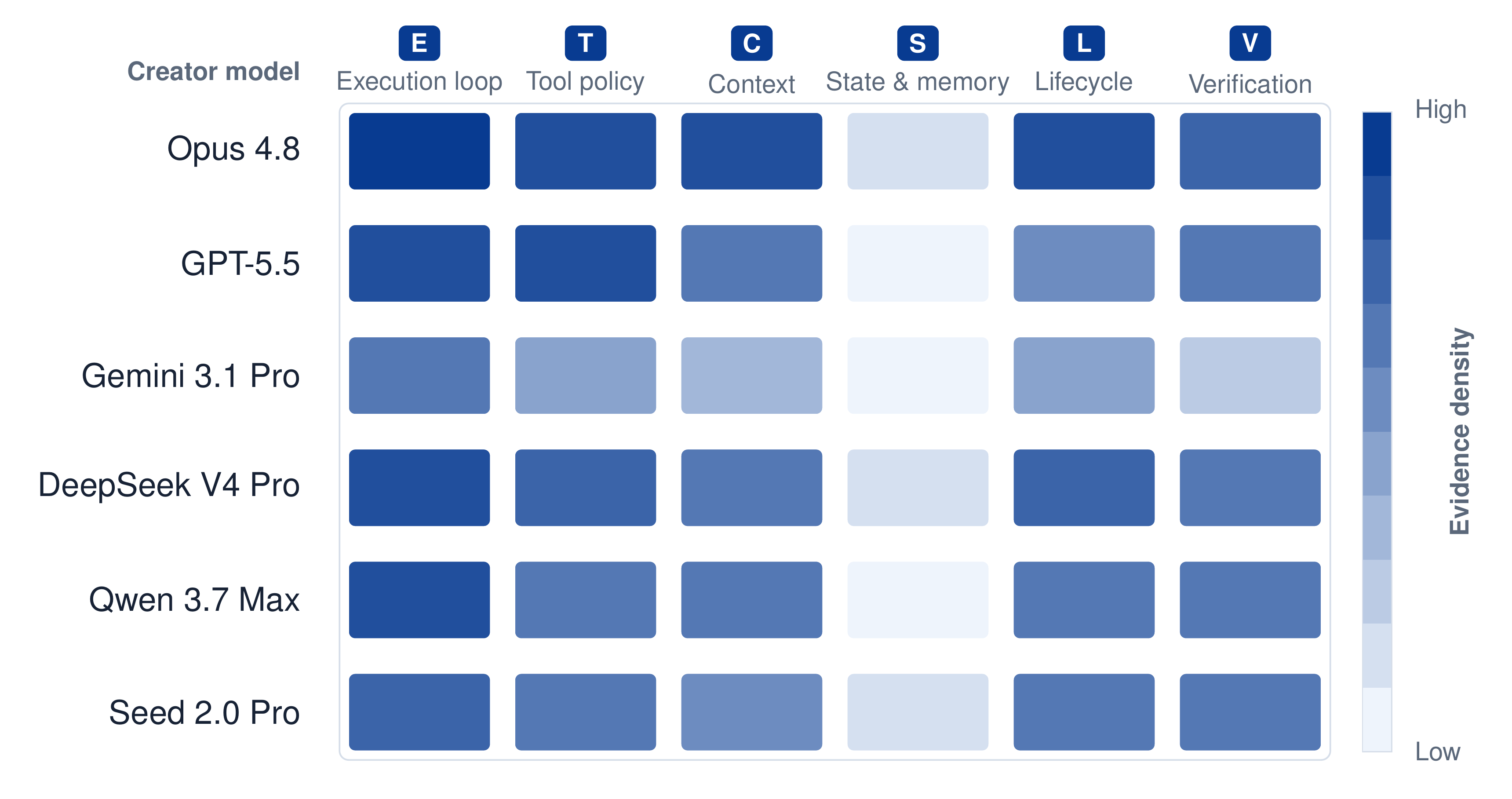
- Unclear effectiveness of individual architecture modules: Execution loops, tool policies, context management, state, recovery, and verification are documented, but their independent and interaction effects are not experimentally isolated.
- State and memory mechanisms remain largely untested: Generated harnesses rarely implement checkpointing, and no dedicated tasks evaluate whether persistent state, resumability, or cross-task memory improves performance under interruptions or long-horizon workloads.
- Limited evaluation of failure recovery: Recovery logic is examined mainly through code inspection and observed trajectories. The benchmark lacks targeted perturbation tests involving tool failures, network errors, malformed outputs, timeouts, process restarts, or corrupted intermediate state.
- Verification quality is underexplored: The paper identifies degenerate submissions and premature completion but does not systematically measure verifier precision, recall, calibration, or susceptibility to false positives and false negatives.
- No adversarial evaluation of constraint compliance: Compliance is audited post hoc, but the benchmark does not actively test whether harnesses can exploit evaluator weaknesses, infer hidden information, memorize benchmark artifacts, or behave differently under auditing.
- Audit procedures are insufficiently characterized: The paper reports no prohibited routes but does not specify the audit’s sensitivity, automation level, reviewer agreement, coverage of indirect leakage, or ability to detect sophisticated benchmark gaming.
- Potential benchmark contamination is not examined: The study does not establish whether creator or executor models had prior exposure to benchmark tasks, repositories, reference implementations, or related public solutions.
- No evaluation of persistent maintenance over time: Evolution is limited to at most ten post-initial evaluation pairs. It remains unknown whether harnesses can undergo long-term maintenance involving changing requirements, dependency upgrades, security patches, and accumulated technical debt.
- No multi-objective development setting: Creators optimize downstream performance, with token cost reported separately. Real deployments also require safety, latency, interpretability, maintainability, privacy, and reliability constraints, which are not jointly optimized.
- Maintainability is not measured: Code quality, modularity, readability, test coverage, documentation, dependency hygiene, and ease of human takeover are not evaluated, despite the paper framing harnesses as persistent infrastructure.
- Human intervention is absent or standardized: The benchmark does not study mixed-initiative workflows in which humans review, guide, approve, or repair model-generated harnesses, limiting conclusions about practical deployment.
- No investigation of requirement ambiguity: The task specifications are benchmark-defined and relatively explicit. The paper does not test whether models can clarify vague objectives, identify missing constraints, or construct appropriate success criteria in realistic deployment settings.
- Feedback quality is assumed rather than developed: Evolution receives benchmark execution results, but the paper does not study how models create, validate, or improve their own evaluators, tests, diagnostics, or feedback signals.
- Limited analysis of noisy and delayed feedback: The feedback protocol provides relatively structured benchmark outcomes. It remains unclear how evolution behaves with sparse, delayed, partial, contradictory, or unreliable feedback typical of real systems.
- No transfer across task families during Evolution: The study does not determine whether a harness evolved for one benchmark can improve performance on related but unseen task families without task-specific redesign.
- No cross-domain reuse of created harnesses: Creation evaluates each harness within its target domain, leaving open whether models can build general-purpose harness abstractions that transfer across code, research, writing, and data-analysis tasks.
- Unclear relationship between code size and functional complexity: The paper reports lines changed and reachable components, but it does not measure architectural complexity, behavioral diversity, test coverage, or whether larger harnesses increase maintenance and failure risk.
- No systematic test of long-horizon scaling: Search, research, and code tasks suggest long-horizon weaknesses, but the benchmark does not vary horizon length, context pressure, number of tools, task decomposition depth, or interruption frequency to identify scaling limits.
- Limited ecological validity of the runtime: The standardized runtime and provider-neutral interface may not reflect production constraints such as concurrent users, persistent services, authentication, data privacy, multi-agent coordination, or heterogeneous tool ecosystems.
- No security or privacy evaluation: Generated harnesses may introduce vulnerabilities through tool permissions, code execution, data handling, prompt injection, secret exposure, or unsafe persistence, none of which are systematically assessed.
- No multi-agent or multi-user setting: The benchmark studies a single executor operating within a harness. Coordination among multiple agents, users, processes, or specialized models remains unexplored.
- Unclear generality beyond current frontier models: All creators and most executors are recent proprietary or frontier systems. The study does not establish how harness development scales with model size, open-weight availability, tool-use training, or weaker models.
- No analysis of model training effects: It remains unknown whether instruction tuning, coding specialization, reinforcement learning, tool-use training, or exposure to software-engineering trajectories is responsible for better harness creation and evolution.
- Creation and Evolution are not fully disentangled: Evolution begins from each creator’s own Creation harness, so differences in starting quality, architecture, and coding style confound comparisons of evolutionary ability.
- No common starting harness comparison for Evolution: A controlled experiment in which all creators evolve the same initial harness would be needed to separate improvement capability from inherited Creation artifacts.
- No comparison against non-LLM optimization methods: The study does not compare LLM evolution with human-guided search, genetic programming, automated program repair, Bayesian optimization, reinforcement learning, or simple mutation-and-selection baselines.
- No analysis of whether feedback-driven edits outperform random or scripted edits: Without stronger search baselines, it is unclear how much of the observed Evolution gain comes from model diagnosis versus repeated evaluation and chance selection.
- Open question about self-modeling ability: The results show local code changes but do not determine whether models understand their own execution limitations, or whether improvements arise from shallow pattern matching and trial-and-error.
- Open question about durable abstraction discovery: The study does not establish whether models can discover reusable architectural principles that remain effective across executors, tasks, and future revisions rather than applying benchmark-specific patches.
- Open question about safe autonomous deployment: The benchmark demonstrates runnable artifact creation, but it does not determine when a model-generated harness is reliable and safe enough to deploy without human approval.
Practical Applications
Immediate Applications
- Agent-harness benchmarking for software and AI teams (Industry; software/AI infrastructure) — Use HarnessDev’s two-stage protocol to evaluate an agent harness as a reusable software artifact rather than judging only individual task answers. Teams can compare execution loops, tool policies, context management, recovery logic, verification, task success, and executor-token cost before deployment.
- Potential workflow: create a weak baseline, generate or implement candidate harnesses, freeze each version, evaluate on held-out tasks, and report both success rate and tokens per task.
- Dependencies: representative hidden tasks, reliable task evaluators, standardized runtime environments, and sufficient compute for repeated evaluations.
- Continuous integration and regression testing for agent infrastructure (Industry; software engineering) — Treat each harness revision like a software release. Every change to planning, tool use, context compression, stopping rules, or recovery behavior can trigger evaluations on both fixed feedback tasks and hidden regression suites.
- This is directly motivated by the finding that evolution is non-monotonic: eight of 64 observed version switches regressed on both benchmarks, while many apparent gains were within run-to-run noise.
- Potential product: an “agent harness CI” system that stores frozen versions, execution traces, benchmark scores, token costs, and rollback points.
- Dependencies: stable benchmarks, repeatable execution, versioned models and tools, and safeguards against benchmark leakage.
- Pre-deployment compatibility testing across LLM executors (Industry; enterprise AI, software platforms) — Run the same harness with multiple runtime models before selecting a production executor. The paper shows that harnesses may overfit to a particular model’s tool protocol, response style, step budget, or stopping behavior.
- Actionable checks: vary the executor model, detect duplicate tool calls, premature stopping, malformed tool-result pairing, excessive retries, and executor-specific hard-coded limits.
- Potential tool: a compatibility matrix reporting capability, cost, failure modes, and transfer loss for each harness–model pair.
- Dependencies: provider-neutral interfaces and access to multiple models with comparable tool capabilities.
- Token-cost optimization for deployed agents (Industry; cloud computing, customer support, coding assistants, data analysis) — Use the paper’s efficiency metric to identify harnesses that achieve similar task success with fewer executor tokens. The results show that larger execution budgets do not reliably produce better outcomes and that cost can vary substantially between generated harnesses.
- Potential workflow: optimize jointly for success rate, latency, tool-call count, context size, and tokens per completed task rather than maximizing reasoning length.
- Dependencies: task-specific cost models, acceptable quality thresholds, and monitoring for quality degradation after budget reductions.
- Trace-based diagnosis of agent failures (Industry and academia; observability, reliability engineering) — Retain trajectories, tool calls, state transitions, result artifacts, and evaluator outcomes to distinguish model failures from harness failures. This is especially useful because 77.8% of failed data-analysis tasks in the study were attributed to harness defects.
- Practical uses: identify premature completion, invalid output formats, failed tool chains, missing verification, context loss, and unhandled empty responses.
- Potential product: an observability dashboard linking each downstream failure to the responsible harness component.
- Dependencies: complete and privacy-compliant logging, reliable attribution methods, and task evaluators that inspect actual artifacts rather than self-reported success.
- Automated verification gates for coding and data-analysis agents (Industry; software development, machine learning operations) — Add explicit checks before an agent declares completion: repository tests, patch validity, output-schema validation, artifact existence, experiment reproducibility, and final-environment inspection.
- This follows the paper’s observation that many harnesses implement execution loops but lack robust verification; 441 of 2,325 data tasks generated degenerate submissions that were not detected by the harness.
- Potential tools: pre-merge agent gates, experiment-submission validators, repository-diff checkers, and final-state auditors.
- Dependencies: domain-specific validators and access to the actual repository or execution environment.
- Checkpointing and resumability for long-running agents (Industry; research automation, robotics, data processing, cloud operations) — Implement persistent state, periodic checkpoints, recovery after tool or model failure, and resumable execution. The study found that state and memory were commonly declared but rarely connected to the main execution path; no checkpoint event appeared in 26,679 recorded code-task trajectories.
- Potential workflow: save plans, tool results, intermediate artifacts, and task state after major milestones, then resume from the last verified checkpoint.
- Dependencies: stable state schemas, secure storage, idempotent tools, and policies for handling stale or corrupted state.
- Forward-deployed engineering and customer-specific agent adaptation (Industry; enterprise software, finance, healthcare, legal operations) — Use model-assisted harness creation to adapt general-purpose agents to customer-specific data formats, tools, compliance rules, and workflows. A human engineer can provide the task specification and a few development cases while the model proposes execution, context, recovery, and verification logic.
- This can reduce the effort required to customize coding assistants, contract-processing pipelines, data-analysis copilots, or internal research agents.
- Dependencies: human review, customer-specific test suites, access controls, auditability, and strict prohibitions on hard-coded answers or private-data leakage.
- Research benchmark design that evaluates infrastructure, not only models (Academia; AI evaluation) — Adopt the paper’s separation between creator model, frozen harness, executor model, and evaluator. This enables studies of whether an improvement comes from model weights, execution infrastructure, or their interaction.
- Potential benchmark outputs: creation quality, evolution quality, held-out generalization, cross-model transfer, regression rate, and execution cost.
- Dependencies: hidden evaluation sets, transparent artifact release, careful control of model versions, and avoidance of incomparable external reference systems.
- Educational training for agent and platform engineers (Academia and industry training) — Use the weak-seed setup as a practical exercise in designing execution loops, tool policies, context handling, lifecycle control, state management, and verification. Students or engineers can create a harness from a minimal runnable scaffold and evaluate it on held-out tasks.
- Potential course project: build three independent harnesses, compare their failure traces, and explain performance–cost trade-offs.
- Dependencies: safe sandboxed tasks, accessible evaluators, and instruction that emphasizes reliability rather than merely adding code.
- Policy and procurement standards for agent systems (Policy; public-sector and enterprise procurement) — Require vendors to disclose harness-level evidence rather than reporting model scores alone. Procurement templates can request held-out performance, cost per task, executor compatibility, regression rates, audit logs, and recovery behavior.
- Potential policy requirement: no production deployment without artifact-level traceability and independent evaluation on tasks withheld from the developer.
- Dependencies: agreed testing standards, privacy-preserving logging, sector-specific risk thresholds, and vendor cooperation.
- Safer daily use of personal agents (Daily life; productivity and personal computing) — Apply lightweight harness principles to personal coding, browsing, scheduling, and document agents: explicit stopping rules, confirmation before consequential actions, verification of outputs, and recovery from failed tool calls.
- Potential product features: “show what was verified,” reversible actions, task checkpoints, and warnings when an agent reaches a model-specific limit.
- Dependencies: consumer-friendly interfaces, local or encrypted logs, and conservative defaults for external actions.
Long-Term Applications
- Self-improving production agent platforms (Industry; software, robotics, enterprise automation) — Develop systems in which an agent proposes, tests, and deploys revisions to its own harness using execution feedback. The paper establishes that local improvement is possible but that current evolution is unstable, weakly transferable, and vulnerable to overfitting.
- Future architecture: candidate generation, sandboxed evaluation, causal failure diagnosis, held-out validation, multi-model testing, and automatic rollback.
- Dependencies: stronger diagnosis than the current systems demonstrated, reliable automated evaluators, statistically sound version selection, and strict deployment isolation.
- Model-agnostic harnesses with standardized executor interfaces (Industry; AI platforms and open-source tooling) — Build portable harnesses whose planning, tool protocols, context handling, and stopping criteria adapt to different runtime models without requiring a complete rewrite.
- Potential product: a provider-neutral harness SDK with capability negotiation, executor adapters, dynamic budget calibration, and model-independent state representations.
- Dependencies: stable tool-call standards, cross-provider interface compatibility, and research into which harness behaviors transfer across models.
- Automated causal failure diagnosis and repair (Industry and academia; autonomous software maintenance) — Move beyond score-based evolution toward systems that connect a failure to a specific mechanism, such as premature completion, duplicate queries, invalid message pairing, or missing verification, and then generate a narrowly targeted patch.
- The paper suggests that targeted changes backed by end-to-end re-verification are more useful than raw self-test counts or large code edits.
- Dependencies: high-quality execution traces, causal attribution methods, reproducible failures, and safeguards against repairs that merely overfit observed tasks.
- Statistically reliable autonomous version selection (Industry; safety-critical AI and MLOps) — Create selectors that choose harness versions using repeated trials, confidence intervals, task-diverse validation, cost constraints, and unseen canary tasks rather than the best single feedback score.
- This is needed because only two of nine declared versions were optimal on held-out tasks, and feedback and held-out scores moved in the same direction only 53.1% of the time.
- Dependencies: larger evaluation budgets, low-variance task execution, robust statistical procedures, and secure canary sets unavailable to the evolving agent.
- Domain-specialized autonomous research and discovery systems (Healthcare, science, energy, climate, finance) — Mature harness evolution could support agents that search literature, design experiments, analyze data, monitor markets, or optimize energy systems while maintaining persistent state and verifying intermediate results.
- The immediate evidence is strongest for writing and machine-learning experimentation; search and research remain substantially behind mature human systems. Therefore, these applications require improved long-horizon planning, source verification, and uncertainty handling.
- Dependencies: domain-valid evaluators, expert oversight, high-quality data, reproducibility, and controls against fabricated or weakly supported conclusions.
- Robotic systems with self-maintaining execution harnesses (Robotics and industrial automation) — Extend harness evolution to robots that coordinate perception, planning, tool use, recovery, safety checks, and task memory. A robot could use execution traces to improve recovery policies or task decomposition without changing its base model.
- Potential workflow: simulate candidate harness changes, test them in digital twins, validate them on constrained physical tasks, and deploy only after safety certification.
- Dependencies: high-fidelity simulation, safe exploration, real-time constraints, hardware-specific verification, and formal safety guarantees.
- Auditable autonomous agents for regulated sectors (Healthcare, finance, legal services, public administration) — Combine persistent harness state, execution traces, held-out evaluation, and version rollback into an audit layer for agents making recommendations or performing regulated workflows.
- Potential tools: evidence-linked clinical research assistants, finance-compliance agents, contract-review systems, and public-sector case-processing agents with reproducible execution histories.
- Dependencies: regulatory approval, explainable records, data governance, human authorization for high-impact actions, and demonstrable robustness across executor models.
- Adaptive personal operating systems and household automation (Daily life; consumer technology) — A mature self-evolving harness could learn how an individual prefers tasks to be planned, verified, paused, and resumed across calendars, files, browsers, and smart-home devices.
- Potential product: a personal agent that maintains durable task state, asks for confirmation at risk boundaries, and improves its workflow without silently changing permissions.
- Dependencies: privacy-preserving local memory, user control over revisions, transparent change histories, and protection against unauthorized actions.
- Public evaluation infrastructure for agent ecosystems (Policy and academia) — Establish shared, continuously refreshed benchmark suites that assess creation, evolution, transfer, cost, auditability, and safety across domains. Hidden tasks and independent evaluators would reduce benchmark-specific optimization and provide a common basis for comparing commercial and open systems.
- Dependencies: sustainable benchmark maintenance, licensing for real-world tasks, protection against test-set contamination, and governance over evaluator updates.
- Automated co-development between human engineers and LLMs (Industry and academia; software engineering) — Use LLMs as persistent harness-development collaborators that propose architecture changes, inspect traces, run controlled experiments, and prepare reviewed patches, while humans retain release authority.
- This is more feasible than fully autonomous evolution because the study shows that models can implement useful local changes but still struggle with generalization, diagnosis, and portability.
- Dependencies: code review, sandboxed execution, reproducible experiments, access to hidden validation tasks, and clear responsibility for failures.
Glossary
- Agent harness: Execution infrastructure that manages an LLM agent’s tools, context, control flow, recovery, and verification. “This surrounding execution infrastructure, commonly termed the agent harness”
- Ablation: An experiment that removes or fixes a component to isolate its effect. “four fixed-Gemini ablations”
- Avg@3: The average score across three independently generated artifacts or runs. “report avg@3”
- Benchmark suite: A collection of related evaluation tasks used to measure system performance across a domain. “Together, the suites contain 2{,}207 unique downstream instances.”
- Checkpointing: Periodically saving execution state so that work can be resumed after interruption or failure. “only one implements periodic checkpointing”
- Compatibility layer: Software that allows components with different interfaces or assumptions to work together. “a runnable compatibility layer, not a task-solving agent”
- Constraint compliance: Adherence to explicitly specified restrictions during system execution or development. “preserving constraint compliance and held-out performance”
- Context compression: Reducing or summarizing an agent’s accumulated context to control its size. “context compression breaks tool-message pairing”
- Control flow: The ordering and branching of operations in a program. “58 change execution or control flow”
- Cross-model transfer: The extent to which behavior or performance carries over when a different model executes the system. “indicating limited transfer across models”
- Dead code: Code that is present in a program but cannot be reached or executed during operation. “124 of 587 Writing features are confirmed dead code”
- Development environment: The software workspace and tools in which a model constructs or modifies an artifact. “A creator LLM works inside a development environment ”
- Downstream task: A task performed by an evaluated system after its development or construction phase. “An executor LLM then runs inside it on a downstream task ”
- Duplicate-query rate: The proportion of information-seeking requests that repeat an earlier query. “the duplicate-query rate rises from to ”
- Executor model: The LLM that runs a frozen harness to perform evaluation tasks. “Efficiency measures how many executor-model tokens the frozen harness consumes”
- Execution scaffold: The foundational software structure through which an agent performs tasks. “whether LLMs can create this execution scaffold from a weak starting point”
- Execution trace: A record of the actions, observations, and intermediate events produced during execution. “the model recognize its own behavioral limitations from execution traces”
- Feedback set: The collection of tasks whose results are shown to a system during iterative development. “Tasks repeatedly evaluated during Evolution form the feedback set”
- Forward-deployed engineer (FDE): An engineer who adapts and maintains a technical system in the environment of a specific customer or deployment. “the most visible recent crystallization is the forward-deployed engineer (FDE)”
- Held-out set: Evaluation data withheld from development and used to measure generalization. “tasks evaluated only after Evolution, with results never returned to the creator, form the held-out set”
- Human-engineered reference: A mature system created by human developers and used as a performance comparison. “a mature human-engineered harness”
- Lifecycle control: Logic governing the stages, transitions, termination, and recovery of an agent’s operation. “In implementation terms, contains the execution loop, tools, context management, persistent state, lifecycle control, and verification”
- Long-horizon information seeking: Research or search activity requiring many dependent steps over an extended interaction. “which require long-horizon information seeking”
- Metric artifact: A stored output or record used to document or calculate an evaluation measure. “every run retains its trajectory, result, and metric artifacts”
- Monolithic agent: An agent implemented as one large, relatively undivided software component. “GPT-5.5 adds a large monolithic agent”
- Native metric: The evaluation measure originally defined for a particular benchmark. “Each benchmark uses its native metric”
- Overfitting: Adapting too closely to development data or conditions at the expense of performance on unseen data. “A harness can overfit to the model that wrote it”
- Paired candidate: A candidate system evaluated under two linked benchmark conditions before being accepted for comparison. “each official post- candidate is then frozen and submitted as a pair”
- Persistent state: Information retained across steps or tasks rather than existing only temporarily. “The seed has no agent loop, task decomposition, tool policy, context management, persistent task state”
- Post-hoc audit: An examination performed after execution to verify what occurred and whether rules were followed. “which supports a post-hoc audit of the delivered code”
- Provider-neutral runtime interface: An execution interface designed to operate independently of a particular model or service provider. “replace the provided provider-neutral runtime interface with its own LLM access path”
- Regression: A decline in performance or functionality caused by a change to a system. “improve one capability while silently regressing another”
- Runtime model: The model that executes a harness after development. “The outcome also depends strongly on the model that runs the harness”
- Scorer-readable artifact: A structured output that an evaluation system can inspect and score. “the scorer-readable artifacts a finished harness delivers”
- Self-runtime: An evaluation configuration in which the model that created a harness also executes it. “All five self-runtime creators improve on the visible feedback pair”
- Stopping rule: A condition determining when an agent should terminate its execution. “The seed has no agent loop, task decomposition, tool policy, context management, persistent task state, verifier, retry or recovery logic, or stopping rule.”
- Task decomposition: Breaking a complex task into smaller subtasks or steps. “The seed has no agent loop, task decomposition, tool policy”
- Tool orchestration: Coordinating the selection, ordering, and use of external tools by an agent. “The seed fixes only the input and audit envelopes and exposes passive, unorchestrated primitives”
- Trajectory: The recorded sequence of states, actions, and outcomes produced during an agent run. “The nine lineages produce 73 official versions and 64 adjacent version switches”
- Transferability: The ability of a system’s capabilities to remain effective under new tasks, models, or execution conditions. “capability transfers only when its prompts, tool protocol, budgets, and stopping rules remain compatible”
- Verifier: A component that checks whether an agent’s output or task state satisfies the required conditions. “The seed has no agent loop, task decomposition, tool policy, context management, persistent task state, verifier”
- Version selection: Choosing one system revision from a sequence of evaluated alternatives. “Visible feedback is therefore useful for local search but unreliable for final selection”
- Weak seed: A minimal runnable starting system that provides infrastructure but not a task-solving strategy. “Creation should measure whether a model can design an execution system, not whether it can reproduce benchmark boilerplate.”

