A Lagrangian View of Flow Matching
Abstract: Modern explicit-time generative models, such as Flow Matching [Lipman et al., 2023] and Rectified Flow [Liu et al., 2023], are typically derived top-down via Optimal Transport and the continuity equation. This standard Eulerian approach focuses on the macroscopic transport of probability mass. In this paper, we present an alternative, bottom-up mechanical derivation grounded in a Lagrangian (particle-centric) perspective. By analyzing the local Taylor expansion of a continuous denoiser, we motivate a strict invariance condition required for optimal, singlestep generation: the conservation of target identity. Enforcing this condition yields a governing quasi-linear advection Partial Differential Equation (PDE). We demonstrate that solving this PDE via the Method of Characteristics analytically yields the straight-line trajectories of Flow Matching. This geometric perspective isolates the Jacobian of the denoiser as the primary source of trajectory curvature, providing a direct mathematical explanation for why straight-line flows enable massive step sizes, and why empirical models require distillation to flatten intersecting characteristics.
Paper Prompts
Sign up for free to create and run prompts on this paper.
Top Community Prompts
Explain it Like I'm 14
1. What is this paper about?
This paper studies how AI systems can create images by starting with random noise and gradually turning that noise into a clear picture.
Many image-generation methods, such as diffusion models, take many small steps to remove noise. Other methods, including Flow Matching and Rectified Flow, try to use much larger steps—even sometimes just one step.
The paper gives a new explanation for why Flow Matching can move quickly. Instead of looking at the whole cloud of possible images, it follows one imagined sample at a time, like tracking a single car on a road. This is called a Lagrangian, or particle-centered, view.
The main idea is:
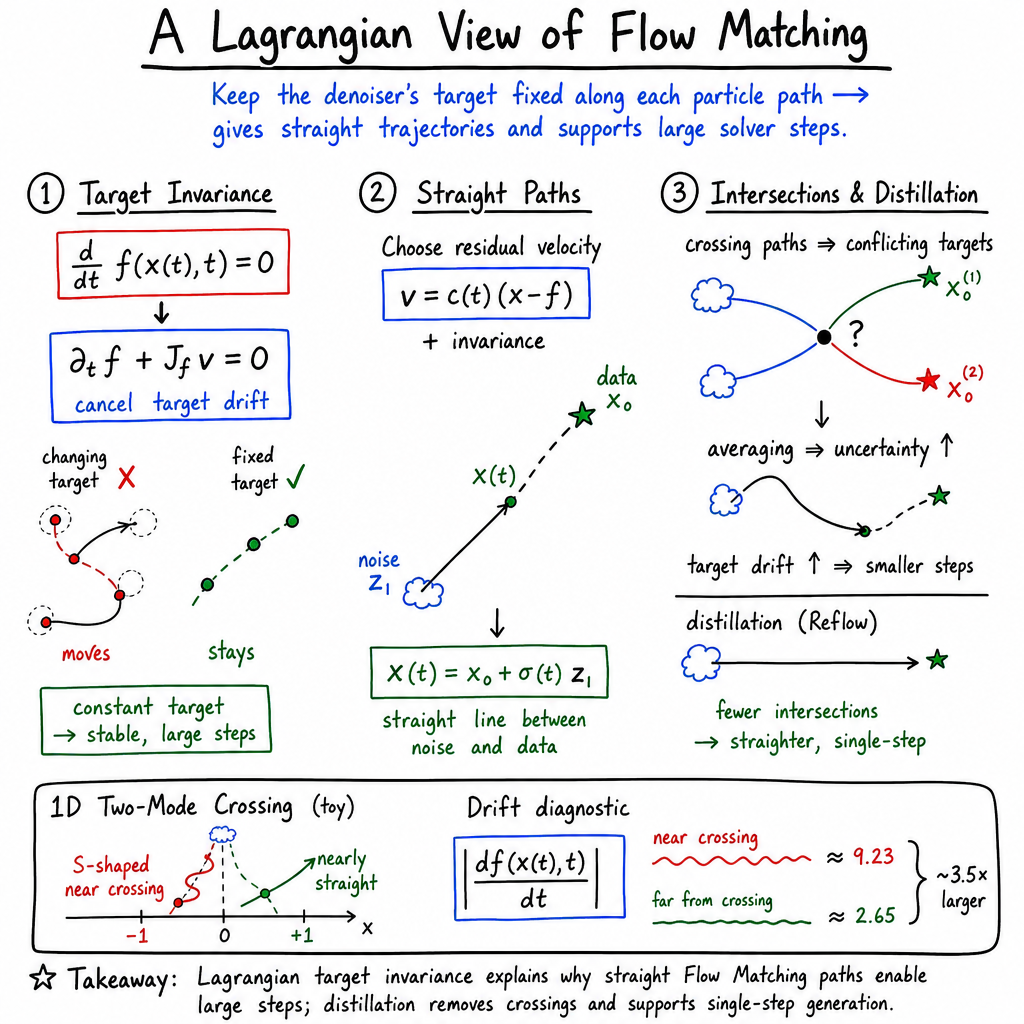
A generation path works best when the model keeps identifying the same final image throughout the journey.
2. What questions does the paper ask?
The paper mainly investigates these questions:
- Why do ordinary diffusion models often need many small steps?
- Why can Flow Matching use straighter paths and larger steps?
- What causes a model’s path from noise to an image to bend?
- Can the model’s changing predictions be used to detect when generation is going wrong?
- Why does distillation, especially a method called Reflow, help models generate images in very few steps?
To answer these questions, the paper focuses on a denoising function called . This function looks at the current noisy state and time and predicts the clean image that the system is trying to produce.
3. How does the paper approach the problem?
Following one particle instead of watching the whole crowd
There are two common ways to study movement:
- An Eulerian view watches what happens at fixed locations, like watching traffic cameras at different streets.
- A Lagrangian view follows one object as it moves, like sitting inside one car and tracking its trip.
Traditional mathematical explanations of Flow Matching often use the Eulerian view. This paper instead follows one generated sample as it travels from noise to an image.
The denoiser’s prediction should stay unchanged
Imagine that, at the beginning of generation, the model predicts that the final image will be a cat. As the sample moves forward, the ideal model should continue predicting the same cat—not switch between a cat, a dog, and a bicycle.
The paper calls this conservation of target identity. In mathematical form, it requires:
In simple language, this means:
As the sample moves along its correct path, the model’s prediction of the final image should not change.
This is similar to following a delivery package whose destination is fixed. The package may move through many places, but its destination should not suddenly change.
The advection equation
The authors use the chain rule from calculus to separate two reasons why the prediction might change:
- The sample has moved to a new position.
- Time has changed, meaning the amount or type of noise has changed.
This produces a mathematical rule:
This is called a quasi-linear advection partial differential equation.
The terms mean:
- is the denoiser’s prediction of the clean image.
- is the direction and speed in which the sample moves.
- is the Jacobian, which describes how sensitive the denoiser is to small changes in its input.
- The equation says that changes caused by time must be balanced by movement through the denoiser’s landscape.
A useful analogy is walking through a hilly landscape while trying to keep a compass pointing toward the same destination. If the landscape changes, your direction must adjust carefully.
Choosing a residual-based movement rule
The equation above does not determine one unique path. Therefore, the authors choose a particular movement rule:
This says that the sample moves according to the difference between:
- its current noisy state , and
- the denoiser’s predicted clean state .
In everyday terms, the sample moves in the direction of “how far it is from the predicted answer.” The function controls the speed at different times.
The paper then uses the Method of Characteristics. This is a mathematical technique for solving certain differential equations by turning them into paths that individual particles follow.
Under the paper’s invariance requirement, the paths become:
where:
- is the final clean data point, such as an image,
- is the starting random noise,
- controls how much noise remains.
This is a straight-line path between noise and data. The paper argues that these are exactly the paths used by Flow Matching and Rectified Flow.
4. Main findings
Flow Matching produces straight paths under the proposed condition
The paper’s central result is that if:
- the model uses the residual-based movement rule, and
- the denoiser keeps the same target identity along a path,
then the path is forced to be a straight line between the starting noise and the final image.
This gives a mechanical explanation for why Flow Matching can use large time steps: a straight path is easier to follow than a winding path.
However, the authors are careful to point out that they have not proved that their movement rule is the only possible solution. Their result applies to the particular type of velocity field they selected.
Curved paths are caused by changes in the denoiser
The paper identifies the denoiser’s Jacobian as an important source of difficulty.
If a small change in the current state causes a large change in the predicted image, the Jacobian is large. This means the destination appears to move strongly as the sample travels.
When this happens, a numerical solver must take smaller steps. Otherwise, it may move too far and miss the correct path, much like trying to follow a sharply turning road while driving quickly.
Near the end of ordinary diffusion generation, the denoiser may become extremely sensitive. This can make the required step sizes very small.
Intersections create confusion
The paper argues that real neural networks do not always follow the perfect straight paths predicted by the theory.
Suppose two different paths cross at the same location:
- One path is supposed to end at image A.
- The other path is supposed to end at image B.
At the crossing point, the model cannot know which destination is correct if it sees only the current location and time. It may average the two answers.
For images, this averaging can lead to blurry or unclear results. It also bends the learned paths away from the ideal straight lines.
The paper calls these crossing paths intersecting characteristics. In this context, “characteristics” means the paths followed by individual generated samples.
Reflow helps untangle the paths
Reflow, a form of distillation, tries to reduce these path intersections.
The basic process is:
- Use an existing model to create more reliable paths from noise to data.
- Train a new model using pairs that are already matched along those paths.
- Encourage the new model to follow straighter, less-confusing routes.
The paper interprets this as reducing uncertainty. If each point along a path clearly belongs to one final image, the model does not need to average conflicting answers.
This can make one-step or very-low-step generation more successful.
A simple two-image example
The paper studies a one-dimensional example with only two possible clean values: and .
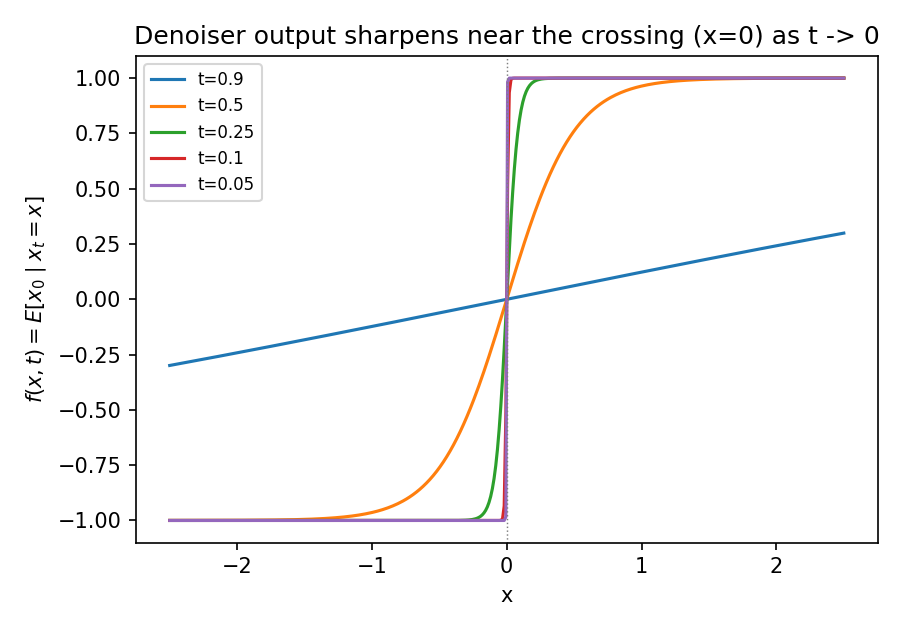
At some noisy points, the model cannot tell whether the original value was or . It therefore gives an average prediction near $0$.
The paper finds that:
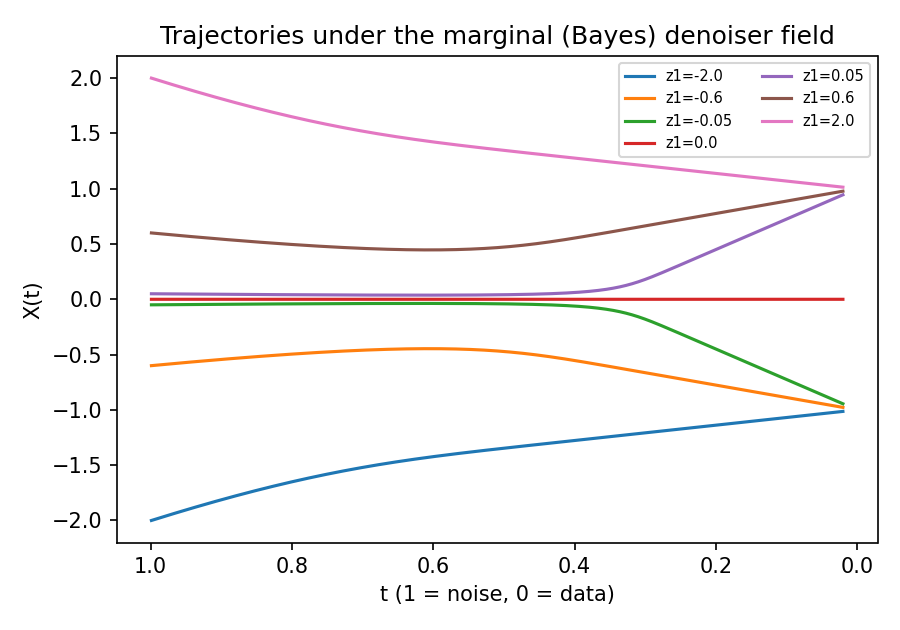
- Paths far from the confusing middle region are almost straight.
- Paths near the middle become curved.
- A path starting exactly at the middle can remain stuck and never decide which target to choose.
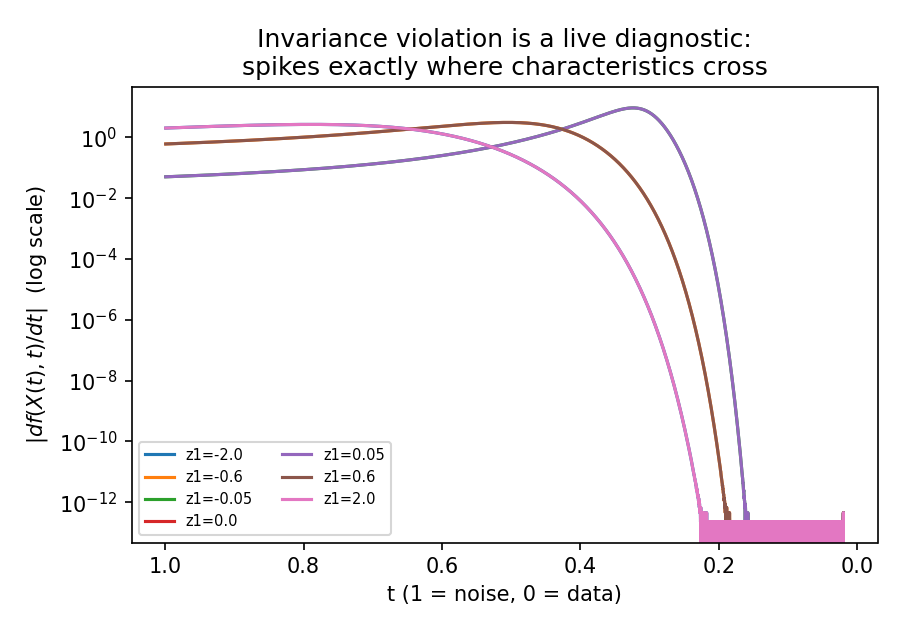
- The model’s prediction changes much more along these uncertain paths.
In the example, the near-crossing paths had a maximum prediction drift of about $9.23$, compared with about $2.65$ for paths far from the crossing. This supports the paper’s claim that uncertainty and path curvature are connected.
5. Why are these findings important?
The paper suggests a practical way to monitor generation while it is happening.
A model can compare its denoiser predictions at nearby steps. If the prediction changes a lot, then:
- the current path may be curved,
- the model may be near a crossing or ambiguous region,
- the solver may need to take smaller steps, or
- the model may benefit from more distillation or Reflow training.
This creates a possible real-time warning signal:
A small value means the predicted target is staying stable. A large value means the target is changing and the path may be difficult to follow.
6. Overall implications
The paper offers a new, intuitive explanation for the difference between slow diffusion generation and fast Flow Matching generation.
Its main message is:
Fast generation is possible when each noisy state has a clear and stable destination, so the path from noise to data can remain straight.
This could affect future generative models in several ways:
- Faster sampling: Models may generate images using fewer solver steps.
- Better debugging: Developers can check when the denoiser’s prediction changes too much.
- Smarter computation: A solver could slow down only in difficult regions instead of using small steps everywhere.
- Improved distillation: Reflow can be understood as untangling confusing paths rather than simply as an abstract training trick.
- Less blurring: Reducing conflicting paths may help one-step generators choose a clear image instead of averaging several possibilities.
The paper does not claim that every generative model will automatically produce perfect one-step results. Real data is much more complicated than the simple example, and neural networks can still make mistakes. Nevertheless, the Lagrangian viewpoint gives researchers a useful way to understand those mistakes: look for places where paths cross and where the model’s predicted destination keeps moving.
Knowledge Gaps
The paper leaves the following knowledge gaps, limitations, and open questions unresolved:
- The invariance principle is assumed rather than derived as an optimality condition. The paper does not prove that preserving the denoiser’s target identity minimizes sampling error, maximizes likelihood, or is necessary for single-step generation.
- The relationship between target invariance and distributional correctness is not established. A trajectory can preserve a fixed denoiser output without guaranteeing that the resulting flow transports the noise distribution to the data distribution.
- The proposed PDE is underdetermined. Equation generally admits many velocity fields, but the paper does not characterize the full solution set, state conditions for existence and uniqueness, or determine when a valid velocity field exists for a given denoiser.
- The residual velocity ansatz is introduced heuristically. The choice is motivated by Tweedie’s formula, but the paper does not derive it from the invariance PDE, compare it with alternative velocity parameterizations, or identify when it is optimal.
- The claim that the ansatz “forces” straight-line Flow Matching trajectories is conditional. The derivation assumes exact invariance along the selected characteristics; it does not show that a learned denoiser or velocity field satisfies this condition, even approximately, over the full state-time domain.
- The boundary condition is insufficiently specified. The notation presumes that each state at has a unique associated data point, but the paper does not address non-injective mappings, data-manifold self-intersections, or how the condition is defined off the data manifold.
- The identification of the denoiser with the inverse flow map is not generally valid. An inverse flow map requires an appropriate deterministic and invertible transport construction; conditional-mean denoisers are generally many-to-one and need not recover particle identities.
- The connection between the schedule and standard Flow Matching schedules is incomplete. The paper does not specify the required boundary conditions, regularity, or time orientation for and , nor show how common diffusion and interpolation schedules fit the proposed derivation.
- The claim that Flow Matching is obtained independently of optimal transport is not fully demonstrated. The resulting straight-line form is compatible with several existing interpolation constructions, but the paper does not clarify what new model or transport class is obtained beyond those established derivations.
- The Jacobian–posterior covariance relationship is stated too broadly. The proportionality depends on the observation model, noise parameterization, and whether the denoiser is the exact posterior mean; the paper does not provide the missing scale factors or establish applicability to neural denoisers trained with other losses.
- The positive-semidefinite Jacobian assumption is restrictive and insufficiently justified. Neural denoisers generally need not have symmetric or PSD Jacobians, so the sign conclusion in Equation (16) may fail for practical models.
- The inference that target drift is always negatively correlated with velocity is therefore not general. It holds only under the stated Jacobian assumptions and the exact invariance PDE, but the paper presents it as an explanation for standard diffusion behavior without testing those conditions empirically.
- The claim that Jacobian eigenvalues diverge as is not universally true. It depends on the data distribution, noise schedule, observation model, and denoiser regularity; no asymptotic analysis is given for continuous, nonsmooth, or high-dimensional data distributions.
- The paper does not derive a quantitative relationship between Jacobian magnitude and solver step size. It lacks stability bounds, local truncation-error estimates, or conditions under which the proposed Jacobian penalty predicts the number of required ODE steps.
- Curvature is attributed primarily to the denoiser Jacobian without separating other sources. Numerical discretization, time-dependent velocity variation, model approximation error, solver choice, and schedule parameterization are not independently analyzed.
- The treatment of characteristic intersections is geometrically ambiguous in high dimensions. Exact intersections of one-dimensional trajectories may have measure zero, so the paper does not define whether “crossing” means exact intersection, near-intersection, overlapping conditional distributions, or regions of high conditional variance.
- The assertion that neural networks average conflicting targets at intersections requires qualification. The conditional expectation depends on the training objective, sampling measure, architecture, and parameterization; the paper does not prove that the learned field behaves as the claimed average in realistic settings.
- The claim that Reflow eliminates posterior uncertainty is too strong. Distillation can reduce conditional ambiguity but generally does not make the mapping deterministic everywhere or drive posterior covariance and the denoiser Jacobian exactly to zero.
- The paper does not establish that Reflow globally uncrosses characteristics. It provides no theorem or empirical measurement showing that repeated distillation removes crossings or guarantees a globally valid single-step map.
- The two-mode example does not fully validate the general mechanism. Its one-dimensional Gaussian-mixture structure has special symmetries and a known posterior, and the paper does not show that the same dynamics hold for multimodal, high-dimensional data.
- The reported toy-example diagnostics are not reproducibly documented. Numerical solver settings, discretization, initialization details, tolerances, and the precise computation of the reported drift maxima are unspecified.
- The proposed diagnostic is not validated against generation quality. The paper does not establish correlations with FID, likelihood, reconstruction error, perceptual quality, mode coverage, or actual local integration error.
- The diagnostic may be expensive or unstable in practice. Computing derivatives from consecutive denoiser evaluations can depend strongly on solver step size, network noise, numerical precision, and schedule scaling; these effects are not analyzed.
- The suggested adaptive solver is not developed into an algorithm. No step-size controller, threshold-selection method, computational overhead analysis, or comparison with existing adaptive ODE solvers is provided.
- The paper lacks experiments on real generative models and datasets. Its central claims are not tested across architectures, image resolutions, modalities, noise schedules, training objectives, or established Flow Matching and diffusion implementations.
- No controlled ablation isolates the proposed mechanisms. The effects of Jacobian norms, target drift, characteristic overlap, Reflow iterations, and solver step count are not separately measured.
- The “single-step generation” claim remains unquantified. The paper does not specify acceptable quality thresholds or demonstrate that one-step sampling preserves distributional fidelity and diversity relative to multi-step baselines.
- The analysis assumes differentiability that may fail near data manifolds and decision boundaries. The treatment does not address neural-network nonsmoothness, generalized derivatives, or the behavior of the PDE when is discontinuous or ill-conditioned.
- Stochastic generative processes are largely excluded. The framework is formulated for deterministic trajectories and does not explain how the invariance PDE, target identity, or diagnostic extends to stochastic differential equations and diffusion samplers.
- The effect of model misspecification is not analyzed. The paper assumes an ideal denoiser but does not characterize how finite data, optimization error, calibration error, architectural constraints, or score/denoising bias alter the proposed conclusions.
- The paper does not provide formal guarantees for approximation error. It remains unknown how violations of translate into endpoint distribution error, sample distortion, or solver instability.
- The scope of the “Lagrangian view” relative to existing characteristic and continuity-equation analyses is unclear. The paper does not formally identify which results are novel, which are equivalent reformulations, and which additional theoretical or practical consequences follow from the proposed perspective.**
Practical Applications
Immediate Applications
The paper’s most directly deployable contribution is a particle-level diagnostic for generative inference: monitoring how much the denoiser prediction changes along a sampled trajectory, approximated by consecutive evaluations of .
- Adaptive-step samplers for diffusion and Flow Matching models — software, imaging, and generative AI
- Compute an inference-time stability signal such as
1
drift_t = ||f(x_{t-Δt}, t-Δt) - f(x_t, t)||- or its time-normalized equivalent.
- Increase the solver step size when the denoiser output is stable and reduce it when the output changes sharply.
- This can replace fixed schedules, allowing easy regions of the trajectory to be traversed quickly while allocating additional steps near ambiguous or high-curvature regions.
- Dependencies: consecutive denoiser outputs must be comparable; the signal must be calibrated against image quality and numerical error; additional evaluations may offset some of the speed gains.
- Per-sample inference monitoring and failure detection — generative-model serving
- Add a monitoring layer to image, video, audio, or 3D-generation pipelines that flags samples with sustained target drift.
- High drift can indicate unresolved characteristic crossings, mode ambiguity, or likely artifacts such as blur, instability, or incorrect mode selection.
- A production workflow could automatically retry flagged samples with a smaller solver step, a higher-step sampler, or a different random seed.
- Dependencies: the diagnostic is a proxy rather than a proof of perceptual quality and may require modality-specific thresholds.
- Solver selection and automatic compute allocation — cloud AI and edge inference
- Use the trajectory diagnostic to select among one-step, few-step, and conventional diffusion samplers on a sample-by-sample basis.
- Easy samples could use a highly compressed Flow Matching model, whereas difficult samples could fall back to 10–50-step integration.
- This could reduce average latency and energy consumption in image-generation APIs, interactive design software, and mobile creative tools.
- Dependencies: fallback decisions must be made early enough to be useful, and the overhead of monitoring must be lower than the saved computation.
- Practical debugging of low-step generative models — machine-learning engineering
- Plot denoiser-output drift along trajectories during model validation.
- Localize the time ranges and regions of latent space where a nominally straight flow becomes curved.
- Use these plots to distinguish solver problems from model-training problems: excessive drift suggests that additional distillation or improved training data couplings may be needed, whereas stable predictions with poor samples suggest other failures.
- Dependencies: the interpretation assumes that the denoiser is sufficiently smooth and that target drift is meaningfully related to trajectory curvature.
- Guiding Reflow and consistency distillation — generative-model training
- Rank training samples, latent seeds, or trajectory segments by their invariance violation, such as or a finite-difference approximation.
- Prioritize high-drift regions for Reflow, consistency training, or targeted resampling.
- This creates a focused distillation workflow rather than applying the same amount of additional training everywhere.
- Dependencies: targeted sampling must not reduce coverage of rare modes; high drift may also reflect model approximation error, schedule effects, or numerical artifacts.
- Evaluation metric for fast generative models — academia and benchmarking
- Report denoiser invariance alongside conventional measures such as FID, likelihood proxies, perceptual quality, and sampling cost.
- A model can therefore be evaluated on both output quality and how consistently it preserves target identity along its trajectories.
- This is especially useful for comparing one-step and few-step models whose aggregate distributional scores may hide localized instability.
- Dependencies: the metric requires standardization across architectures, schedules, data modalities, and solver implementations.
- Faster everyday creative-generation workflows — design, media, and consumer applications
- The straight-flow and monitoring principles can support lower-latency generation for image editing, background removal, stylization, concept design, and interactive text-to-image systems.
- Users could receive an immediate draft from a one-step or few-step model, with additional computation triggered only when the diagnostic indicates ambiguity.
- Dependencies: this application depends on maintaining perceptual quality after step reduction and on the diagnostic correlating reliably with user-visible defects.
- Energy and infrastructure optimization — data centers and edge devices
- Fewer ODE evaluations directly reduce accelerator time, memory traffic, and potentially power usage during generative inference.
- Adaptive sampling can be integrated into serving systems to meet latency or energy budgets while preserving quality on difficult cases.
- Dependencies: actual savings depend on network-evaluation cost, batching efficiency, monitoring overhead, and the fraction of trajectories that can safely use large steps.
Long-Term Applications
The following applications require broader empirical validation, improved theoretical guarantees, or integration with larger production systems.
- Fully reliable single-step generation — generative AI
- The paper suggests that eliminating characteristic crossings through Reflow or related distillation could produce generators that evaluate the learned flow in one step.
- Such models could enable real-time image, video-frame, speech, music, and 3D asset generation with substantially lower latency.
- Dependencies: exact uncrossing is difficult in high-dimensional, multimodal data; deterministic denoisers may be unable to represent genuinely ambiguous conditional mappings; one-step quality must be validated beyond toy examples.
- Curvature-aware training objectives — machine learning research
- Training could explicitly penalize target variation along predicted trajectories:
- Approximations could use finite differences, Jacobian-vector products, or consistency losses without constructing the full Jacobian. - The objective could encourage models whose characteristics remain nonintersecting and whose denoiser predictions remain stable over large time intervals. - Dependencies: Jacobian-related calculations may be expensive or unstable; excessive invariance enforcement could reduce diversity or harm modeling of multimodal distributions.
Uncertainty-aware adaptive generation — healthcare, scientific imaging, and engineering
- Since the paper links the denoiser Jacobian to posterior uncertainty under idealized assumptions, estimated drift or Jacobian-vector products could identify ambiguous regions in medical reconstruction, microscopy, remote sensing, or inverse problems.
- A system could request more measurements, use more solver steps, or present uncertainty warnings when a trajectory approaches a high-ambiguity region.
- Dependencies: the covariance interpretation requires assumptions such as an approximately optimal denoiser and suitable Jacobian properties; clinical or safety-critical use would require calibrated uncertainty and independent validation.
- Interactive robotics and control with generative planners — robotics
- Flow-based generators could produce candidate robot trajectories, manipulation plans, or sensor reconstructions with adaptive computation near obstacles or contact-mode ambiguities.
- A drift-based safety monitor could trigger slower refinement when the generated plan is unstable or has multiple plausible outcomes.
- Dependencies: image-generation theory does not automatically transfer to control dynamics; real-time guarantees, physical constraints, collision checking, and closed-loop validation are necessary.
- Generative simulation for autonomous systems — transportation and embodied AI
- Straightened flows could reduce the cost of generating synthetic camera frames, lidar observations, scene completions, or rare-event scenarios.
- This could support large-scale simulation for autonomous driving, warehouse systems, or aerial robotics.
- Dependencies: errors in low-probability or highly ambiguous regions are especially consequential; one-step speedups must not compromise physical consistency or scenario diversity.
- Hardware and compiler co-design for generative inference — chips and systems software
- If inference becomes reliably one- or few-step, accelerators could be optimized for large parallel denoiser evaluations rather than long sequential solver loops.
- Runtime systems could implement drift-based early exits, variable precision, dynamic batching, and per-sample solver schedules.
- Dependencies: adaptive control flow can reduce hardware utilization in batched workloads; benefits depend on model architecture, memory bandwidth, and deployment scale.
- Formal stability and certification tools for generative samplers — academia and policy-relevant AI assurance
- The advection PDE and Jacobian analysis could motivate bounds connecting denoiser smoothness, local curvature, step size, and sampling error.
- Such bounds might support standardized reliability claims for generative systems used in regulated imaging, scientific computing, or public-sector workflows.
- Dependencies: the paper’s claims rely on idealized smoothness, deterministic mappings, and covariance-Jacobian relationships; rigorous guarantees for neural networks and multimodal data remain to be established.
- Data-coupling and dataset-design tools — generative-model training
- Training pipelines could search for noise–data couplings that minimize trajectory intersections rather than relying only on random pairings.
- Examples include stratified pairing, class- or semantic-aware couplings, latent-space matching, and iterative trajectory rearrangement.
- This could reduce the need for repeated Reflow cycles and improve few-step generation.
- Dependencies: reducing crossings in one region may increase them elsewhere; semantic labels or reliable representations may be unavailable; coupling optimization could be computationally expensive.
- Policy and procurement standards for efficient generative AI — public-sector computing
- The proposed invariance and drift measures could eventually become part of reporting requirements for generative systems: quality per solver step, energy per sample, percentage of samples requiring fallback computation, and instability rates.
- Such metrics could inform procurement of lower-energy generative services and encourage transparent reporting of computational efficiency.
- Dependencies: policy adoption requires validated, modality-independent metrics and agreement that denoiser drift predicts meaningful operational risk.
- User-facing confidence and escalation mechanisms — daily-life AI assistants
- Consumer applications could expose a lightweight “generation confidence” or “needs refinement” signal based on trajectory instability.
- Ambiguous outputs might automatically receive additional refinement, while stable outputs are delivered immediately.
- This is potentially useful for photo editing, document illustration, avatar creation, and multimodal assistants.
- Dependencies: confidence must not be presented as factual correctness; user interfaces would need to distinguish generative uncertainty from real-world truth or safety guarantees.
Glossary
- Advection PDE: A partial differential equation describing how a quantity is transported by a velocity field. “Equation~\eqref{eq:6} is a system of first-order, quasi-linear advection PDEs.”
- Ansatz: A proposed form for a solution or model component introduced as a basis for analysis. “we postulate the residual-based velocity field”
- Bayes-optimal denoiser: A denoiser that minimizes expected prediction loss by using the conditional distribution of the clean signal given the observation. “the Bayes-optimal (i.e., population-optimal) denoiser”
- Boundary condition: A prescribed value or behavior that a differential equation’s solution must satisfy at a boundary or initial point. “The boundary condition then fixes that constant”
- Characteristic curve: A curve whose tangent follows the velocity field and along which a partial differential equation can be reduced to an ordinary differential equation. “the only self-consistent characteristic curves under this residual ansatz are straight lines”
- Continuity equation: A conservation law describing the evolution of a density under a flow. “relying on the Continuity Equation”
- Covariance matrix: A matrix representing variances and pairwise correlations among components of a random vector. “the posterior covariance matrix ($\Sigma_{\text{post}$)”
- Denoiser: A function or model that estimates a clean signal from a noisy observation. “We rely on a differentiable denoising function ”
- Distillation: Training a model to reproduce the behavior of another model, often to reduce computational cost or sampling steps. “This is achieved through Reflow (distillation)”
- Eulerian perspective: A field-centered description that studies quantities at fixed spatial locations. “Standard Flow Matching and stochastic interpolant literature derives the velocity field from an Eulerian (field-centric) perspective”
- Fokker--Planck equation: A differential equation describing the time evolution of a probability density under stochastic dynamics. “Fokker--Planck marginals”
- Flow Matching: A generative-modeling method that trains a velocity field to transport a noise distribution into a data distribution. “Equation~\eqref{eq:14} is the exact formulation of Flow Matching”
- Generative advection PDE: A transport equation governing a generative process while enforcing invariance of a denoiser’s target. “the governing equation for an invariant generative field”
- Jacobian matrix: A matrix of first-order partial derivatives describing how a vector-valued function changes locally with its inputs. “where is the spatial Jacobian matrix”
- Lagrangian perspective: A particle-centered description that follows individual objects or probability particles through a flow. “we are conceptually sitting inside a specific particle riding the flow”
- Marginal distribution: The probability distribution of a subset or individual variable obtained by integrating out other variables. “the noise schedules non-linearly warp the intermediate marginal distributions”
- Method of Characteristics: A technique for solving certain partial differential equations by following curves determined by the equation’s velocity field. “we employ the Method of Characteristics”
- MMSE denoiser: A minimum-mean-square-error estimator, typically given by the conditional expectation of a clean signal. “the optimal MMSE denoiser”
- Noise schedule: A time-dependent specification of how noise is added, removed, or scaled during a generative process. “where serves as the noise schedule”
- Optimal Transport: A mathematical framework for finding an efficient mapping or flow between probability distributions. “Modern explicit-time generative models ... are typically derived top-down via Optimal Transport”
- Posterior covariance: The covariance of a latent or clean signal conditioned on an observed noisy signal. “the posterior covariance ”
- Posterior mean: The conditional expectation of an unknown quantity given observed data. “the posterior mean has closed form”
- Positive Semi-Definite (PSD): A symmetric matrix whose quadratic form is nonnegative for every vector. “Because any valid covariance matrix is Positive Semi-Definite (PSD)”
- Probability mass: The amount of probability assigned to regions of a sample space. “This standard Eulerian approach focuses on the macroscopic transport of probability mass.”
- Quasi-linear PDE: A partial differential equation that is linear in its highest-order derivatives, with coefficients that may depend on the unknown function or its variables. “a system of first-order, quasi-linear advection PDEs”
- Rectified Flow: A generative-flow method designed to learn straighter transport trajectories between noise and data. “Equation~\eqref{eq:14} is the exact formulation of Flow Matching and Rectified Flow”
- Reflow: A distillation procedure that retrains a model using pre-matched, non-intersecting source–target pairs to straighten trajectories. “A new model is then trained to draw straight lines between these pre-matched pairs.”
- Residual flow: A flow whose velocity is defined using the difference between the current state and a denoiser’s prediction. “Tweedie's formula-based residual flow”
- Separability: A property allowing an equation, especially an ODE, to be solved by placing different variables on opposite sides and integrating. “This is now a separable, linear ODE.”
- Stochastic interpolant: A time-dependent random interpolation between probability distributions, used to construct generative flows. “Standard Flow Matching and stochastic interpolant literature”
- Taylor expansion: A local approximation of a function using its derivatives at a reference point. “by taking a first-order Taylor expansion at the new state”
- Total differential: An expression for the infinitesimal change in a multivariable function resulting from changes in all of its arguments. “the denoiser's prediction of the target changes according to its total continuous differential”
- Tweedie’s formula: A statistical identity relating a posterior mean to the score or derivative of a noisy observation density. “motivated by Tweedie's formula”
- Velocity field: A function assigning a velocity vector to each point in space and time. “Let be the velocity vector field ”
- Vector field: A function that assigns a vector to every point in a domain. “The Eulerian view deals with vector fields ()”
- Wasserstein/transport coupling: A probabilistic pairing that specifies how samples from two distributions are jointly related during transport. “straightening the transport couplings between distributions”

