Science sandboxes measure the scientific capability of AI agents
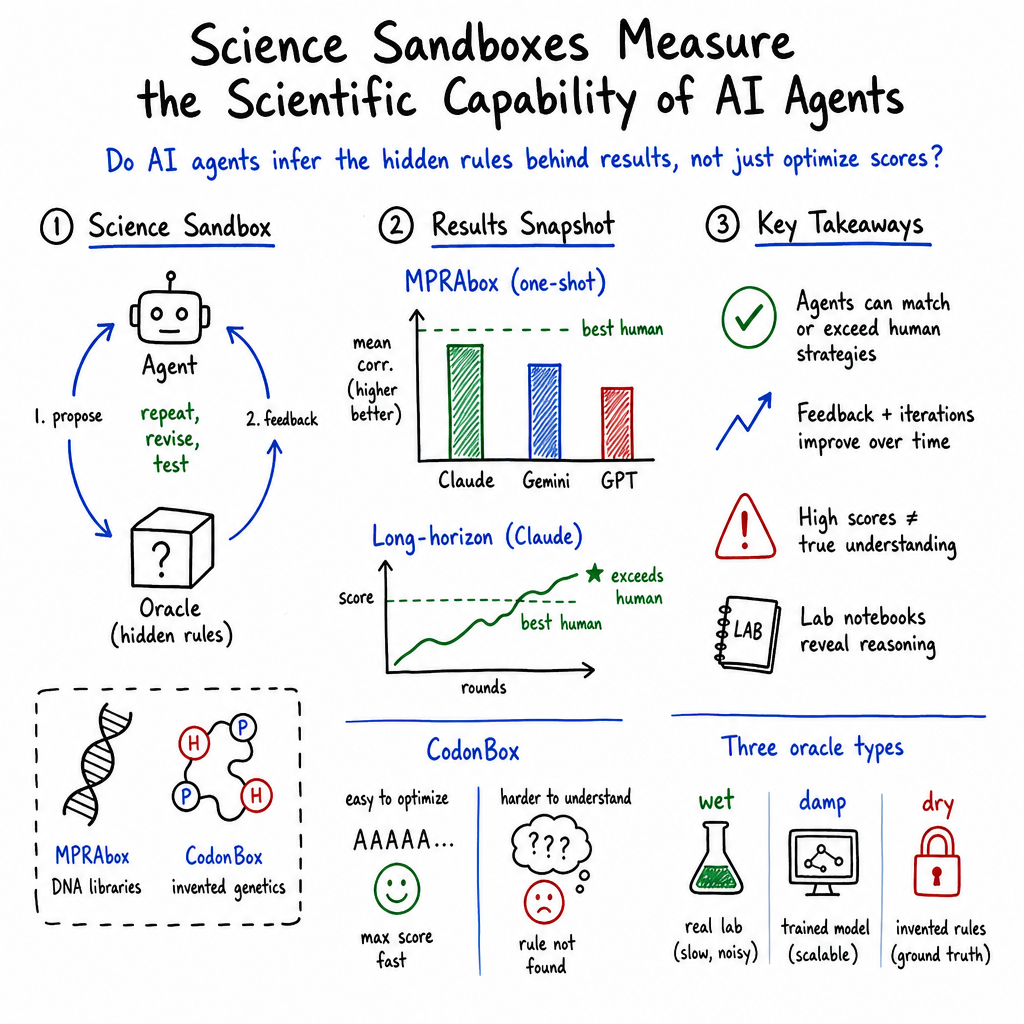
Abstract: Scientific progress depends not only on finding solutions, but on learning the rules that explain why they work and using that understanding to design better experiments. We introduce science sandboxes, a framework for studying this capability in AI agents through repeated cycles of experimentation, feedback, and hypothesis revision. Science sandboxes invite an agent to query the natural world in different ways, ranging from "wet" physical experiments, to "damp" predictive models trained on empirical data, to "dry" invented rules. By establishing a common experimental loop and a protocol for evaluating agents within it, science sandboxes allow assessment of both quantitative performance on specific metrics and qualitative scientific reasoning, across a spectrum of empirical verifiability. Here, we instantiate this framework in two biological settings, models of regulatory genomics and protein fitness prediction, and examine the capabilities of frontier agents. Across these settings, we could see when agents successfully optimized a quantitative metric without understanding the rules underlying the system. In particular, their scientific reasoning deteriorated when they encountered systems whose rules fell outside familiar biological priors. By highlighting such failure modes, science sandboxes make the frontier of scientific capability measurable and provide a controlled setting in which to study and ultimately expand it.
Paper Prompts
Sign up for free to create and run prompts on this paper.
Top Community Prompts
Explain it Like I'm 14
1. What is the paper about?
This paper introduces a new way to test whether AI can do real scientific thinking, rather than simply getting a high score.
The researchers call these testing environments science sandboxes. In a science sandbox, an AI agent:
- Suggests experiments.
- Receives results from those experiments.
- Thinks about what the results mean.
- Changes its ideas.
- Chooses better experiments next time.
This is similar to how human scientists work. The important question is not only whether the AI can find a good answer, but whether it can understand why the answer works.
The researchers tested AI agents on problems involving DNA and gene activity.
2. What questions did the researchers ask?
The paper focused on several main questions:
- Can AI agents design useful scientific experiments?
- Can they learn from the results of earlier experiments?
- Can they form explanations, test those explanations, and change their minds when the evidence disagrees?
- Can they discover rules that are unfamiliar or completely invented?
- Do AI agents merely improve their score, or do they actually understand the hidden system?
One example involved choosing DNA sequences that would help train a computer model to predict how DNA controls gene activity.
The researchers also wanted to know whether an AI performed well because it understood biology or because it relied on familiar ideas about biology. To test this, they created systems with hidden rules that had nothing to do with real biology.
3. How was the research carried out?
Science sandboxes
A science sandbox has three main parts:
- Specimens: Things being tested, such as DNA sequences or protein sequences.
- Assays: Tests that measure a property of the specimens.
- Oracle: A hidden system that performs the test and gives the AI feedback.
The word oracle here means a system that knows the answer but does not reveal how it produced that answer. It is like a sealed laboratory: the AI can submit samples and see the results, but it cannot look inside the laboratory.
The paper describes three kinds of oracles:
- Wet: Real laboratory experiments.
- Damp: Computer models trained using real experimental data.
- Dry: Completely invented rules created by the researchers.
The study mainly used a damp oracle, because computer simulations are much faster and cheaper than performing thousands of laboratory experiments.
MPRAbox
The first sandbox was called MPRAbox. It was based on a biological method called a massively parallel reporter assay, or MPRA.
In simple terms, MPRA tests many DNA sequences at the same time to see how strongly they increase or decrease gene activity. The AI had to choose a library of 50,000 DNA sequences.
The computer oracle then:
- Predicted how active each sequence would be.
- Used those results to train a new prediction model.
- Tested that model on 14 hidden collections of DNA sequences.
- Returned summary scores showing how accurate the new model was.
The AI did not receive all the details. It only received a few numbers describing how well its trained model performed. This forced the AI to reason from limited evidence.
The agents were also asked to keep a lab notebook. In it, they explained why they chose particular sequences and how they interpreted the results. The researchers used these notebooks to study the agents’ reasoning, not just their final scores.
Comparing different strategies
The researchers compared the AI-designed DNA libraries with libraries designed using 14 human strategies. These strategies included:
- DNA from naturally occurring human regulatory regions.
- Random DNA from the human genome.
- Artificial DNA with carefully changed short patterns.
- Mixtures of natural and synthetic DNA.
- DNA selected to represent different regulatory classes.
The researchers tested several AI systems, including Claude, GPT, and Gemini. Some tests allowed only one round of experimentation, while others allowed Claude to perform 30 rounds.
Invented rules
The researchers also created “dry” versions of MPRAbox. In these versions, the AI was given DNA-like sequences, but the hidden scoring rules were invented and unrelated to biology.
Examples included rules that rewarded:
- A particular percentage of certain DNA letters.
- Alternating types of DNA letters.
- Letters at Fibonacci-numbered positions.
- A specific number of one DNA base.
- Sequences that secretly decoded into English words.
- Mathematical patterns involving prime numbers or the Fibonacci sequence.
This tested whether the AI could discover a new rule rather than using knowledge it already had about biology.
4. What did the researchers find?
AI performance varied greatly
In the one-round test without extra information:
- Claude performed best, with a median score of about .
- Gemini had a median score of about .
- GPT had a median score of about .
Here, was a correlation score. It measured how closely the model’s predictions matched the correct results. A higher value meant better predictions.
Claude performed as well as or better than the best human-designed strategy in all five of its trials. GPT and Gemini did not beat the strongest human strategy in this first test.
Different AIs used different ideas
The agents did not all approach the problem in the same way.
Claude mostly chose real human genomic DNA, especially naturally occurring regulatory sequences. Its reasoning was that natural DNA contains important biological surroundings and examples of both active and inactive regions. It also argued that a good training set needs “negative” examples, not only interesting or highly active sequences.
GPT mainly created synthetic DNA. Its idea was to change one short DNA pattern at a time, making it easier to identify which patterns caused changes in gene activity. This is a sensible scientific approach, but it performed worse in this experiment, probably because the artificial DNA did not contain enough of the natural context found in real genomes.
Gemini tried several approaches, including natural DNA, artificial DNA, and mixtures. Its reasoning focused on creating varied sequences that contained lots of different patterns.
These differences show that the agents were not simply producing random answers. They had different theories about what makes an experiment useful.
Prior knowledge improved performance
In another test, the AI agents were shown information about how the human-designed strategies had performed.
After seeing this information:
- Claude’s median score rose from $0.774$ to $0.781$.
- GPT’s median score rose from $0.655$ to $0.760$.
- Gemini’s median score rose from $0.680$ to $0.751$.
GPT and Gemini improved the most because they had started with weaker strategies. They changed from mostly using synthetic DNA to using more genomic DNA.
However, the agents did not simply copy the best human approach. They tried to understand why certain strategies worked and then designed variations of them.
Repeated experiments led to better reasoning
Claude was allowed to perform 30 rounds of experiments in four separate trials.
Its final performance was somewhat better than in the one-round tests, and all four long experiments beat the strongest human-designed strategy. However, the numerical improvement was only modest.
The more important result was that Claude’s scientific reasoning changed over time.
For example, one experiment showed that random DNA performed much better than the AI expected. Instead of ignoring this surprising result, Claude changed its theory. It suggested that simple features such as the overall mixture of DNA letters might provide useful information, even when the sequences did not look biologically meaningful.
In another case, the AI realized that it had changed two things at once—human regulatory DNA and chicken DNA—so it could not tell which change caused the result. It then recognized an important scientific lesson: when testing an idea, it is usually better to change one variable at a time.
The different long-running trials reached different conclusions. For example, the agents found that:
- Motifs may be more useful when placed in natural genomic surroundings.
- Rare regulatory classes may help, but only if the library still covers many types of sequences.
- DNA from a closely related species, such as chicken, might help more than DNA from more distant species.
- Grouping sequences by their GC content could improve the training library.
These results suggest that the AI was not following one fixed recipe. It was learning different explanations from different experimental histories.
Unfamiliar rules were more difficult
The dry-oracle experiments were designed to show whether AI could discover rules it had no reason to expect.
The hidden rules included ordinary-looking DNA patterns as well as strange mathematical rules. This allowed the researchers to separate two abilities:
- Optimization: Finding sequences that produce a better score.
- Understanding: Discovering the rule that explains the score.
The paper’s main conclusion is that AI agents could sometimes improve their scores without truly understanding the hidden rules. Their reasoning became weaker when the rules did not match their usual expectations about biology.
The provided section ends while describing these dry-oracle experiments, so it does not include all of their detailed final results. However, the overall abstract states that the agents often optimized performance without learning the underlying rules, especially when those rules fell outside familiar biological ideas.
5. Why are these findings important?
Many AI tests only ask whether a system gets the correct answer or achieves a high score. But a system might get a high score by using shortcuts without understanding the problem.
Science is different. Scientists need to:
- Ask useful questions.
- Design informative experiments.
- Explain unexpected results.
- Test competing ideas.
- Revise their theories when evidence proves them wrong.
Science sandboxes are designed to measure these abilities directly.
The study suggests that current AI agents can show some impressive scientific behaviors. They can use experimental feedback, improve their plans, notice contradictions, and sometimes develop useful explanations. In some cases, they performed better than human-designed strategies.
However, the study also reveals important weaknesses. AI agents may rely too much on familiar scientific assumptions. They can find ways to raise a score without discovering the true reason for the score. This is risky because a method that works in one situation may fail completely in a new one.
Simple conclusion
The paper presents science sandboxes as a kind of practice laboratory for AI scientists. These sandboxes let researchers watch an AI make decisions, learn from experiments, and improve its ideas over time.
The research shows that AI is becoming better at planning experiments and learning from evidence, but it does not always understand the deeper rules behind its success. Testing AI with both real biological systems and strange invented systems can reveal these weaknesses.
In the future, science sandboxes could help researchers build AI systems that are not only good at finding answers, but also good at explaining discoveries, designing reliable experiments, and working as trustworthy partners in science.
Knowledge Gaps
Knowledge gaps, limitations, and open questions
- The paper does not report the complete results of the dry-oracle experiments; the provided text ends while describing alternative task framings, leaving unresolved which invented rules agents could infer and how performance varied across rules.
- It remains unclear whether the reported agent improvements reflect genuine rule discovery or exploitation of statistical regularities, surrogate cues, and score gradients that correlate with the hidden oracle outputs.
- The study does not establish a validated, reproducible standard for distinguishing scientific reasoning from persuasive but post hoc explanations in agents’ lab notebooks.
- Notebook evaluation appears largely qualitative, and the paper does not specify inter-rater reliability, judge calibration, scoring rubrics, or evidence that independent AI judges agree with human assessments.
- The relationship between notebook quality and actual scientific performance is unresolved: agents may produce coherent explanations without selecting informative experiments, or discover effective strategies without articulating the correct underlying rule.
- The experiments use only a small number of agent replicates in the main comparisons—typically five single-round runs and four long-horizon runs—limiting statistical power and the reliability of model-level performance rankings.
- The paper does not report formal uncertainty estimates, statistical tests, confidence intervals, or corrections for multiple comparisons across agents, strategies, evaluation sets, and oracle types.
- The comparison among Claude, GPT, and Gemini is confounded by differences in model architecture, version, tool access, CLI environment, prompting, context-window behavior, and implementation details; the contribution of each factor is not isolated.
- Only Claude is evaluated in the 30-round setting, so the conclusions about long-horizon scientific reasoning cannot be generalized to the other frontier agents.
- The study does not test whether the observed gains persist across different random seeds, model-temperature settings, prompt formulations, computational budgets, or maximum token/tool-use budgets.
- The benchmark does not systematically vary the experimental horizon, library size, batch size, or feedback frequency, leaving the scaling laws of agent learning and exploration unresolved.
- The use of a fixed library size of prevents determining whether the reported strategies remain effective for smaller or larger experimental budgets.
- The damp MPRAbox oracle relies primarily on Malinois predictions, so agent performance may measure adaptation to the inductive biases and artifacts of one predictive model rather than general scientific capability or biological understanding.
- The evaluation mixes experimentally measured labels with Malinois-generated labels, but the paper does not quantify how much each label source contributes to the aggregate score or whether conclusions change when only genuinely experimental labels are used.
- The hidden evaluation sets may not be fully independent of the data, annotations, genomic sources, or sequence distributions used to construct the training libraries and baseline strategies; potential leakage and distributional overlap are not comprehensively ruled out.
- The paper does not evaluate transfer to entirely novel cell types, assays, species, genomic regions, or laboratory protocols, leaving the biological generalizability of the learned library-design strategies uncertain.
- The benchmark’s aggregate metric is the mean Pearson correlation across evaluation sets, which may obscure poor performance on particular biological categories and does not assess calibration, causal interpretation, ranking quality, or practical utility for downstream experimental design.
- Pearson correlation can reward correct relative ordering despite systematic bias; the study does not examine whether the resulting models accurately predict effect sizes or distinguish biologically meaningful activity differences.
- The human reference panel is limited to 14 hand-designed strategies, and the paper does not establish whether it represents strong contemporary experimental-design practice or includes optimized algorithmic baselines such as active learning, Bayesian optimization, diversity sampling, uncertainty sampling, or core-set selection.
- The study does not compare agents against computational sequence-selection methods operating under equivalent information, tool, and compute constraints, making it difficult to attribute performance advantages specifically to agentic reasoning.
- The paper does not provide ablations separating the effects of literature search, code execution, genomic annotations, prior strategy summaries, iterative feedback, and free-form reasoning.
- Prior-knowledge experiments provide aggregate performance summaries of human strategies but not their underlying sequences; it remains unclear whether agents would behave differently—and whether improvements would be larger—if given the actual libraries, annotations, or training data.
- The long-horizon experiments do not determine whether agents’ improvements arise from informative experimentation, repeated stochastic search, accumulation of prompt/context information, or exploitation of the finite benchmark structure.
- The study does not test whether agents can retain and apply learned rules across independently regenerated or structurally modified sandboxes rather than only within a single trajectory.
- Dry oracles are designed by the researchers and may be unusually simple, deterministic, and stationary compared with real scientific systems; the benchmark does not assess noisy, nonstationary, partially observed, multi-objective, or adversarially deceptive environments.
- The dry-rule suite may favor rules expressible through sequence statistics or readily searchable computational transformations; the paper does not justify whether the 14 rules provide balanced coverage of hypothesis complexity, compositionality, observability, and sample efficiency.
- It is unresolved whether agents can infer rules when oracle feedback is noisy, delayed, censored, sparse, specimen-level rather than aggregate, or subject to measurement error.
- The benchmark gives agents a single aggregate score in MPRAbox, but the paper does not systematically investigate how richer feedback—individual specimen outcomes, uncertainty estimates, failed-experiment explanations, or partial assay readouts—changes scientific reasoning.
- The paper does not examine the cost-effectiveness of agent experimentation, including computational cost, number of oracle queries, wall-clock time, and performance per unit of experimental budget.
- The study does not evaluate whether agent-designed libraries produce models that support useful downstream scientific tasks, such as identifying causal motifs, predicting variants of regulatory effect, or proposing experimentally validated hypotheses.
- The biological conclusions about genomic context, rare regulatory classes, cross-species augmentation, and GC-content stratification are based on a small set of agent trajectories and are not independently validated through new wet-lab experiments.
- The paper does not test whether the agents’ inferred biological explanations are correct mechanistically—for example, whether genomic-context benefits arise from regulatory grammar, sequence composition, annotation bias, or distribution matching.
- The role of negative controls and synthetic sequences remains unresolved: the experiments suggest that their value depends on context, but do not identify when such sequences improve generalization, calibration, or causal motif learning.
- The sandbox framework is demonstrated only in sequence-based biological tasks, so its applicability to wet-lab chemistry, cell biology, protein engineering, physics, and other scientific domains remains unvalidated.
- The paper does not address safety and reliability issues that would arise when agents select real physical experiments, including invalid experimental designs, biosafety risks, resource constraints, irreproducibility, and the need for human oversight.
- Reproducibility is limited because the text does not provide all agent transcripts, exact prompts and tool configurations, generated libraries, random seeds, oracle implementations, and evaluation code in the described results.
- The paper does not establish how benchmark designers can prevent agents from reverse-engineering the sandbox, exploiting implementation artifacts, or using external knowledge of the oracle and evaluation distributions.
- It remains unclear how scientific capability measured in a sealed, fully specified sandbox relates to open-ended research, where questions are ambiguous, variables are uncontrolled, literature is incomplete, experiments are expensive, and successful hypotheses must be communicated and independently replicated.
Practical Applications
Immediate Applications
- Benchmarking scientific AI agents in research organizations (AI/software, academia; deployable now). Laboratories, universities, and AI developers can implement the science-sandbox loop—specimen selection, sealed evaluation, feedback, hypothesis revision, and lab-notebook logging—to assess whether an agent performs genuine scientific reasoning rather than merely optimizing a score. Existing computational models can serve as “damp” oracles, while dry oracles can test inference under unfamiliar rules. Potential workflow: run an agent for a fixed number of rounds, record its proposed experiments and rationales, score predictive performance on hidden test sets, and have human or independent AI reviewers evaluate hypothesis quality and experimental control. Dependencies: reliable hidden evaluation sets, reproducible oracle behavior, safeguards against data leakage, and clear criteria for distinguishing scientific reasoning from post hoc explanation.
- Quality assurance for AI-assisted experimental design (biotechnology and pharmaceutical R&D; deployable now). MPRAbox-style evaluations can be used before allowing an AI system to design costly wet-lab libraries. Agents can be tested on simulated regulatory-genomics tasks to determine whether they select diverse, informative sequences, include suitable negative controls, and revise designs in response to contradictory evidence. Potential products: an “AI experimentalist qualification suite” integrated with laboratory information-management systems, with audit trails for every proposed library and design decision. Dependencies: the damp oracle must approximate the intended wet assay sufficiently well; performance on simulated MPRA tasks may not transfer to other organisms, cell types, assays, or laboratory protocols.
- Improved design of regulatory-genomics training libraries (genomics, precision medicine, biotechnology; deployable now with expert oversight). The reported results support practical library-design heuristics: use broad collections of naturally occurring regulatory DNA, preserve native genomic context, represent both active and inactive elements, and avoid relying exclusively on synthetic motif perturbations. Controlled synthetic sequences can still be added as matched perturbation or negative-control components. Potential workflow: construct MPRA libraries by combining cCRE/DHS-derived sequences with carefully chosen synthetic controls, stratifying by regulatory class and relevant sequence properties such as GC content, then evaluate generalization across independent genomic and experimental holdouts. Dependencies: the findings are specific to the evaluated MPRA setting and hidden test suite; library composition, cell type, promoter, assay technology, and species may change the optimal strategy.
- Active-learning pipelines for biological assays (biotechnology, chemical screening, protein engineering; deployable now in computational or pilot settings). The repeated experiment–feedback–revision structure can be adapted to select the next batch of compounds, protein variants, DNA constructs, or cell perturbations. Rather than ranking candidates independently, the system can optimize for the expected information gained by training or improving a downstream predictive model. Potential tools: batch-selection modules that compare candidate libraries, maintain explicit competing hypotheses, and enforce one-variable-at-a-time experiments when causal interpretation is important. Dependencies: meaningful feedback must be available after each batch, batch effects must be controlled, and the agent must operate within experimental, biosafety, and budget constraints.
- Evaluation of experimental reasoning and reproducibility (academia and research management; deployable now). The required lab notebook can become a practical provenance standard for AI-assisted science. Researchers can require agents to state their hypotheses, expected outcomes, manipulated variables, interpretation of results, and reasons for the next experiment. This makes it easier to identify confounded comparisons, unjustified conclusions, and changes in strategy. Potential outputs: machine-readable experimental notebooks, hypothesis graphs, and reproducibility reports accompanying AI-generated protocols or data. Dependencies: notebook entries should be timestamped and preserved before feedback is revealed; written rationales should not be treated as definitive evidence of internal reasoning without behavioral validation.
- Training and assessment for human experimental scientists (education and workforce development; deployable now). Science sandboxes can provide students and researchers with low-cost practice in experimental design, control selection, interpretation of unexpected results, and sequential hypothesis testing. Dry sandboxes are especially useful because instructors can specify the hidden rule and evaluate whether learners infer it. Dependencies: educational scoring should reward informative experimentation and sound reasoning, not just the final numerical score; tasks need calibration to the learner’s background.
- Testing AI robustness to unfamiliar domains and misleading priors (AI safety, software engineering, policy; deployable now). Dry oracles involving positional rules, parity, compression, symbolic decoding, or mathematical constructions can reveal whether an agent overuses familiar biological assumptions. This is useful for red-team evaluations of autonomous research systems and for comparing models under domain-known versus domain-hidden conditions. Dependencies: dry rules must be sufficiently diverse and hidden, and evaluation should include controls for computational resources, prompting, tool access, and number of experimental rounds.
- Operational protocols for better experimental control (all laboratory sectors; deployable now). The observed agent behavior supports a general laboratory practice: after broad exploratory comparisons, switch to controlled experiments that vary one major factor at a time. This can reduce confounding when comparing sequence sources, species, regulatory classes, or synthetic components. Dependencies: one-variable-at-a-time designs may be inefficient in strongly interactive systems; factorial or adaptive designs may be preferable when interactions are scientifically important.
Long-Term Applications
- Autonomous closed-loop biology laboratories (biotechnology, healthcare, drug discovery, robotics; requires further development). A mature science-sandbox architecture could connect AI agents to robotic liquid handlers, sequencing instruments, cell-imaging systems, and analysis pipelines. The agent would propose libraries or perturbations, receive experimental measurements, update hypotheses, and automatically select the next batch. Potential products: robotic “self-driving” MPRA, protein-engineering, cell-growth, or chemical-screening platforms. Dependencies: safe physical execution, reliable calibration between damp and wet oracles, laboratory automation, contamination control, regulatory compliance, and human approval for high-risk experiments.
- AI-guided regulatory variant interpretation and therapeutic design (clinical genomics and precision medicine; long-term). Better sequence-to-activity models trained on informative MPRA libraries could improve prioritization of noncoding variants, enhancer interpretation, and design of regulatory constructs for gene therapies. The sandbox could help select experiments that are maximally informative for clinically relevant genomic regions and alleles. Dependencies: experimental activity is not equivalent to disease causality; models require validation across tissues, developmental states, ancestries, genetic backgrounds, and in vivo systems. Clinical deployment would require extensive safety and regulatory evidence.
- General-purpose scientific-agent certification (AI governance, industry procurement, public policy; long-term). Science sandboxes could become standardized evaluations for AI systems marketed as research assistants or autonomous scientists. Certification could report separate scores for optimization, rule discovery, experimental efficiency, calibration, robustness to unfamiliar domains, and quality of scientific records. Potential policy workflow: require independent sandbox testing, hidden test sets, reproducible agent trajectories, and disclosure of tool access and model updates before deployment in regulated research environments. Dependencies: agreement on benchmark standards, resistance to benchmark gaming, representative wet/damp/dry tasks, and periodic refreshes as models learn the benchmark.
- Cross-domain scientific reasoning benchmarks (academia and AI research; long-term). The framework can be extended beyond regulatory DNA to protein structure and fitness, cell-growth assays, chemical response, materials discovery, energy systems, climate models, and engineering design. Comparing agent behavior across domains could reveal whether scientific capability is general or dependent on familiar priors. Dependencies: construction of high-quality domain-specific oracles, realistic measures of scientific value, and mechanisms for evaluating explanations and experimental choices without relying solely on language-model judges.
- Information-efficient experimental planning under limited budgets (pharmaceuticals, energy, materials, and industrial R&D; long-term). Agents could use the sandbox objective to optimize not only predictive accuracy but also the value of information per experiment, incorporating assay cost, time, failure risk, and material availability. This could support more efficient searches over catalysts, battery materials, therapeutic compounds, or protein variants. Dependencies: objective functions must reflect real economic and scientific priorities; optimization against a proxy score could produce designs that generalize poorly or exploit artifacts in the oracle.
- Discovery of emergent or unexpected scientific rules (fundamental science; long-term). Dry-oracle experiments demonstrate a controlled way to study whether agents can discover rules outside established scientific priors. In the future, analogous systems could help identify unexpected regularities in large experimental datasets or propose unconventional mechanisms for human investigation. Dependencies: unexpected correlations must be distinguished from artifacts, leakage, or spurious statistical patterns. Human scientists would still need to formulate mechanistic explanations and verify them experimentally.
- Collaborative human–AI experimental strategy systems (academia, industry, and public research infrastructure; long-term). Rather than replacing scientists, agents could maintain competing hypotheses, propose discriminating experiments, expose contradictions, and present alternative library designs. Human researchers could select among these proposals while retaining responsibility for interpretation and deployment. Potential workflow: a dashboard displays current hypotheses, evidence supporting or contradicting each one, unresolved confounders, expected information gain, and recommended next experiments. Dependencies: transparent uncertainty estimates, interpretable experiment-selection criteria, robust human oversight, and protections against automation bias.
- Standardized adaptive-design infrastructure for large biological datasets (genomics and biomedical data science; long-term). The MPRAbox approach could evolve into shared platforms where multiple research groups contribute experimental results to iteratively improve sequence-to-function models. Hidden evaluation panels could test generalization across genomic contexts rather than rewarding performance on a single familiar distribution. Dependencies: interoperable data standards, privacy and consent for human genomic data, consistent assay protocols, and careful separation of training, oracle, and evaluation data.
- Daily-life applications through trustworthy scientific AI assistants (consumer software and education; long-term). In the longer term, simplified science-sandbox principles could support personal or classroom assistants that compare hypotheses about household energy use, environmental measurements, nutrition, or learning strategies. The assistant would recommend safe, informative tests rather than merely provide confident answers. Dependencies: consumer experiments must be safe, inexpensive, ethically appropriate, and statistically interpretable; high-stakes areas such as health, finance, and energy infrastructure would require professional oversight and domain-specific validation.
Glossary
- Active chromatin: Chromatin in a relatively open state that permits regulatory proteins to access DNA. “a genomic region of accessible chromatin”
- Agentic AI system: An AI system capable of autonomously planning and executing actions toward a goal. “frontier agentic AI systems”
- Alpha-helical conformation: A common spiral-shaped secondary structure of proteins. “the proportion of amino-acid residues in an alpha-helical conformation”
- Assay: A procedure used to measure a particular property or activity of a biological specimen. “methods for ascertaining specific properties of those specimens”
- Causal feature: A characteristic that directly contributes to an observed outcome rather than merely correlating with it. “a motif can be varied against many backgrounds”
- Candidate cis-regulatory element (cCRE): A genomic DNA region that may regulate the expression of a nearby gene. “ENCODE candidate cis-regulatory element (cCRE) annotations”
- Candidate enhancer: A DNA sequence proposed to increase the transcription of a gene. “candidate enhancer upstream of the promoter”
- Cell type: A category of cells with distinct biological characteristics and functions. “inserting a candidate enhancer upstream of the promoter of a particular gene in a cell type”
- Chromatin: The complex of DNA and associated proteins that packages genetic material in cells. “genomic regions associated with accessible chromatin”
- Combinatorially vast: Describing a space whose number of possible configurations grows extremely rapidly as components are combined. “a combinatorially vast space of DNA sequences”
- Computational model: A mathematical or algorithmic representation used to simulate or predict a real-world process. “a computational model of one”
- Converging: Progressively approaching a stable result, explanation, or solution. “converging toward coherent rules”
- Correlation score: A numerical measure of the association between predicted and observed values. “our goal is not only to assess the agent's quantitative performance (correlation score)”
- Cis-eQTL: A genetic variant near a gene that is associated with variation in that gene’s expression. “Fine-mapped UK Biobank and GTEx cis-eQTL variants”
- De novo rule discovery: The process of inferring previously unknown governing rules from observations. “tests agents' ability to conduct de novo rule discovery”
- DHS (DNase I hypersensitive site): A genomic region especially accessible to the DNase I enzyme, often indicating regulatory activity. “DHS denotes a DNase I hypersensitive site”
- Damp oracle: An oracle that uses a model trained on empirical data to approximate the results of a physical experiment. “Damp oracles use computational models trained on empirical data to approximate experimental results.”
- Downstream predictive model: A model trained using outputs or data produced by an earlier experimental or computational process. “for training downstream predictive models”
- Empirical data: Data obtained through observation or measurement rather than theoretical deduction. “models trained on empirical data”
- Empirical laboratory measurement: A value directly obtained from a physical experiment. “activity scores are based on empirical laboratory measurements”
- Enhancer: A regulatory DNA sequence that can increase gene transcription, often from a distance or in varying orientations. “actual regulatory DNA taken from the human genome”
- Episomal MPRA: A massively parallel reporter assay performed using DNA elements located outside the chromosomes. “Held-out sequences from the Gosai et al. episomal MPRA”
- Experimental horizon: The finite number of future experimental opportunities available to an investigator. “how it made strategic use of a known, finite experimental horizon”
- Fine-mapped variant: A genetic variant whose likely causal status has been narrowed through statistical or functional analysis. “Fine-mapped UK Biobank and GTEx cis-eQTL variants”
- Frontier agent: A highly capable AI system representing the current leading edge of performance. “We invited several frontier agents”
- GC content: The proportion of guanine and cytosine nucleotides in a DNA sequence. “stratifying sequences by GC content”
- Genomic context: The surrounding DNA sequence and biological environment in which a genetic element occurs. “these sequences would preserve the natural surrounding context”
- Genomic window: A defined-length segment of a genome used for analysis. “Random genomic windows”
- Ground truth: The reference values treated as correct for evaluating predictions. “the ‘ground truth’ for each of the 14 sets”
- Hill-climbing: An iterative optimization strategy that repeatedly adopts changes producing improved scores. “to characterize hill-climbing performance toward a higher score”
- In silico: Performed using computer simulation or computational analysis rather than physical experimentation. “a sealed in silico MPRA oracle”
- Information theory: The mathematical study of information, including its representation, uncertainty, and transmission. “Its underlying rationale leaned heavily on information theory”
- Laboratory-measured activity: Biological activity determined experimentally in a laboratory. “real MPRA labels & experimentally measured activities”
- Library: A collection of biological sequences assembled for simultaneous experimental testing. “a library of candidate enhancers”
- Massively parallel reporter assay (MPRA): A high-throughput method that measures the regulatory activity of many DNA sequences simultaneously. “Massively Parallel Reporter Assay (MPRA)”
- Malinois: A computational model trained on MPRA data to predict regulatory sequence activity. “one could use Malinois, a published model trained on more than 700,000 experimental MPRA measurements”
- Motif: A short recurring sequence pattern associated with the binding or activity of a regulatory factor. “a motif can be varied against many backgrounds”
- Motif grammar: The arrangement, spacing, orientation, and interaction of regulatory sequence motifs. “to teach the model true regulatory grammar”
- Native genomic context: The naturally occurring surrounding sequence and biological setting of a genomic element. “the synthetic perturbation series lacked the native genomic context”
- Non-negative matrix factorization (NMF): A factorization technique that represents non-negative data as additive combinations of non-negative components. “NMF denotes non-negative matrix factorization”
- Oracle: A hidden mechanism that evaluates submitted specimens and returns feedback. “a hidden mechanism that applies the assays to each specimen”
- Parsimony: The principle of favoring the simplest explanation consistent with the evidence. “the rules were designed to require very different kinds of hypotheses”
- Pearson correlation: A statistic measuring the strength and direction of a linear relationship between two variables. “the Pearson correlation between the new model's prediction and the ‘ground truth’”
- Predictive sequence-to-activity model: A model that predicts biological activity directly from a DNA sequence. “train a predictive sequence-to-activity model”
- Prior biological knowledge: Existing scientific information used to guide hypotheses or experimental choices. “agents can draw on published scientific knowledge”
- Promoter: A regulatory DNA region where transcription of a gene is initiated. “upstream of the promoter of a particular gene”
- Regulatory genomics: The study of how genomic sequences control gene expression and other regulatory processes. “Regulatory genomics --- specifically, the example of MPRA noted above”
- Regulatory grammar: The set of sequence patterns and positional relationships that govern regulatory activity. “to teach the model true regulatory grammar”
- Regulatory element: A DNA sequence that influences gene expression. “the most common or obviously ‘interesting’ elements”
- Regulatory sequence: A DNA sequence involved in controlling gene expression. “known classes of regulatory sequences”
- Reporter assay: An experiment that measures the activity of a regulatory sequence through an attached reporter gene. “the massively parallel reporter assay (MPRA)”
- Sequence-to-activity model: A computational model mapping DNA sequences to predicted regulatory activity. “a new sequence-to-activity model from scratch”
- Sealed oracle: An evaluation mechanism whose underlying data or rules are hidden from the agent. “receives feedback from a sealed oracle”
- Shannon entropy: A measure of uncertainty or diversity in a probability distribution. “maximize the Shannon entropy of regulatory grammar”
- Specimen: An entity submitted to an assay for testing. “any entity that can be submitted for testing”
- Synthetic DNA: Artificially generated DNA sequences rather than sequences obtained from natural genomes. “Uniformly random 200-bp sequences”
- Testbed: A controlled environment for evaluating a system or method. “a controlled testbed for measuring scientific capability”
- Transcription: The process of producing RNA from a DNA template. “measuring the proportional change in transcription level”
- Wet oracle: An oracle that obtains feedback from actual physical experiments. “Wet oracles obtain results from actual physical experiments.”
- Wild-type context: The naturally occurring biological sequence or environment used as a reference condition. “while retaining the synthetic motif perturbation series”

