Fast Weight Attention for Continual Learning
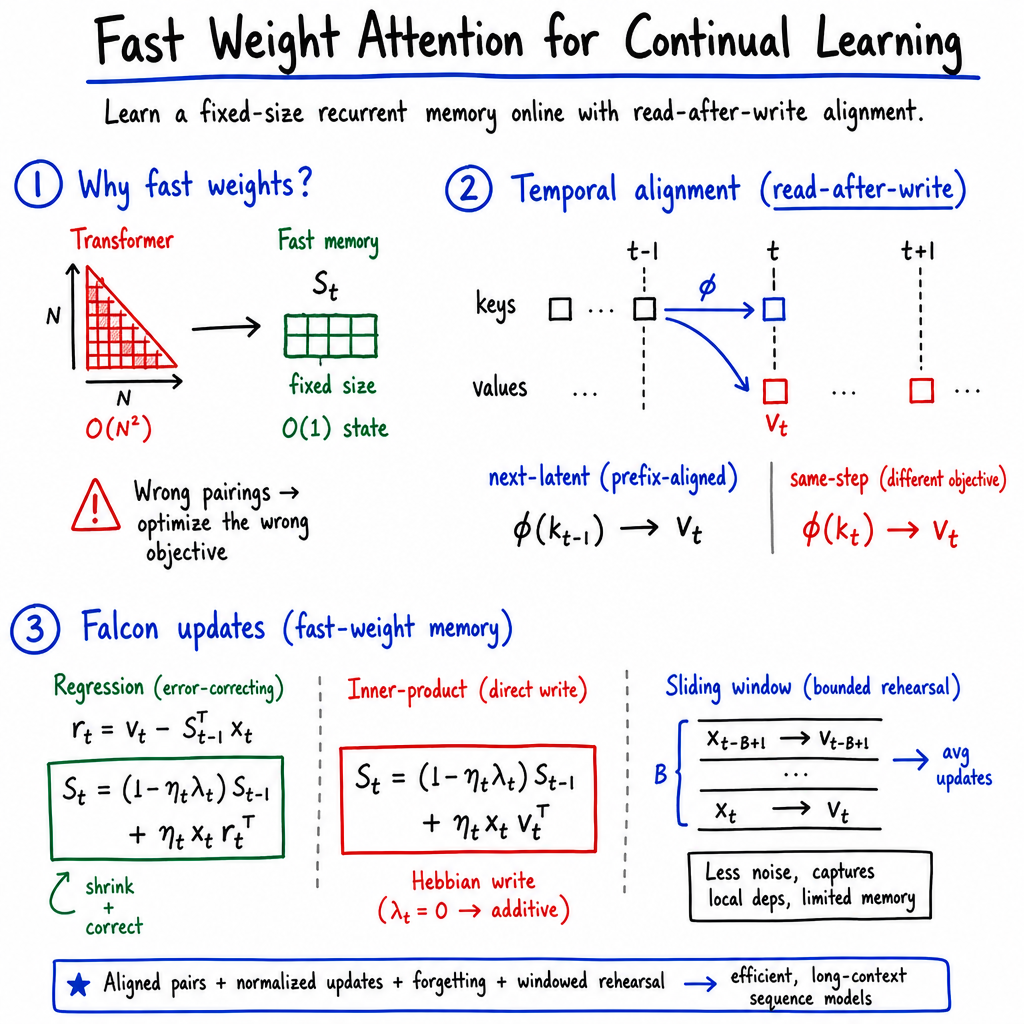
Abstract: Recurrent fast-weight memories and selective state-space models compress an expanding context into a fixed-size recurrent state, making the state transition an online learning rule. We study this rule under read-after-write autoregressive semantics. For the prefix-prediction objective considered here, the local fast-memory example revealed at step is the prefix-aligned pair . The common same-step association remains causal, but optimizes a different internal objective. We derive normalized first-order updates for squared-error regression and negative inner-product objectives. The regression family comprises Falcon-1 (a scalar NLMS update), Falcon-2 (its per-column extension), and Falcon-3 (a sliding-window mini-batch update); Falcon-1A/Falcon-2A/Falcon-3A are the corresponding inner-product variants. We provide recurrent, masked-parallel, and chunk-parallel forms, together with numerically stable positive-decay renormalization. Representative variants remain competitive in language modeling and improve length extrapolation on variable-digit addition. This framework separates temporal alignment, plasticity, forgetting, and bounded rehearsal in recurrent sequence models.
Paper Prompts
Sign up for free to create and run prompts on this paper.
Top Community Prompts
Explain it Like I'm 14
1. What is this paper about?
This paper studies a way for artificial intelligence models to remember useful information while reading a long sequence, such as a paragraph, book, or conversation.
Today’s popular LLMs often use a method called attention. Attention helps a model look back at earlier words, but it can become expensive when the text gets very long because the model may need to compare many words with one another.
The paper explores a different idea called fast-weight attention. Instead of saving every past word, the model stores a compact summary in a fixed-size memory. This memory can be quickly updated whenever new information arrives.
The paper’s main goal is to design better update rules for this memory, especially when the model must keep learning continuously as it reads.
2. What questions are the researchers asking?
The researchers focus on several main questions:
- What information should be written into the model’s fast memory at each step?
- When should the model write new information, and when should it forget older information?
- How can the memory learn from new examples without accidentally destroying useful old information?
- Can this memory work efficiently on long sequences?
- Can the method help models handle tasks involving information much farther away in the sequence than they saw during training?
A particularly important question concerns timing.
Imagine a student trying to predict the next word in a sentence. The student should use information that was already available before the next word appeared. The paper argues that the model’s memory should follow the same rule.
For a prediction at time , the memory should connect:
- a feature from the previous step, written as , and
- the newly observed value .
The paper calls this next-latent alignment. In simpler terms, the model learns from the information that was available when it made its prediction, rather than pairing information with itself at the same instant.
3. How did the researchers approach the problem?
A compact memory
The model keeps a matrix called . This matrix is the model’s fast memory at time .
You can think of like a notebook with a fixed number of pages. As the model reads, it writes important information into the notebook. Unlike a normal attention cache, the notebook does not grow forever.
To answer a question, the model uses a query to read from the memory:
This means that the query searches the stored information and produces an output.
Online learning
The memory is updated one step at a time using Online Gradient Descent, or OGD.
This sounds technical, but the basic idea is simple:
- The memory makes a guess.
- The model compares the guess with the correct answer.
- It measures the error.
- It adjusts the memory to reduce that error.
This is similar to practicing math problems: after seeing which answer was wrong, a student changes their understanding slightly so that they will perform better next time.
The paper uses a squared-error objective:
In everyday language:
- is the information used to make a prediction.
- is the newly revealed correct information.
- The first part measures how wrong the prediction was.
- controls how strongly the model shrinks or forgets older memories.
The update is based on the residual, which is simply the difference between the correct answer and the model’s prediction:
If the error is large, the model makes a bigger correction. If the error is small, it changes its memory only a little.
Three main memory-update methods
The paper introduces three main versions, named Falcon-1, Falcon-2, and Falcon-3.
Falcon-1: one learning speed
Falcon-1 uses one learning rate, , for the whole memory.
This is like a teacher telling every subject in a student’s notebook to be updated at the same speed. Its general update looks like:
Here:
- the first term gently reduces old memories;
- the second term writes in the new correction;
- controls how strongly the new information is written.
Falcon-2: different learning speeds
Falcon-2 gives each output channel its own learning rate.
This is like allowing a student to spend more time on difficult subjects and less time on subjects they already understand. Some parts of the memory can change quickly, while others remain more stable.
Falcon-3: learn from a small recent window
Falcon-3 does not update the memory using only one example. Instead, it uses a small group of recent examples, called a sliding window or mini-batch.
This is like reviewing the last four homework problems together instead of correcting only the most recent one. The update uses the average correction from this group.
Different ways to run the computation
The paper also describes three ways to compute the updates:
- Recurrent form: process one token after another, like reading a sentence from left to right.
- Parallel form: process many tokens at once using a causal mask, which prevents the model from seeing future tokens.
- Chunk-parallel form: divide the sequence into small blocks. Work inside each block can happen in parallel, while a compact memory is passed from one block to the next.
The chunk method is a compromise between speed and memory efficiency. It is similar to organizing a long book into chapters: each chapter can be processed efficiently, while a summary is carried from one chapter to the next.
The researchers also study related versions called Falcon-1A, Falcon-2A, and Falcon-3A, which use an inner-product objective instead of the squared-error objective.
4. What did the researchers find?
The paper reports several important findings.
The timing of memory updates matters
The researchers argue that there is a difference between:
- pairing the current key and current value, and
- pairing the previous key feature with the newly observed value.
Both methods can be causal, meaning they do not directly look into the future. However, they train the internal memory to do different jobs.
For next-step prediction, the paper says the prefix-aligned pair is the more natural choice because it matches the information available when the prediction was made.
The methods provide flexible memory behavior
The Falcon methods separate several useful controls:
- Plasticity: how quickly the memory learns new information.
- Forgetting: how quickly old information fades.
- Temporal alignment: which past information is connected to the new target.
- Rehearsal: whether the model reviews several recent examples together.
This flexibility allows different parts of the memory to react differently. Some information can be changed quickly, while important long-term information can be protected.
The methods can be computed efficiently
The paper gives recurrent and chunk-parallel versions of the methods. These are designed to avoid the full cost of ordinary attention on long sequences.
Standard attention usually requires about work for a sequence of length . This means that doubling the sequence length can require about four times as much pairwise comparison.
The recurrent fast-memory approach can use about work during processing and keep a fixed-size memory during step-by-step use. This makes it more attractive for very long inputs.
The methods performed competitively
In experiments, representative Falcon variants remained competitive on language modeling, where a model predicts the next piece of text.
They also improved length extrapolation on variable-digit addition. This means that models trained on shorter addition problems were better able to handle longer ones.
For example, a model might train on:
1 |
37 + 82 |
and then be tested on:
1 |
48391 + 72946 |
Being able to handle longer examples suggests that the model learned a useful procedure rather than simply memorizing the lengths seen during training.
5. Why is this research important?
Long-context AI systems need two abilities at the same time:
- They must remember information from earlier in the sequence.
- They must avoid becoming too slow or using too much memory.
Fast-weight attention tries to achieve this by turning the model’s memory into a small, constantly updated learning system.
The paper’s ideas could help create models that:
- process long documents more efficiently;
- remember important information while reading;
- adapt quickly to new facts;
- forget outdated or less useful information;
- handle sequences longer than those used during training;
- combine the speed of recurrent models with some of the flexibility of attention.
However, the paper does not show that these methods solve every problem. A fixed-size memory may still lose details when too much information must be stored. The best balance between remembering and forgetting may also depend on the task.
Overall, the paper presents fast-weight attention as a promising way to build AI systems with a small but trainable “working memory.” Its central message is that how and when a model updates its memory can be just as important as the memory itself.
Knowledge Gaps
Knowledge gaps, limitations, and open questions
The paper establishes a unified formulation of fast-weight updates, but leaves the following issues unresolved:
- Incomplete theoretical characterization of alignment: It does not formally establish when the proposed prefix-aligned pair improves autoregressive likelihood over same-step association, beyond the conceptual distinction between the two objectives.
- No generalization theory for learned fast-memory updates: The paper does not provide bounds or guarantees relating the local regression objective to the outer next-token prediction loss, especially when gradients are backpropagated through many recurrent updates.
- Stability conditions remain underspecified: Although positive-decay renormalization is introduced, the paper does not fully characterize conditions on , , feature norms, and sequence length that ensure bounded states or prevent exploding and vanishing gradients.
- Limited analysis of catastrophic interference: The work frames fast-weight updates as continual learning but does not quantify interference between temporally distant examples or compare forgetting rates with established continual-learning methods.
- Unclear effect of feature-map choice: The impact of different kernel maps , including signed versus nonnegative features, feature dimension, normalization, and learned feature maps, is not systematically studied.
- Insufficient treatment of the boundary condition: The use of and is prescribed, but the effect of alternative initialization and boundary conventions on short sequences, generation quality, and training dynamics remains unknown.
- No analysis of distribution shift: The proposed updates are not evaluated under abrupt changes in task, topic, domain, or token distribution, so their adaptation–retention trade-off under nonstationary streams is unresolved.
- Unresolved role of learned plasticity and decay gates: The paper does not determine whether , , and learn interpretable memory policies or merely act as unconstrained capacity and optimization mechanisms.
- Per-channel plasticity may be insufficient: Falcon-2 adapts learning rates across value channels but retains shared write features and residual structure; whether more expressive parameterizations, such as per-feature or low-rank plasticity, provide meaningful gains is unexplored.
- Sliding-window updates lack a principled window-selection rule: Falcon-3 introduces a window size , but the paper does not derive how should depend on sequence statistics, model size, task structure, or hardware constraints.
- Mini-batch updates may introduce stale-state effects: The consequences of computing all window residuals against rather than sequentially updated states are not theoretically or empirically isolated.
- The relationship to cumulative optimization is incomplete: The paper contrasts online gradient descent with full-batch methods such as MesaNet but does not quantify how many online steps, replay mechanisms, or window sizes are needed to approximate cumulative ridge-regression solutions.
- No convergence analysis for the nonstationary online problem: Since both the examples and the learned update parameters change over time, convergence or regret guarantees for the proposed online learning rules are not established.
- Inner-product variants lack a clear task-dependent interpretation: The conditions under which Falcon-1A/2A/3A outperform squared-error regression variants are not identified, and the relationship between their energy normalization and retrieval accuracy remains unclear.
- The effect of explicit shrinkage is not disentangled from plasticity: Experiments do not appear to isolate whether improvements arise from the proposed alignment, normalized learning rate, decay, or interaction among these components.
- Limited empirical coverage of architectures: The claims are not established across a broad range of recurrent architectures, state dimensions, feature maps, and backbone sizes, particularly at modern large-language-model scale.
- Insufficient comparison with strong long-context baselines: The paper does not resolve how the methods compare with optimized soft-attention systems, recurrent memory transformers, retrieval-augmented models, modern SSMs, and other test-time-training approaches at matched parameter, memory, and compute budgets.
- Length extrapolation evidence is narrow: Improvements are demonstrated on variable-digit addition, but it remains unknown whether they transfer to language tasks requiring algorithmic extrapolation, hierarchical reasoning, long-range copying, or multi-hop dependencies.
- No systematic evaluation of very long contexts: The practical behavior of the fixed-size state at context lengths far beyond training, including degradation, saturation, and retrieval collisions, is not characterized.
- Computational claims lack end-to-end validation: The stated asymptotic complexity does not establish actual throughput, latency, memory bandwidth, kernel efficiency, or wall-clock advantages relative to flash attention and optimized SSM implementations.
- Numerical stability is not evaluated under extreme conditions: The stability of recurrent and chunk-parallel implementations with long sequences, mixed precision, quantization, large feature norms, and small decay factors remains untested.
- Chunk size trade-offs are unresolved: The paper gives chunk-parallel forms but does not determine how chunk size affects numerical error, parallelism, memory use, latency, and final model quality.
- Read normalization remains incompletely analyzed: The distinction between normalized and denominator-free reads is described, but the effects of signed features, near-zero denominators, and mismatch between the auxiliary normalizer and the learned state update are not fully investigated.
- No robustness analysis for noisy or conflicting targets: The response of the updates to mislabeled values, outliers, repeated contradictory associations, and adversarial sequences is unknown.
- The memory capacity of the matrix state is not quantified: The paper does not provide empirical or theoretical measures of how many independent associations can be retained as a function of , , feature coherence, and decay.
- No study of retrieval interference between similar keys: It remains unclear how feature similarity and kernel non-orthogonality affect the ability to overwrite one association without damaging neighboring associations.
- Training-time and inference-time behavior are not separated sufficiently: Because the slow model learns through differentiating through the updates, the paper does not establish whether benefits persist when update gates are frozen, truncated backpropagation is used, or the model is adapted online without gradient updates to slow weights.
- The cost of backpropagating through recurrent memory is not quantified: The paper emphasizes constant-state inference but does not fully report training memory and computational costs when gradients are propagated through long sequences or chunk states.
- Generalization across sequence formats and modalities is untested: The framework is presented for language modeling and digit addition, leaving its applicability to code, speech, vision sequences, multimodal streams, and irregularly sampled data unresolved.
- Ablations are needed to separate temporal alignment from update design: The independent contributions of shifted alignment, regression loss, normalization, decay, per-channel gains, and rehearsal windows are not fully established through controlled comparisons.
- The paper does not identify when same-step writes are preferable: Although same-step association is described as optimizing a different objective, the tasks or conditions in which that objective is actually more useful remain open.
- No principled method is given for selecting among Falcon variants: The paper does not provide a criterion for choosing scalar, per-channel, windowed, regression, or inner-product updates for a given task and computational budget.
- Long-horizon credit assignment remains unresolved: It is unclear whether the proposed local update rules alleviate or merely relocate the difficulty of learning dependencies over thousands or millions of recurrent steps.
- The empirical reproducibility scope is unclear: The available description does not establish sensitivity to random seeds, hyperparameter tuning effort, dataset composition, training duration, or implementation details needed to reproduce the reported gains.
Practical Applications
Immediate Applications
The paper’s methods can be applied immediately as design patterns or software components, although production deployment would still require task-specific benchmarking and engineering.
- Efficient long-context language-model inference — software and cloud AI
- Replace or augment a transformer KV cache with a fixed-size fast-weight state using Falcon-1, Falcon-2, or the corresponding inner-product variants.
- The state can be updated recurrently in memory per token, avoiding storage of every previous key-value pair.
- Potential tools/workflows: a streaming language-model layer for chat systems, document assistants, code completion, and log analysis; hybrid architectures that use fast-weight memory for recent or compressible context and standard attention for selected tokens.
- Assumptions/dependencies: the feature dimension and value dimension must be sufficiently expressive; compression may lose information that a full KV cache would preserve. Quality must be evaluated on retrieval-heavy and multi-document tasks, not only language modeling perplexity.
- Streaming and continual sequence modeling — industrial monitoring and operations
- Use the recurrent state as an online predictor that updates after each observation, with or controlling plasticity and controlling forgetting.
- This is suitable for telemetry, network traffic, industrial sensors, user-event streams, and transaction sequences where the data distribution changes over time.
- Potential products: adaptive anomaly detectors, predictive-maintenance models, online demand forecasters, and event-stream classifiers that do not require retraining from scratch.
- Assumptions/dependencies: the stream must be ordered and sufficiently stationary over the chosen memory horizon. Forgetting rates require calibration; excessive plasticity can cause instability or erase useful historical information.
- Adaptive personalization in assistants and recommender systems — consumer software
- Maintain a per-user or per-session fast-weight state that learns preferences and recent behavioral patterns online.
- Falcon-2’s per-channel plasticity can allow different output dimensions to adapt at different rates, while Falcon-3’s sliding-window update can reduce sensitivity to individual noisy events.
- Potential products: session-aware recommendation, personalized autocomplete, adaptive notification ranking, and short-term preference memory in conversational agents.
- Assumptions/dependencies: privacy-preserving state storage, safeguards against preference poisoning, and explicit reset or expiration policies are required. The approach does not by itself solve identity, consent, or long-term user-profile management.
- Low-memory inference on edge and mobile devices — mobile computing and embedded AI
- Deploy the recurrent form of the models on devices that cannot store large KV caches, such as phones, wearables, cameras, or industrial gateways.
- Fixed-size state and constant-state inference can reduce memory traffic and make streaming inference more practical.
- Potential tools: offline voice assistants, sensor-fusion models, mobile text prediction, and embedded controllers.
- Assumptions/dependencies: actual energy and latency gains depend on optimized kernels, state dimensions, quantization, and hardware support. Matrix-state updates may still be expensive if is large.
- Chunk-parallel training of recurrent models — AI infrastructure and research engineering
- Use the paper’s recurrent, masked-parallel, and chunk-parallel formulations to train fast-weight or SSM-like models efficiently.
- Intra-chunk computation can use parallel matrix operations, while a fixed-size state is propagated between chunks.
- Potential tools/workflows: GPU kernels, distributed training libraries, and hybrid training pipelines that expose a configurable chunk size .
- Assumptions/dependencies: the implementation must preserve the paper’s temporal alignment and numerical conventions. The computational trade-off depends on chunk size, accelerator memory, sequence length, and kernel quality.
- Causal next-step prediction for streaming data — academia and applied modeling
- Adopt the prefix-aligned training pair when the intended task is to predict newly revealed information from the available prefix.
- This can be used to audit existing recurrent attention or DeltaNet implementations for accidental mismatch between the training objective and read-after-write semantics.
- Potential tools: a causality/indexing test suite, visualization of write-read timing, and ablation workflows comparing same-step and prefix-aligned updates.
- Assumptions/dependencies: the correct alignment depends on the task’s read/write convention. Same-step association remains causal in some architectures, but it optimizes a different internal objective.
- Adaptive memory policies for real-time systems — robotics and control
- Use the plasticity and decay gates to retain or rapidly overwrite latent representations of changing environments.
- A robot could maintain a compact state of recent visual, proprioceptive, or language observations while adjusting its memory horizon according to event novelty.
- Potential products: streaming perception modules, adaptive navigation memory, and event-driven robot controllers.
- Assumptions/dependencies: the paper evaluates sequence modeling rather than closed-loop control or safety-critical robotics. Stability, latency bounds, sensor noise, and control-theoretic guarantees would need separate validation.
- Length-extrapolating arithmetic and symbolic sequence modules — education technology and verification
- The reported gains on variable-digit addition suggest using these models as compact sequence processors for structured tasks whose input lengths vary at inference time.
- Potential applications: arithmetic tutoring systems, lightweight symbolic calculators, and preprocessing modules for structured-data models.
- Assumptions/dependencies: improved extrapolation on variable-digit addition does not establish reliable performance on general symbolic reasoning, exact arithmetic, or educational assessment. Formal correctness testing is necessary.
- Policy and standards for evaluating continual-learning systems — public-sector AI governance
- The paper provides operational dimensions for evaluating recurrent memories: temporal alignment, plasticity, forgetting, rehearsal-window size, and state boundedness.
- These can inform evaluation protocols for adaptive AI systems used in public services or regulated environments.
- Potential outputs: reporting templates that document memory horizon, reset behavior, online-update rules, and resistance to distribution shift.
- Assumptions/dependencies: these are evaluation concepts rather than a complete governance framework. Privacy, explainability, fairness, and auditability require additional controls.
Long-Term Applications
These applications require larger-scale experiments, model development, or evidence beyond the results reported in the paper.
- Long-context foundation models with hybrid external and internal memory — language AI
- Develop architectures combining standard attention, recurrent fast-weight memory, retrieval systems, and selective state-space layers.
- Fast weights could summarize routine or redundant context, while exact KV storage or retrieval is reserved for high-value facts.
- Potential products: very-long-document analysts, persistent coding agents, enterprise knowledge assistants, and streaming multimodal models.
- Dependencies: research is needed on information loss, factual recall, interference between memories, state compression, and mechanisms for selectively restoring discarded context.
- Trainable memory hierarchies — AI systems and cognitive architectures
- Build multiple fast-weight states with different decay schedules: a rapidly changing episodic state, a medium-term task state, and a slowly changing semantic state.
- Falcon-style updates could provide local learning rules for each level.
- Potential tools: hierarchical agent memory, continual-learning libraries, and adaptive context managers.
- Dependencies: the paper establishes configurable plasticity and forgetting but does not demonstrate stable multi-timescale memory, explicit consolidation, or reliable memory retrieval across very long tasks.
- Continual learning without full model retraining — enterprise AI
- Use fast-weight states as task-, customer-, or environment-specific adaptation layers while keeping the slow model parameters fixed.
- This could support rapid adaptation to new product catalogs, changing terminology, new software repositories, or evolving operational patterns.
- Potential products: tenant-specific AI models, continuously updated code assistants, and adaptive fraud or cybersecurity detectors.
- Dependencies: further work is needed on catastrophic interference across tasks, state isolation, rollback, poisoning resistance, privacy, and guarantees that online updates cannot degrade critical behavior.
- Adaptive financial and cybersecurity monitoring — finance and security
- Apply per-channel learning rates and controlled forgetting to nonstationary streams such as market microstructure, fraud patterns, or attack signatures.
- Sliding-window updates could reduce the influence of isolated anomalous observations.
- Potential products: online fraud scoring, adaptive intrusion detection, and risk-monitoring systems.
- Dependencies: the reported experiments do not establish robustness in adversarial, highly nonstationary, or high-stakes environments. Deployment would require calibrated uncertainty, explainability, backtesting without leakage, regulatory validation, and strict update governance.
- Real-time multimodal memory for autonomous agents — robotics and autonomous systems
- Extend the fast-weight state to jointly encode text, vision, audio, and sensor features, allowing agents to update a compact world representation as observations arrive.
- Prefix-aligned writes could help ensure that observations are associated with the latent state available at the time of prediction or action.
- Potential products: household robots, autonomous inspection systems, adaptive vehicles, and multimodal personal agents.
- Dependencies: multimodal feature compatibility, memory capacity, sensor synchronization, uncertainty handling, and safety guarantees remain open problems. The paper’s language-model and arithmetic results are insufficient evidence for autonomous operation.
- Energy-efficient large-scale inference hardware — semiconductor and data-center infrastructure
- Design accelerator kernels or dedicated hardware for rank-one state updates, positive-decay renormalization, and chunk-parallel computation.
- Hardware could exploit the fixed-size state to reduce KV-cache bandwidth and memory movement.
- Potential products: inference chips for streaming models, energy-efficient server accelerators, and embedded AI processors.
- Dependencies: end-to-end gains depend on arithmetic intensity, state size, precision, memory hierarchy, batching behavior, and support for dynamic gates. Hardware benefits must be measured against optimized attention and existing SSM implementations.
- Online system identification and adaptive control — energy, manufacturing, and infrastructure
- Interpret the fast-weight matrix as an online linear predictor of system outputs from recent latent features.
- This could support adaptive models of power demand, renewable generation, building dynamics, industrial plants, or robotic actuators.
- Potential workflows: a fast adaptive model alongside a conventional controller, with the learned state reset or constrained during anomalous conditions.
- Dependencies: the paper’s update rules are derived for sequence prediction, not stability-certified control. Safe deployment requires bounded-error analysis, persistent-excitation conditions, robust estimation, and controller-level verification.
- Personal on-device memory with user-controlled retention — daily life and privacy technology
- Maintain a compact local state for recurring routines, preferences, or context without transmitting the full interaction history to a cloud service.
- Explicit decay and reset mechanisms could give users control over how quickly information is forgotten.
- Potential products: privacy-preserving personal assistants, adaptive accessibility tools, and offline household automation.
- Dependencies: a fast-weight state may still encode sensitive information and may be difficult to inspect or delete selectively. Practical systems need interpretable memory controls, secure erasure, poisoning defenses, and testing for unintended reconstruction of private data.
- Formal analysis of learning-rule alignment and memory capacity — theoretical research
- Extend the paper’s distinction between same-step and prefix-aligned updates into general conditions for causal online learning, memory capacity, stability, and length extrapolation.
- Compare regression and inner-product objectives under distribution shift and derive principled schedules for , , and rehearsal window size .
- Potential academic outputs: convergence results, capacity bounds, benchmark suites, and automated architecture-selection tools.
- Dependencies: the current empirical evidence is limited to representative language-modeling and arithmetic experiments. Broader theoretical and empirical validation is needed before claiming general superiority over transformers, Delta Networks, or selective SSMs.
Glossary
- Autoregressive modeling: A sequence-prediction approach in which each prediction depends on previously observed elements. “efficient autoregressive modeling requires an online approximation.”
- Causal mask: A masking matrix that prevents a position from attending to future positions. “with a causal mask ”
- Chunk-parallel training: Processing groups of sequence positions in parallel while propagating a state between groups. “remain compatible with SSD-style chunk-parallel training”
- Continual learning: Learning from a stream of data while retaining previously acquired information. “long-context modeling is also a continual-learning problem”
- Curvature normalization: Scaling an optimization step according to a local measure of the objective’s curvature. “interpreting the denominator as write-magnitude normalization rather than curvature normalization.”
- Delta Networks: Fast-weight architectures that update an associative memory using prediction errors. “Fast Weight Programmers and Delta Networks”
- Dimensionless gain: A scale-free multiplier that controls the strength of an update. “ denotes a dimensionless normalized gain”
- Energy-based normalization: Normalizing an update using a quantity representing the magnitude or energy of its input. “energy-based for the inner-product implementations.”
- Feature map: A transformation that represents inputs in a feature space, often enabling efficient kernel computations. “a kernel feature map ”
- Fast-weight memory: A rapidly updated internal memory represented by model parameters or a state matrix. “Recurrent fast-weight memories”
- First-order update: An optimization update based on the first derivative, or gradient, of an objective. “We derive normalized first-order updates”
- Forgetting: The intentional reduction of the influence of older information in a memory state. “ controls shrinkage/forgetting”
- Gradient descent: An optimization method that changes parameters in the direction opposite to the gradient. “We therefore employ Online Gradient Descent (OGD).”
- Hebbian learning: An associative learning rule in which co-occurring input and output features strengthen their connection. “the write is purely additive rank-one Hebbian learning”
- Inner-product objective: An optimization objective based on maximizing or otherwise using the inner product between represented quantities. “gradient descent on an inner-product objective”
- Kernelized linear attention: Linear attention implemented by mapping queries and keys into a feature space where similarities become inner products. “In kernelized linear attention”
- Length extrapolation: The ability of a model trained on shorter sequences to perform effectively on longer sequences. “improve length extrapolation on variable-digit addition.”
- Linear attention: An attention mechanism that reorganizes computations to avoid explicitly forming the full pairwise attention matrix. “Linear Attention~\citep{katharopoulos2020transformers}”
- Local objective: An objective evaluated for an individual time step or local training example rather than over an entire dataset. “it optimizes a different internal fast-memory objective.”
- Masked attention: Attention whose pairwise interactions are restricted by a mask, typically to enforce causality. “Parallel Form (masked attention)”
- Mini-batch update: An optimization update computed from a small group of examples rather than one example at a time. “a sliding-window mini-batch update”
- Negative inner-product objective: A loss formed by taking the negative of an inner product, so minimizing it encourages larger alignment. “negative inner-product objectives.”
- Online Gradient Descent (OGD): An optimization method that updates a model after each newly observed example. “We therefore employ Online Gradient Descent (OGD).”
- Plasticity: The capacity of a memory or model state to adapt to new information. “ controls plasticity”
- Prefix-prediction objective: A prediction objective in which the target is predicted from information available in the preceding prefix. “For the prefix-prediction objective considered here”
- Read-after-write (RAW): A sequencing convention in which a state is updated with the current observation before being read for prediction. “We use the read-after-write (RAW) convention throughout”
- Rank-one update: A matrix update expressed as the outer product of two vectors, producing a rank-one modification. “The rank-one factor performs a targeted shrinkage/edit”
- Recurrent state: A fixed-size representation updated sequentially as a sequence is processed. “compress it into a fixed-size recurrent state.”
- Regularization coefficient: A parameter that penalizes model complexity or large parameter values. “where is a regularization coefficient.”
- Ridge regression: Linear regression with an added squared-norm penalty on the parameters. “optimize an instantaneous ridge-regression loss”
- Selective state-space model: A state-space model whose transition or input parameters depend on the current input. “Modern selective SSMs, such as Mamba”
- Shrinkage: An operation that reduces the magnitude of a state or parameter, often to encourage forgetting. “ controls shrinkage/forgetting”
- Smoothness scale: A local measure of how rapidly an objective’s gradient changes, used to select a stable optimization step size. “the appropriate local smoothness scale.”
- State-space model (SSM): A sequence model that represents temporal information through a latent state governed by state-transition equations. “Modern neural State Space Models (SSMs)”
- Structured State Space Duality (SSD): A theoretical correspondence between certain recurrent state-space computations and causal linear-attention computations. “a theoretical bridge known as Structured State Space Duality (SSD).”
- Temporal alignment: The correspondence between the time at which information is available and the time at which it is used for prediction. “its temporal alignment determines whether the fast memory is trained”
- Unnormalized attention: Attention in which the weighted output is not divided by a sum of attention weights. “Many SSM/SSD-style architectures instead drop the denominator”
- Variable-digit addition: An arithmetic task involving addition problems whose numbers contain differing numbers of digits. “variable-digit addition.”
- Write feature: The feature vector used to write a target into a recurrent memory state. “the generic write feature”
- KV cache: A stored collection of key and value representations used to avoid recomputing attention history. “the memory traffic of the key-value (KV) cache become major bottlenecks.”

