DINOcular: Self-Supervised Visuospatial Representations
Abstract: We introduce a self-supervised framework for learning joint visuospatial representations from RGB-D observations. While modern vision foundation models are trained almost exclusively on RGB images, many embodied systems have access to explicit depth sensing, which provides geometric information that monocular inputs cannot recover. Our method integrates depth-derived geometric priors with a visual backbone through inter-patch and intra-patch fusion, enabling the model to encode both appearance and spatial structure efficiently. The resulting representation shows promising improvements on 3D awareness while preserving semantic transfer: it outperforms prior methods of comparable scale on multiple 3D geometry benchmarks, and remains competitive when probed for standard RGB-D semantic segmentation tasks.


Paper Prompts
Sign up for free to create and run prompts on this paper.
Top Community Prompts
Explain it Like I'm 14
1. What is this paper about?
This paper introduces DINOcular, a computer-vision system designed to help machines understand both:
- What objects look like, using regular color images (
RGB), and - Where objects are in 3D space, using depth information (
D).
Most modern AI vision systems mainly use ordinary photographs. These images show color and appearance, but they do not directly tell the computer how far away each part of the scene is. DINOcular combines color images with depth maps so that a robot or other machine can better understand the shape, distance, and position of objects.
The name “DINOcular” is a playful combination of DINO, an earlier computer-vision method, and binocular, which refers to how two eyes help humans and animals judge depth.
2. What questions did the researchers ask?
The researchers wanted to find out:
- Can a computer learn appearance and 3D shape at the same time?
- Does adding depth help a model recognize objects and understand their geometry?
- Can the model learn without humans labeling every training image?
- Can the same learned features be reused for many tasks, such as recognizing objects, matching the same object from different views, and estimating an object’s position?
- How should depth information be added to an existing vision model so that the model stays efficient and does not become too large?
3. How did they do the research?
Using RGB and depth together
Each training example contained a color image and a depth map. A depth map is like a picture where every pixel says how far that part of the scene is from the camera:
- Bright or large values might mean “far away.”
- Small values might mean “close.”
- The exact display depends on how the depth map is represented.
This is similar to how humans use two eyes. Each eye sees a slightly different view, and the brain compares them to estimate distance. DINOcular instead receives depth information directly.
Breaking images into patches
The model uses a type of neural network called a Vision Transformer. Rather than looking at the whole image at once, it divides the image into many small squares called patches.
This is similar to cutting a large picture into puzzle pieces. The model studies each piece and then learns how the pieces fit together.
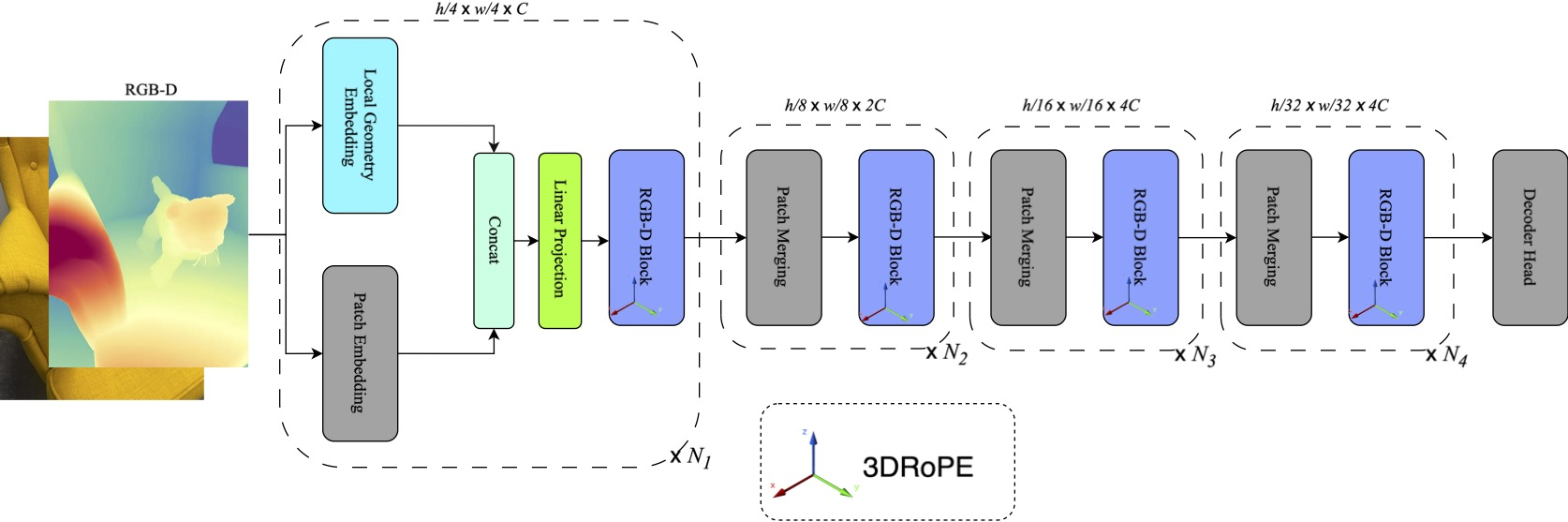
Adding depth in two ways
DINOcular adds depth information at two different levels:
Between patches: The model learns where each patch is located in 3D. It knows not only a patch’s position on the image’s height and width, but also its distance from the camera.
The researchers call this 3D positional encoding. It is like giving every puzzle piece a label containing its position on a table and its height above the table.
Inside each patch: The model also examines the detailed depth changes within each small square. This helps it notice whether a surface is flat, curved, rough, or sharply changing.
Learning without human labels
The model is trained using self-supervised learning. This means the researchers do not need to label every image by hand. Instead, the model creates learning problems from the data itself.
For example:
- The model sees different crops of the same image and learns that they belong to the same object.
- Some patches are hidden, and the model learns to predict information about them.
- It sees the same object from different camera angles and learns that matching parts should have similar features.
This is similar to studying a partly covered photograph and using clues from the visible parts to understand the hidden parts.
Training data
The researchers used:
- About 1.3 million images from ImageNet.
- More than 300,000 samples from a multiview dataset, with several views of many objects.
- Estimated depth maps created by newer depth-prediction systems.
They tested DINOcular on several tasks:
- Semantic segmentation: labeling each part of an image, such as “wall,” “chair,” or “person.”
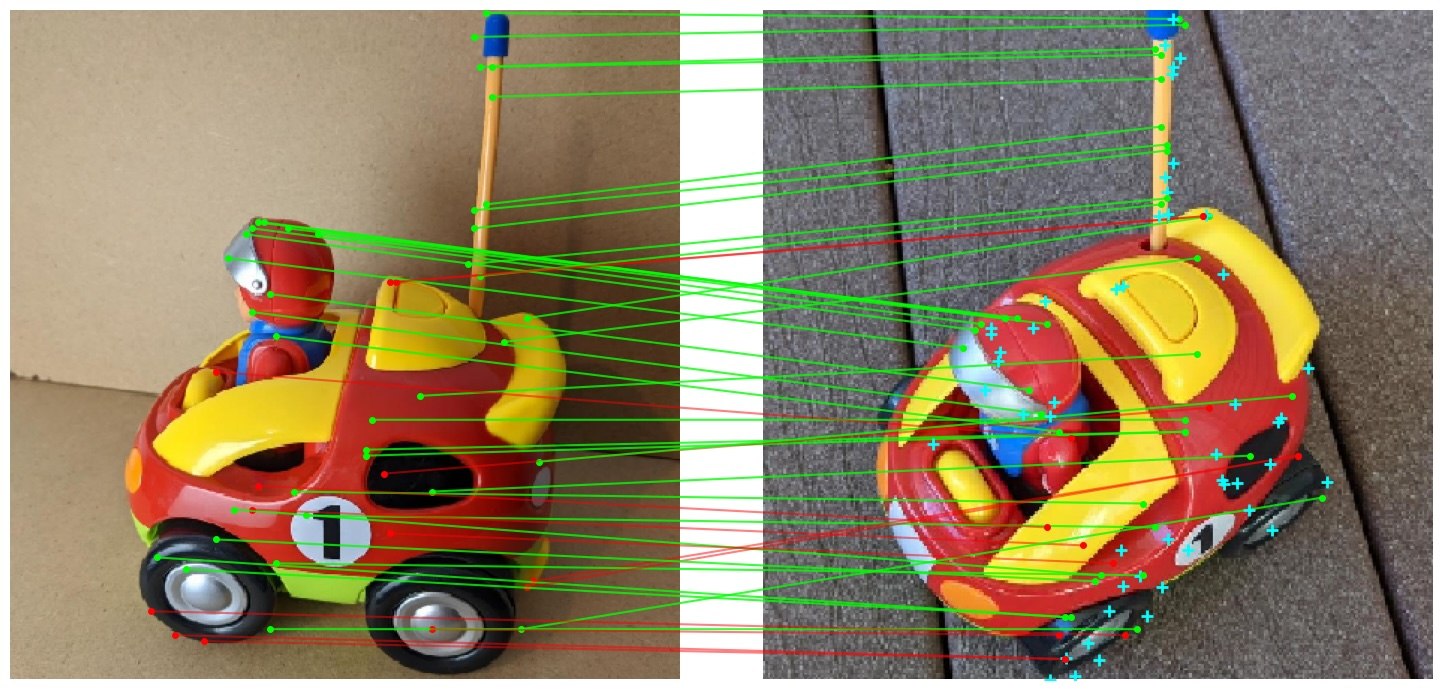
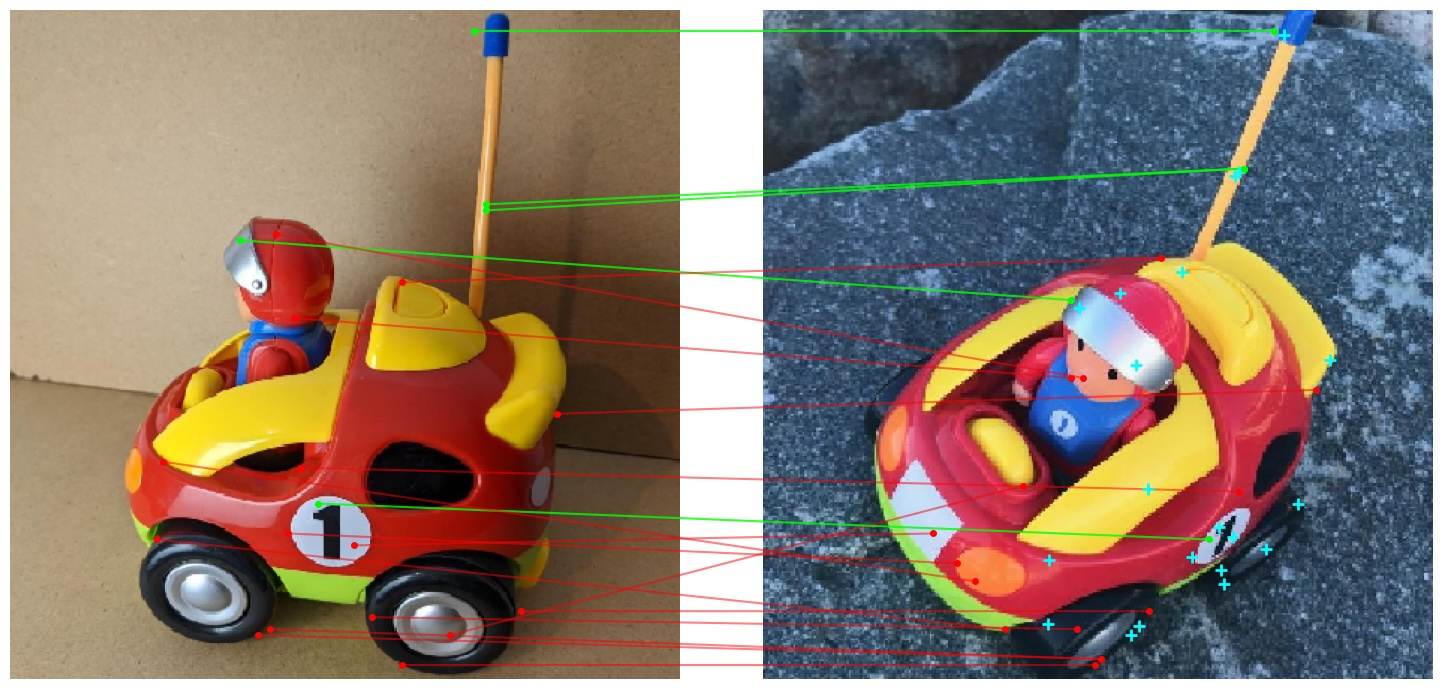
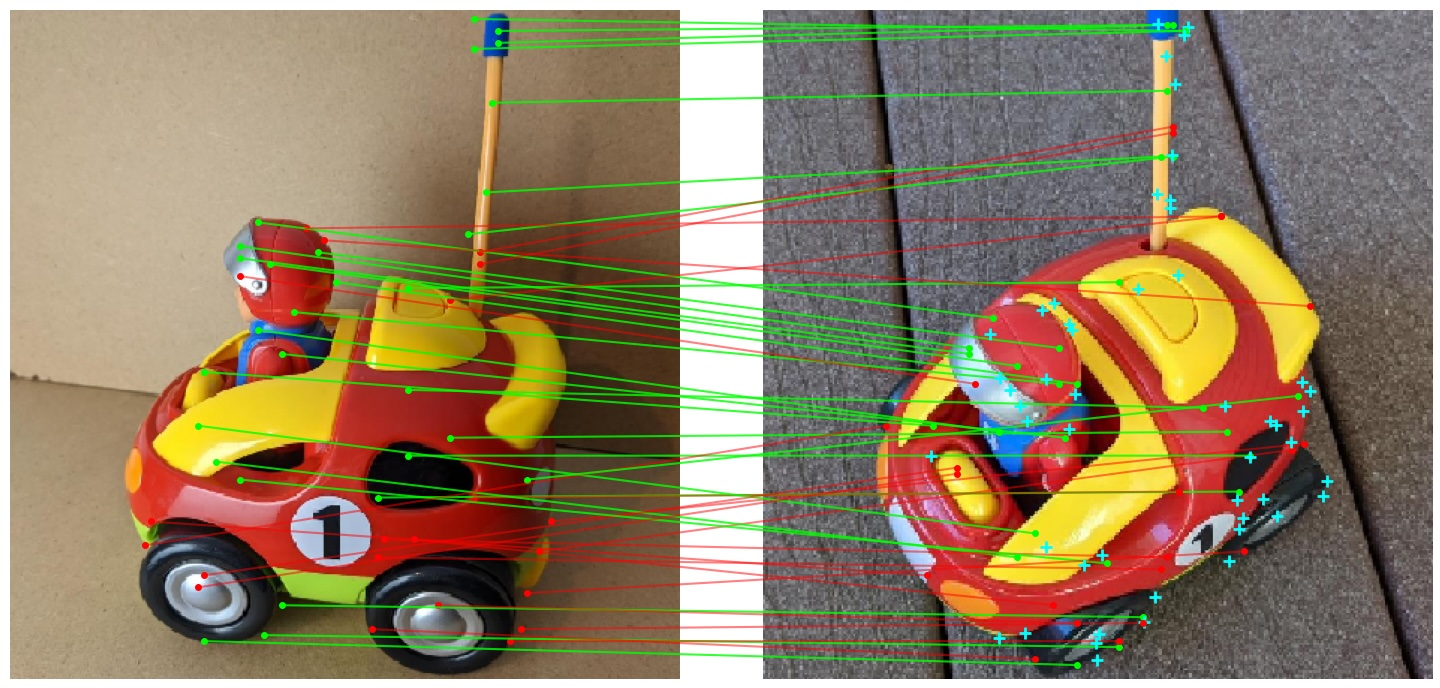
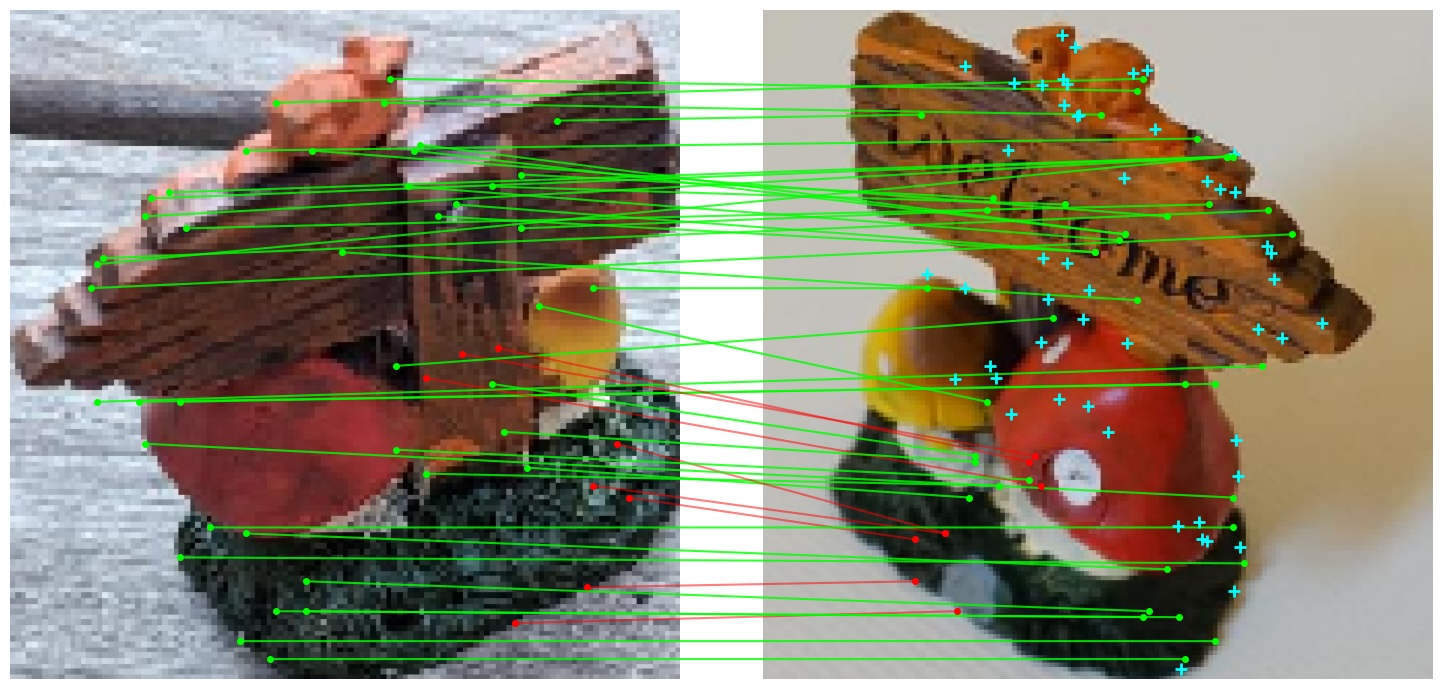
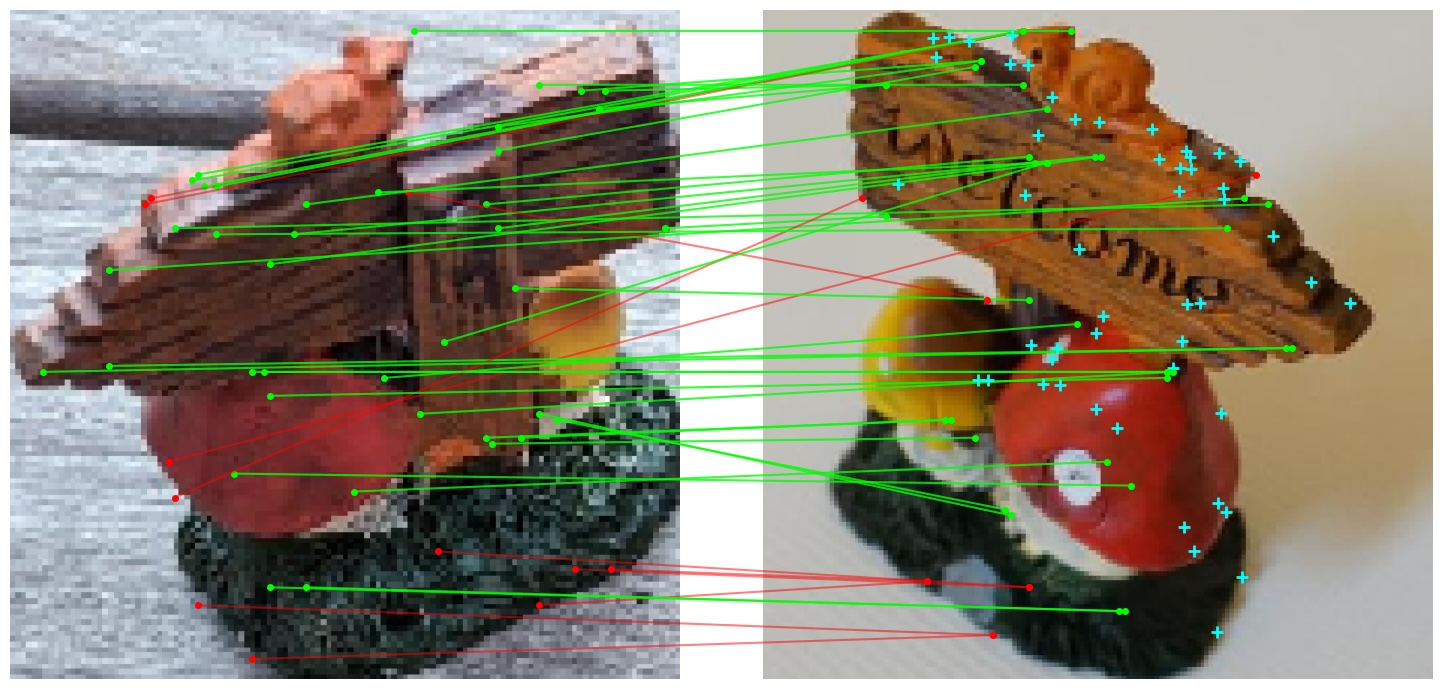
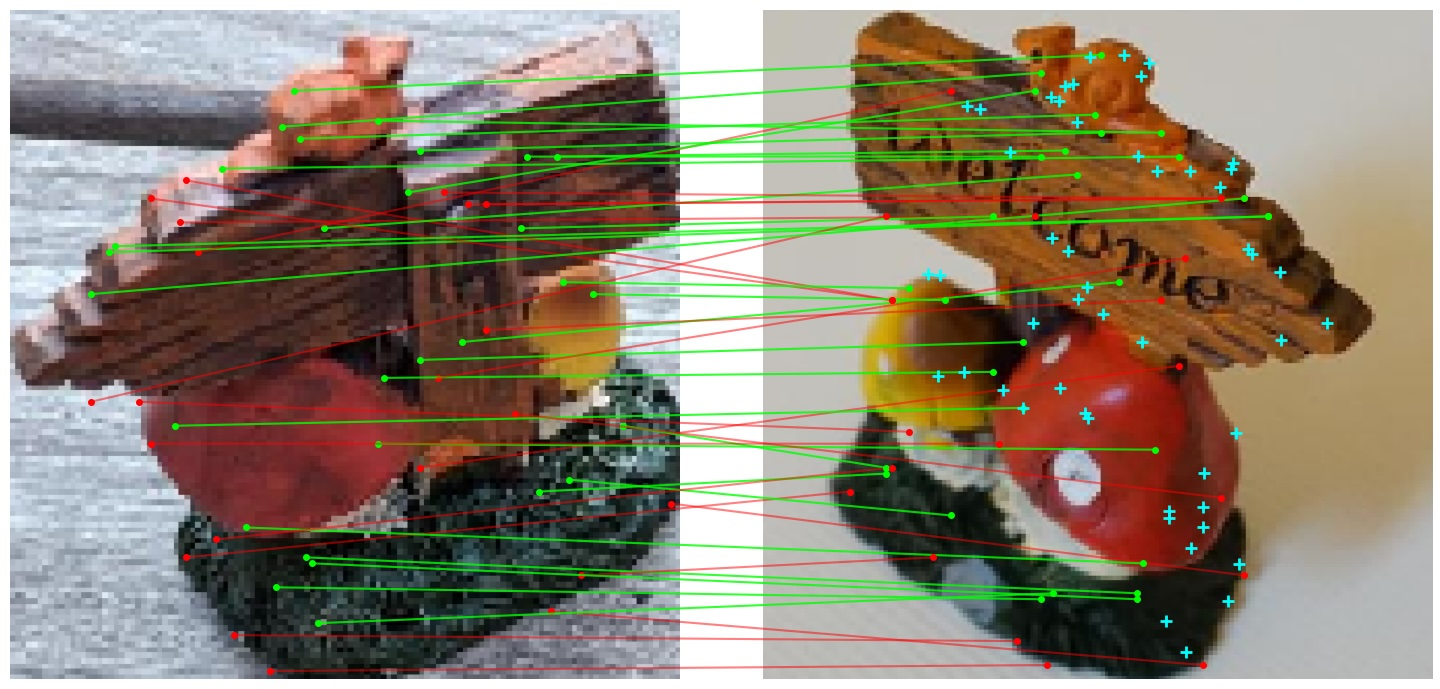
- 3D correspondence: finding the same part of an object in pictures taken from different angles.
- Object pose estimation: predicting where an object is and how it is rotated.
They mostly kept the trained model fixed and added only a simple task-specific layer. This tests whether the model’s general features are genuinely useful.
4. What did they find?
Better understanding of 3D structure
DINOcular generally performed better than similar RGB-only and RGB-D systems on 3D tasks.
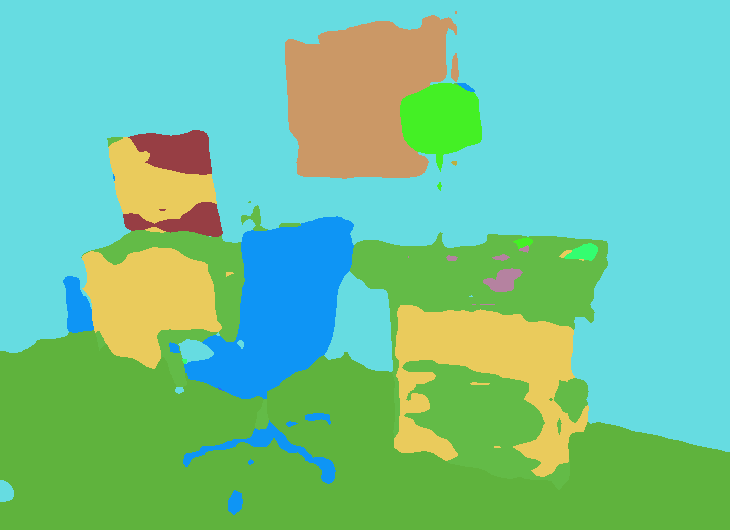
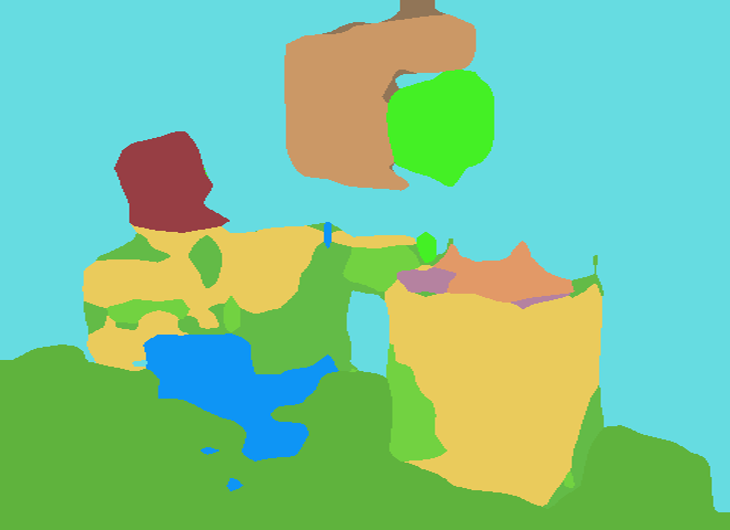
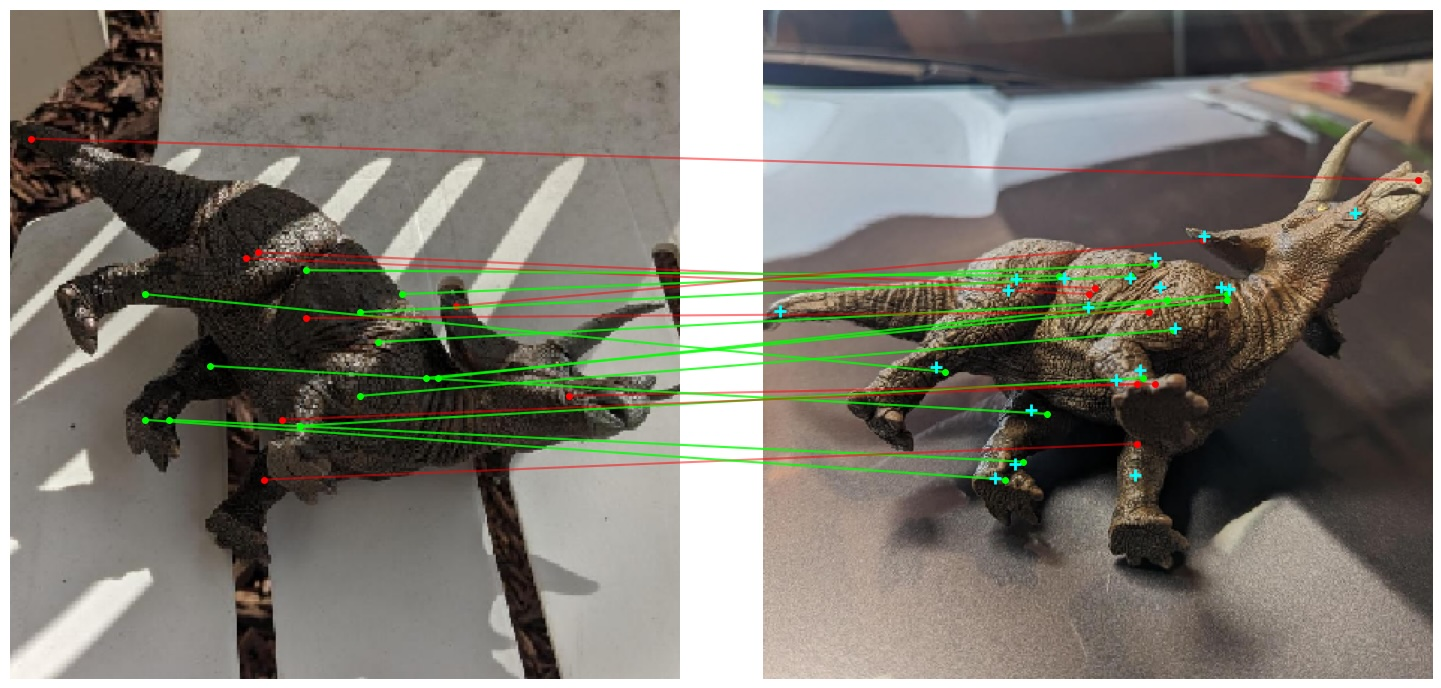
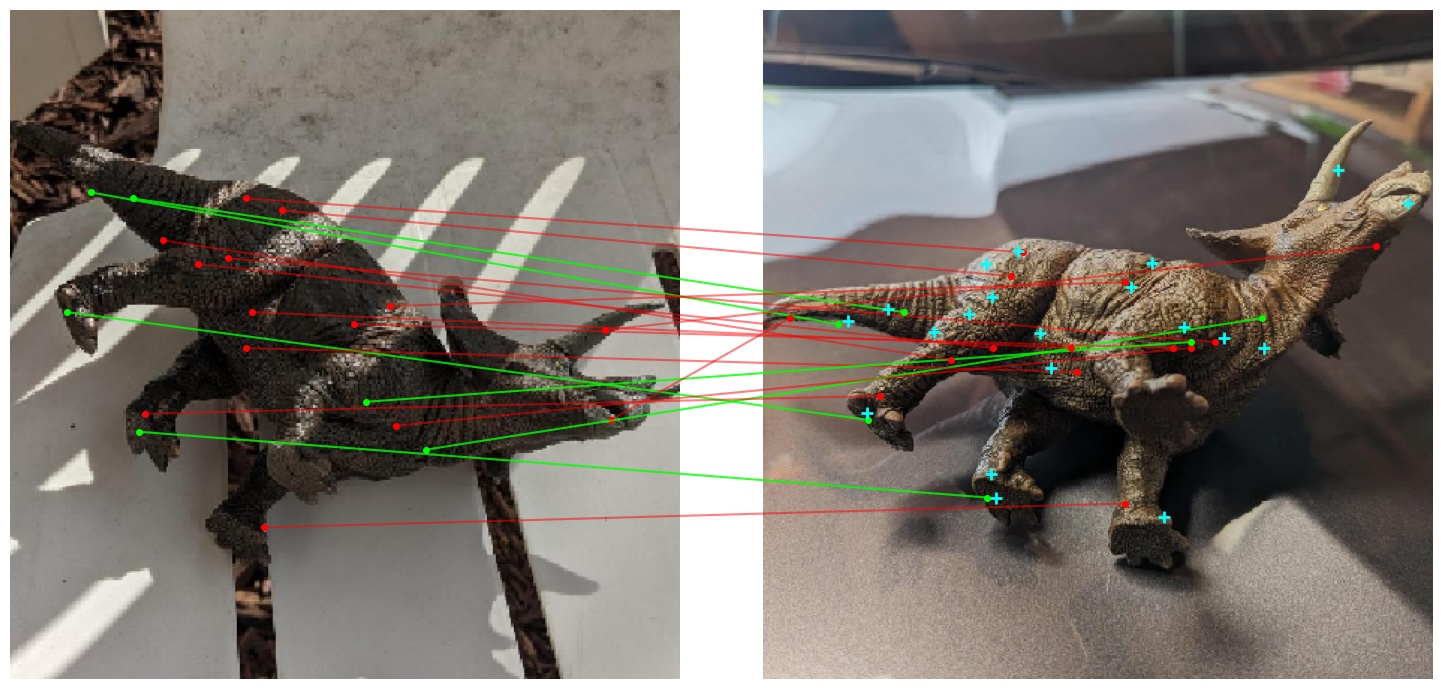
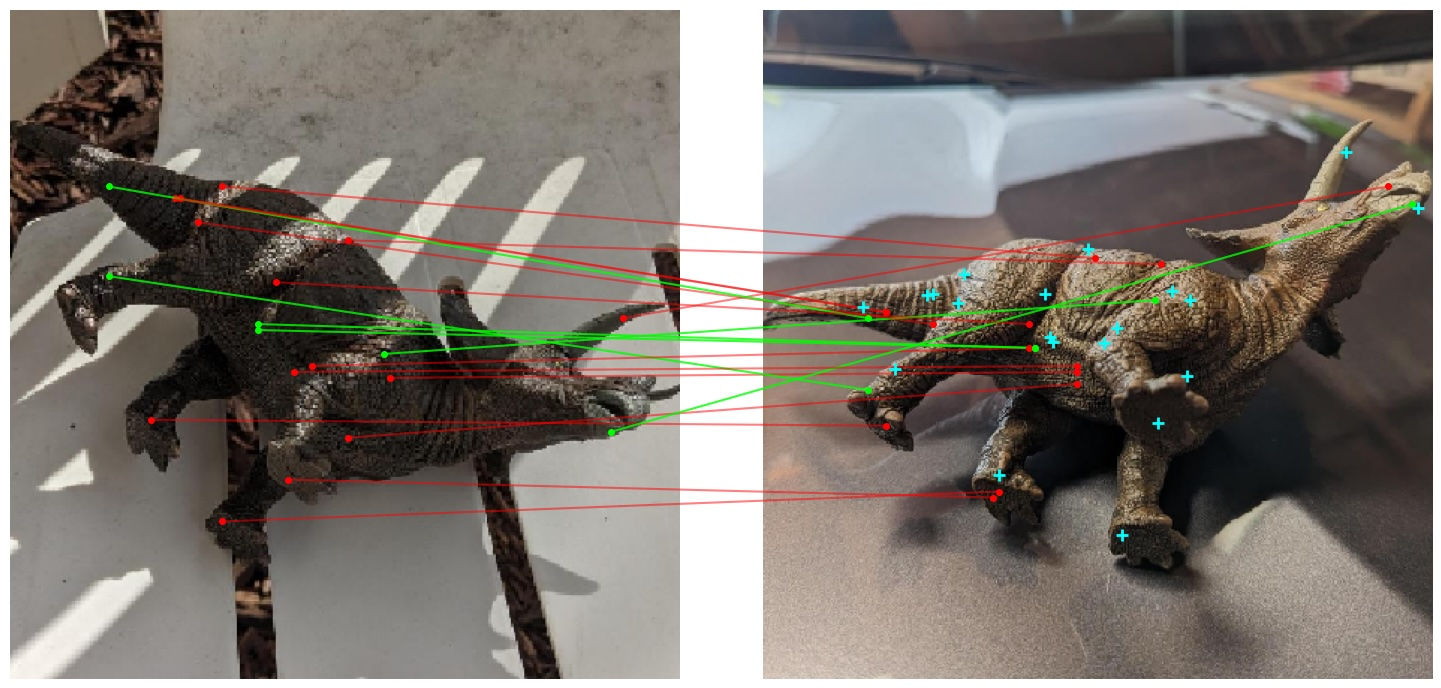
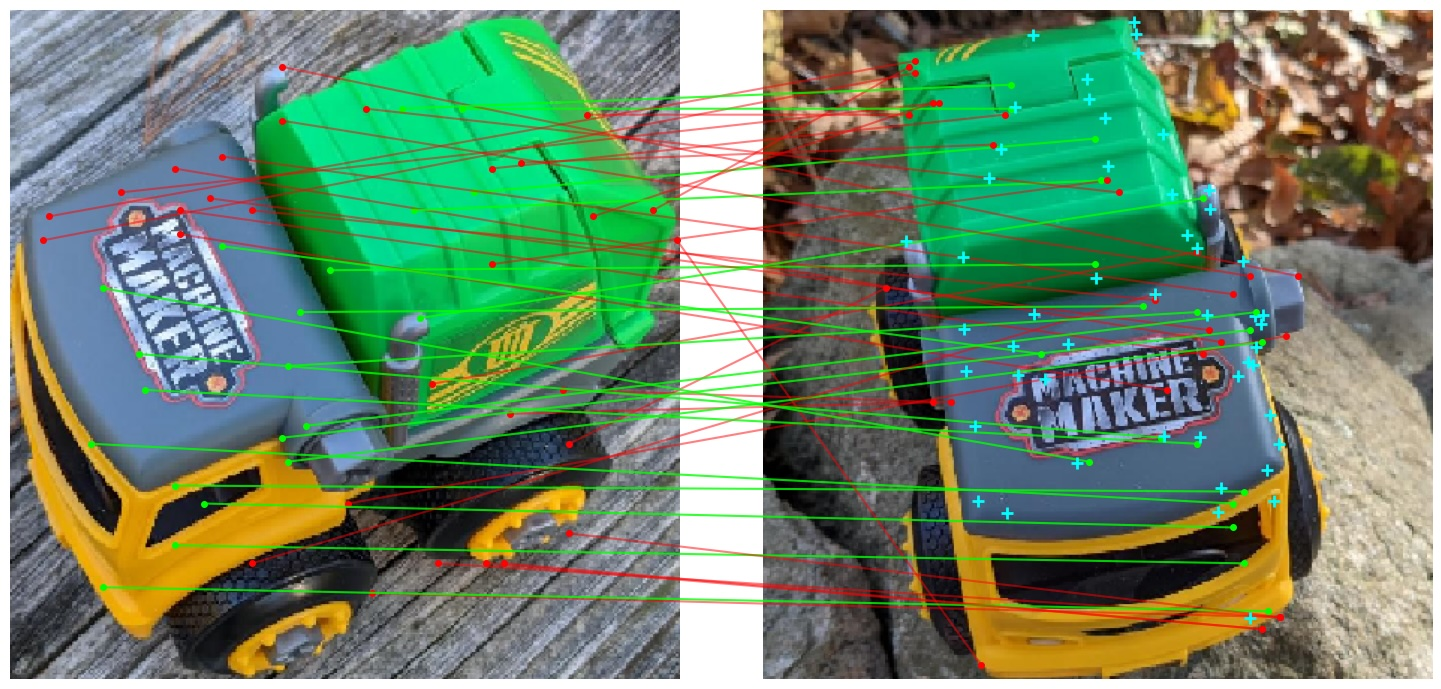
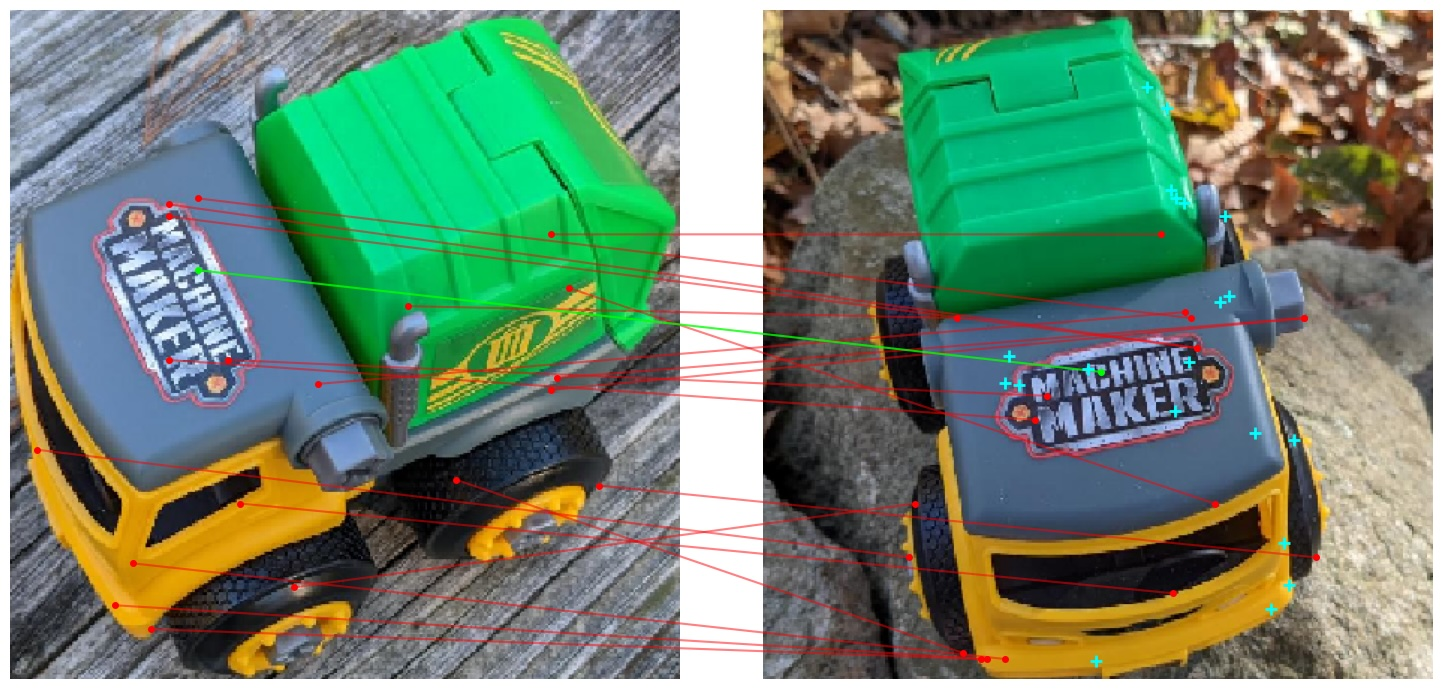
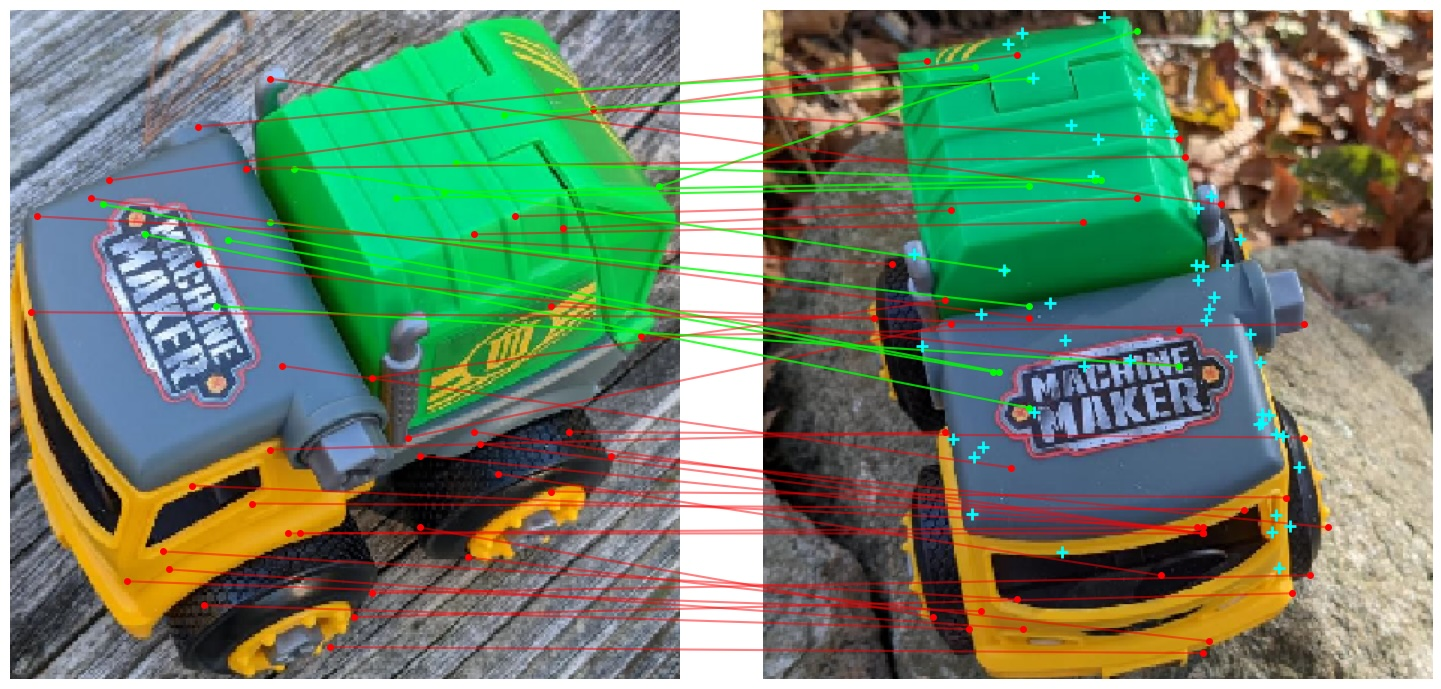
For example, when the camera angle changed greatly, DINOcular was better at matching the same object parts between two images. This means it learned features that were more stable across different viewpoints.
The smaller DINOcular model performed especially well on the ScanNet correspondence test, even beating larger reference models in some conditions.
Strong performance on object position and rotation
DINOcular also performed well at estimating the 3D pose of objects. In simple terms, it was good at answering:
“Where is this object, and which way is it facing?”
This is important for robots that need to pick up objects, move around them, or interact with them.
It still recognized image content well
Adding depth did not make the model forget ordinary visual information. DINOcular remained competitive on semantic segmentation tasks.
Compared with other models trained using a similar amount of data, the larger DINOcular model achieved higher results on several datasets, including:
- ADE20K
- NYU Depth V2
- SUN RGB-D
- Cityscapes
For example, its mean intersection-over-union score, a common measure for segmentation accuracy, was:
| Dataset | DINOcular-L score |
|---|---|
| ADE20K | 40.23% |
| NYU Depth V2 | 47.46% |
| SUN RGB-D | 42.25% |
| Cityscapes | 59.19% |
A higher score means the predicted labels matched the correct image regions more closely.
Multi-view training helped with geometry
Training with several views of the same object improved 3D matching. The model learned that a part of an object should remain related to the same part even when the object looks different from another angle.
However, this created a trade-off:
- More multiview training improved 3D understanding.
- Leaving it out sometimes improved semantic recognition, such as labeling objects and surfaces.
This is similar to training a student to be excellent at both geometry and art: extra time spent on one subject may leave slightly less time for the other.
The design was reasonably efficient
DINOcular used almost the same number of parameters as the comparison model DFormerv2. It was:
- A little faster than DFormerv2.
- Less memory-hungry than DFormerv2.
- Only slightly slower than an RGB-only model.
This matters because robots and phones often have limited computing power.
5. Why are these findings important?
Many robots, self-driving vehicles, mixed-reality devices, and smartphones can access depth information. Yet many powerful AI vision models ignore that information and use only color images.
DINOcular shows that depth can be included directly in a general-purpose vision model without requiring a very large or complicated extra network. This could help machines:
- Understand the 3D layout of rooms.
- Recognize objects from unusual viewpoints.
- Estimate how far away objects are.
- Pick up and move objects more accurately.
- Navigate safely around people and obstacles.
- Connect language instructions with real-world locations.
For example, a robot told to “pick up the cup beside the laptop” would benefit from knowing not only what a cup looks like, but also where it is in three-dimensional space.
Limitations and final conclusion
The researchers also point out some limitations. DINOcular was tested with a moderate amount of training data, so it is not yet clear whether the same advantages will remain when the model is trained on much larger datasets. Also, depth data can be noisy or incomplete, and the system often uses depth estimated by another AI model rather than always using a real depth sensor.
Overall, the paper shows that combining appearance and depth can produce more useful visual features. DINOcular is better at many 3D tasks while still being good at ordinary image understanding. In the future, ideas like this could lead to robots and other AI systems that understand the physical world more like humans do.
Knowledge Gaps
The paper leaves the following knowledge gaps, limitations, and open questions unresolved:
- Scaling behavior is untested: It remains unknown whether DINOcular’s geometric gains persist with substantially larger models, more training data, and longer training schedules.
- Fair comparison at equal data scale is unresolved: Comparisons with DINOv2, DINOv3, and DUNE are confounded by differences in dataset size, data composition, distillation sources, and training procedures.
- The contribution of real versus generated depth is unclear: Most training and evaluation depth is predicted or reconstructed, so the benefits of DINOcular with high-quality stereo, structured-light, time-of-flight, or LiDAR depth are not established.
- Robustness to realistic depth failures is insufficiently characterized: The study does not systematically test missing pixels, severe sparsity, multipath artifacts, motion-induced errors, reflective or transparent surfaces, sensor miscalibration, and temporally inconsistent depth.
- Cross-domain generalization remains uncertain: The experiments focus mainly on indoor datasets and selected object-centric benchmarks; performance in outdoor, driving, aerial, underwater, industrial, and highly dynamic environments is not evaluated.
- Generalization across camera and sensor configurations is unexplored: The effect of changing camera intrinsics, depth range, field of view, RGB-depth alignment, resolution, and viewpoint conventions is not quantified.
- Metric-scale dependence is unresolved: Because the model encodes average patch depth directly, it is unclear whether features generalize across scenes and sensors with different absolute scales or require calibration and normalization.
- The collapse of surface-normal encoding is unexplained: The paper reports that the surface-normal variant collapses but does not identify whether the cause is noise amplification, architectural incompatibility, optimization instability, normalization, or inadequate hyperparameters.
- The role of intra-patch depth encoding is not fully isolated: The experiments do not distinguish whether improvements arise from local geometric shape, additional depth capacity, low-level depth statistics, or interactions with the 3D RoPE representation.
- The mechanism behind the spatial–semantic trade-off is unclear: The paper observes that multi-view training can reduce semantic transfer, but does not determine which loss terms, sampling strategies, or representation dimensions cause this specialization.
- The effectiveness of depth dropout is incompletely studied: No systematic analysis varies dropout probability, placement, scheduling, or modality-specific masking to establish how depth reliance should be controlled.
- Multi-view sampling assumptions limit applicability: The spatial objective requires paired views, known point maps, object masks, and sufficient overlap; its performance when these annotations or reconstructions are noisy or unavailable is unknown.
- Dependence on pretrained geometry models is not assessed: Training relies heavily on MapAnything and SAM3 outputs, but the sensitivity of DINOcular to errors, biases, versions, and domain mismatch in these auxiliary models is not measured.
- Potential teacher–student information leakage is not examined: The paper does not clarify whether teacher and student receive depth estimates derived from shared reconstruction processes or whether this could make the multi-view objective easier without improving intrinsic visual representations.
- The choice of multi-view contrastive loss is underexplored: The study identifies contrastive ranking as the best tested option, but does not compare different negative-sampling schemes, temperature settings, correspondence tolerances, or hard-negative mining strategies.
- Viewpoint and occlusion limits are not established: Although large viewpoint changes are evaluated, the method’s tolerance to disocclusion, severe self-occlusion, partial visibility, repeated structures, and nonrigid deformation remains unknown.
- Dynamic-scene behavior is untested: The multi-view consistency objective assumes that corresponding observations depict stable geometry, so its behavior with moving objects, articulated bodies, changing illumination, and temporal scene changes is unresolved.
- Representation quality beyond linear probing is unclear: The evaluation largely uses frozen linear probes and selected correspondence protocols; nonlinear probing, fine-tuning, retrieval, depth-aware VLM tasks, and embodied decision-making are not evaluated.
- Practical utility for robotics is not demonstrated: The paper motivates embodied systems but does not test navigation, manipulation, grasping, localization, visual servoing, or policy learning using DINOcular features.
- Fusion at inference time is not investigated: It remains unclear whether the model can gracefully operate with RGB only, depth only, intermittent depth, or asynchronously captured modalities, despite the practical relevance of missing sensors.
- The RGB-only fallback is poorly understood: The reported RGB-only variant performs substantially worse, but the paper does not determine whether this results from architectural mismatch, training distribution shift, unused depth pathways, or inadequate modality dropout.
- Efficiency is only partially reported: Latency and memory are measured for a limited backbone and apparent hardware/setup conditions; training cost, preprocessing cost, depth-estimation latency, throughput, energy use, and scaling efficiency are not reported.
- Statistical reliability is not established: The tables do not report confidence intervals, multiple random seeds, significance tests, or variance across training runs, making the stability of reported improvements uncertain.
- Evaluation coverage is limited: The method is tested on a small set of semantic and geometric benchmarks, leaving open how it performs on metric depth, surface normals, 3D reconstruction, optical flow, scene flow, instance-level retrieval, and dense pose estimation.
- The effect of dataset composition is confounded: ImageNet and MVImgNet2.0 differ in object-centricity, viewpoint distribution, depth quality, and scene content, so the separate contributions of additional data volume and multi-view supervision are not fully disentangled.
- Object-mask dependence is not fully evaluated: Since SAM3 masks are used to focus the multi-view objective, it is unknown whether gains persist with imperfect masks, scene-level training without masks, or classes poorly represented by the segmentation model.
- The learned representation’s invariances are not characterized: The effects of lighting, texture changes, color shifts, image corruption, depth perturbations, object scale, and camera motion on feature stability remain unexplored.
- The theoretical basis of 3D RoPE is underdeveloped: The paper motivates depth as a third positional axis but does not analyze identifiability, coordinate-frame dependence, frequency selection, or why 3D RoPE outperforms proximity-based attention.
- Absolute depth versus relative geometry is unresolved: The experiments do not establish whether the model benefits primarily from metric depth, relative depth ordering, surface orientation, or other depth-derived quantities.
- Feature localization limitations remain unexplained: The observed blurriness over the image plane, particularly for the smaller model at strict pose thresholds, is reported but not linked to patch size, hierarchical downsampling, fusion design, or training objectives.
- Reproducibility is incomplete: The paper refers to additional training details in an appendix, but the provided text does not specify all hyperparameters, preprocessing steps, compute resources, checkpoint-selection criteria, or implementation details needed for independent replication.
Practical Applications
Immediate Applications
The paper’s results support immediate deployment primarily as a pretrained RGB-D feature extractor for systems that already have an RGB-D camera, stereo camera, time-of-flight sensor, or estimated depth pipeline. The evidence is strongest for 3D correspondence, object pose estimation, and RGB-D semantic segmentation.
- Robotic object localization and manipulation — robotics, warehousing, manufacturing
- Use frozen DINOcular features to match object parts across viewpoints and estimate the pose of low-texture objects without requiring a CAD model.
- A practical workflow could combine DINOcular with an RGB-D camera, a feature-matching module, and a grasp planner for bin picking, shelf retrieval, assembly, or inspection.
- This is supported by the reported gains in ScanNet and NAVI 3D correspondence and in one-shot pose estimation.
- Dependencies: calibrated RGB-D input, sufficiently accurate depth, camera synchronization, task-specific pose or grasp heads, and validation under occlusion, reflective surfaces, motion blur, and sensor-range limitations.
- Indoor robot navigation and scene understanding — service robotics, autonomous platforms
- Use the representation for semantic segmentation and geometry-aware matching in homes, offices, hospitals, warehouses, and laboratories.
- The model can provide features for identifying floors, walls, furniture, equipment, obstacles, and repeated structures while retaining spatial consistency across changing viewpoints.
- The reported performance on NYU Depth v2, SUN RGB-D, and ScanNet makes this suitable for prototype navigation and mapping pipelines.
- Dependencies: domain adaptation to the target environment, reliable depth completion, real-time inference on the robot’s hardware, and a separate mapping, localization, or planning system.
- RGB-D semantic segmentation with limited labeled data — computer vision, smart buildings, industrial inspection
- Freeze the DINOcular backbone and train a lightweight linear or shallow task-specific head for scene or object segmentation.
- This can reduce annotation requirements for applications such as warehouse inventory regions, building components, manufacturing parts, or indoor accessibility mapping.
- The paper shows that frozen features transfer across ADE20K, NYU Depth v2, SUN RGB-D, and Cityscapes, although the model is most naturally suited to settings with depth input.
- Dependencies: the target domain must be sufficiently represented by the pretraining data; dense depth must be available or generated; performance should be checked separately for safety-critical classes.
- Viewpoint-robust visual inspection — manufacturing, infrastructure, retail
- Match the same physical component or surface region across images captured from different angles, enabling inspection systems to detect missing parts, misalignment, deformation, or surface changes.
- DINOcular features can serve as the correspondence layer before geometric registration or change detection.
- The multi-view contrastive objective is particularly relevant because it improves correspondence under larger viewpoint changes.
- Dependencies: stable camera calibration, controlled or measurable illumination, sufficient depth quality, and a method for distinguishing genuine changes from viewpoint or sensor noise.
- Augmented reality and mixed-reality anchoring — consumer devices, training, design
- Use RGB-D features to maintain more stable object- or part-level anchors as a user moves around an object.
- Potential products include interactive maintenance instructions, furniture placement, industrial training overlays, and room-scale object annotation.
- The combination of semantic features and 3D-consistent correspondences is useful for associating virtual content with physical surfaces.
- Dependencies: the device must provide sufficiently dense depth or a reliable monocular-depth estimate; low latency and robust tracking are required; privacy protections are important for camera-based household applications.
- Depth-aware image and video retrieval — software, digital asset management, e-commerce
- Index images using DINOcular embeddings to retrieve objects or scenes that are visually and geometrically similar, rather than relying only on color and texture.
- E-commerce systems could retrieve similarly shaped products, while industrial repositories could locate previously observed components despite changes in viewpoint.
- Cross-view consistency can improve duplicate detection and multi-image grouping.
- Dependencies: embeddings must be calibrated for the retrieval domain; depth estimates may introduce systematic biases; large-scale indexing infrastructure and evaluation against conventional RGB embeddings are needed.
- Synthetic-data and annotation assistance — academia, industry
- Use DINOcular correspondences to propagate labels, masks, or object identities between views of the same object or scene.
- This could accelerate annotation for segmentation, pose estimation, and 3D reconstruction datasets by allowing an annotator to label one view and transfer the result to geometrically corresponding views.
- Dependencies: accurate multi-view geometry or point maps are needed for training and label propagation; human verification remains necessary, particularly around occlusions and object boundaries.
- Low-cost depth integration into existing vision systems — software engineering
- Add a depth-estimation model such as MapAnything or DepthAnything3 to an existing RGB pipeline, then use DINOcular as a geometry-aware feature extractor without requiring a physical depth sensor.
- The appendix reports relatively stable results across different depth sources, including monocular and densified sensor depth.
- This provides a practical migration path for systems whose hardware cannot immediately be upgraded.
- Dependencies: monocular depth is generally scale-ambiguous and may fail on unusual scenes; the application must tolerate depth uncertainty and should expose confidence estimates where possible.
- Research and teaching infrastructure for visuospatial learning — academia
- Use the architecture, 3D RoPE encoding, intra-patch depth fusion, and DINO/iBOT plus multi-view contrastive objectives as a reproducible baseline for experiments in RGB-D representation learning.
- Researchers can test alternative sensors, multi-view losses, depth normalization methods, or integrations with vision-LLMs and robot policies.
- Dependencies: access to suitable RGB-D or multi-view datasets, reproducible implementations, GPU resources, and careful separation of real sensor depth from model-generated depth during evaluation.
- Technical assessment of perception systems — industry and policy research
- Adopt viewpoint-based correspondence and pose-estimation tests as evaluation procedures for robotic or augmented-reality perception systems.
- Testing performance across increasing viewpoint changes can reveal whether a system has genuine spatial consistency rather than merely strong 2D appearance matching.
- Dependencies: standardized datasets, task-specific safety thresholds, and evaluation under realistic sensor degradation.
Long-Term Applications
The following applications are plausible extensions of the paper’s findings but require larger-scale validation, multimodal integration, hardware development, or safety research.
- General-purpose visuospatial vision-LLMs — AI software, robotics
- Integrate DINOcular-style RGB-D representations into vision-LLMs so that systems can answer questions involving distance, relative position, object permanence, occlusion, and 3D scene layout.
- Potential tools include assistants that can identify “the object behind the box,” explain spatial relationships, or ground language commands in physical locations.
- Dependencies: alignment between geometric features and language tokens, training on spatially grounded language, support for uncertainty, and validation against hallucinated measurements.
- Vision-language-action models for general-purpose robots — robotics
- Use the representation as the perception backbone for robots that must manipulate objects from novel viewpoints and transfer skills across rooms, objects, and sensor configurations.
- Multi-view-consistent features could improve object tracking, regrasping, manipulation after occlusion, and execution of commands such as “pick up the tool beside the red container.”
- Dependencies: integration with temporal state estimation and action policies, real-world robot data, robust handling of dynamic objects, and closed-loop safety evaluation. The paper does not itself demonstrate end-to-end robotic control.
- Autonomous driving and mobile mapping — transportation, infrastructure
- Apply the approach to camera-plus-LiDAR or stereo systems for geometry-aware detection, road-scene segmentation, cross-frame feature matching, and localization.
- It could support mapping and perception in visually ambiguous or low-texture environments where RGB-only features are less reliable.
- Dependencies: adaptation to outdoor scale, sparse and nonuniform LiDAR, weather, high-speed motion, long temporal horizons, and formal safety certification. Results on indoor datasets should not be assumed to transfer directly.
- Persistent 3D digital twins — construction, facilities management, energy
- Build systems that associate semantic object identities and features across repeated scans of buildings, factories, or infrastructure.
- A digital twin could track equipment, detect component changes, and connect inspection records to stable 3D locations.
- Dependencies: long-term feature stability, accurate registration across dates and sensors, standardized spatial coordinate frames, change-detection confidence, and integration with building-information or asset-management systems.
- Medical and assistive spatial perception — healthcare, rehabilitation, elder care
- Adapt the method to depth-enabled systems for room-scale fall-risk assessment, physical rehabilitation tracking, surgical or clinical navigation, and assistive object localization.
- The geometric representation could help distinguish body or object locations across viewpoints while reducing reliance on texture.
- Dependencies: extensive clinical validation, privacy-preserving processing, demographic and environmental bias assessment, medical-device regulation, and conservative human oversight. The current paper provides no medical evidence, so these are research directions rather than clinical applications.
- Human-robot collaboration and workplace safety — manufacturing, logistics
- Develop systems that track people, tools, and workpieces in 3D and maintain identity across camera viewpoints.
- Geometry-aware features could support dynamic exclusion zones, handover planning, and detection of misplaced equipment.
- Dependencies: high recall under occlusion, low latency, reliable uncertainty estimation, protection against adversarial or unusual sensor conditions, and compliance with workplace safety standards.
- Depth-aware consumer photography and smartphone interaction — consumer electronics
- Use the model for object-aware editing, 3D photo organization, spatial search, camera relocalization, and stable augmented-reality effects.
- Devices could group photographs of the same object across viewpoints or enable editing based on physical surfaces and object parts.
- Dependencies: efficient mobile deployment, power consumption, depth availability across devices, robustness to low light and reflective materials, and on-device privacy guarantees.
- Large-scale self-supervised pretraining with heterogeneous sensors — foundation-model research
- Scale training beyond the paper’s moderate data regime using stereo, structured-light, time-of-flight, LiDAR, synthetic depth, and monocularly inferred depth.
- A sensor-agnostic model could serve as a general backbone for robotics, mapping, AR, and 3D perception.
- Dependencies: sensor calibration and normalization, handling missing or sparse depth, scalable multi-view data collection, removal of pseudo-depth artifacts, and experiments confirming that the reported gains persist at much larger data and model scales.
- Adaptive semantic–geometric foundation models — general AI
- Develop models whose objective can be adjusted depending on whether an application prioritizes semantic recognition, precise geometry, or an explicit trade-off between them.
- For example, a navigation system could emphasize multi-view contrastive training, while an image-understanding system could weaken that objective to preserve semantic transfer.
- Dependencies: principled objective weighting, task-conditioned adapters, reliable downstream calibration, and methods for preventing the spatial–semantic trade-off observed in the paper.
- Policy and standards for spatial-AI evaluation — public-sector governance
- Establish benchmarks and procurement requirements that test spatial consistency, depth robustness, sensor substitution, and performance under viewpoint changes—not only 2D classification accuracy.
- Such standards could guide evaluation of robots, autonomous systems, AR devices, and public-space perception tools.
- Dependencies: representative public datasets, agreed definitions of geometric accuracy, privacy and surveillance safeguards, and independent testing across demographic, environmental, and sensor conditions.
- Everyday spatial assistants — daily life
- In the longer term, household or wearable assistants could locate objects, guide users through rooms, provide spatially grounded instructions, or help visually impaired users understand object arrangement.
- DINOcular-like features could support stable object and part matching as the user or camera moves.
- Dependencies: substantial advances in multimodal dialogue, personalization, real-time edge inference, privacy-preserving storage, accessibility testing, and very high reliability before use in safety-relevant situations.
Glossary
- Ablation: An experiment that removes or changes one component to measure its effect. “In our experiments, we therefore investigate an ablation where local shape features are instead computed based on per-pixel surface normals.”
- Affine bias: An additive adjustment applied to model values, often to alter attention scores. “DFormerv2~\citep{yin2025dformerv2} derives a geometry prior from pooled patch distances and relative depth, applied as an additive bias on self-attention weights.”
- Binocular stereopsis: Depth perception produced by comparing the views from two eyes. “binocular stereopsis, which compares observations from two eyes to infer depth”
- CAD-model-free: Operating without requiring a preexisting computer-aided-design model of an object. “We evaluate single-shot, CAD-model-free object pose estimation for low-texture objects”
- Centering: Normalizing teacher outputs by subtracting a running or estimated center before distillation. “Both are passed through a projection head and softmax activation, and centering (for the teacher).”
- Contrastive learning: Learning representations by bringing related examples closer and separating unrelated examples. “The contrastive objective is also used in~\citet{you2025multiview} as an isolated objective”
- Cross-entropy: A loss function measuring the difference between predicted and target probability distributions. “ is then the cross-entropy between the student's output and the centered teacher's output.”
- Dense depth map: A depth image containing an estimated depth value for essentially every pixel. “we can homogenize different depth sources through completion and denoising into dense pixel-wise depth maps.”
- Depth completion: The process of filling missing or sparse depth measurements to produce a denser representation. “we can homogenize different depth sources through completion and denoising into dense pixel-wise depth maps.”
- Depth-derived geometric prior: Geometric information computed from depth and used to guide feature processing. “Our architecture efficiently integrates depth-derived geometric priors with a visual backbone”
- Depth regression: Predicting continuous depth values from image or feature representations. “we report results on linear probing for depth regression/reconstruction (NYU Depth v2).”
- Distillation: Training one model to reproduce the outputs or representations of another model. “As semantic loss objective , we utilize the teacher-student distillation framework of DINO and DINOv2”
- Embodied system: An autonomous agent or robot that perceives and acts in a physical environment. “In artificial embodied systems, however, the dominant vision models remain largely monocular.”
- Exponential moving average: A weighted running average that gives greater importance to recent values. “Teacher is updated through exponential moving average.”
- Feature collapse: A failure mode in representation learning in which different inputs produce indistinguishable or uninformative features. “where coordinate-based positional encodings cause representation collapse.”
- Feature fusion: Combining feature vectors from different sources or modalities. “We apply lightweight patch embedding layer and fuse both embeddings through a linear projection”
- Foundation model: A large pretrained model intended to support many downstream tasks. “modern vision foundation models are still trained almost exclusively on RGB images.”
- Frozen backbone: A feature-extraction network whose parameters are not updated during downstream training. “with the different frozen backbones on the dataset”
- Geometric consistency: The preservation of compatible spatial relationships across observations or viewpoints. “post-training refinement of DINOv2 features with this objective”
- Geometric prior: An assumption or informative signal about spatial structure used to guide learning. “we explore approaches that make use of depth as a geometry prior”
- Hierarchical vision transformer: A transformer that processes visual features at multiple spatial resolutions and stages. “The backbone architecture is a Swin hierarchical vision transformer”
- Inductive bias: A built-in modeling assumption that favors particular solutions or patterns. “the representation inherits the inductive bias of the target task”
- Intra-patch: Occurring within an individual image patch. “We therefore add this local geometric information to the patchified RGB embeddings”
- Linear probing: Evaluating fixed learned features by training a linear predictor on top of them. “For all methods and datasets, we fit a linear probe over their training data, keeping the feature predictor completely frozen.”
- Masked reconstruction: Learning by hiding portions of an input and recovering the missing content. “Masked reconstruction~\citep{he2022masked,wang2023videomae} forms the second family and targets pixel-level recovery.”
- Metric reconstruction: Reconstructing geometry with distances expressed in a consistent physical scale. “Follow-up work generalises the paradigm to dynamic scenes, persistent state, and broad metric reconstruction”
- Monocular depth estimation: Inferring depth from a single image. “We generate Depth for all our training samples using monocular depth estimation on ImageNet-1k”
- Multi-view consistency: Agreement between representations or predictions obtained from different viewpoints. “We therefore experiment with different formulations of a multi-view consistency loss.”
- Object-centric: Focused on an individual object rather than an entire scene. “We give student and teacher different crops of the same object-centric image”
- Patch token: A vector representing a local image patch in a vision transformer. “Vision Transformers~\citep{dosovitskiy2020vit} established patch tokens as the common interface”
- Point map: A representation assigning a three-dimensional point to image locations or pixels. “From known point maps and the depth, we find a subset of patches that is visible to both.”
- Positional encoding: Information added to features to represent their spatial positions. “By encoding depth directly into the coordinate system (as 3rd, z-axis)”
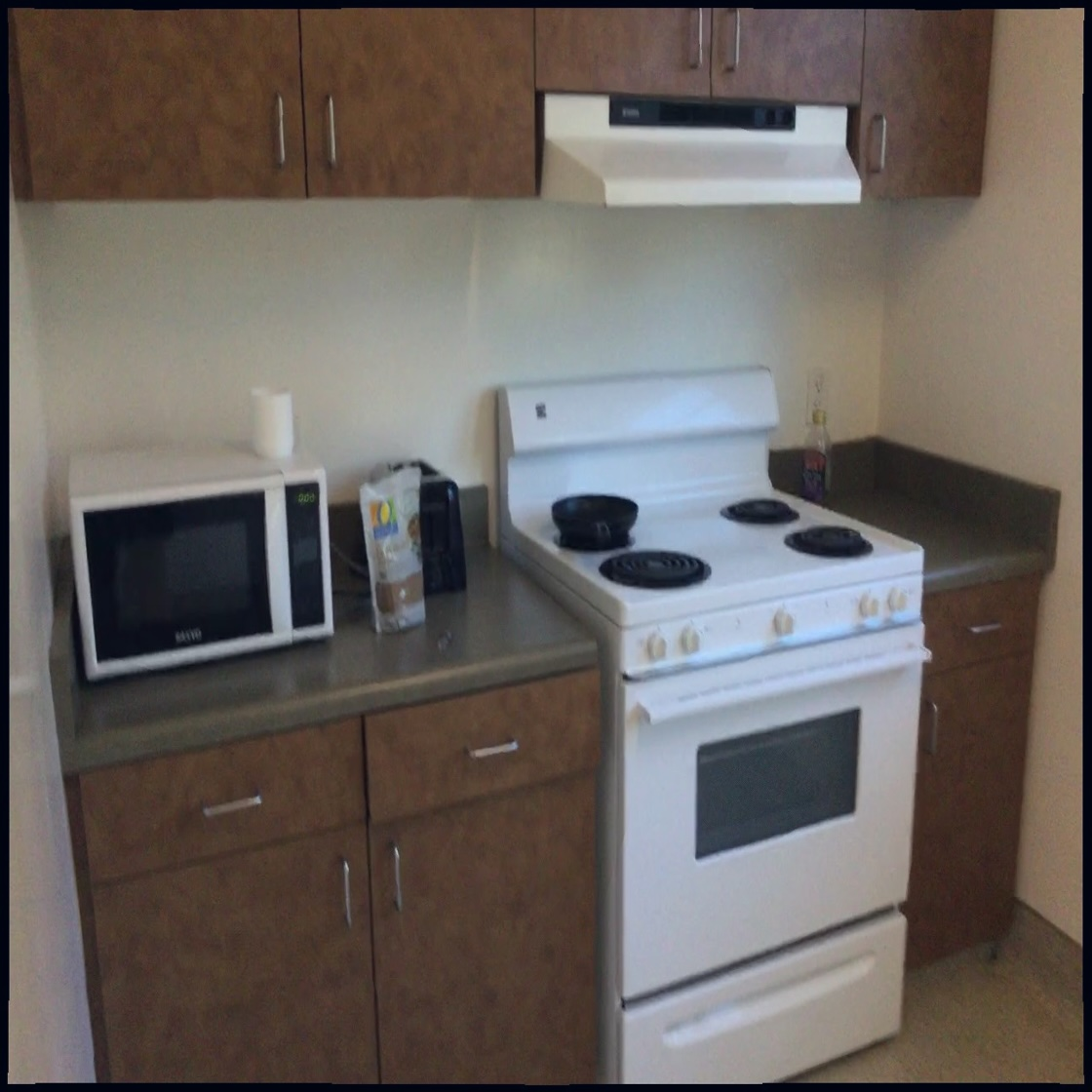
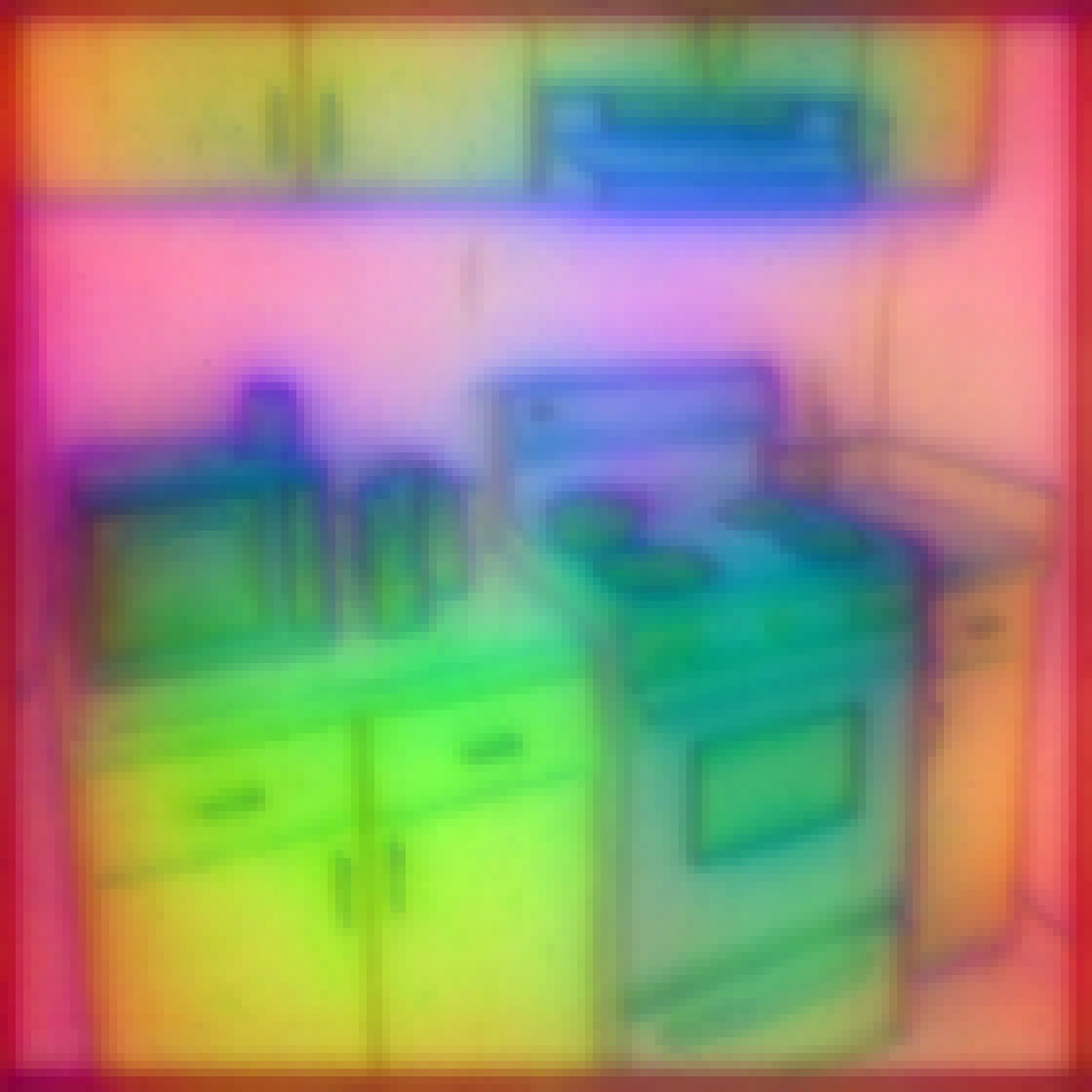
- Principal component analysis (PCA): A dimensionality-reduction method that projects data onto directions of greatest variance. “Figure~\ref{fig:pca_qual} visualizes the three strongest PCA components of the extracted features.”
- Rotary positional encoding (RoPE): A positional encoding method that applies position-dependent rotations to feature vectors. “Instead of additive biasing, we extend rotary positional encoding (RoPE)~\citep{su2024roformer} into three dimensions”
- Scale ambiguity: The inability to determine absolute physical scale from monocular visual observations alone. “spatial reasoning remains physically constrained by the scale ambiguity of monocular sensing.”
- Self-distillation: Representation learning in which a model learns from another version of itself, commonly a teacher network. “Self-distillation, where DINO~\citep{caron2021emerging} and iBOT~\citep{zhou2021ibot} were scaled”
- Self-supervised learning: Learning representations from automatically generated signals rather than human-provided labels. “We introduce a self-supervised framework for learning joint visuospatial representations from RGB-D observations.”
- Surface normal: A vector perpendicular to a surface at a particular location. “Surface normals are the spatial derivative of the depth value and therefore scale-free.”
- Teacher-student framework: A training arrangement in which a student model learns to match a teacher model’s outputs. “As semantic loss objective , we utilize the teacher-student distillation framework of DINO and DINOv2”
- Token embedding: A vector representation of a token used as input to a neural network. “We instead embed depth at the level of token positions.”
- Triangulation: Estimating three-dimensional structure from observations taken from multiple viewpoints. “multi-view triangulation on MVImgNet2.0.”
- Viewpoint consistency: Stability of a representation when the same object is observed from different camera positions. “These features are strongly semantic but only weakly geometric.”
- Visuospatial representation: A learned representation encoding both visual appearance and spatial or geometric structure. “We propose a scalable, self-supervised framework for learning joint visuospatial representations from RGB-D observations.”
- Vision Transformer (ViT): A transformer architecture that processes an image as a sequence of patch tokens. “Given that RoPE is a foundational component in the self-attention mechanisms of most modern Vision Transformers (ViTs)”
- Voxel: A volumetric analogue of a pixel, representing a location in three-dimensional space. “Sonata~\citep{wu2025sonata} trains a self-supervised point cloud encoder on aggregated scene-level scans”