SPARGen: Unifying Spatial Perception and Reasoning through Native Multimodal Generation
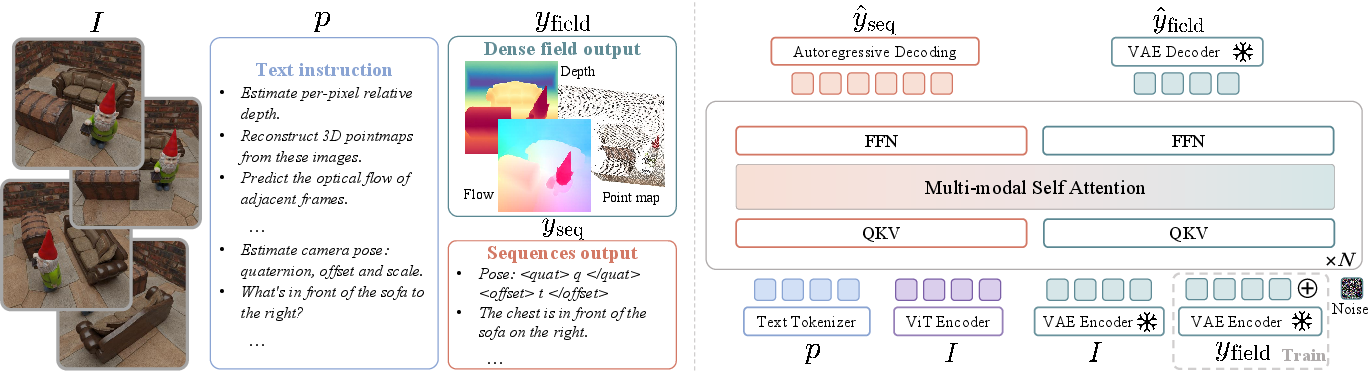
Abstract: Spatial perception and reasoning from visual observations require recovering geometric structure, establishing correspondences, and understanding spatial relations. Existing approaches typically address these capabilities separately using task-specific architectures or external geometric modules, limiting knowledge transfer among complementary representations of the same physical scene. We introduce SPARGen, a unified multimodal framework that casts 3D reconstruction, dense correspondence, and spatial reasoning as instruction-conditioned generation tasks. SPARGen serializes compact structured and linguistic outputs as token sequences while generating dense geometric fields in image-aligned forms, enabling spatial supervision to jointly shape shared representations within a native multimodal generative model. Experiments across benchmarks for 3D reconstruction, correspondence, and spatial reasoning show that SPARGen achieves competitive performance across heterogeneous spatial tasks within a single native multimodal generative framework.
Paper Prompts
Sign up for free to create and run prompts on this paper.
Top Community Prompts
Explain it Like I'm 14
1. What is the paper about?
The paper introduces SPARGen, an artificial intelligence system that helps computers understand the 3D structure of the world from images.
For example, given several pictures of a room and an instruction such as “Which object is closer to the camera?”, SPARGen can:
- Estimate how far away objects are.
- Rebuild parts of the scene in 3D.
- Match the same object across different images.
- Understand movement between images.
- Answer questions about where objects are located.
Most existing AI systems are designed for only one or two of these jobs. SPARGen tries to do all of them with one shared model.
2. What questions did the researchers investigate?
The researchers mainly wanted to find out:
- Can one AI model perform many different spatial tasks? These tasks include depth estimation, 3D reconstruction, camera movement prediction, optical-flow estimation, and spatial question answering.
- Can these tasks help one another? Understanding 3D shape might help the model answer questions. In the same way, understanding language might help it organize visual information.
- Can the model do this without special add-on tools? Many earlier systems use separate components designed for geometry or 3D vision. SPARGen tries to use the normal image and text-generation abilities of one multimodal model instead.
3. How did the researchers build and test SPARGen?
One model with different kinds of outputs
SPARGen receives:
- One or more color images.
- A written instruction or question.
It then produces different kinds of answers depending on the task.
For simple or compact answers, it produces tokens. Tokens are small pieces of text or numbers that an AI uses to build an answer. For example, a camera position can be written as a sequence of special number tokens.
For information covering every part of an image, it produces dense fields. A dense field is like an image-sized map in which every pixel contains extra information. Examples include:
- A depth map, showing which parts of the image are near or far.
- A point map, showing the 3D position of points in a scene.
- An optical-flow map, showing how pixels move from one image to another.
An analogy is that SPARGen uses two ways of answering:
- It writes short answers in a notebook.
- It draws detailed maps when information is needed for every point in a picture.
Generating image-like maps
SPARGen is based on a multimodal model called Bagel. This type of model can work with both images and text.
For dense maps, SPARGen uses a process related to image generation. During training, it starts with a correct map and adds random noise. The model learns how to remove or reverse that noise until it can recreate the correct map.
This is similar to learning to restore a blurry or noisy photograph. The difference is that the “picture” may represent depth, 3D positions, or motion rather than ordinary colors.
For text and structured numbers, SPARGen predicts one token after another, much like an autocomplete system guessing the next word.
Training data
The model was trained using several types of information:
- Images and 3D geometry.
- Depth maps and camera positions.
- Optical-flow examples.
- Spatial questions and answers.
The researchers also tested it on separate benchmark datasets. These included indoor and outdoor scenes, moving objects, 3D reconstruction tasks, and spatial reasoning questions.
Comparing with other systems
SPARGen was compared with:
- Specialized geometry models, which focus mainly on 3D vision.
- Optical-flow models, which focus on motion between images.
- General vision-LLMs, such as Qwen and LLaVA.
- Other models that combine geometry and language.
The researchers also performed ablation studies. In these experiments, they removed one type of training information at a time to see what happened. This is like taking one ingredient out of a recipe to discover how important it is.
4. What were the main results?
Strong spatial reasoning
SPARGen performed especially well on spatial question-answering tests. It achieved the highest average score among the compared non-proprietary models on all four tested benchmarks.
It was particularly good at harder questions, such as those in the medium- and high-difficulty parts of the SPAR benchmark. It even outperformed a much larger 72-billion-parameter vision-LLM in these tests.
This suggests that giving the model detailed geometric training can help it reason about spatial relationships.
Competitive 3D understanding
SPARGen also performed well at:
- Estimating depth.
- Reconstructing 3D point maps.
- Predicting camera movement.
It generally performed better than the closely related unified model, G²VLM. However, specialized models such as VGGT were still better on some 3D reconstruction measurements.
This is an important trade-off: SPARGen can handle many tasks with one model, while specialized systems may be stronger at a single task.
Good optical-flow performance
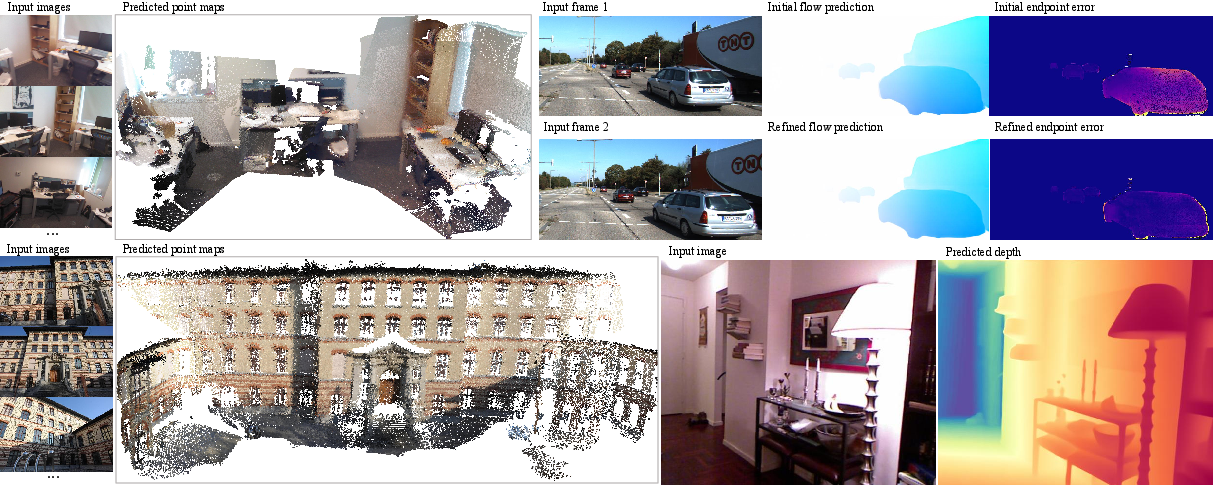
Optical flow estimates how objects or pixels move between two images. For example, it can show how a car moves across a video frame.
On the KITTI test, SPARGen achieved an endpoint error of 4.09 and an F1-all score of 13.34. Lower values are better for these measurements. It performed better than the other compared optical-flow systems.
The researchers also used a refinement step. First, the model predicted the movement. Then it used that prediction to line up the second image and predicted the remaining error. This improved the motion estimate.
Different types of training helped each other
The ablation experiments showed useful connections between the tasks:
- Removing 3D geometry training made both optical-flow results and spatial reasoning worse.
- Removing optical-flow training hurt some 3D reconstruction and reasoning results.
- Removing reasoning training slightly weakened 3D reconstruction.
These results suggest that the different tasks can share useful knowledge. However, the effects were not always positive. Without reasoning training, optical-flow performance improved slightly, possibly because the model had more capacity available for motion prediction.
5. Why are these findings important?
SPARGen shows that one AI system can combine seeing, measuring, understanding, and explaining space.
This could be useful for future systems such as:
- Robots that need to understand rooms and move safely.
- Self-driving vehicles that must track nearby objects.
- Augmented-reality applications that place virtual objects correctly.
- Search-and-rescue systems that analyze unfamiliar environments.
- Assistive technologies that describe where objects are located.
A single model may also be easier to use than several separate systems connected together. Because SPARGen uses a common interface based on images and instructions, users could ask it to perform different spatial tasks in a flexible way.
However, the system has limitations. It mainly learns relative depth and position, meaning it can tell what is nearer or farther but cannot always determine exact real-world measurements. Also, its image-compression system, called a VAE, may lose very fine details and sharp edges. This could make it less accurate for tasks requiring extremely precise physical measurements.
Simple conclusion
SPARGen is an attempt to create a general-purpose AI for understanding 3D space. Instead of building a separate tool for every job, the researchers trained one multimodal model to produce maps, numbers, motion information, and language answers.
The results show that combining these abilities can improve spatial reasoning while still giving good 3D and motion predictions. Although specialized systems may remain better at some individual tasks, SPARGen demonstrates that a single model can perform many kinds of spatial understanding in a useful and flexible way.
Knowledge Gaps
Knowledge gaps, limitations, and open questions
The paper establishes the feasibility of a unified generative framework, but leaves the following issues unresolved:
- Metric-scale recovery remains unsupported: SPARGen predicts relative depth and normalized point maps, so it cannot recover absolute scene scale or metric distances required for robotics, navigation, measurement, and physical interaction.
- Geometric precision is limited by the frozen VAE: The paper acknowledges that VAE spatial compression may blur object boundaries and high-frequency geometric details, but does not quantify this effect or compare against a trainable, higher-resolution, or geometry-specific latent representation.
- The effect of VAE design choices is not isolated: No experiments evaluate alternative VAEs, latent resolutions, decoder architectures, or direct pixel-space prediction to determine whether the observed geometric errors arise primarily from the VAE bottleneck.
- Dense-field representation may be task-dependent and lossy: Depth, point maps, and optical flow are converted into image-like three-channel fields, but the paper does not establish whether this representation preserves discontinuities, occlusions, invalid regions, uncertainty, or multimodal geometric solutions.
- The depth normalization removes absolute information and may be unstable: Per-image min–max normalization depends on scene-specific extrema and can be sensitive to outliers, cropped views, missing depth values, and varying camera ranges; its impact on cross-scene generalization is not evaluated.
- Optical-flow encoding is incompletely specified: The third channel is said to encode flow magnitude, but the exact encoding and decoding procedure, handling of occlusions, and treatment of invalid or extremely large displacements are not described.
- The refinement procedure introduces an unexamined iterative component: Although the framework is presented as native generation without external geometric modules, optical flow uses a predict–warp–predict refinement stage. Its computational cost, number of iterations, robustness to accumulated warping errors, and comparison with standard refinement architectures are not systematically studied.
- The framework is not evaluated on dynamic 3D reconstruction: Optical flow includes dynamic motion, but reconstruction and reasoning experiments largely focus on static scenes. The ability to produce temporally consistent geometry in scenes containing independently moving objects remains unclear.
- Long-sequence scalability is unresolved: The paper formulates inputs as image sequences but does not report performance, memory usage, or degradation as the number of frames increases.
- Temporal consistency is not directly measured: Predictions are evaluated framewise or with benchmark-specific metrics; no metrics assess consistency of depth, point maps, camera poses, or spatial answers across time.
- Generalization to unseen domains is insufficiently characterized: The reported benchmarks are limited to selected indoor, synthetic, driving, and spatial-reasoning datasets. Robustness to low light, weather, motion blur, fisheye cameras, crowded environments, aerial imagery, and real-world robotics data is not established.
- Cross-dataset contamination and pseudo-label leakage are not addressed: The training mixture is very large and includes datasets related to the evaluation domains, while MoGe is used to produce pseudo-labels. The paper does not document overlap checks, duplicate removal, or whether pseudo-label generation could leak benchmark-specific information.
- The quality and bias of MoGe pseudo-labels are not quantified: The contribution of pseudo-labels is not separated from that of ground-truth annotations, and their effect on different scene types, depth ranges, object boundaries, and failure cases remains unknown.
- Training-data mixture effects are underexplored: The paper does not report dataset-level sampling ratios, annotation coverage, curriculum strategies, or whether performance is dominated by particular datasets or supervision sources.
- Task-loss balancing is insufficiently justified: The sequence-loss weight is fixed at , but no sweep or adaptive weighting study shows how this choice affects geometry, flow, reasoning, and multitask trade-offs.
- The ablation evidence for cross-task transfer is limited: Removing one supervision category at a time does not distinguish genuine representation transfer from changes in data volume, optimization dynamics, or task-specific sample composition.
- The reported multitask gains lack statistical validation: Results are presented from apparently single runs, with no confidence intervals, multiple random seeds, or significance testing to establish whether the observed improvements are reproducible.
- Capacity competition is hypothesized but not tested mechanistically: The explanation that reasoning supervision competes with dynamic dense-field prediction is not supported by experiments varying model capacity, expert routing, token budgets, or task-specific parameter allocation.
- Instruction sensitivity is not evaluated: Because all tasks are instruction-conditioned, it remains unknown how performance changes under paraphrased, ambiguous, adversarial, multilingual, or incorrectly specified instructions.
- The canonical serialization choices are not compared: The paper does not test alternative token orders, quantization resolutions, pose parameterizations, numerical tokenizers, or continuous representations for camera poses and sparse geometric quantities.
- Pose-token quantization may constrain accuracy: Scalar components are quantized at , but the resulting rotation and translation errors, especially for long-baseline or fine-grained pose estimation, are not analyzed.
- Pose representation has unresolved degeneracies: Separating translation direction and magnitude is appropriate for relative-scale settings, but the paper does not examine numerical instability near zero translation, quaternion ambiguities, or consistency under different coordinate conventions.
- Uncertainty estimation is absent: The generative formulation can potentially represent uncertainty, but SPARGen reports only point predictions and does not estimate confidence, calibrated error, ambiguity, or the reliability of generated spatial answers.
- Geometric consistency across outputs is not enforced explicitly: Depth, point maps, camera poses, flow, and textual answers are generated by shared parameters, but no losses enforce multiview reprojection, epipolar, flow-cycle, pose–point-map, or answer–geometry consistency.
- Reasoning may still rely on language priors rather than recovered geometry: High spatial-question-answering scores do not demonstrate that answers are causally grounded in the generated geometric fields. Counterfactual, geometry-only, and controlled scene-pair evaluations are needed to test genuine geometric reasoning.
- Failure cases for spatial reasoning are not analyzed: The paper provides aggregate benchmark scores but does not identify errors involving occlusion, counting, depth ordering, ambiguous referents, small objects, clutter, or relations requiring metric scale.
- Comparisons are not fully controlled for model and training differences: Specialized and unified baselines may differ in parameter count, input resolution, pretraining data, test-time processing, and supervision. The paper does not provide a matched-compute or matched-data comparison.
- Optical-flow evaluation is narrow: Flow is assessed only through zero-shot KITTI results, leaving performance on Sintel, HD1K, Spring, real non-driving videos, large motion, nonrigid motion, and occlusion-heavy scenes unresolved.
- Camera-pose evaluation is limited to relative metrics: The paper does not report absolute trajectory error, scale-aware pose accuracy, robustness to sparse views, or performance under varying numbers and arrangements of input views.
- Inference efficiency is not reported: The computational cost of autoregressive decoding, rectified-flow sampling, VAE encoding/decoding, and optical-flow refinement is not compared with specialized models or modular pipelines.
- The feasibility of real-time deployment is unknown: No latency, memory, throughput, energy, or performance-at-resolution analysis is provided for practical applications.
- The role of the pretrained Bagel model is not isolated: It remains unclear how much of the performance comes from Bagel’s pretrained multimodal capabilities versus SPARGen’s spatial supervision and output representations; training from different initialization points or comparing frozen-backbone variants would clarify this.
- The claim of avoiding task-specific modules is qualified by task-specific transformations: Although no prediction heads are introduced, each task uses custom normalization, serialization, decoding, and—in the case of flow—refinement. The generality and maintenance cost of adding new spatial tasks are not demonstrated.
- Extension beyond the current task set is untested: The framework does not evaluate surface normals, segmentation, 3D object detection, 3D grounding, scene graphs, articulated pose, occupancy, signed distance fields, or action-conditioned spatial planning.
- Safety and reliability in embodied settings remain open: The paper does not evaluate whether geometric hallucinations or incorrect spatial answers can be detected before they cause failures in navigation, manipulation, or autonomous decision-making.
Practical Applications
Immediate Applications
The paper supports several near-term applications because SPARGen already produces depth, point maps, camera poses, optical flow, and natural-language spatial answers through one instruction-conditioned model. These uses are technically deployable now, although production deployment would require domain-specific validation and optimization.
- Robotics and embodied AI: scene mapping and navigation
- A robot can provide RGB images and instructions such as “What is to the left of the table?” or “Map the room from these views.” SPARGen can return relative depth, point maps, camera motion, and a textual spatial interpretation.
- Potential workflow: camera capture → SPARGen reconstruction → obstacle or object-location query → navigation or manipulation planner.
- Dependencies: calibrated integration with the robot’s coordinate system, temporal consistency, real-time inference, uncertainty estimation, and metric-scale recovery. Since SPARGen predicts normalized geometry, it cannot by itself provide reliable absolute distances.
- AR/VR and mobile spatial understanding
- Smartphone or headset cameras could use the model for coarse scene reconstruction, relative-depth estimation, camera-motion analysis, and natural-language queries about the surrounding environment.
- Potential products: an AR assistant that answers “Where is the nearest chair?”, identifies spatial relations, or helps place virtual objects consistently across views.
- Dependencies: low-latency inference, efficient model compression, robust performance under changing illumination and motion blur, and accurate tracking over long sequences.
- 3D content capture and rapid environment digitization
- A small set of RGB images can be converted into point maps, depth fields, and estimated camera poses, providing an initial 3D representation for architecture, games, virtual production, or inspection.
- Potential workflow: image-sequence upload → automated pose estimation and point-map generation → export to a reconstruction or visualization tool.
- Dependencies: downstream alignment and meshing software, sufficient viewpoint overlap, handling of occlusions and dynamic objects, and post-processing to restore metric scale and geometric detail.
- Computer-vision preprocessing and correspondence estimation
- SPARGen’s optical-flow pathway, including its predict–warp–predict refinement procedure, can provide dense correspondences for video stabilization, image registration, frame interpolation, visual tracking, and motion segmentation.
- Its zero-shot KITTI result indicates that the model can transfer across domains without benchmark-specific fine-tuning.
- Dependencies: production data may differ substantially from training distributions; dynamic scenes, extreme motion, textureless regions, and high-resolution inputs require separate validation. Specialized optical-flow models may remain preferable for latency-critical systems.
- Autonomous driving and driver-assistance prototyping
- Depth, camera motion, optical flow, and spatial question answering can support prototyping of scene understanding modules, including relative obstacle location, vehicle motion analysis, and road-scene explanation.
- Potential workflow: synchronized camera frames → geometry and flow estimation → object or scene query → input to an existing perception and planning stack.
- Dependencies: safety certification, sensor fusion with LiDAR/radar/GPS, metric depth, predictable failure behavior, temporal tracking, and rigorous testing in adverse weather. The paper does not establish suitability for safety-critical control.
- Industrial inspection and infrastructure surveying
- Engineers can use image sequences to obtain preliminary surface geometry, compare views, estimate motion, and ask spatial questions about equipment or structural components.
- Potential tools: inspection assistants for queries such as “Which component is above the pipe?” or “Has the position of this object changed between inspections?”
- Dependencies: high-precision geometric boundaries may be lost through the frozen VAE’s spatial compression; domain-specific fine-tuning, measurement calibration, and human verification are needed for compliance or engineering decisions.
- Education and academic research tools
- SPARGen can serve as a unified baseline for experiments in 3D vision, multimodal learning, spatial reasoning, and multi-task training.
- Researchers can use its instruction interface to compare task combinations, study transfer between geometry and language reasoning, or build educational demonstrations of depth, camera pose, and optical flow.
- Dependencies: reproducible access to training data, substantial GPU resources, careful separation of real annotations and pseudo-labels, and evaluation beyond the reported benchmarks.
- Visual question answering for spatial accessibility
- A camera-based assistant could answer questions about relative positions, orientation, and scene layout for users with visual or mobility impairments.
- Potential interaction: the user submits a video or live camera stream and asks “Is there an obstacle in front of me?” or “Where is the doorway relative to the desk?”
- Dependencies: conservative confidence handling, multimodal uncertainty reporting, privacy-preserving processing, personalization, and extensive testing in homes and public spaces. It should supplement rather than replace established mobility aids.
- Dataset inspection, annotation assistance, and quality control
- The model can generate preliminary depth, point maps, optical flow, poses, and spatial descriptions that human annotators can correct.
- This could reduce annotation cost for robotics, autonomous-driving, AR, and 3D-reconstruction datasets.
- Dependencies: pseudo-label errors must be detected; human review remains necessary, particularly for geometric boundaries, dynamic objects, and metric measurements.
Long-Term Applications
The following applications are plausible extensions of the paper’s unified representation, but they require further research, scaling, hardware integration, or stronger guarantees than the current experiments provide.
- General-purpose spatial foundation models for robots
- SPARGen could evolve into a model that converts visual observations and natural-language goals directly into structured spatial representations and robot actions.
- Potential product: a reusable spatial intelligence layer for household, warehouse, agricultural, or service robots.
- Required development: temporal memory, object permanence, active viewpoint selection, metric and semantic maps, action grounding, uncertainty calibration, and closed-loop evaluation in physical environments.
- Language-driven 3D scene reconstruction and editing
- Users could request operations such as “Reconstruct the room and remove the chairs”, “Show the object behind the cabinet”, or “Generate a layout from these views.”
- The model’s shared spatial and linguistic interface could connect reconstruction, querying, and generative scene editing.
- Dependencies: higher-fidelity geometry, object-level decomposition, reliable referent grounding, consistent multi-view editing, and integration with CAD, simulation, or graphics representations.
- Metric-scale digital twins
- Combining SPARGen with depth sensors, known object dimensions, GPS, or calibration targets could produce digital twins for factories, buildings, warehouses, and cities.
- The unified model could support both reconstruction and natural-language inspection of the resulting twin.
- Dependencies: absolute-scale estimation, repeatable registration across time, legal-grade accuracy, persistent identity tracking, and robust handling of scene changes.
- Autonomous navigation and manipulation from natural-language instructions
- A robot might receive instructions such as “Pick up the tool behind the blue container” and use reconstructed geometry, correspondence, and spatial reasoning to locate and manipulate it.
- Dependencies: precise 6D object pose estimation, grasp planning, physical interaction modeling, real-time operation, safety constraints, and grounding language references in persistent object identities.
- Healthcare and assistive spatial systems
- In hospitals or elder-care settings, a future system could interpret room layouts, identify obstacles, guide navigation, or support spatially aware telemedicine and rehabilitation.
- Dependencies: medical-device regulation, patient privacy, robust operation in cluttered and changing environments, explainability, and validation with clinicians and vulnerable users. The current paper provides no clinical evidence.
- Policy, urban planning, and emergency response
- Image or video collections from buildings, streets, or disaster sites could be converted into spatial maps and queried in natural language—for example, locating blocked exits or estimating routes around damaged infrastructure.
- Dependencies: reliable georeferencing and metric scale, operation under smoke or poor visibility, secure data governance, human-in-the-loop decisions, and formal validation before use in emergency command systems.
- Energy and facility management
- Spatially aware models could inspect energy infrastructure, identify equipment relationships, and compare site geometry across maintenance cycles.
- Potential workflow: periodic image capture → reconstruction and change analysis → natural-language maintenance report → prioritized work orders.
- Dependencies: integration with building-management and asset systems, precise change detection, domain-specific labels, cybersecurity, and reliable detection of small defects that may be obscured by VAE compression.
- Unified multimodal operating systems for spatial data
- SPARGen’s task formulation suggests a common API in which applications request outputs using instructions rather than calling separate depth, flow, pose, and QA modules.
- Potential tool:
spatial_model(images, instruction, output_type)returning a point map, flow field, pose sequence, or textual answer. - Dependencies: standardized output schemas, deterministic serialization, confidence and provenance metadata, model routing, latency controls, and compatibility with conventional geometric libraries.
- Adaptive multi-task systems with dynamic supervision
- The ablations indicate positive interactions among geometry, flow, and reasoning, but also possible capacity competition: reasoning slightly improves static reconstruction while marginally reducing optical-flow performance.
- A future system could dynamically allocate experts, inference steps, or training weights according to the application.
- Dependencies: better task-balancing methods, task-specific uncertainty estimates, continual learning, and evidence that the observed transfer generalizes beyond the reported benchmarks.
- High-precision scientific and engineering vision
- With improved field representations, SPARGen could support microscopy, metrology, robotics calibration, geological imaging, or laboratory visualization where spatial relationships must be explained as well as measured.
- Dependencies: replacing or augmenting the frozen VAE, preserving fine geometric edges, metric calibration, domain-specific data, uncertainty bounds, and validation against physical instruments.
- Policy and governance for spatial AI deployment
- The model’s ability to infer scene structure and answer location-related questions creates a basis for standards concerning privacy, surveillance, biometric or household mapping, and retention of spatial data.
- Potential outputs: audit logs recording image sources, generated geometry, queried instructions, and confidence levels.
- Dependencies: transparent benchmarks, bias and failure analysis across environments, consent mechanisms, secure storage, and rules limiting deployment in sensitive spaces.
Glossary
- Autoregressive pathway: A generation mechanism that predicts each output token conditionally on previously generated tokens. “Sequence targets are generated autoregressively”
- Camera pose: The position and orientation of a camera relative to a coordinate system. “SPARGen predicts depth maps, camera poses, and point maps for 3D reconstruction”
- Canonical token sequence: A standardized, deterministic ordering of discrete tokens representing a structured target. “the serializer maps its target to a canonical token sequence”
- Cartesian coordinates: A coordinate system representing points by perpendicular spatial axes, commonly in 3D. “The three channels of encode the normalized Cartesian coordinates .”
- Cross-entropy: A loss function measuring the discrepancy between a target probability distribution and a model’s predicted distribution. “We minimize the average cross-entropy over the target tokens”
- Dense correspondence: A pixel- or point-level association between elements in different images or observations. “optical flow for dense correspondence estimation”
- Dense geometric field: An image-aligned array in which each pixel stores a geometric quantity such as depth, position, or motion. “while generating dense geometric fields in image-aligned forms”
- Dense prediction: The task of producing an output value for every spatial location in an image. “A complementary line of work repurposes generative priors for dense prediction”
- Depth map: An image whose values encode the distance from the camera to visible scene points. “SPARGen predicts depth maps, camera poses, and point maps for 3D reconstruction”
- Diffusion model: A generative model that produces data by progressively transforming noise into structured samples through a learned denoising process. “Marigold adapts a diffusion model for depth estimation”
- Detector-free matching: Image matching that establishes correspondences without first detecting separate keypoints or feature primitives. “LoFTR performs detector-free matching with transformers”
- Displacement: The image-plane movement of a point between two observations, often represented by optical-flow components. “we normalize the displacements by the image dimensions”
- External geometric module: A separate component outside the main multimodal model that performs geometric prediction or processing. “without task-specific modules or external geometric prediction modules”
- Feed-forward reconstruction model: A model that directly predicts geometric structure from input observations in a single forward computation. “More recently, feed-forward reconstruction models have moved toward broader geometric representations.”
- Foundation model: A broadly pretrained model that can be adapted to many downstream tasks. “This native generative formulation distinguishes SPARGen by how spatial capabilities are incorporated into a foundation model.”
- Gaussian noise: Random noise sampled from a normal distribution, commonly used as the starting point or perturbation in generative models. “we construct a linear rectified-flow path between the clean latent and Gaussian noise ”
- Geometric pseudo-label: An automatically generated approximate annotation used as a training target when reliable human or original annotations are unavailable. “we additionally use MoGe~\cite{wang2025moge} to generate dense, image-aligned geometric pseudo-labels for training the dense-field pathway.”
- Image-aligned field: A spatial representation whose values correspond directly to locations in an image. “Dense spatial fields, including depth maps, point maps, and optical flow, are encoded as image-like representations”
- Instruction-conditioned generation: Generation in which a natural-language instruction specifies the task or desired output. “SPARGen formulates geometric reconstruction, correspondence estimation, and spatial reasoning as instruction-conditioned generation tasks”
- Latent space: A learned lower-dimensional representation in which a model performs computation or generation. “dense fields are generated in the VAE latent space through rectified flow”
- Metric scale: An absolute physical scale, such as distances measured in meters, rather than only relative proportions. “cannot recover metric scale”
- Mixture-of-Transformer-Experts (MoT): An architecture that combines multiple transformer-based expert streams or subnetworks within a shared model. “Both generative pathways are integrated within a shared Mixture-of-Transformer-Experts (MoT) backbone”
- Multimodal self-attention: An attention mechanism allowing representations from different modalities, such as images and text, to interact. “Text and visual tokens interact through joint multimodal self-attention.”
- Optical flow: A field of apparent pixel motions between consecutive images or video frames. “Given an optical flow field ”
- Point map: An image-aligned representation assigning a 3D point, often in Cartesian coordinates, to each pixel. “DUSt3R casts uncalibrated stereo reconstruction as pointmap regression”
- Predict–warp–predict procedure: An iterative refinement method that warps an image using a current motion estimate and predicts a residual correction. “SPARGen refines optical flow through a predict–warp–predict procedure.”
- Quantization: The conversion of continuous numerical values into a finite set of discrete levels or tokens. “Their scalar components are quantized with a resolution of ”
- Rectified flow: A generative modeling method that learns a velocity field transporting noisy samples toward clean data along a prescribed flow path. “the generation pathway predicts the velocity field $\widehat{v}_t=v_{\theta}(z_t,t;C_{\mathrm{field})$, which is trained to match .”
- Relative-depth representation: A depth encoding that preserves ordering or proportional relationships without specifying absolute physical distances. “the resulting relative-depth representation is replicated across three channels.”
- Residual flow: A correction flow estimated after an initial optical-flow prediction. “predict a residual flow between and .”
- Rotation quaternion: A four-component mathematical representation of a 3D rotation that avoids some ambiguities associated with Euler angles. “where is the rotation quaternion”
- Scale-aligned evaluation: An evaluation procedure that adjusts predicted and reference geometry to a common scale before comparison. “We follow their standard scale-aligned evaluation protocol.”
- Serializer: A component that converts a structured object or target into an ordered sequence of tokens. “the serializer maps its target to a canonical token sequence”
- Sparse geometric supervision: Training information specifying geometric values only at selected locations or for a limited set of quantities. “This design provides sparse geometric supervision while retaining standard autoregressive decoding.”
- Spatial compression: The reduction of a spatial representation to a more compact latent representation. “VAE spatial compression inherently poses a bottleneck for geometric edges and high-precision physical quantities.”
- Spatial reasoning: The process of inferring relationships, positions, orientations, or other conclusions about objects and scenes. “We introduce SPARGen, a unified multimodal framework for spatial perception and reasoning”
- Structured output: An output with a predefined organization, such as a camera pose represented by ordered numerical components. “Compact structured outputs, such as camera poses”
- Task-specific regression head: A specialized output layer designed to predict a particular task’s numerical values. “without introducing task-specific regression heads”
- Token sequence: An ordered series of discrete symbols used to represent text or structured data. “SPARGen serializes compact structured and linguistic outputs as token sequences”
- Tokenizer vocabulary: The finite set of discrete symbols available to a tokenizer for representing input or output sequences. “Here, denotes the tokenizer vocabulary”
- Translation direction and magnitude: The unit-vector direction and scalar length describing a camera’s translational displacement. “ denote the translation direction and magnitude, respectively.”
- Uncalibrated stereo reconstruction: 3D reconstruction from multiple images captured without known camera calibration parameters. “DUSt3R casts uncalibrated stereo reconstruction as pointmap regression”
- Variational autoencoder (VAE): A neural network that encodes data into a probabilistic latent representation and decodes that representation back into data. “The VAE encoder and decoder are frozen”
- Velocity field: A function assigning a direction and rate of movement to points in a generative flow. “the generation pathway predicts the velocity field $\widehat{v}_t=v_{\theta}(z_t,t;C_{\mathrm{field})$”
- Vision Transformer (ViT): A transformer architecture that processes images as sequences of visual tokens, typically derived from image patches. “The input images are encoded into visual-understanding tokens by a ViT encoder”
- Visual geometry: The recovery and representation of spatial structure, depth, camera motion, and 3D relationships from images. “We train SPARGen using three groups of supervision: spatial understanding, visual geometry, and optical flow.”
- Warping: Transforming an image or feature map according to a motion or correspondence field. “we align the second frame to the first as ”